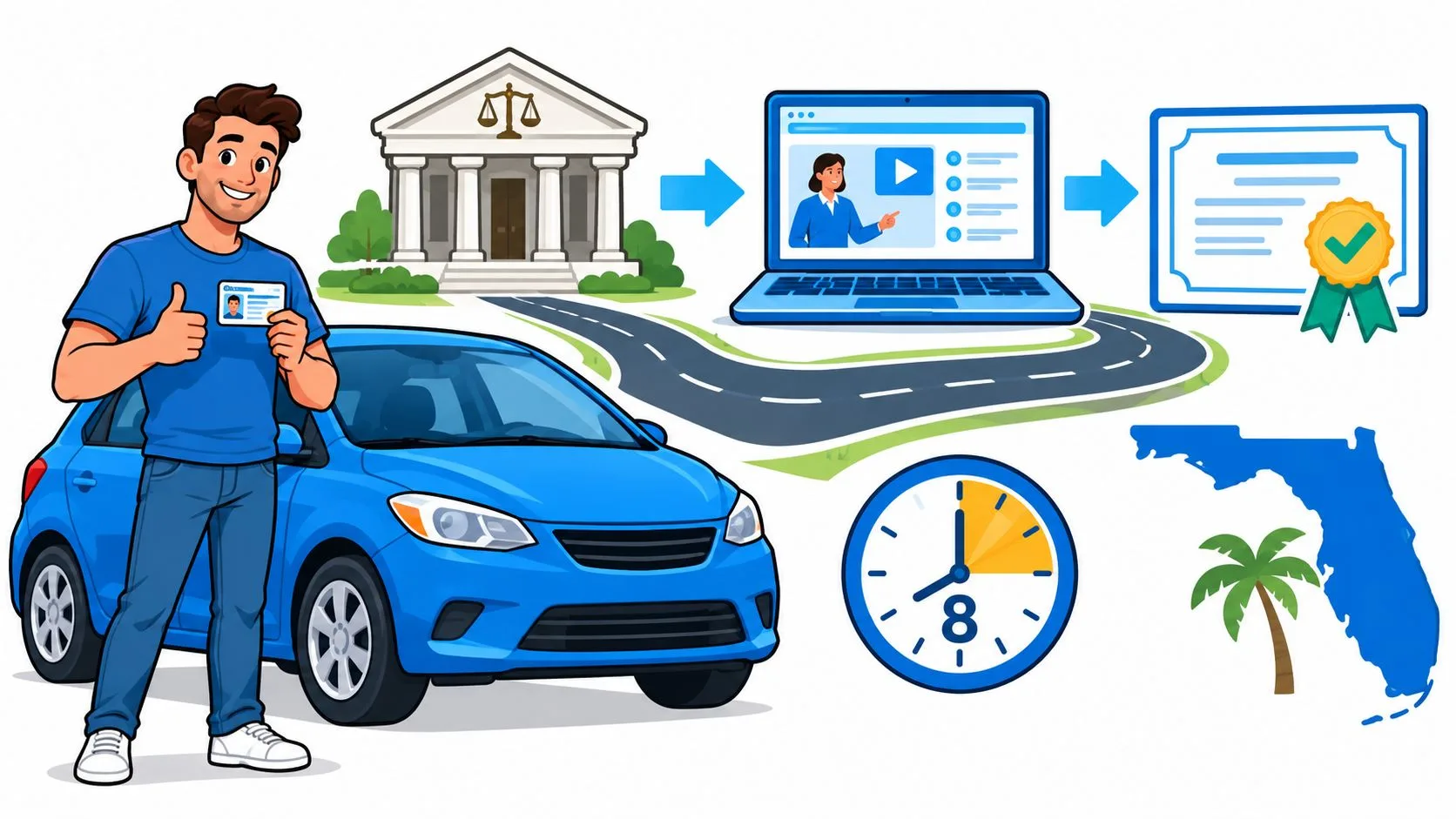
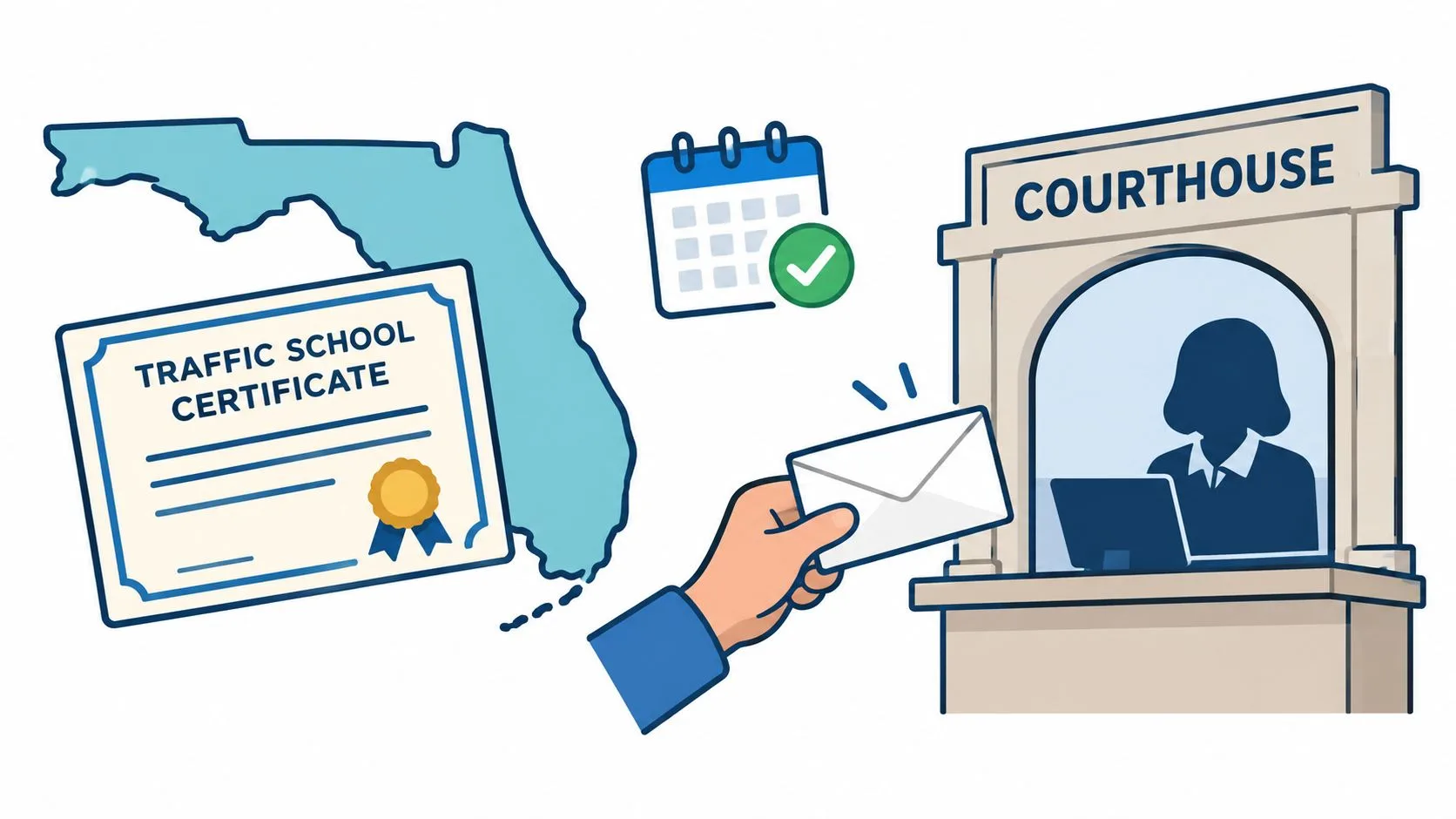
A state-approved Basic Driver Improvement course takes 4 hours, can prevent points from being added for an eligible moving violation, and may qualify you for an insurance discount of up to 10% for 3 years. If you’ve just received a Florida ticket, the practical move is to confirm eligibility, elect the course with the court, and finish before the deadline.
You’re probably not looking for a lecture. You’re looking at a citation on the kitchen counter, wondering whether paying it is easier than dealing with traffic school, points, insurance, and court paperwork. Florida gives eligible drivers a way to address that problem, but the benefit depends on choosing the right course and acting before the election window closes.
The Moment Every Florida Driver Eventually Faces
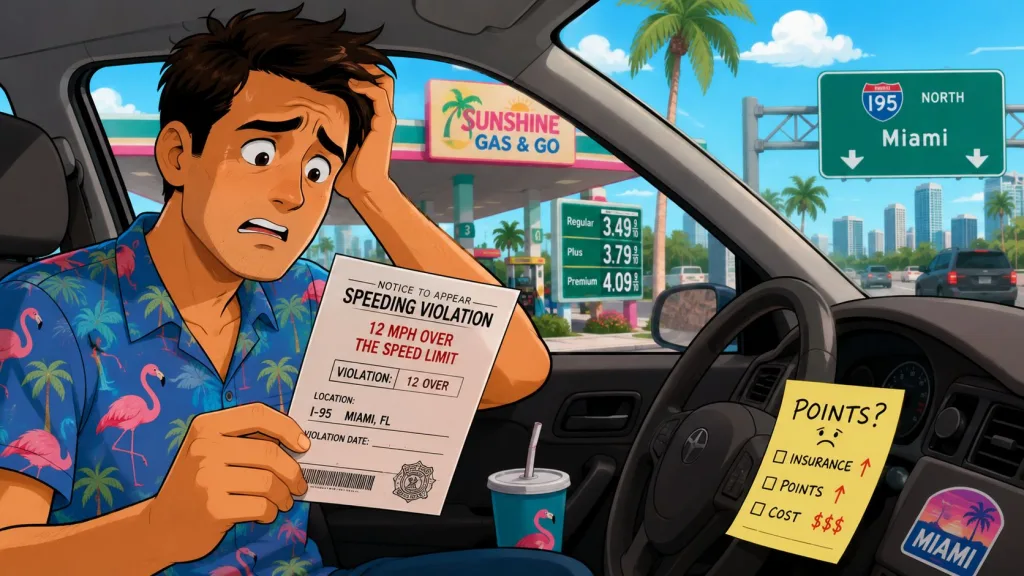
The flash comes quickly on I-95. One moment, you’re moving with Miami traffic, and the next, you notice the patrol car, the pull-over, and the citation showing that you were driving 12 miles per hour over the limit. You sign, drive to a gas station, and start calculating the damage.
The first questions usually involve the fine and points. Then comes the uncomfortable call to an insurance agent, followed by the realization that a brief mistake can affect your driving record and insurance decisions long after the stop.
Florida’s traffic system includes driver improvement as a practical response to qualifying violations. Under Florida Statute 322.0261, the state screens crash reports for specific patterns, including a crash involving death or bodily injury requiring transport, a second property-damage crash within 2 years involving at least $500 in damage, or a third crash within 36 months after the first crash. When the statutory conditions apply and the driver was convicted of, or pleaded nolo contendere to, a related traffic offense, Florida can require a department-approved course to preserve driving privileges.
The real choice after a citation
You can pay the ticket and accept the consequences, if you’re eligible to do so. Or you can ask the clerk whether you may elect a state-approved Basic Driver Improvement, or BDI, course.
The BDI route is designed for many eligible minor moving violations. It can keep points from being assessed on the current violation, and Florida’s highway-safety agency says eligible customers may receive an 18% reduction in citation fees through the traffic-citation process, as explained by FLHSMV traffic citation guidance.
That makes defensive driving Florida a decision about timing and record protection, not merely a classroom requirement. The same choice applies whether you’re a year-round resident, a snowbird, or a driver who recently moved to Florida and needs a clear answer without guessing.
Practical rule: Don’t enroll first and ask questions later. Confirm eligibility and formally elect the course with the clerk listed on your citation.
What Defensive Driving Actually Means in Florida
Florida defines defensive driving as using safe strategies to prevent crashes by adapting your speed, spacing, and expectations to weather, your own condition, and the behavior of other road users. The Florida Driver Handbook emphasizes early hazard scanning, anticipating what other motorists may do, and taking extra care at intersections.
That definition matters because defensive driving isn’t just “drive carefully.” It’s a method for creating more time and space before a conflict becomes an emergency.
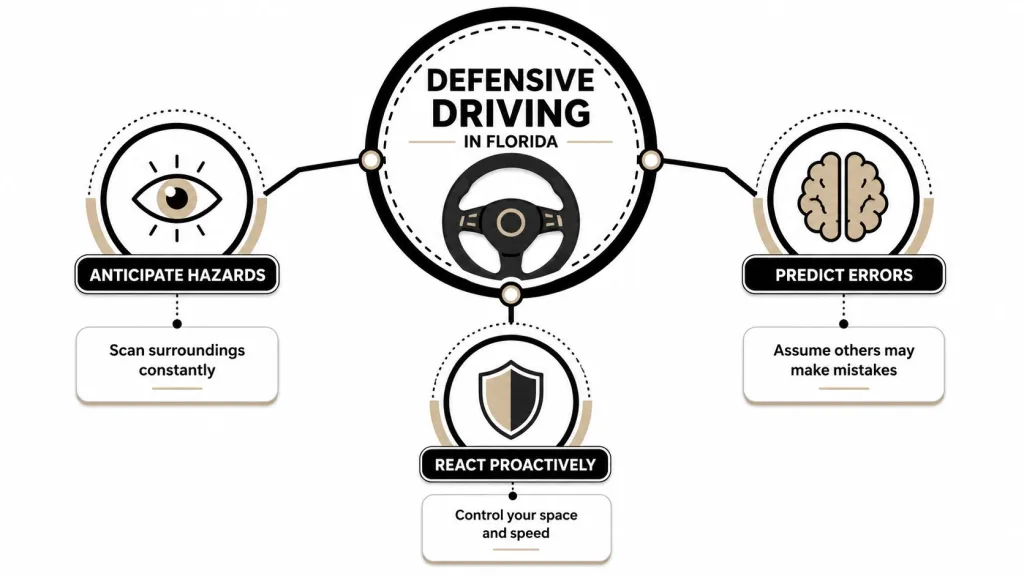
Three habits that make the method work
Scan beyond the vehicle ahead. On I-95, traffic can stop before the car directly in front of you brakes. Look through gaps, watch brake lights several vehicles ahead, and check signs, ramps, and shoulders early. You’re trying to identify a developing problem before it reaches your lane.
Protect your following distance. Florida’s handbook recommends at least 3 to 4 seconds in normal conditions, with an additional second for weather or traffic stressors, according to Florida following-distance guidance. On I-4 in rain, a gap that feels comfortable in dry weather may disappear when tires lose traction and visibility drops. Pick a fixed roadside marker, count the seconds after the vehicle ahead passes it, and slow down if you reach the marker too soon.
Manage blind spots around larger vehicles. SUVs and trucks can hide lane changes, stopped traffic, and motorcycles. Don’t linger beside them on a crowded expressway. Either create space or pass decisively when you have a clear view.
The point of all three habits is simple. You reduce the reaction-time demand placed on your hands, eyes, and judgment. Florida treats defensive driving as both a safety intervention and, in qualifying circumstances, a compliance tool that can include vulnerable-road-user instruction and behind-the-wheel assessment for course credit.
The Four State-Approved Course Options Explained
Choosing the wrong course wastes time and can leave a legal requirement unresolved. Match the course to the trigger, not to the course title that sounds most familiar.
| Course Type | Length | Typical Trigger | Audience | Point Impact |
|---|---|---|---|---|
| Basic Driver Improvement, BDI | 4 hours | Eligible minor moving violation | Drivers seeking point prevention or approved citation mitigation | Points may be withheld when eligible |
| Intermediate Driver Improvement, IDI | 8 hours | Court or driver-improvement requirement after repeated violations | Drivers facing a more demanding corrective program | Depends on the order and violation |
| Aggressive Driver Course | 8 hours | Aggressive-driving or behavioral-risk requirement | Drivers ordered to address road rage or repeated unsafe behavior | Depends on the order and violation |
| Mature Driver Course | 6 hours | Voluntary insurance or refresher purpose | Florida drivers age 55 and older | May support an approved insurance discount |
Basic Driver Improvement
The 4-hour BDI course is the usual starting point after an eligible non-criminal moving violation. It’s the course most drivers consider when they want points withheld rather than paying the citation and accepting the record consequence. Review the Florida Basic Driver Improvement course before enrolling, then confirm the election rules with the relevant clerk of court.
Intermediate Driver Improvement
The 8-hour IDI course is for drivers with a more serious or repeated compliance issue. It may follow a second moving violation within 12 months or another court-directed situation. This isn’t the course to select casually after an ordinary ticket. Read the court order and ask the clerk exactly what course name is required.
Aggressive Driver Course
The aggressive-driver option addresses behavior such as road rage, tailgating, and dangerous lane changes. The required format depends on the order and provider approval. If a judge or agency specifies an aggressive-driver program, don’t substitute BDI because it’s shorter.
Mature Driver Course
The 6-hour Mature Driver Course is designed for Florida drivers 55 and older, with course providers describing that length as part of the approved structure. It’s generally a voluntary safety and insurance-discount option, not a ticket-dismissal substitute. Ask your insurer whether it accepts the completed course before you register.
What You Will Learn Inside a Florida Defensive Driving Course
A good Florida defensive-driving course turns rules into decisions you can make in traffic. The material covers Florida law, hazard recognition, space management, vulnerable road users, distraction, impairment, and the behaviors that turn a close call into a crash.
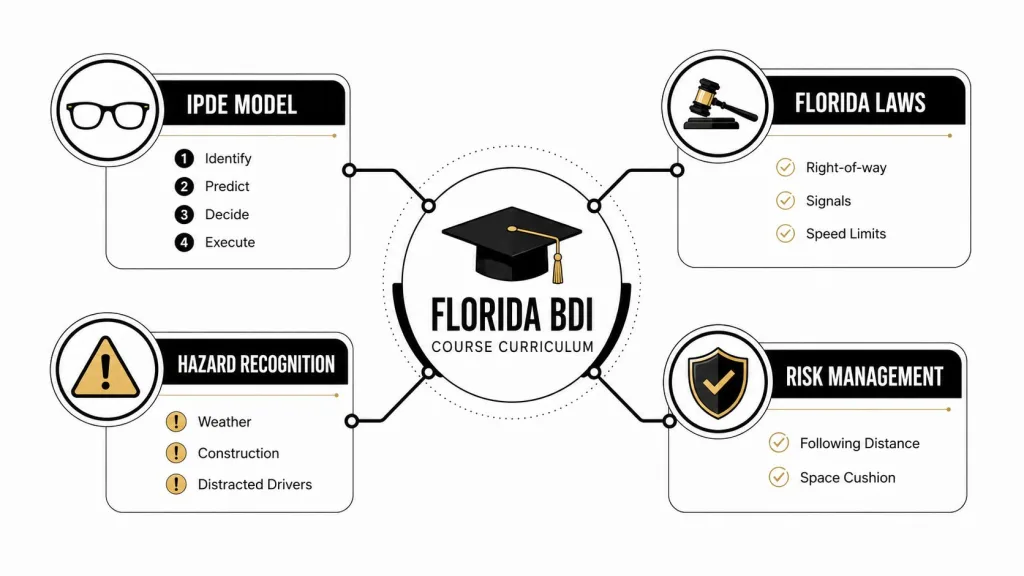
IPDE in a real Florida merge
The IPDE model means Identify, Predict, Decide, Execute. Suppose you’re entering I-4 and a vehicle in the right lane is drifting toward the merge area.
- Identify: Notice the vehicle’s speed, lane position, turn signal, and surrounding gaps.
- Predict: Assume the driver may continue moving over without seeing you.
- Decide: Choose whether to adjust speed, maintain a cushion, or merge behind the vehicle.
- Execute: Make one controlled move, then reassess the traffic around you.
This process keeps you from relying on a last-second swerve. It also gives you a framework for handling construction, rain, sudden braking, and drivers who look at their phones instead of the road.
The course also addresses vulnerable road users, including motorcyclists, cyclists, and pedestrians near school zones. Florida law specifically requires driver-improvement instruction in this area under the statutory framework cited earlier.
Space, speed, and impairment
The handbook’s following-distance rule uses time rather than car lengths. A 3-second minimum gives you a consistent benchmark, while rain, congestion, or reduced visibility calls for more room. Speed management matters because higher speed leaves less usable time to identify a hazard and less distance to stop.
Impairment receives direct attention as well. Florida’s 2024 impaired-driving fact sheet reports 1,044 traffic fatalities, or 29%, in impaired-driving crashes. The same fact sheet reports that DUI citations fell 12.7%, from 50,377 in 2013 to 44,001, over the prior ten years.
Phone distraction, tailgating, and erratic lane changes belong in the same conversation. They all reduce attention or decision space. The final knowledge review and certificate of completion document that you finished the approved curriculum.
Here’s a short visual introduction to the kind of concepts covered in defensive-driving training:
For additional practice applying these ideas in traffic, review these Florida defensive-driving techniques.
How the Right Course Saves Your Record and Your Premium
The financial decision is straightforward when the BDI election is available. Completing the course can prevent points from being assessed for the eligible violation, while paying the ticket alone may leave the citation and its point consequences to affect your record.
Florida law also permits an insurance premium reduction for approved driver-improvement courses. Under Florida Statute 627.06501, the discount may not exceed 10% and is generally effective for 3 years after successful completion when the insurer applies it. The statute allows an insurer to condition the reduction on no at-fault accident and no new moving violation during that period.
| Outcome | Pay the Ticket Only | Elect Traffic School |
|---|---|---|
| Points | May be assessed, depending on the violation and eligibility | May be withheld for the eligible current violation |
| Citation fees | No course-based reduction decision | FLHSMV says eligible customers may qualify for an 18% reduction |
| Insurance | The violation may affect future underwriting or pricing | An approved course may qualify for up to a 10% discount for 3 years |
| Record strategy | Accept the immediate result | Use the available legal mitigation route |
| Next quote | More explanation may be required | A cleaner point count can help the conversation |
Timing matters more than optimism
Florida’s driver-improvement law sets a 90-day completion window in qualifying crash-related cases, and ordinary citation elections also carry a court deadline. The exact election rules depend on the violation and court, so check the citation and clerk instructions rather than relying on a generic countdown.
Commercial-license and CDL holders should be especially careful. Eligibility can differ, and a BDI course isn’t a universal solution for commercial driving violations.
Read the details of a Florida defensive-driving insurance discount before assuming your carrier will apply it automatically. Ask the insurer what documentation it needs and whether the course fits its approved discount policy.
How to Enroll and Finish an Online BDISchool Course
Start with the court, not the course dashboard. Confirm that your violation is eligible, ask the clerk whether you may elect traffic school, and record the court’s deadline before registering.
Follow the enrollment sequence
- Confirm eligibility: Check the citation, your prior course-election history, and any court instructions. If you have a CDL or a court order naming another course, get clarification first.
- Elect with the clerk: Notify the clerk listed on the citation within the applicable election window. Keep a confirmation or receipt.
- Register online: Enter your name and license details accurately. A mismatch can delay certificate processing.
- Choose your language: BDISchool provides course access in English and Spanish, with publisher materials also describing Portuguese availability for its broader traffic-school offerings.
- Complete the modules: The BDI course is designed as 4 hours of self-paced study on a phone or laptop. Work somewhere you can concentrate, not while driving or multitasking.
- Pass the knowledge review: Read each module carefully and complete the final assessment required by the approved course.
- Save the certificate: Keep the electronic completion record and any receipt. The court or insurer may require proof, and you should not depend on memory or an inbox search months later.
The provider lists a $24.95 course fee, a mobile-friendly format, and same-day certificate delivery as course features. Because fees, court handling, and insurer procedures can vary, verify what the clerk and your insurer require before assuming electronic reporting replaces every submission step.
You can use the BDISchool course login to return to your course and continue where you stopped. Finish before the court deadline, then confirm that the clerk received whatever documentation the citation requires.
Deadline advice: Treat the court deadline as the real finish line. Completing lessons without completing the court’s administrative step may not protect your record.
Common Misconceptions About Florida Traffic School
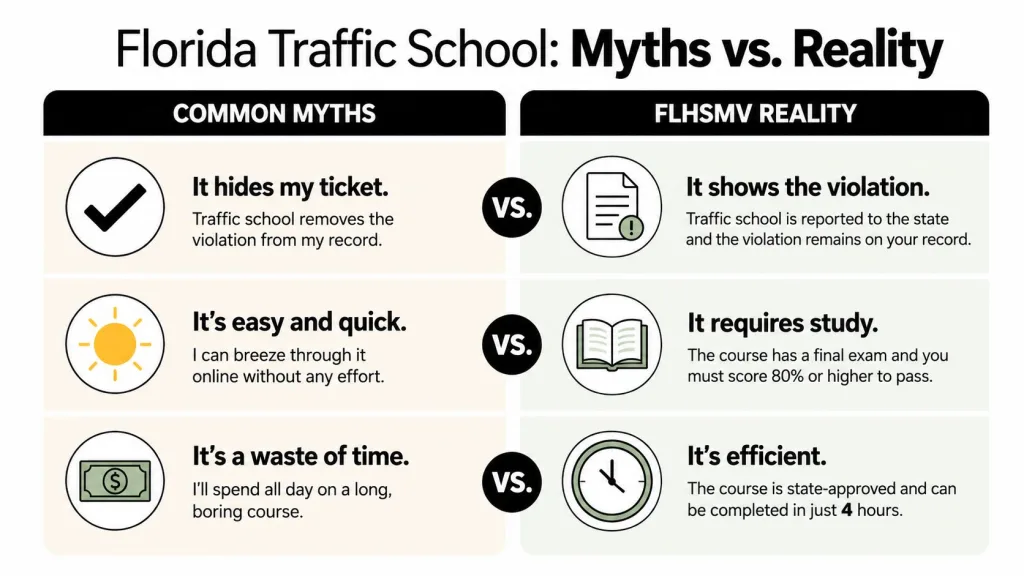
Myth: Traffic school erases the citation. The violation can remain in the driving record history even when points aren’t assessed. Florida traffic school is better understood as a legal mitigation option, not a magic deletion button.
Myth: The course makes an insurer label you high-risk. An approved course can support an insurance discount of up to 10% for 3 years, subject to the statute and insurer application, as explained in Florida’s insurance-discount law. Ask your carrier for its documentation rules instead of assuming either a discount or a surcharge.
The rules people get wrong
Myth: Online means automatic. An approved online course still requires structured study and a knowledge assessment. The point isn’t to click through blindly. It’s to demonstrate completion of the required material.
Myth: Every course handles every ticket. BDI, IDI, aggressive-driver, and mature-driver programs serve different purposes. A court order can require a specific course, and substituting a different program can leave the requirement open.
Myth: You can use Florida traffic school for any ticket from anywhere. Florida’s election process applies to eligible violations handled under Florida’s system. An out-of-state citation doesn’t automatically qualify for a Florida BDI election.
Myth: You can elect BDI endlessly. Course eligibility is conditional, and Florida limits how often a driver may use the election privilege. Check your record and court instructions before assuming a previous election is irrelevant.
The safest approach is boring but effective: read the citation, contact the clerk, verify the exact course, and use an approved provider. That sequence prevents the expensive mistake of finishing a course the court won’t accept.
Your Next Step Toward a Cleaner Driving Record
If you have an eligible moving violation, the decision is simple. A 4-hour BDI course can keep points from being added for the current violation and may result in an insurance discount of up to 10% for 3 years, subject to Florida law and your insurer’s approval.
Don’t wait for the citation to become an insurance problem. Contact the clerk listed on your ticket, confirm the election window and course requirement, then register before the deadline gets close. If your record is currently clean, ask your insurer whether a voluntary mature-driver or defensive-driving course could qualify for a discount before a future violation creates pressure.
Choose based on your situation:
- BDI: Use this first for an eligible minor moving violation when point prevention is available.
- IDI: Follow this route when the court or driver-improvement requirement specifies the intermediate program.
- Aggressive Driver: Complete the named behavioral course when a court requires it after aggressive or dangerous conduct.
- Mature Driver: Consider the 6-hour option if you’re 55 or older and want a refresher or possible insurance benefit.
Registration should take only the information requested by the provider, and course materials are available in multiple languages. After completion, save the certificate and follow the clerk’s instructions rather than assuming the process is finished automatically.
You’ve got a citation, a deadline, and a legal option. Confirm the course, start tonight, and finish before the weekend.
BDISchool offers Florida-approved BDI, IDI, Aggressive Driver, and Mature Driver courses for drivers handling citations, court requirements, or insurance-discount goals. Visit BDISchool to choose the course that matches your situation and begin your defensive-driving training online.