You’re sitting at the kitchen table with your driver’s license nearby, wondering whether a defensive driving course for old people is really worth the time. You’ve driven for decades, handled rain, traffic, unfamiliar roads, and plenty of close calls. Still, newer road designs, brighter headlights, medication side effects, and more complicated intersections can make a practical refresher a sensible way to protect your independence.
The important question isn’t only whether a course gives you a certificate. It’s whether the lessons help you recognize hazards earlier, leave more room to stop, judge intersections more carefully, and make calm decisions when traffic changes quickly. For Florida drivers age 55 and older, the answer also depends on the course provider, the insurer’s rules, and whether you’re enrolling voluntarily or responding to a citation.
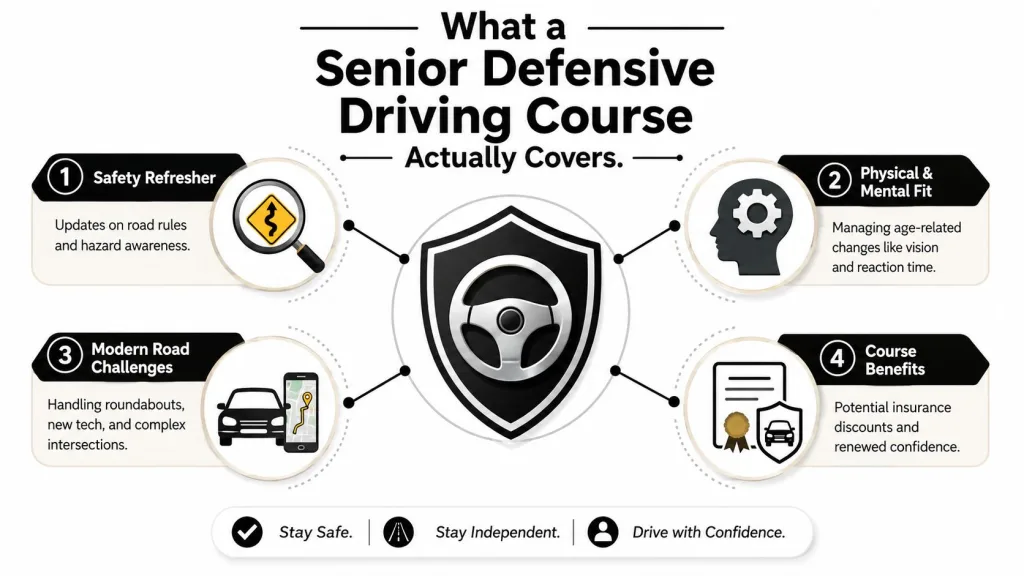
What a Senior Defensive Driving Course Actually Covers
A defensive driving course for old people is a state-approved refresher designed around the challenges experienced older drivers may face. It isn’t a beginner class for teenagers, and it shouldn’t rely only on memorizing traffic signs. A mature course should connect current rules with practical decisions behind the wheel.
Older drivers may show little slowdown in simple reflexive reactions, yet become much slower when a task is complex or visibility is limited, according to this explanation of age-related reaction-time changes. That’s why useful instruction emphasizes scanning, gap judgment, and anticipating several traffic events at once.
The lessons should match real Florida driving
A strong course typically revisits:
- Current traffic laws: Florida rules may have changed since you first earned your license, so the course should explain modern right-of-way expectations and other updates in plain language.
- Complex intersections: You’ll examine how to avoid collisions when several vehicles, pedestrians, turning lanes, and traffic signals compete for attention.
- Roundabouts: Instruction should show how to choose a lane, yield correctly, maintain a steady speed, and exit without making a last-second move.
- Following distance: More space gives you time to recognize a developing hazard and move your foot from the accelerator to the brake.
- Night and glare management: Clean glass, appropriate speed, careful mirror use, and conservative route choices matter when headlights or sunlight reduce contrast.
- Multi-lane left turns: A safe turn across multiple lanes requires planning, lane awareness, and patience rather than reacting to the nearest vehicle.
The course should also discuss how medication side effects, fatigue, or reduced vision can affect alertness and judgment. Case studies are more useful than rule memorization because they let you practice asking, “What did the driver notice too late, and what could have been done earlier?”
For a Florida-specific option, review the mature driver refresher course before registering. Look for lessons that help you change a driving habit, not just finish a screen.
Real Safety Outcomes vs Certificate Perks
A completion certificate and safer driving are related, but they aren’t the same outcome. The certificate may help with an insurer’s requirements, a court deadline, or an eligible point-related process. The safety benefit depends on whether the course changes how you observe, judge, and respond to traffic.
The U.S. highway safety review of older-driver behavior-change strategies says classroom-only education isn’t effective at reducing crashes, while classroom instruction combined with individualized on-road feedback improves driving performance. A systematic review also describes older-driver retraining evidence as limited but encouraging. In practical terms, a course should invite self-assessment and discussion of personal risk patterns, even when the program is delivered online.
Separate paperwork from performance
Ask what you’ll be able to do differently after the course. Can you explain when to increase following distance? Can you identify a dangerous gap before entering it? Can you describe how glare, a complex intersection, or a medication side effect might affect your decision?
| Outcome Type | What You Get | Evidence of Real Impact |
|---|---|---|
| Certificate perk | Documentation for an eligible insurance or administrative benefit | Useful for proving completion, but paperwork alone doesn’t change driving behavior |
| Point-related benefit | A possible way to handle an eligible traffic matter under applicable Florida rules | Depends on the violation, election, deadline, and approved course |
| Knowledge update | Current rules and clearer explanations of right-of-way decisions | More meaningful when you apply the information to situations you actually encounter |
| Behavior change | Better scanning, larger gaps, earlier braking, and more conservative choices | Stronger when instruction includes reflection, feedback, and practical application |
A good defensive driving techniques course should make the “why” visible. If a lesson says to leave more room, it should connect that habit to delayed perception, changing traffic, and the time needed to brake smoothly.
Practical rule: Treat the certificate as an administrative result. Treat safer observation and decision-making as the reason to enroll.
Benefits Beyond the Discount
A Florida driver may enter a mature driver course for an insurance discount, help with an eligible moving violation, or court compliance. These goals are separate. Choosing the wrong course can leave a certificate unable to serve the purpose you intended.
Insurance savings depend on the insurer
Drivers 55 or older may complete an approved Mature Driver Discount course and submit the certificate to their insurer, according to the Florida mature driver guidance. The insurer sets the discount amount, eligibility conditions, and paperwork process. State guidance says the discount typically lasts three years, provided the driver avoids cited crashes and certain moving-violation outcomes.
Before enrolling, ask your carrier:
- Does this specific mature driver course qualify?
- Should you send the certificate, or will the provider report completion?
- When does the discount begin?
- Which date determines renewal?
The certificate is the administrative benefit. The safety value comes from applying better observation and decision-making after the course.
Point handling is different
Florida’s basic driver improvement framework uses a 4-hour course for eligible non-criminal moving violations. It may help handle a citation without adding points, but it doesn’t remove points already placed on your record, as explained in this driver safety course overview.
That process has separate election rules and deadlines. If you received a ticket, confirm with the clerk, court, or insurer whether you need basic driver improvement rather than a mature driver discount course.
Court compliance requires timing
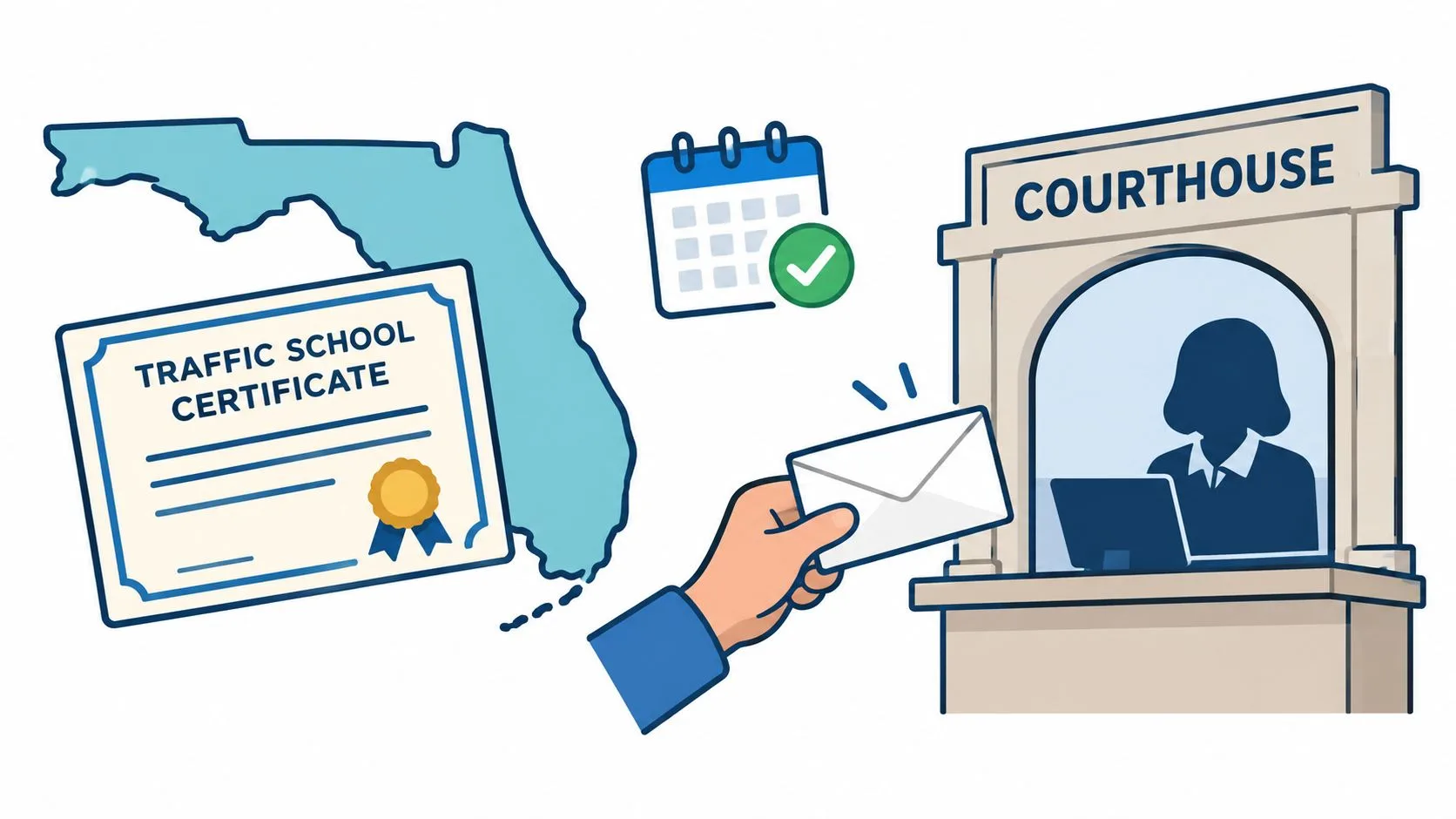
A judge or clerk may name the course type, approved provider, and completion deadline. Keep the citation, election paperwork, registration confirmation, and certificate together, like the documents for one trip. Voluntary completion for an insurance discount does not automatically satisfy a court order. Confirm the course purpose before paying, then check that your completion reaches the required office on time.
Florida Rules Old People Need to Know First
Florida’s mature driver pathway begins with the 55+ age threshold. The state authorizes eligible drivers in this age group to take an approved Mature Driver Discount course and submit successful-completion documentation to their insurer, but the insurer decides the discount amount.
The course itself is six hours long, and it should come from a provider approved through the Florida Department of Highway Safety and Motor Vehicles. The Florida mature driver course explanation confirms that successful completion can be submitted for a discount and that the discount typically lasts three years when the driver meets the stated conditions.
Approval matters
A certificate from an unapproved provider may not satisfy an insurer or a court. The same problem can arise if you choose a general traffic class when your situation calls for a mature driver course, or select a point-related course when the citation requires a different program.
Before enrolling, verify the provider and course type through current Florida guidance. You can also use this Florida state driving laws resource to identify the questions you need to ask before registration.
Keep the renewal date visible
The initial discount period typically covers three years after completion. If your insurer allows renewal through another approved mature driver course, plan ahead rather than waiting until the discount expires. Request the renewal rules in writing, because the insurer may control acceptable courses, submission procedures, and effective dates.
The mature driver discount and a point-related course address separate administrative purposes. A voluntary six-hour mature driver course may support insurance eligibility, while a court-directed or citation-related matter may require a basic driver improvement course. The correct choice depends on the reason you’re enrolling.
Choosing a Format That Fits Older Learners
The right format is the one that lets you absorb the material without straining your eyes, rushing through examples, or worrying about transportation. Florida old people commonly choose an online self-paced course, an in-person classroom, or a hybrid arrangement.
| Format | Pacing | Accessibility Features | Best For |
|---|---|---|---|
| Online self-paced | Study when convenient and pause for breaks | May offer adjustable display settings, captions, audio, and language choices | Drivers who prefer privacy, flexible timing, and home study |
| In-person classroom | Follow the instructor’s schedule | Direct questions, printed materials, and face-to-face explanation | Learners who value social interaction and live guidance |
| Hybrid | Combine independent modules with scheduled meetings | Mix digital flexibility with personal support | Students who want both convenience and discussion |
Online learning
A self-paced course can work well if you have reliable internet and a comfortable device. Increase text size where possible, use a high-contrast display, test the audio before beginning, and choose closed captions if hearing spoken instruction is difficult.
The self-paced online course option may suit a driver who needs to study in shorter sessions. Keep your reading glasses nearby, silence phone notifications, and stop when concentration fades. A break protects learning quality.
Classroom learning
A classroom gives you immediate access to an instructor and other older learners. You can ask how a rule applies to a familiar intersection, hear different perspectives, and receive an explanation without navigating a website.
Travel and mobility can make classroom attendance harder. Check the room’s seating, lighting, restroom access, parking, and availability of large-print materials before registering.
Hybrid and language support
Hybrid courses can help students who want independent review plus human interaction. Also ask whether the content is available in Spanish, Portuguese, or another language you understand comfortably. The best format respects your eyesight, hearing, memory, technology comfort, and preferred pace.
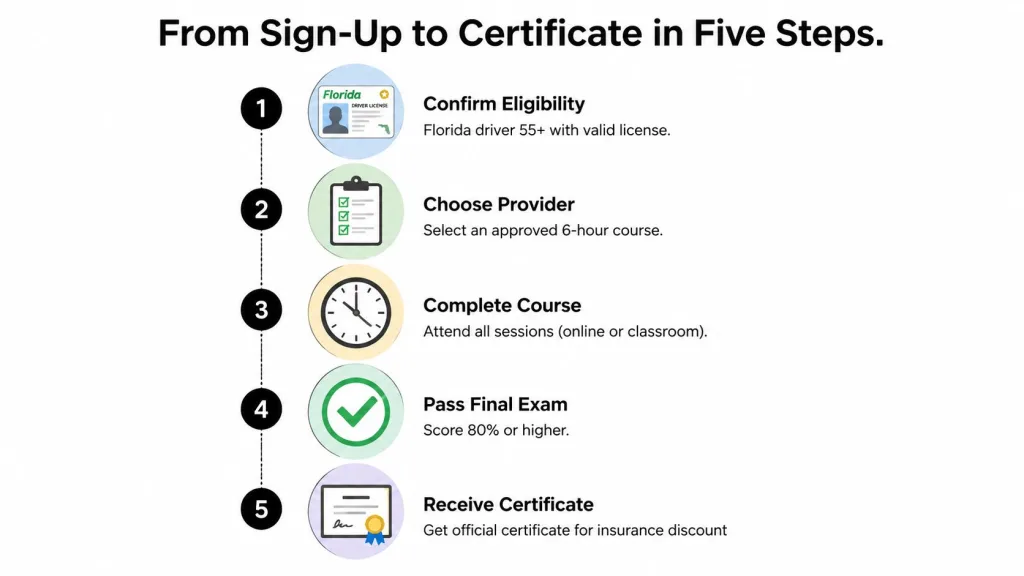
From Sign-Up to Certificate in Five Steps
Registration becomes easier when you separate the administrative decisions from the study itself. Use this sequence before you begin.
1. Confirm your purpose
Start by confirming that you’re a Florida driver 55 or older with a valid license. Then decide whether you’re seeking an insurance discount, addressing a citation, meeting a court requirement, or looking for a safety refresher.
The purpose determines the course type. If a court or clerk gave you written instructions, follow those instructions before choosing a mature driver program.
2. Choose an approved provider
Check the provider’s Florida approval status and confirm that the program is the six-hour mature driver course. Register online or by phone, and provide accurate license and contact information so your certificate reaches you correctly.
3. Prepare your learning space
Choose a device with a readable screen. Test the speakers or headphones, place your glasses within reach, and arrange a chair that lets you remain comfortable. Schedule breaks instead of trying to push through fatigue.
4. Complete the lessons
Work through the full six hours of course content at a manageable pace. Read each example carefully, complete the required module checks, and return to difficult topics rather than guessing.
5. Receive and submit the certificate
Florida course providers may issue completion documentation electronically. One Florida course description says the certificate is emailed after completion and that the six-hour course can be completed over multiple sessions, which can make online study more practical for older learners (course delivery details).
Send the certificate to your insurer or the clerk of court when required. Keep a copy, record the submission date, and ask when the benefit becomes active.
How to Pick an Approved Provider
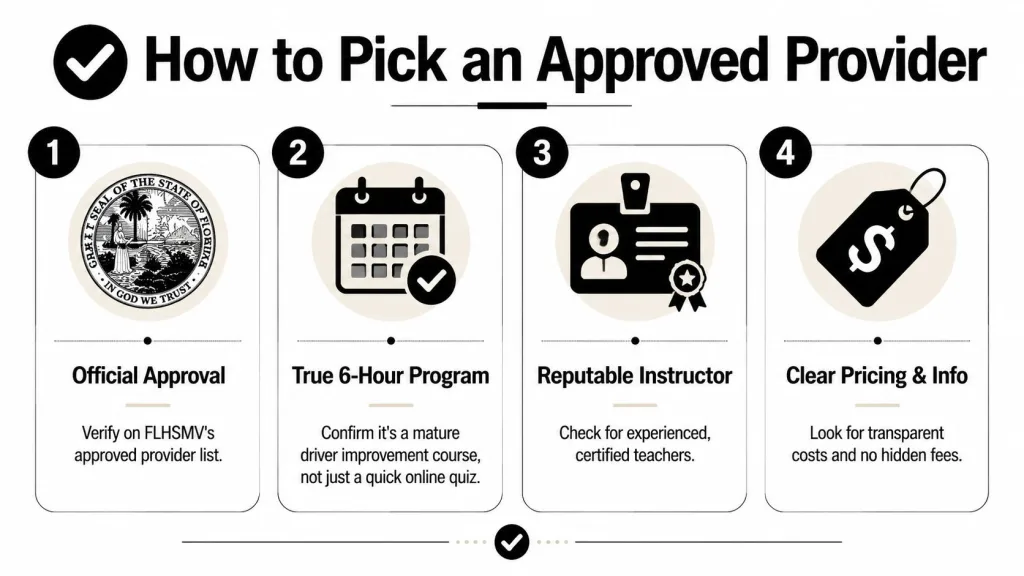
A trustworthy provider makes approval, course length, certificate delivery, and support easy to verify. Don’t choose a program because its advertisement promises the fastest possible finish.
Use this four-part check
Confirm official approval. Search the current FLHSMV-approved provider information, or ask the school to identify its approval clearly. If the answer is vague, pause before registering.
Verify the course type. A genuine mature driver course is not the same as a quick traffic-school quiz. Florida’s mature driver program is six hours, while the basic driver improvement course for eligible violations is four hours. Choose based on your purpose.
Check certificate delivery. Ask whether the certificate arrives electronically or by mail, how long delivery takes, and whether you must submit it yourself. Clear answers reduce deadline problems.
Read reviews carefully. Look for comments about readable materials, patient support, audio quality, pacing, and help with registration. Reviews that discuss only price or speed tell you little about the learning experience.
Watch for shortcut promises
Promises of completion in under an hour, missing contact information, aggressive upsells, or unclear fees are warning signs. A legitimate school should explain what the course covers, what you’ll need to complete, and which benefit the certificate may support.
BDISchool offers a Florida-approved six-hour Mature Driver Course for drivers age 55 and older, delivered online in English, Spanish, and Portuguese, with electronic certificate delivery described in its course information. Compare those practical details with other approved providers and confirm acceptance with your insurer when a discount is your goal.
Quick Answers to Common Senior Questions
How much is the insurance discount?
There is no single statewide discount amount. Florida guidance says the insurer sets the amount, and the benefit typically lasts three years when the driver meets the applicable conditions. Ask your carrier for its current figure before enrolling. The certificate may support a discount, but it does not guarantee one.
Does the course remove points?
Florida’s 4-hour basic driver improvement process may help an eligible driver handle a qualifying moving violation without adding points. It does not erase points already on the record. A mature driver course serves a different purpose and is generally used to support an insurance discount.
How often must I repeat the course?
The insurance benefit typically lasts three years. Ask your carrier whether you must repeat an approved course to renew the discount, and how far in advance it wants the new certificate. Treat the certificate like an expiration reminder, not a permanent change to your policy.
Can I use large print or audio?
That depends on the provider and course format. Before registering, ask whether the online platform supports display enlargement, high contrast, audio, or captions. Classroom students can ask about printed materials, room lighting, and seating. These details can make the difference between concentrating on safe-driving lessons and struggling with the screen or room.
Will the provider send the certificate to my insurer?
Some providers report completion or issue the certificate electronically, but you may still need to submit it to your carrier. Keep the certificate and confirmation email. Then call the insurer to verify receipt and the date the benefit will take effect.
Can a family member help me register?
Yes. A trusted family member can help enter contact information, check email, adjust the device, or contact support. You should still complete the learning yourself, and the name and license details should match your records.
Is the course difficult for older adults?
A well-designed course should support adult learners rather than test youth or technology skills. Take breaks, replay explanations when available, and contact the provider’s support line when a step is unclear. Asking for help is part of completing an online course, not a sign that you lack driving experience.
BDISchool offers a Florida-approved Mature Driver Course for drivers 55 and older, with online access in English, Spanish, and Portuguese and electronic certificate delivery. Review the course details, confirm your insurer’s requirements, and register through BDISchool when you are ready to turn a routine refresher into a practical safety step.