Florida’s mature driver refresher is a six-hour, state-approved online course for drivers 55 and older that can earn a 3% to 10% insurance discount, typically renewable every three years. The course can refresh your knowledge and support savings, but drivers who’ve had near-misses, fender-benders, or health-related changes may need practical on-road retraining too.
You might be looking at your insurance renewal, wondering whether a short online course is worth the time. Perhaps you’ve driven safely for decades, but roundabouts, phone distractions, newer vehicle features, and changing traffic patterns have made some situations less comfortable.
The important distinction is simple. A rules refresher can update what you know and document course completion for your insurer. It can’t, by itself, test how you handle merging, left turns, gap acceptance, or scanning an unfamiliar intersection in real traffic. This guide explains what Florida’s course provides, what it may save you, and when additional driving practice makes more sense.
What a Mature Driver Refresher Course Is and Who It Is For
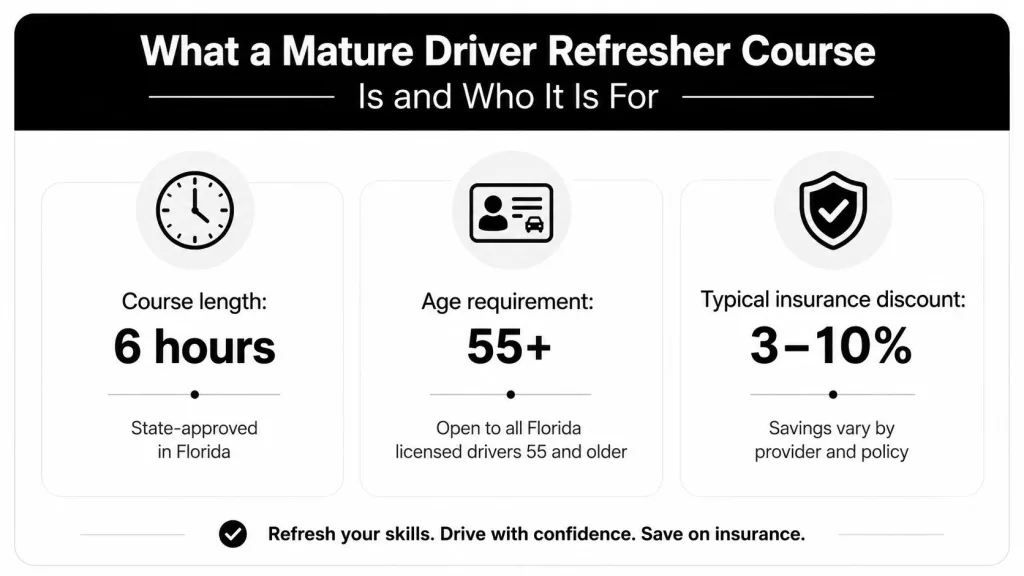
Florida’s mature driver discount course is a six-hour online program for licensed drivers age 55 and older. After completing it, you submit the certificate to your insurer. The insurer decides whether you qualify and how much you save. Florida guidance commonly describes a 3% to 10% insurance discount, while the Florida Highway Safety and Motor Vehicles explains that the discount typically lasts three years, subject to your policy and insurer’s rules. You can also review the state’s Florida mature driver course guidance before registering.
The course fits a driver with a valid Florida license who wants to refresh traffic knowledge, strengthen safety awareness, and pursue an insurance discount. It is voluntary education, not a license-reinstatement program. A completion certificate also does not replace an evaluation of your actual driving ability.
That distinction matters. A rules review is like checking an old map after roads have changed. It can update your knowledge of traffic rules and safety habits, but it cannot show whether you merge smoothly, judge a left-turn gap, or scan an unfamiliar intersection under real traffic pressure. A driver with recent near-misses, collisions, or health-related changes may need supervised on-road practice as well.
Choose the course that matches your situation
A mature driver course generally serves education and insurance purposes. A Basic Driver Improvement course is different and may relate to a moving violation, court order, or point concern. Registering for the wrong program can waste time and leave the original requirement unresolved.
Check these points before you pay:
- Age: You’re at least 55.
- License: You hold a valid Florida driver license.
- Purpose: You want updated knowledge or insurance documentation.
- Court status: No court order requires another traffic school.
- Vehicle category: You need a passenger-driver course, not a CDL or motorcycle program.
The Florida Mature Driver Course page provides a Florida-specific course option. Confirm approval, completion rules, and insurance eligibility with the provider and your agent.
Use the course as a knowledge and awareness reset when your driving remains generally sound but your understanding of current rules or road designs needs attention. Choose practical retraining when the concern is how you perform behind the wheel.
What the Course Actually Teaches You
A mature driver refresher course connects familiar driving experience with situations that may have changed. You already understand steering, braking, lane position, and courtesy. The lessons help you apply those skills to updated traffic laws, modern distractions, changing road layouts, and the physical changes that can affect driving.
The online curriculum can be understood as six short learning blocks:
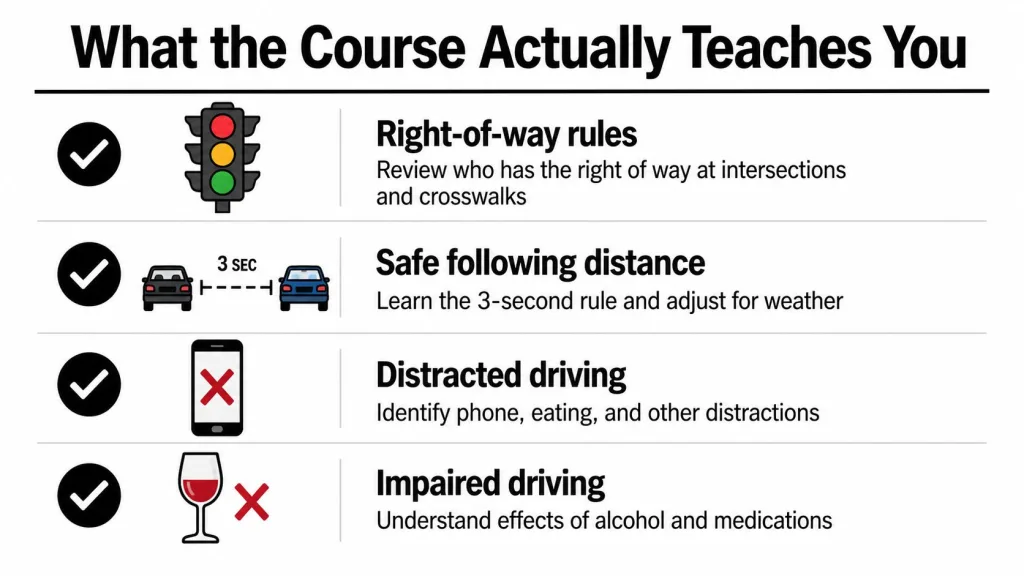
- Florida traffic law updates: Review rules that may differ from the ones you learned years ago.
- Right-of-way decisions: Work through intersections, crosswalks, four-way stops, and turning situations.
- Following distance: Use a time-based gap rather than judging distance only by the number of car lengths.
- Speed management: Adjust speed for highways, local roads, congestion, weather, and visibility.
- Age-related driving factors: Consider how vision, hearing, and reaction time can influence decisions.
- Impaired and distracted driving: Examine alcohol, medication effects, cellphone use, eating, fatigue, and divided attention.
Turn rules into driving habits
Think of a following-distance rule like keeping a familiar beat in a song. You aren’t trying to memorize a measurement. You’re giving yourself enough time to recognize that traffic has slowed, move your foot to the brake, and stop smoothly.
Roundabout yielding follows a similar logic to a merge. You wait for a safe opening, yield to traffic already in the flow, and enter without forcing another driver to brake. That comparison often makes a newer road design easier to understand than a definition alone.
The course also addresses habits formed before widespread cellphone use, school-zone cameras, advanced driver-assistance features, and modern roundabouts. The point isn’t to criticize long-time drivers. It’s to identify which old habits still serve you and which ones need adjustment.
The format is self-paced reading with short knowledge checks, rather than a timed race through material. You should focus on comprehension, especially when a question exposes a habit you haven’t reconsidered recently.
Practical rule: If a lesson makes you pause and think, “I usually do that automatically,” treat it as an invitation to slow down and reassess the habit.
For broader defensive-driving ideas, review these defensive driving techniques. Drivers who use mobility devices or help a family member travel independently may also benefit from these practical mobility scooter tips from DME Superstore.
Insurance Discounts and Point Effects in Florida
A six-hour Florida course can help with insurance costs, but it does not answer the larger safety question: would a rules review help you, or do you need supervised practice on the road? Drivers who meet the age and course requirements may submit completion records to an insurer. The insurer decides whether the policy qualifies, how much the discount is, and which conditions apply, as explained in Florida Highway Safety and Motor Vehicles mature driver information.
Consumer guidance describes a possible discount of 3% to 10%. Ask your insurance agent for the exact figure before enrolling, and confirm whether it applies to your policy, which coverages it affects, when it begins, and what documentation the company needs (Florida consumer guidance). The course certificate supports an insurance review. It does not guarantee a lower bill.
Discount is not the same as point removal
A mature driver refresher course is generally a voluntary safety and insurance program. It doesn’t directly remove license points the way a qualifying driver-improvement option may address a moving violation. If you received a citation, check its specific course requirement and deadline. Do not assume the mature driver course satisfies that obligation.
The safety benefit also deserves a clear explanation. An evaluation of California mature driver home-study and in-person courses found no evidence that participation reduced later fatal or injury crashes for either format. It also noted that participant characteristics can affect results (California DMV evaluation of mature driver improvement courses). In practical terms, a course can refresh knowledge, while a driver who struggles with lane position, braking, vision, or confidence may need an on-road assessment instead.
| Outcome | Effect | Florida Rule | Renewal |
|---|---|---|---|
| Insurance discount | May lower the premium with a participating insurer | Discount amount is set by the insurer | Typically lasts three years, subject to conditions |
| Course documentation | Shows successful completion for insurance review | Submit the certificate as directed by the carrier | Retake before the discount expires if required |
| License points | Mature driver course doesn’t directly erase points | Citation-related rules may require another course | Follow the deadline tied to the citation |
| Safety knowledge | Refreshes rules, awareness, and decision-making concepts | Course must meet Florida approval requirements | Repeat when useful or when the insurer requires it |
Other states show that course incentives can follow different rules. Pennsylvania provides at least a 5% discount for eligible drivers age 55 or older and requires a refresher every three years. Connecticut provides at least a 5% discount for eligible motorists age 60 or older, with the discount lasting at least two years (Pennsylvania mature driver improvement requirements). Florida’s details remain insurer-controlled, so your agent is the right source for your policy.
For a plain-language explanation of how driving courses and records may interact, review this guide to points on insurance. Treat general information as background, not as a personal legal or insurance determination.
How to Enroll and Complete the Online Course
Registration is straightforward when you prepare the right information first. Use this sequence to avoid enrolling in a course that doesn’t match your age, license status, or insurance goal.
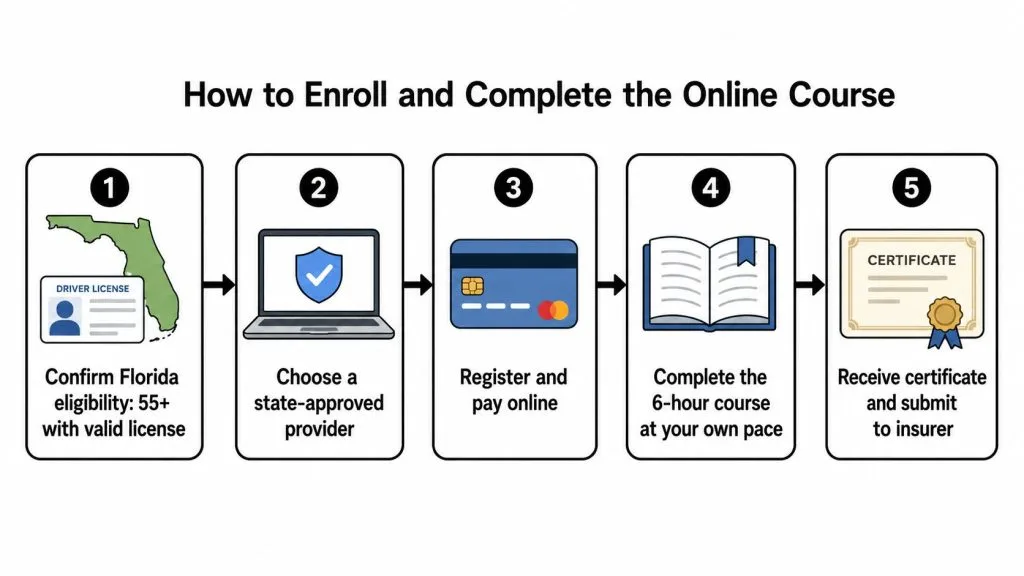
Confirm eligibility. Make sure you’re 55 or older and hold a valid Florida driver license. If a court ordered a different class, stop and verify that requirement before registering.
Choose an approved provider. Look for a Florida-approved mature driver course, not a generic safety video or an out-of-state program. Approval is what connects completion to Florida’s reporting and insurance process.
Create your account. Have your driver license information, email address, and basic contact details available. Enter your information carefully because certificate and reporting errors can create unnecessary delays.
Pay and begin the lessons. Keep a payment method ready and use a computer or tablet with a stable internet connection. A quiet workspace helps you concentrate on situations such as intersections, merging, and medication-related impairment.
Complete the required material and checks. Work through the six-hour course and its knowledge checks at your own pace. Read the explanations rather than clicking through, because the safety value depends on what you understand and remember.
Finish the end-of-course exam. Follow the provider’s instructions for the final assessment. If you miss a question, use the explanation as a learning opportunity.
Save the certificate. Download or retain the electronic certificate of completion. The provider can report completion electronically to the Florida Department of Highway Safety and Motor Vehicles, and you should still send the certificate to your insurer according to the carrier’s instructions.
Keep your driver license nearby while registering. Have your payment method ready, check that your device displays text comfortably, and avoid starting during a rushed evening when you may absorb less.
If you need a certificate for a specific Florida driving requirement, review the provider’s online driving certificate information before beginning. Your insurer may also have its own submission process, even when electronic reporting occurs.
What Changes After You Finish the Course
Before the course, Margaret’s driving habits run on memory. She enters a new roundabout too fast, gives intersections a quick scan, drifts toward lane lines in heavy traffic, and does not know whether her insurer offers a mature-driver discount.
After the lessons, she has a clearer routine. She leaves more space behind the vehicle ahead, checks the whole intersection before moving, and treats a highway on-ramp merge as a planned gap decision instead of a last-second move. The course can refresh rules and improve awareness, much like a checklist helps you remember each step, but the result depends on practicing those choices behind the wheel.
Vehicle technology also needs careful use. Blind-spot monitoring and adaptive cruise control can support attention. They still require mirror checks, shoulder checks, and active control of speed and space.
The insurance outcome is separate from the safety outcome. A participating carrier may offer a 3% to 10% discount, while the completed course supplies documentation for eligibility. The exact discount depends on the insurer, as explained in the Florida mature driver discount information.
The course may also prompt Margaret to review minor citations. Education can help her identify habits behind avoidable mistakes, but it does not directly erase points.
A certificate records completion. Daily driving choices show whether the lessons changed anything.
When a Refresher Is Enough and When You Need More
An online refresher is a sensible choice when your basic driving skills remain intact, your main concern is stale knowledge, and you want to review current safety practices or pursue an insurance discount. It can also give you a structured reason to examine following distance, intersection scanning, distractions, medication effects, and speed control.
A rules review isn’t enough when the underlying problem involves physical, cognitive, or emotional changes. A driver who can’t comfortably turn their neck because of arthritis may know the blind-spot rule and still struggle to check properly. A driver with a recent vision change may understand lane discipline but have difficulty seeing hazards early.
Signs that deserve practical follow-up
Consider additional support after:
- Recent near-misses or fender-benders: Repeated mistakes call for observation, not only more reading.
- Family concerns: If relatives notice confusion, hesitation, or risky decisions, invite a calm conversation and professional assessment.
- Vision or cognitive changes: Arrange appropriate medical checks and ask how the condition may affect driving.
- A long gap behind the wheel: Gradual supervised practice can rebuild comfort and control.
- Limited neck movement: An on-road evaluator can suggest mirror, seating, and scanning adjustments.
A systematic review found strong evidence for combining classroom education with individualized on-road training, while education alone wasn’t effective at reducing crashes (systematic review of older-driver education and training). A randomized controlled trial also found that on-road lessons focused on the driver’s specific needs reduced critical errors more than controls, with IRR = 0.53 and unsafe-driving remediation of 64% compared with 25% in the control group (tailored older-driver intervention trial).
| Driver Situation | Recommended Approach |
|---|---|
| Skills feel steady, but traffic rules seem outdated | Refresher course and insurer confirmation |
| Main goal is insurance documentation | Approved course, certificate retention, and agent follow-up |
| Recent near-miss or crash | Refresher plus an individualized on-road evaluation |
| Vision, hearing, medication, or cognitive concern | Medical review and driver rehabilitation guidance |
| Night, highway, or rush-hour driving feels unsafe | Supervised practice and self-regulation |
| Neck movement or physical control is limited | Occupational or driver rehabilitation assessment |
Possible next steps include an on-road evaluation through a driver rehabilitation specialist, a refresher drive through AAA or AARP, and regular vision and hearing checks. You can also reduce exposure to difficult situations by avoiding night driving, high-speed highways, or rush-hour traffic until a qualified professional helps you judge your readiness.
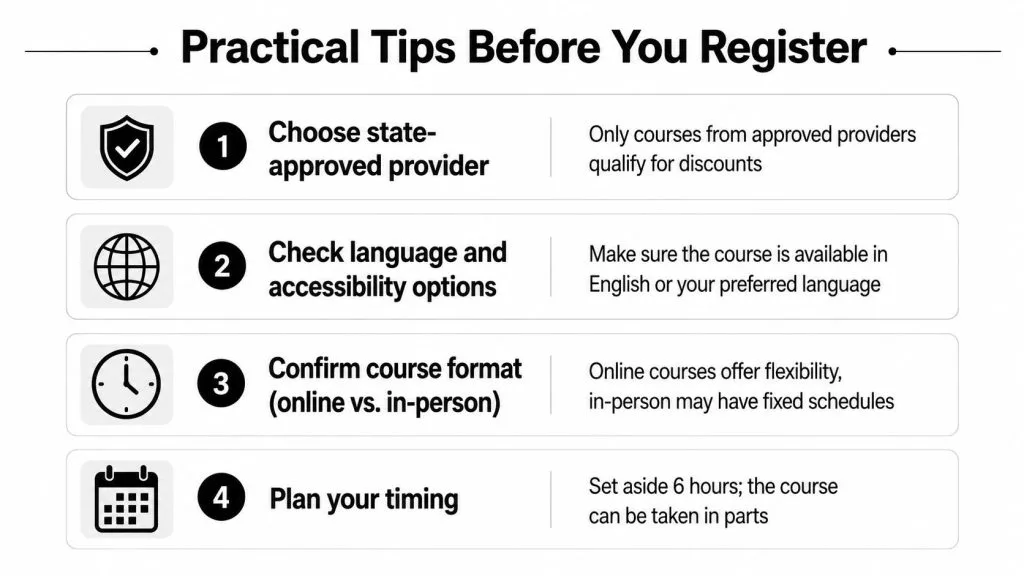
Practical Tips Before You Register
Before paying, check the course, the insurer, and your own study needs. A low price and a “start” button do not show whether the class meets Florida’s mature-driver requirements or whether you can complete it comfortably.
Use this registration checklist
- Verify approval first: Confirm that the provider is approved for Florida’s mature-driver requirements. A general defensive-driving class may not qualify for the mature-driver discount.
- Ask your insurer: Request the discount amount, eligible coverages, effective date, and certificate instructions. Written details can prevent confusion later.
- Compare the full cost: Find out whether the fee includes the lessons, final assessment, certificate, and processing. An advertised price may cover only the course.
- Confirm the required duration: Florida guidance identifies a six-hour mature driver course. Check that the course timer and lessons meet that requirement, as noted by the Florida Highway Safety and Motor Vehicles.
- Choose readable technology: A laptop or desktop may be easier than a phone for extended reading. A stable internet connection also reduces interruptions.
- Check accessibility: Ask about audio narration, closed captions, adjustable text, and screen-reader compatibility if vision or hearing affects how you study.
- Check language options: BDISchool lists course availability in English, Spanish, and Portuguese. Confirm that the language you need applies to the exact Florida course before registering.
- Plan the sittings: Reserve the required study time. Shorter sessions may work better if concentration fades, but avoid beginning when interruptions are likely.
- Track the completion date: The discount depends on course completion and insurer processing, not just the date you create an account. Ask when savings will begin and when renewal will be required.
A classroom course can suit someone who learns by asking questions in person. An online course may fit a driver who needs flexible scheduling, larger text, or the ability to pause between lessons. Resolve device, hearing, vision, and language concerns before enrollment.
Questions a certificate can’t answer
Will the course tell me whether I should keep driving at night? No. It can review safer habits, but a vision professional or qualified on-road evaluator can assess your individual situation more directly.
Will it identify whether medication affects my driving? It can explain why medication deserves attention. Ask your prescriber or pharmacist about your own medicines, side effects, and timing.
Will it prove I’m safe behind the wheel? No. The certificate records course completion and refreshed knowledge. Driving ability requires observation in the vehicle, under conditions that match your concerns.
Should I take it after a near-miss? It may help review rules and habits, but first examine what happened. Individualized on-road training may be more useful when the event involved judgment, vehicle control, or difficulty managing traffic.
A rules review works like checking a map before a trip. It can correct outdated knowledge, but it cannot show whether your vision, reactions, or vehicle control hold up in real traffic.
BDISchool offers a Florida-approved, online six-hour mature driver course for drivers age 55 and older, with access in English, Spanish, and Portuguese. Visit BDISchool to review the course, complete the required lessons, and request the appropriate insurance discount from your carrier.