You’re gripping the wheel after a Florida traffic stop, replaying the officer’s words and wondering whether the ticket will raise your insurance or put points on your license. The most important decision isn’t what you hope will happen. It’s what you do before the deadline printed on the citation.
Florida gives eligible drivers a structured way to prevent points from being assessed after a qualifying moving violation. The process depends on the violation, your license status, your prior elections, the county’s procedure, and whether you act within the required window. This guide explains how to avoid points on your license in Florida, what traffic school does, when contesting a ticket makes sense, and how to protect your record after the immediate problem is handled.
That Sinking Feeling After the Red and Blue Lights
The siren comes on, you pull over, and your first thought may be the insurance bill rather than the civil penalty. A moving violation can lead to points, a conviction on your record, and possible insurance consequences. Repeated violations can also push you toward Florida’s suspension thresholds before you realize how quickly the totals have accumulated.
The clock starts when the citation is issued. Waiting until the payment deadline, assuming the ticket will resolve itself, or enrolling in a random online class can cost you the opportunity to use an approved point-avoidance option.
Practical rule: Treat every moving citation as a deadline-driven administrative problem on the day you receive it.
Florida drivers generally have three paths to evaluate. You may contest the citation, elect an approved Basic Driver Improvement course, or pursue a court option such as pleading no contest with adjudication withheld when available. These choices aren’t interchangeable, and none applies automatically to every violation.
What’s actually at stake
Points matter because Florida counts them across rolling time windows. A driver who collects separate moving violations can reach a suspension threshold through accumulation, even when no single ticket seems catastrophic. The Florida Highway Safety and Motor Vehicles point guidance lists the governing thresholds and explains how points affect suspension decisions in its official license suspension guidance.
Your immediate job is simple:
- Read the citation: Identify the violation, county, and response deadline.
- Check eligibility: Confirm whether you can elect BDI and whether the violation qualifies.
- Contact the clerk: Make the election through the county process, not through the officer who issued the ticket.
- Finish on time: Complete the required course and ensure the completion is reported correctly.
A course can protect your record when the rules allow it, but it doesn’t erase the ticket, cancel every financial obligation, or excuse a missed deadline. The next step is understanding how quickly Florida’s point totals can become a license problem.
How Florida’s Point Thresholds Work
A driver can move from a routine citation to a suspension before noticing how quickly separate violations overlap. Florida applies three major accumulation thresholds: 12 points within 12 months triggers a 30-day suspension, 18 points within 18 months triggers a three-month suspension, and 24 points within 36 months triggers a one-year revocation. The Florida license point system guide provides a practical explanation of these rules.
These are rolling windows, not fixed annual resets. Older points can remain relevant when a new moving violation is added, so every citation deserves attention even if the individual offense seems minor. Review the official FLHSMV driver improvement courses FAQ for course-related guidance and confirm how your record is affected.
A cumulative example
Suppose a driver receives a citation carrying four points. Six months later, that driver receives a three-point violation. Four months after that, another violation adds six points. The total reaches 13 points within 10 months, crossing Florida’s 12-point threshold and creating the possibility of a 30-day suspension.
The first threshold deserves immediate attention. Drivers do not need to reach the longer-term limits before a suspension becomes a real concern.
| Threshold | Time Window | Points | Resulting Action |
|---|---|---|---|
| First threshold | 12 months | 12 points | 30-day suspension |
| Second threshold | 18 months | 18 points | 3-month suspension |
| Third threshold | 36 months | 24 points | 1-year revocation |
Phone use and other attention failures also deserve separate review because distracted driving can create legal and insurance concerns. See the resource on penalties for distracted driving in Florida for that issue.
The goal is practical: prevent violations from compounding and use an eligible point-avoidance option while the window is open. Track the citation date, the response deadline, and your prior election history, since Florida limits traffic-school elections to once every 12 months and eight over a lifetime.
Electing Traffic School Before Your Window Closes
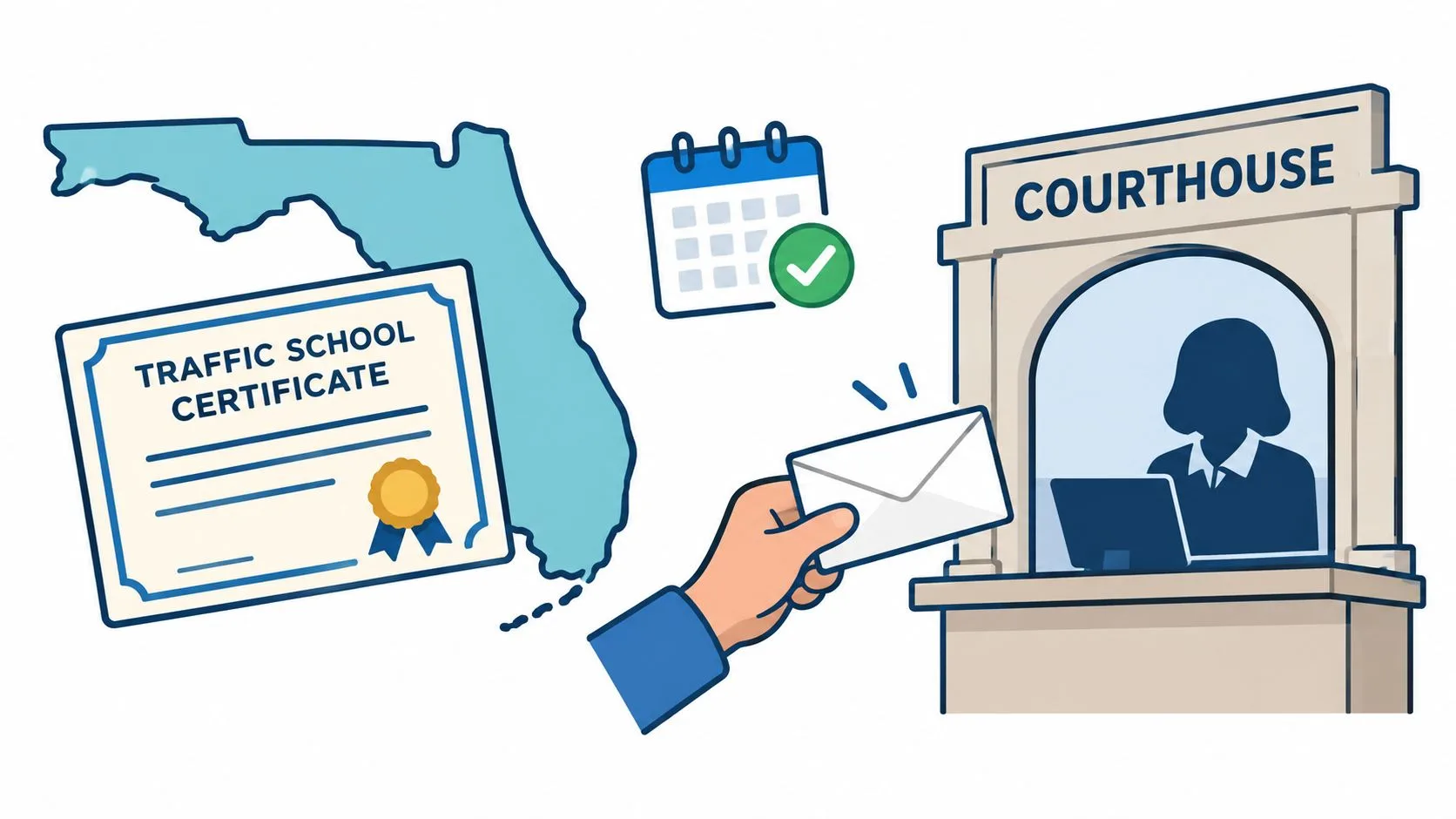
After a Florida moving violation, the deadline controls your options. For an eligible non-criminal moving violation, a driver without a commercial driver license may elect an FLHSMV-approved Basic Driver Improvement, or BDI, course once every 12 months, with a lifetime limit of eight elections. The election must be made within 30 days of the citation. Miss that deadline, and points are assessed, according to FLHSMV’s driver improvement school guidance.
Follow the administrative sequence
Read the citation first. It identifies the county and response deadline. Paying the civil penalty does not automatically elect traffic school.
Contact the correct clerk of court. Make the election through the clerk in the county where the citation was issued or filed. Florida requires the election before course attendance, with notice to the appropriate clerk within the permitted period, under the BDI election process.
Check eligibility before paying anything. Review your license status, commercial license restrictions, violation type, prior traffic-school elections, and court-specific exclusions. An approved provider cannot make an ineligible election valid.
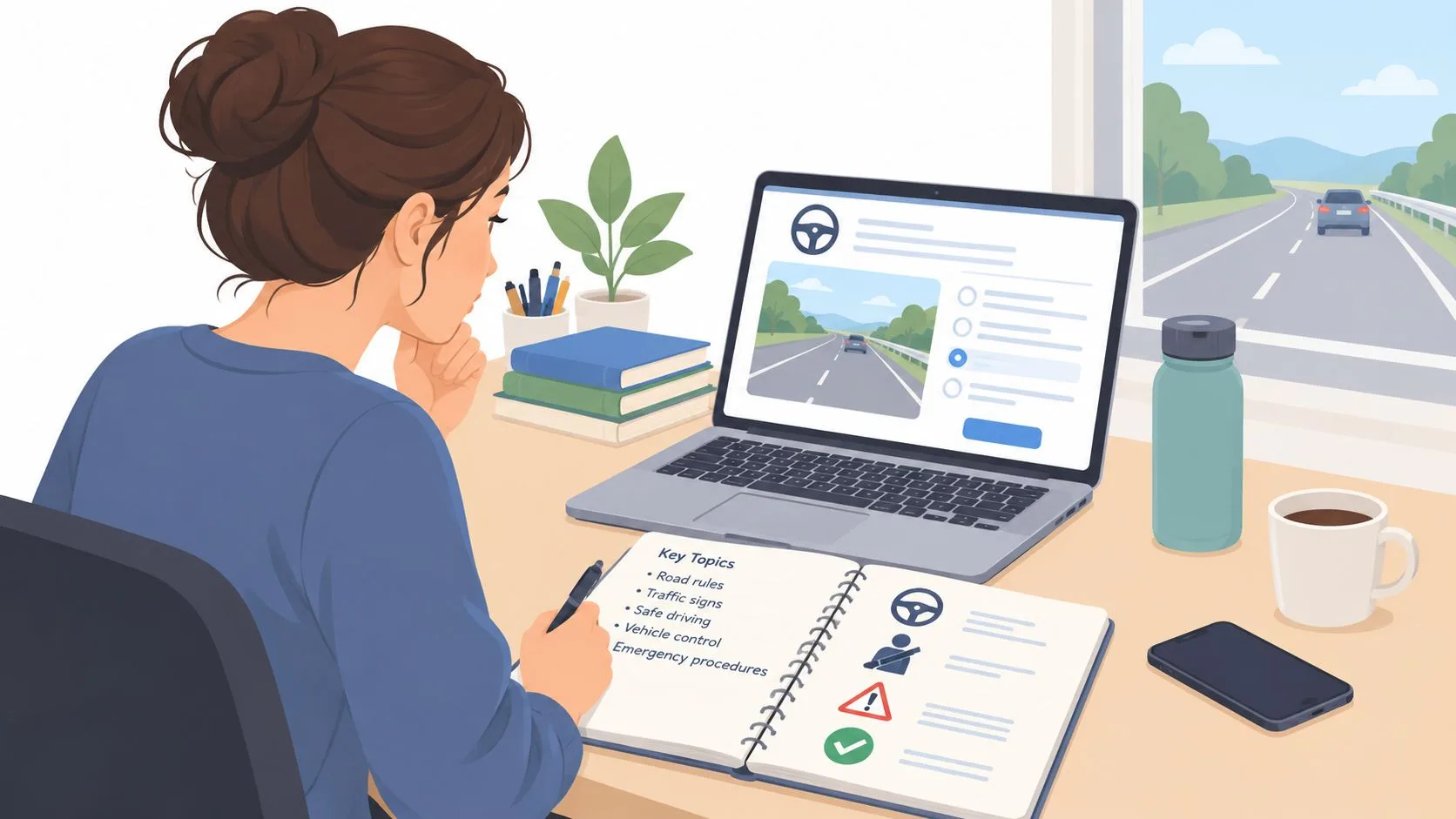
Select an approved provider. The standard Florida BDI course is a 4-hour program. When the election and completion requirements are satisfied, the qualifying violation does not add points, according to the FLHSMV BDI FAQ.
Finish by the assigned deadline. The clerk sets the controlling date. Some Florida guidance describes completion periods of 60 to 90 days, but follow the date given for your citation. The course fee and court election fee are separate, and the civil penalty still must be handled.
Verify the report. Keep your certificate and confirm that the clerk receives the completion record. Traffic school prevents points for the qualifying citation. It does not erase the ticket or eliminate the underlying payment obligation.
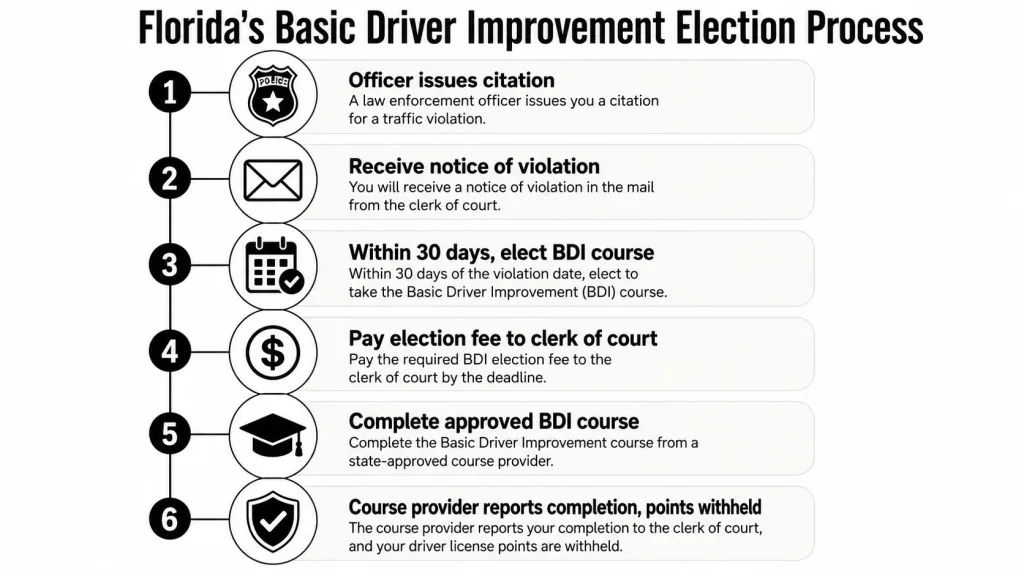
Use this Florida traffic ticket process guide to review the response steps before choosing a payment or course option. Follow the order exactly: elect first, enroll second, complete third, and verify last.
Which Approved Course Fits Your Situation
The right course depends on why you’re taking it. Florida traffic-school programs aren’t interchangeable, and completing a course for insurance purposes doesn’t automatically prevent points from a citation.
Compare the purpose before enrolling
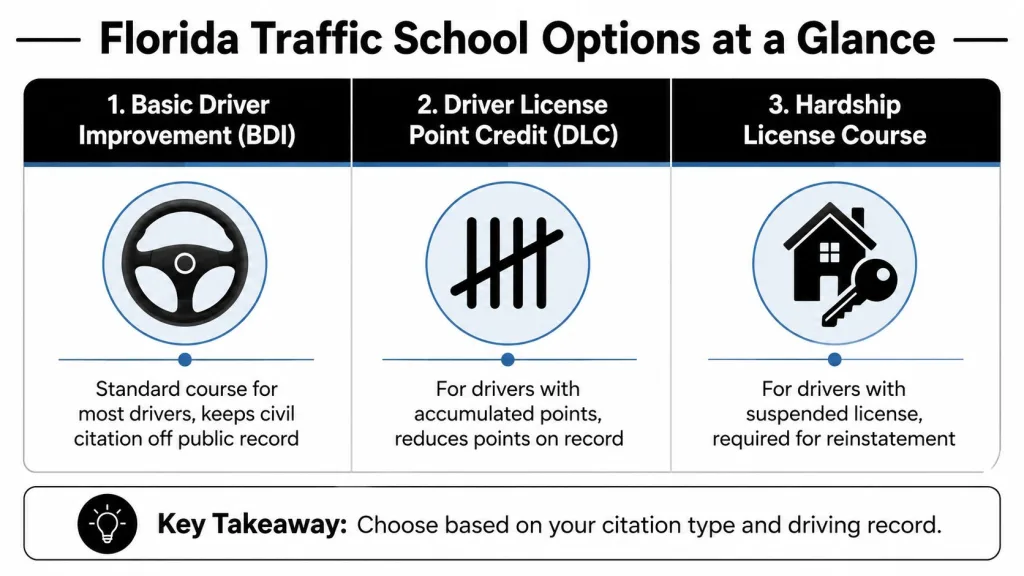
Basic Driver Improvement, or BDI, is the standard option for many eligible drivers handling a non-criminal moving violation. A properly elected and completed BDI course prevents points from being assessed for the qualifying citation. It’s the course to investigate first when your immediate concern is keeping a new citation from adding points.
Intermediate Driver Improvement, or IDI, serves a different purpose. It may be required after an administrative action such as a suspension, revocation, or disqualification, or when FLHSMV or a court orders additional instruction. It isn’t a substitute for electing BDI on a new eligible ticket.
Aggressive Driver courses address conduct involving aggressive behavior and repeated moving violations. A driver facing a specific order should follow the course named by the court or FLHSMV rather than selecting a shorter class based only on convenience.
Mature Driver courses are refresher programs designed for older drivers and may support an insurer discount requirement. They don’t replace BDI when the purpose is handling a qualifying citation.
Before you enroll, ask the clerk or FLHSMV:
- What is the violation type? Confirm the ticket is eligible for the course you’re considering.
- What is the deadline? Mark the election date separately from the course completion date.
- How often have you used BDI? Florida limits elections to once every 12 months and maintains an eight-election lifetime cap.
- Who receives proof? Keep the certificate and verify whether the provider or clerk must complete the final reporting step.
BDISchool offers a Florida-approved online BDI course for drivers who qualify for this point-prevention route. Choose a provider based on approval, course fit, reporting procedures, and your county’s requirements.
When Fighting the Ticket Beats Taking the Class
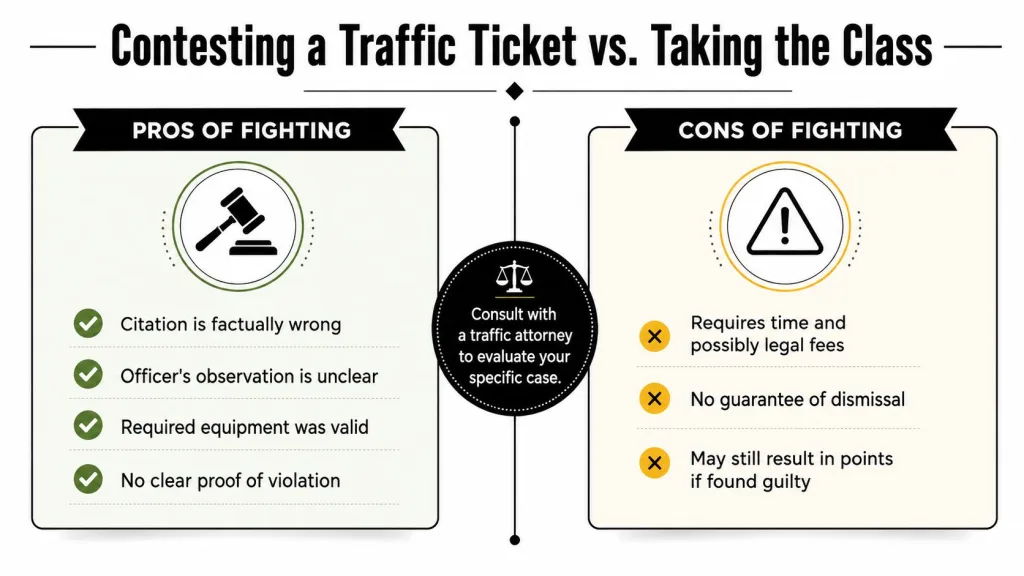
Contesting a ticket can be smarter than taking a class when you have a clear factual or legal defense. It isn’t automatically smarter because you dislike the citation.
A court challenge may make sense when the citation is factually wrong, the officer’s observation is unclear, the required equipment was valid, or the evidence doesn’t establish the violation. You should identify the exact charge, review the available evidence, and decide whether dismissal is realistic before choosing court.
Use a decision test
Fight the citation when:
- The facts are wrong: The ticket describes conduct that didn’t occur.
- The observation is weak: The evidence doesn’t clearly establish the alleged violation.
- A legal defense exists: Equipment, signage, procedure, or another required element is in question.
- You can accept uncertainty: A court appearance may take time and may not produce dismissal.
Elect BDI when the citation is valid, you’re eligible, and protecting the record is the priority. Never let a court strategy cause you to miss the traffic-school election window while you’re still deciding what to do.
A driver reviewing a careless-driving citation should understand the possible consequences before making that choice. This explanation of careless driving Florida points and fines from Ticket Shield, PLLC, provides useful context for evaluating the charge.
Decision rule: Contest a ticket because you have a defensible case, not because court sounds more powerful than traffic school.
Florida’s BDI option is limited by timing and frequency. As stated in the state guidance, eligible drivers can generally elect it once in a 12-month period, subject to the applicable rules and the eight-election lifetime cap. If the evidence is strong and the course is available, the approved class is often the more reliable point-prevention choice.
For a practical overview of the litigation process, review how to fight a traffic ticket in Florida. Serious, criminal, or otherwise excluded violations require closer legal review and shouldn’t be treated like an ordinary civil moving ticket.
Driving Habits That Keep Points Off Long Term
Traffic school is a recovery tool. The stronger strategy is avoiding the next citation, especially on Florida roads where visitors change lanes abruptly, congestion encourages aggressive driving, rain reduces visibility, and motorcycles and bicycles can disappear into blind spots.
Build a repeatable routine instead of relying on good intentions. Before moving, adjust the mirrors, buckle up, set navigation, and put the phone away. If navigation needs attention, pull over safely rather than trying to solve the route in traffic.
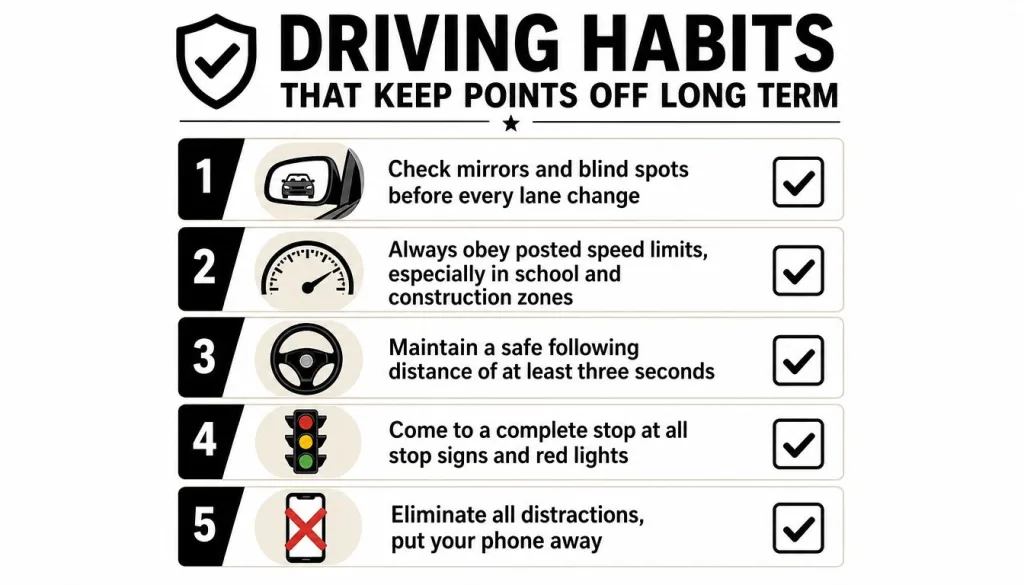
Use this defensive checklist
- Scan beyond the vehicle ahead: Look through traffic for sudden stops, merging lanes, pedestrians, and construction changes.
- Protect your space: Maintain a following distance of at least three seconds, and increase it when rain, glare, or congestion reduces reaction time.
- Check before changing lanes: Signal early, inspect mirrors, and check the blind spot before moving. Don’t force a merge when another driver has the right of way.
- Adjust speed to conditions: Obey posted limits, but slow down when rain, visibility, traffic, or roadway conditions make that speed unsafe.
- Remove distractions: Don’t text, program navigation, eat, or reach for objects while driving. Use phone settings that limit alerts.
School zones and construction areas deserve deliberate attention. Drivers should expect sudden braking, lane shifts, workers near traffic, and vehicles entering from unexpected angles.
At intersections, look for pedestrians and cyclists even when you believe you have the right of way. A complete scan takes less effort than dealing with another citation, a point assessment, or a damaged driving record.
Administrative habits matter too. Review your record periodically, respond to every citation promptly, and add court and course deadlines to a calendar immediately. Point avoidance works best when safe driving and deadline management operate as one system.
Your Personal Point-Protection Playbook
Create the plan before you need it. If you’ve received a citation, pull out the document today, write the 30-day election deadline on your calendar, and contact the county clerk to confirm whether BDI is available.
Then separate the immediate response from the long-term routine:
Protect the current ticket. Confirm eligibility before paying or enrolling. Make the election through the clerk, complete the approved course by the assigned deadline, and retain proof of completion.
Protect future eligibility. Track each BDI election so you know when you last used the option and how many elections remain under Florida’s lifetime cap. Don’t waste an election on a violation that isn’t eligible or a course that doesn’t satisfy the court’s requirement.
Protect every trip. Use a five-second pre-drive scan, maintain a following distance of at least three seconds, and keep your phone out of reach. Check mirrors and blind spots before every lane change.
Protect the record. Review your official information through FLHSMV resources, watch for inaccurate entries, and address discrepancies promptly. Keep certificates, receipts, clerk correspondence, and citation paperwork together.
Point avoidance isn’t one clever fix. It’s a system that combines prompt election decisions, approved education, careful driving, and accurate recordkeeping.
The most common mistake is postponement. Drivers wait to contact the clerk, wait to start the course, or wait to check whether the citation posted. That delay can close the option that would have prevented points in the first place.
If your citation is still within its election window, act this week. If you’re shopping for a course, compare the available Florida traffic school courses and choose one that matches your violation and court instructions.
BDISchool offers Florida-approved traffic education, including the 4-hour BDI course used by eligible drivers to prevent points from being assessed for a qualifying moving violation. Visit BDISchool to review the available course options, confirm the program that fits your situation, and start before your deadline closes.