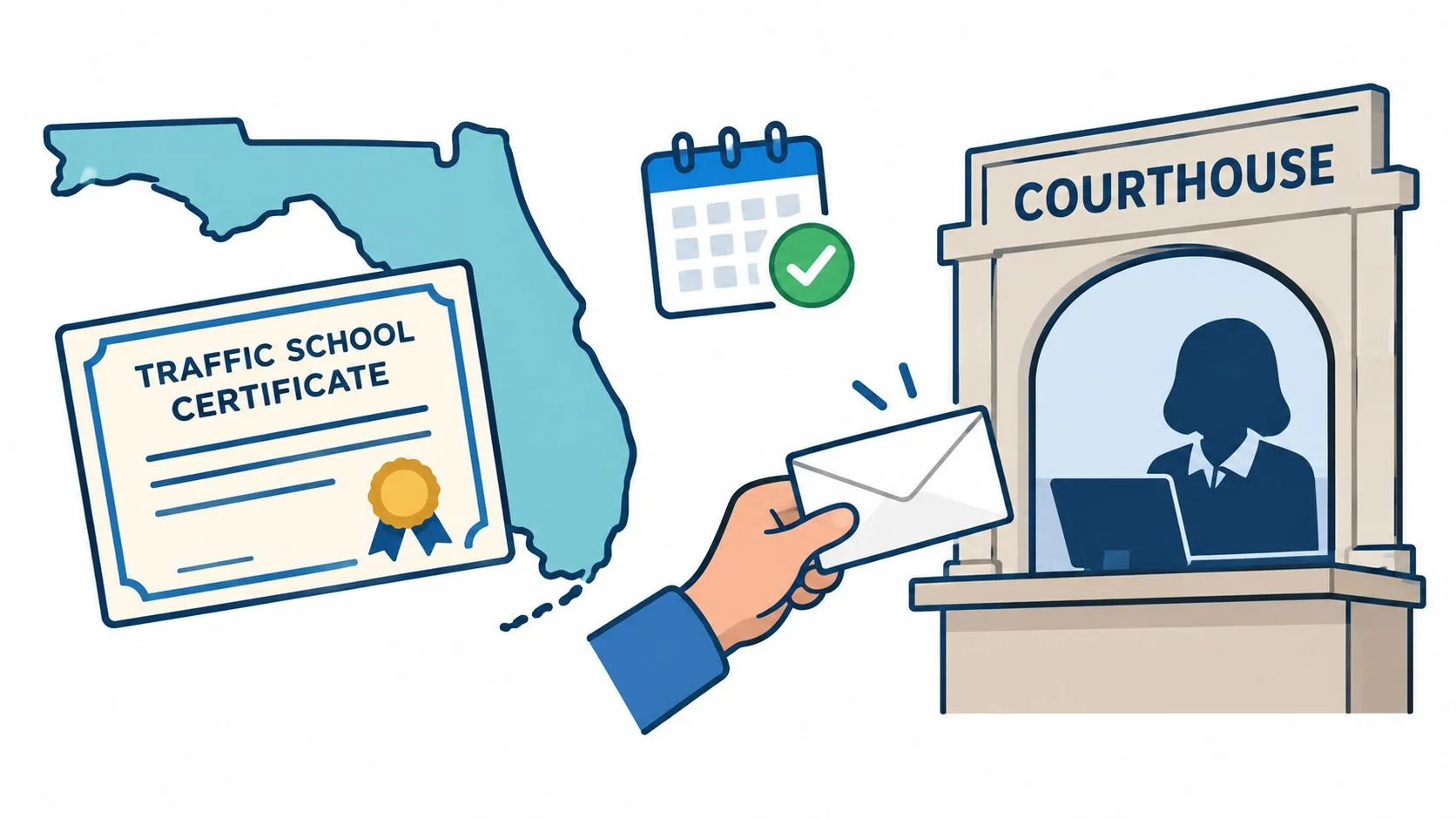
A moving-violation notice is on one Florida driver’s counter, while another driver, age 55, is looking at a renewal bill that feels too high. They’re both searching for a way to protect their insurance costs, but they don’t need the same course. One may be eligible to elect traffic school to address a citation; the other may qualify for an insurance discount by completing an approved Mature Driver course.
That distinction matters. A defensive driving course can lower insurance through a specific, regulated eligibility pathway, but completing just any class won’t automatically reduce a premium. The course, the driver’s situation, and the insurer’s requirements all determine what happens next.
The useful question isn’t simply whether a course can lower your insurance. It’s which course matches your situation, and what you need to do with the certificate.
If you’re comparing programs or looking for a broader overview of how defensive driving course savings work, this guide to defensive driving course savings offers another point of reference. For Florida drivers, the practical route is to understand the law, choose the correct approved course, and confirm the credit directly with the insurer.
Why a Florida Driver Is Reading This Right Now
A ticket can set off a chain of questions: Should I elect traffic school? Will points affect my record? Could my insurer raise my premium? Meanwhile, a driver whose renewal notice just arrived may be asking a different question: Is there an approved course that could qualify me for a discount?
Those situations can lead to very different outcomes. A driver with an eligible citation may use Basic Driver Improvement to address the violation and avoid points. A driver aged 55 or older may take an approved Mature Driver course to qualify for an insurance reduction under Florida law. Traffic school for a citation and a course taken for an insurance discount aren’t interchangeable.
Florida’s mature-driver discount has a statutory basis. Under Florida Statute 627.0652, an insurer must include an appropriate premium reduction for specified coverages when the principal operator is at least 55 and completes a qualifying accident-prevention course. That makes the benefit more than a course provider’s sales pitch, but it doesn’t mean every driver qualifies or every insurer applies the same percentage.
The rest comes down to practical details: which course fits your goal, what coverages the insurer discounts, how long the credit lasts, and how to get the completion certificate to the right person. If you’ve received a ticket, timing matters too. Florida’s traffic-school election has its own rules and deadline, separate from the mature-driver insurance pathway.
Start with your situation, not the course name. That one decision helps you avoid paying for a class that doesn’t meet the goal you have in mind.
How Florida Law Creates the Discount
Florida Statute 627.0652 provides the legal foundation for an insurance reduction tied to an approved accident-prevention course. It applies when the principal operator is at least 55 years old and successfully completes a course approved by the Florida Department of Highway Safety and Motor Vehicles (FLHSMV). The insurer must include an appropriate reduction for liability, personal-injury-protection (PIP), and collision coverages. (Read Florida Statute 627.0652)
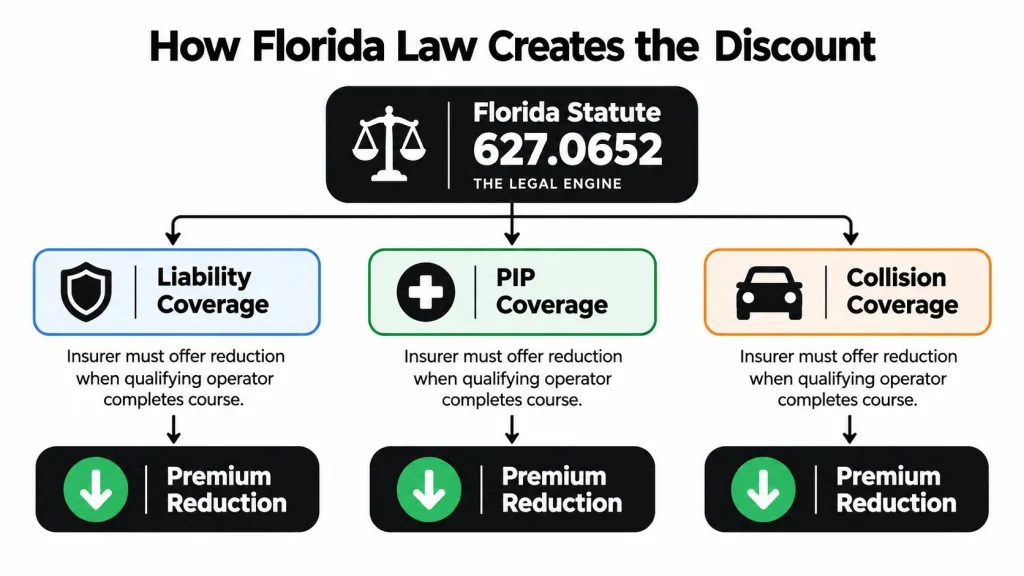
The statute requires approved courses to meet state standards. FLHSMV evaluates instructor competency, instructional quality, accident-prevention value, and course cost. It also sets minimum course hours, requires students to pass a written examination, and provides for a certificate of completion used to establish insurance eligibility.
The legal distinction: The reduction is tied to a state-regulated course and qualifying driver, not simply to a provider’s promise that a class is helpful.
The credit remains effective for three years after course completion. During that period, an insurer may require the driver to maintain a clean record, including no at-fault accident and no conviction or guilty plea for a moving violation. The statute doesn’t prescribe one statewide percentage, so the dollar amount depends on the insurer and the eligible policy coverages.
Don’t confuse the insurance course with a class taken as punishment for a moving violation. Florida’s statute excludes courses taken as punishment, which is why a ticket-related traffic-school election and the mature-driver discount are different paths. Check the relevant Florida traffic laws before you enroll, and verify that the specific course is FLHSMV-approved.
What a Real Discount Looks Like in Dollars
There’s no single discount percentage that every Florida driver should expect. The National Association of Insurance Commissioners says driver-education and defensive-driver discounts vary by state and insurer, and advises consumers to confirm availability with their agent. Insurers may apply a credit only to eligible portions of a premium, not necessarily to the full bill. (NAIC consumer guidance on personal-lines pricing)
Published examples help frame expectations. The Delaware Department of Insurance says an eligible driver may receive up to 15% off part of an auto-insurance premium for three years after completing a refresher course. Nationwide describes its defensive-driver discount as usually about 5% for qualifying drivers in selected states. These are reference points, not a Florida guarantee. (Delaware Department of Insurance discount information)
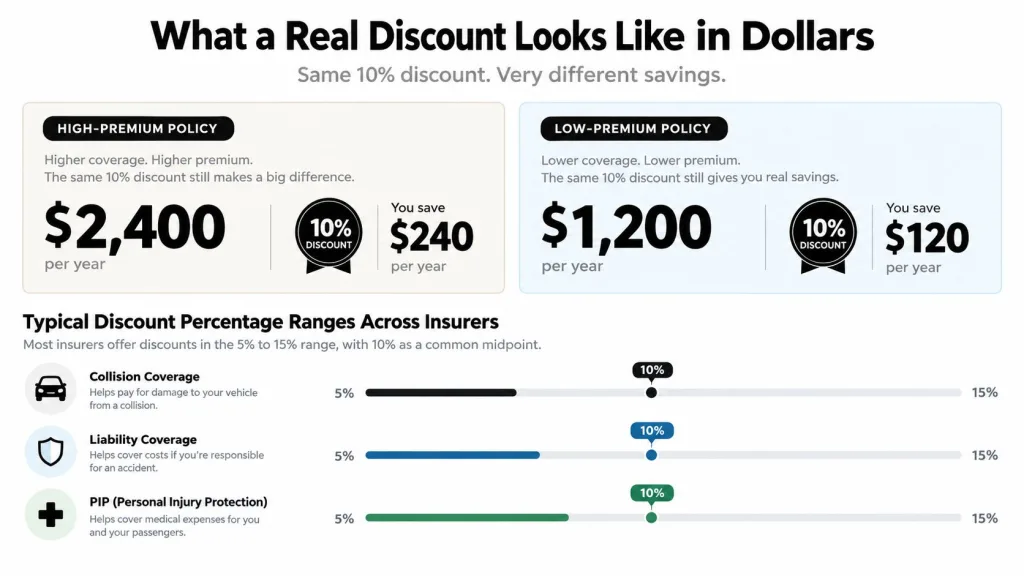
A Consumer Reports example shows how the math works: a New York policy with an average annual premium described as nearly $3,700 would yield about $370 per year from a 10% approved-course discount, or approximately $1,110 over three years, before course costs and policy changes. The example’s course cost roughly $25 and took 5 hours and 20 minutes. A lower-premium policy would produce less dollar savings at the same discount rate. (Consumer Reports’ defensive-driving insurance example)
The sample figures in the infographic are illustrations, not promises about any driver’s quote. Ask your insurer for a written comparison showing the premium with and without the credit, which coverages qualify, and how long the discount applies. Then subtract the course fee to see whether the expected savings make sense for your policy. For more ways to review your policy costs, see this guide to lowering car insurance rates.
Picking the Right BDISchool Course for Your Goal
Choose a course based on why you need it, not on which title sounds familiar. A Mature Driver course is the course associated with the statutory insurance discount for qualifying drivers aged 55 or older. Basic Driver Improvement (BDI) serves a different purpose: it’s used for an eligible citation or when a court orders it, and can help protect the driving record by withholding adjudication.
Florida also has courses for court orders, suspensions, and other circumstances. A BDI course doesn’t automatically qualify a driver for the mature-driver insurance credit, and a Mature Driver course doesn’t replace a citation-related election.
| Match Your Situation to the Right FLHSMV-Approved Course | Hours | Best Fit For | Insurance or Licensing Benefit |
|---|---|---|---|
| Basic Driver Improvement | 4 | Eligible citation or court direction | May withhold adjudication and prevent points for an eligible violation |
| Intermediate Driver Improvement | 8 | Court-ordered driver seeking additional instruction | Meets a court requirement where applicable |
| Aggressive Driver | 8 | Drivers ordered to address aggressive driving | Satisfies the applicable course requirement |
| Mature Driver | 6 | Drivers aged 55 or older seeking a refresher | May qualify for the statutory insurance discount when the insurer accepts the course |
Florida requires Advanced Driver Improvement when a license has been suspended for point accumulation, when a driver is classified as a non-DUI habitual traffic offender, or when a court orders it. An FLHSMV-approved improvement course is also required after a conviction or no-contest plea to a third traffic offense that caused a crash within 36 months. Use the course specified for your situation rather than assuming a different class will satisfy the requirement.
Check traffic-school costs and confirm the course matches your citation, court order, or insurance goal before registering. BDISchool’s Florida-approved courses are online and self-paced, available in English, Spanish, and Portuguese, and report completion directly to FLHSMV.
How to Claim the Discount With Your Insurer
The certificate doesn’t put a credit on your bill by itself. You need to make sure the insurer receives it and confirms how the credit will be applied.
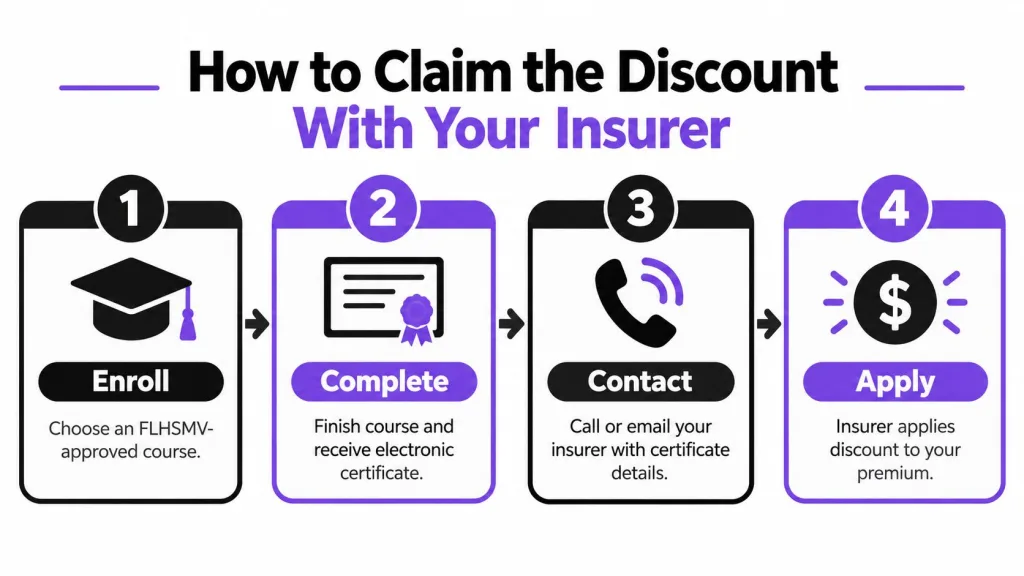
Use this sequence:
- Enroll in the right approved course. Confirm the course meets your specific insurance or court purpose before paying.
- Complete the course and get your certificate. Keep the electronic certificate where you can retrieve it.
- Contact your insurer. Ask whether to submit it through your agent, an online account, or an underwriting phone line.
- Confirm the credit in writing. Get the effective date, eligible coverages, discount duration, and renewal requirements documented.
For a citation-driven BDI election, act quickly. The driver must contact the county Clerk of Court and elect the course within 30 days of receiving the citation. The driver also pays the citation with an 18% reduction in the civil penalty and completes the approved course; points may then be withheld. Florida limits this election to five times during a driver’s lifetime, and missing the deadline generally means losing the option for that citation. (FLHSMV traffic-citation guidance)
Keep your own certificate copy even if course completion is reported to FLHSMV. Direct reporting supports state compliance, but the insurance discount still depends on the insurer applying its credit. Follow the carrier’s instructions for submitting a traffic-school certificate, then check the next bill or renewal document to make sure the change appears.
Three Assumptions That Cost Drivers Money
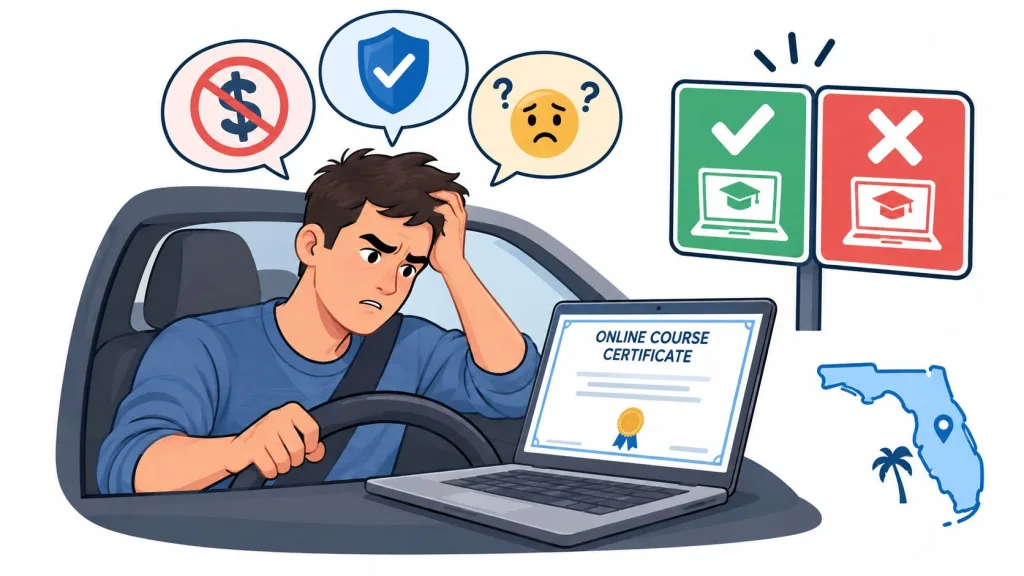
Assumption one: any online course will do. It won’t. For the statutory mature-driver credit, the course must be FLHSMV-approved; a generic class without that approval may not establish eligibility. Check the approval status before enrolling.
Assumption two: the insurer applies the discount automatically. Don’t count on it. The certificate establishes completion, but you should submit it as directed and ask the insurer to confirm the effective date and eligible coverages. If you skip that follow-up, the credit may never show up when you expect it.
Assumption three: any ticket automatically cancels the benefit. The details matter. When a driver completes an improvement course to satisfy an eligible violation, adjudication is withheld, no points are assessed, and insurers may not impose an additional premium or refuse to renew solely because of that non-criminal infraction. Exceptions apply to a second infraction within 18 months, a third within 36 months, or speeding more than 15 mph over the posted limit. (FLHSMV driver-improvement course FAQ)
That protection is not a blanket exemption from every insurance consequence. It applies to the eligible infraction under the stated rules. For a driver trying to maintain a clean record during a discount period, knowing how the citation was handled is more useful than assuming that every ticket has the same effect.
The avoidable mistake is treating course completion as the finish line. Drivers often leave a potential credit unclaimed because they choose the wrong course, miss a deadline, or never submit the certificate to the insurer.
Your Decision Checklist Before You Enroll
Take a moment to identify the problem you’re solving. The right choice depends on whether you’ve received a citation, been ordered to attend a course, had a points-related suspension, or are a driver aged 55 or older looking for the mature-driver insurance credit.
- Match the course to the situation. Don’t use a discount course as a substitute for a required citation or court course.
- Verify approval. Confirm that the provider and course meet FLHSMV requirements for your purpose.
- Get the insurer’s terms in writing. Ask for the credit amount, eligible coverages, start date, and renewal conditions.
- Calculate net value. Compare expected savings over the applicable period with the course fee. Don’t assume a credit will apply to the full premium.
If you’ve received a citation, check the Clerk of Court’s election process promptly. If you’re pursuing an insurance discount, confirm acceptance with your insurer before enrolling.
Once you’ve identified the right program, browse the Florida course catalog and start the course that matches your goal.
Questions Drivers Ask After They Click Enroll
What format is the certificate, and can I get it again? Course certificates are issued electronically. Keep a copy, and contact the provider if you need help retrieving it for your insurer.
What languages are available? Courses are available in English, Spanish, and Portuguese. Check the course listing to confirm the language offered for the program you choose.
When should I take a refresher for the insurance credit? The statutory discount period lasts three years. Ask your insurer whether you need to retake the course and when to submit the new certificate.
What if my insurer says it doesn’t recognize the provider? Ask what approval documentation it needs, then check the current FLHSMV approval information for the course. Give the insurer the course details and certificate, and request that underwriting review the eligibility.
BDISchool offers Florida-approved online courses for citation, court, and mature-driver needs, with self-paced study and electronic completion reporting. Choose the course that fits your situation and visit BDISchool to get started.