Florida generally requires covered negligence judgments to follow each defendant's percentage of fault, rather than making every responsible driver liable for the entire award. If you're sorting out a crash where more than one driver played a part, that rule decides who can be asked to pay, and how much.
When Two Drivers Cause the Same Crash
You're stopped at a Florida intersection when one driver turns across traffic too late and a second driver, following too closely, pushes into the collision. You're hurt, your car needs repair, and both drivers start blaming each other.
That scene creates four separate questions. Drivers often blend them into one.
- Assigned legal fault: Who contributed to the crash, and in what share?
- Joint liability: Can one responsible party be required to cover someone else's share?
- Insurance coverage: What does each policy promise to pay?
- Collectability: Can the money be collected from that person or policy?
Why the Distinction Matters Before You Negotiate
A traffic citation answers a traffic law question. It doesn't, by itself, allocate civil damages among you, two drivers, a vehicle owner, or an employer whose worker was driving.
Insurance adds another layer. An insurer may dispute coverage, fault, or the value of losses, and none of those disputes automatically changes what a court would enter as a judgment.
The date your claim accrued, the legal theory you use, whether losses are economic or noneconomic, and who is included in the case can all change the analysis. That's why a confident headline about joint and several liability in Florida can mislead you if it skips those details.
Separate fault, joint liability, coverage, and collectability first. You'll ask better questions and avoid assuming one solvent driver guarantees full recovery.
You don't control another driver's assets or policy. You can control whether you preserve evidence, identify every potentially responsible actor, and get qualified advice before you accept an explanation of fault.
This guide is educational, not individualized legal advice. It gives you the current percentage based framework, the historical traps, and the practical questions to bring to an insurer or attorney.
Understanding Joint and Several Liability
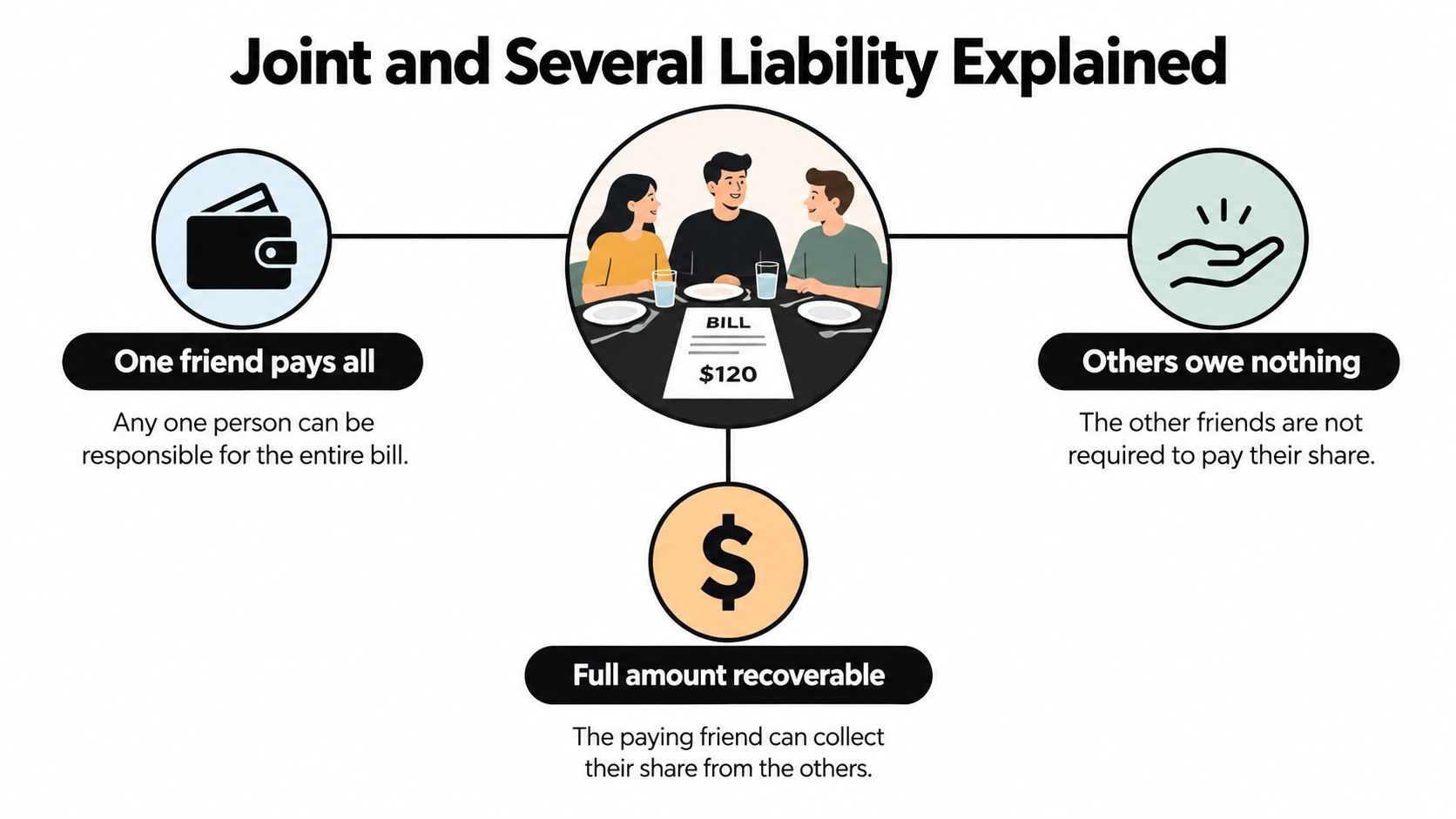
Start with one shared restaurant bill. Three friends order together, but the server can collect the whole bill from any one of them.
Traditional joint and several liability worked in a similar legal way. Each defendant whose conduct contributed to one injury could be held responsible for the plaintiff's total damages, regardless of that defendant's individual percentage of fault, as explained in Florida case law describing the older framework.
Florida's modern approach splits the bill. Each liable party generally pays its assigned slice.
The visual below uses that shared bill idea to show the older rule before you contrast it with Florida's current system.
How Florida Allocates the Shares
Under Florida Statutes section 768.81(3), the court enters judgment against each liable party according to that party's percentage of fault, rather than automatically making every defendant responsible for the entire award. The fact finder allocates fault among the claimant, defendants, and other legally responsible parties whose conduct contributed to the injury under that same statute.
Your own share matters too. A claimant's comparative fault proportionally reduces both economic and noneconomic damages under section 768.81(6).
Plain language rule: In a covered Florida negligence case, a defendant's judgment generally follows that defendant's percentage of fault.
If you want a complementary plain language walkthrough of the older shared responsibility idea, see how shared fault works legally from Lawyer in Martin County. It helps to read that concept beside Florida's percentage based statute, because the labels sound similar but produce different results.
Don't confuse a legal share with payment. A judgment states what a party owes, an insurance policy states what an insurer has agreed to cover, and collectability asks whether money is available to satisfy the judgment.
Those three answers can differ in the same crash. A driver can owe a share that no policy fully covers, or a policy can exist while fault remains disputed.
How Florida Changed Its Fault Rules
Older webpages aren't always wrong for their time. They're often wrong for your accident date.
Florida moved toward today's system in stages. Each stage answers a different fairness problem, and each left language that still appears in search results.
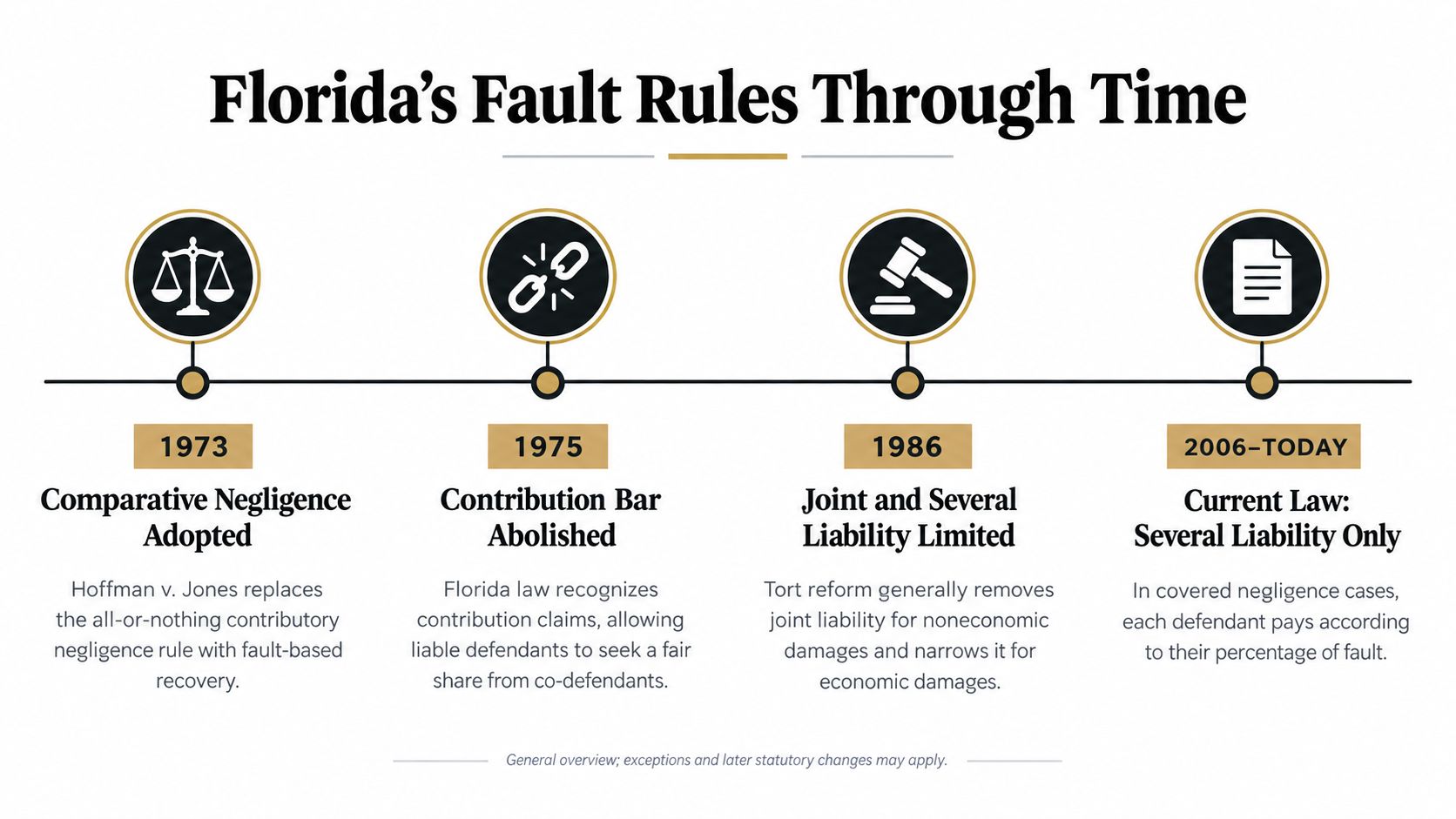
The timeline below places those milestones in order so you can see why date checking comes before fault math.
The Milestones That Still Cause Confusion
- 1973 comparative negligence: The Florida Supreme Court adopted comparative negligence in Hoffman v. Jones, replacing contributory negligence, under which a negligent plaintiff could be barred from recovery, according to the Florida Bar Journal history of comparative fault.
- 1975 contribution: The court abolished the rule against contribution among joint tortfeasors, reasoning that a fault based system shouldn't place the entire loss on only one responsible party.
- 1986 statute: The Legislature enacted section 768.81 in the Tort Reform and Insurance Act of 1986, citing a liability insurance crisis and concerns about availability and affordability.
- 1999 sliding scale: Lawmakers introduced a more complex sliding scale for economic damages.
- 2006 percentage rule: Effective April 26, 2006, section 768.81(3) required courts in covered negligence cases to enter judgment according to each party's percentage of fault rather than joint and several liability.
The 1986 framework generally assigned fault proportionally for noneconomic damages but preserved joint and several liability for economic damages in specified circumstances. That split explains why older summaries discuss damage categories that a current summary may barely mention.
For most negligence causes of action accruing on or after April 26, 2006, a defendant found 20% at fault generally owes 20% of the recoverable damages, not the entire judgment if another defendant can't pay.
Check the Version That Governs Your Claim
Don't copy historical thresholds into a current analysis. Compare the statute governing your claim date, then confirm the legal theory and parties.
If you're also reviewing broader crash duties and reporting issues, read Florida accident laws drivers should know alongside the fault statute. The duties at the scene and the later civil allocation are related, but they aren't the same inquiry.
This short video gives you another way to review the shift from shared full liability toward allocated fault.
Your takeaway is simple. Ask which version applies before you ask what percentage anyone owes.
Comparing Fault Allocation and Collectability
Use one set of numbers and watch the result change. Suppose total damages are $200,000 and a defendant is assigned 30% fault, so the ordinary judgment against that defendant is $60,000, not $200,000, under the percentage based framework in section 768.81(3).
That's fault allocation. It doesn't promise the defendant has $60,000 available, and it doesn't transfer another party's share to this defendant.
Florida Liability Concepts Compared
| Concept | How Responsibility Is Assigned | Practical Result | Key Limitation |
|---|---|---|---|
| Traditional joint and several liability | Each contributing defendant can be responsible for total damages | Plaintiff may pursue one defendant for the full award | Generally replaced for covered Florida negligence actions |
| Modern proportional liability | Judgment follows each party's percentage of fault | Each defendant generally owes only its assigned share | Claimant fault, nonparties, and exceptions affect allocation |
| Collectability | Based on insurance, assets, and ability to pay | A valid judgment may still produce incomplete recovery | Another party's insolvency doesn't automatically shift its share |
| Historical economic damage thresholds | Older brackets tied possible exposure to fault percentages | Result depended on the governing statutory version | Don't apply old thresholds to a claim governed by later law |
Economic and Noneconomic Damages Aren't Interchangeable
Economic damages can include medical expenses, rehabilitation, lost income, lost support, property losses, and repair costs. Pain and suffering falls on the noneconomic side and must be treated separately.
That distinction shaped older versions of the statute. Under the framework in the 2005 version of section 768.81, a defendant at 10% or less fault wasn't subject to joint and several liability, while higher brackets referenced $200,000, $500,000, and $1 million thresholds for economic damages.
Those amounts operated as caps on potential exposure beyond a proportional share. They didn't turn noneconomic damages into unlimited joint liability.
A judgment is a legal allocation. Collectability is a practical question about insurance and assets.
Before you negotiate, review Florida insurance requirements and coverage basics so you can separate a policy limit from a court's fault percentage. Then ask who else may belong in the allocation, including an employer, vehicle owner, or nonparty.
Adding a potentially responsible actor doesn't guarantee payment. It can affect how fault is divided and whether an assigned share is realistically collectible.
Examples From Florida Crash Claims
Examples make the categories visible. These are hypothetical teaching scenarios, not reported judgments or predictions.
The diagram below shows why an intersection crash can involve several fault shares rather than one simple blame decision.
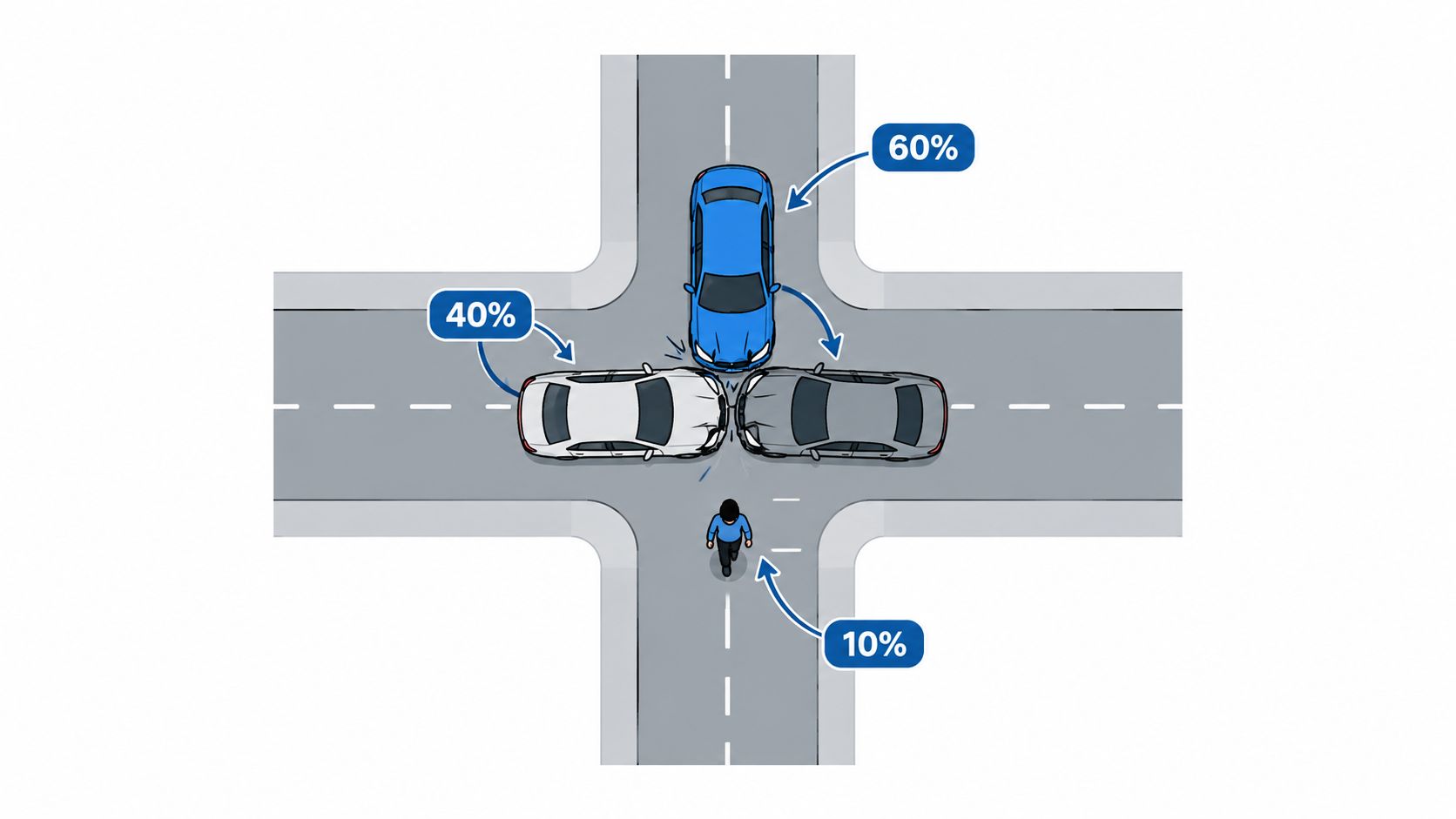
Multi Driver Intersection Crash
One driver turns left without enough clearance. A second driver approaches too fast, and you brake late because you looked at navigation.
A fact finder can assign shares to all three of you. Your share reduces your recovery, and each defendant generally faces judgment based on its own share in a covered negligence case.
Preserve signal timing information, vehicle positions, photographs, witness names, and any video. Percentages built on memory alone are easier to challenge but harder to correct.
Employer Linked and Unidentified Driver Scenarios
Now change one fact. One driver was working for an employer when the crash happened.
That relationship may make the employer another legally responsible actor to investigate. It doesn't mean the employer automatically absorbs every other party's share.
Change the fact again. One contributing driver leaves and remains unidentified.
You may still have claims against identified parties for their shares, but an unidentified party's share presents a collection problem. A judgment against a known defendant doesn't create money for an unknown driver's portion.
Two Boundaries Drivers Miss
Medical malpractice has a specific teaching hospital rule. Under section 768.81(5) in the 2024 statutes, if damages are apportioned to a teaching hospital as defined in section 408.07, the court must enter judgment against that hospital according to its percentage of fault rather than under joint and several liability.
That provision applies whether the malpractice claim is pleaded in contract or tort. Changing the label doesn't avoid the rule.
Intentional conduct needs separate analysis. The Florida Supreme Court has reiterated that section 768.81 governs a "negligence action," while noting the statutory rule doesn't automatically control an intentional tort, in a Florida courts opinion addressing that boundary.
So road rage allegations can't be analyzed solely as ordinary negligent driving. Verify the legal theory before you rely on the percentage rule.
What Drivers Should Do After a Crash
Your first job is safety and medical care. Your next job is preserving the facts while they're still available.
Fault percentages are built from evidence. Weak documentation invites other people to fill gaps with their own version.
This checklist turns the immediate steps into a sequence you can save before you need it.
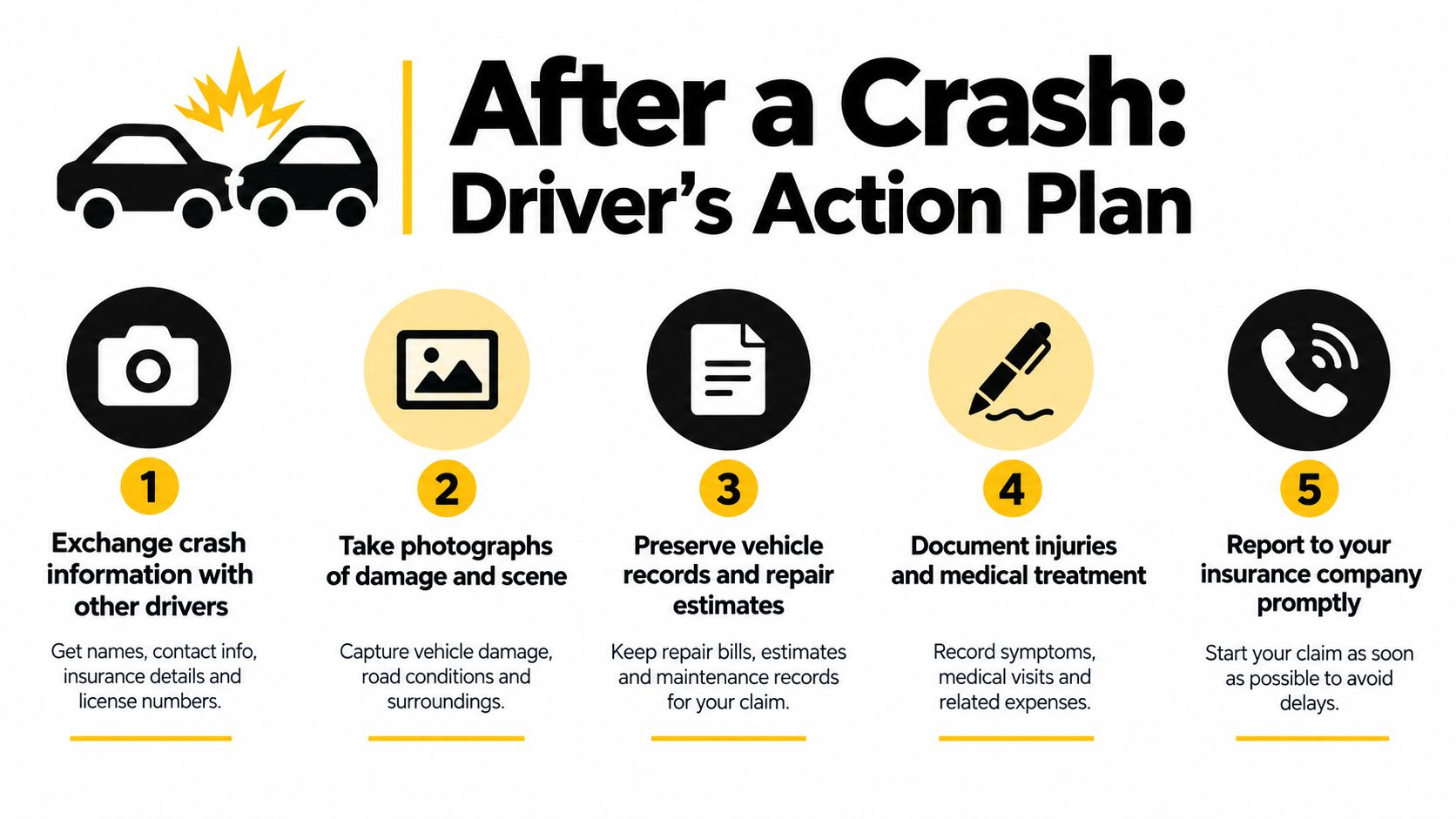
Preserve Evidence That Supports or Challenges Fault
- Exchange complete information: Record drivers, owners, employers, insurers, vehicles, and contact details.
- Photograph context: Capture damage, lanes, signals, debris, weather, skid marks, and final vehicle positions.
- Identify witnesses: Save names and contact information before people leave.
- Keep loss records: Preserve medical documentation, repair estimates, vehicle records, wage information, and receipts.
- Write your timeline: Note what you personally observed while it's fresh, without guessing about speed or fault.
For health focused next steps after a smaller collision, the MedAmerica Rehab Center accident guide from MedAmerica Rehab Center is a useful companion. Pair it with steps to take after a Florida car accident so medical, reporting, and documentation tasks don't get separated.
Questions to Ask an Insurer or Attorney
Ask which version of section 768.81 governs the claim date. Ask which damages are economic, which are noneconomic, and which parties or nonparties may receive a fault share.
Ask whether an intentional tort, medical malpractice provision, or another special regime could change the analysis. Ask how collectability affects settlement value even if liability looks clear.
Documentation rule: Don't treat a crash report, citation, or early insurance position as the final civil allocation of fault.
Traffic school decisions belong in a separate column. Completing a course doesn't preserve a civil claim, set a fault percentage, or force an insurer to pay.
Common Florida Liability Misconceptions
The most common error is treating a short headline as a complete rule. Florida's system depends on claim date, legal theory, damage type, parties, and collectability.
Check each statement below against those five items before you repeat it.
Statements That Need Correction
- "Florida completely abolished joint and several liability." For most covered negligence actions, judgments follow percentages under the 2025 version of section 768.81, but claims outside that framework and separate legal bases require their own analysis.
- "The solvent driver must pay for the uninsured driver." In an ordinary negligence claim, the short answer is generally no under the current percentage based framework.
- "A citation decides civil fault." A traffic violation, crash fault, civil liability, and insurance payment are separate questions.
- "A settlement proves the legal fault percentage." Parties can settle for business, coverage, or collectability reasons without a court allocating fault.
- "Course completion changes who pays a judgment." Driver improvement doesn't itself determine civil responsibility.
Historical thresholds create another trap. Under the 2000 version of section 768.81, different economic damage ceilings applied depending on defendant fault and whether the plaintiff was also at fault, including $500,000, $1 million, and $2 million limits in specified situations.
Those figures explain older cases. They shouldn't be pasted onto a newer claim without checking the governing version and transition provisions.
Don't ask whether joint and several liability exists in the abstract. Ask whether it applies to this claim, on this date, under this legal theory.
Another misconception runs in the opposite direction. Florida's percentage rule doesn't make an injured claimant responsible for an entire judgment merely because several parties contributed.
It allocates responsibility. The practical risk is that an allocated share may be hard to collect, not that every share automatically lands on the claimant or on the deepest pocket.
When you read any summary of joint and several liability in Florida, look for the accrual date first. If the page doesn't identify it, treat the conclusion as incomplete.
Build Safer Driving Habits and Course Options
You can't control whether another driver carries enough insurance. You can control following distance, attention, speed choices, and how prepared you are when traffic compresses around you.
That's where legal awareness becomes useful instead of frightening. Understanding allocated fault shows why small decisions matter when several drivers contribute to one crash.
Habits That Reduce Your Share of Risk
Leave space so another driver's mistake doesn't become your rear end collision. Scan intersections after the light changes, because a lawful signal doesn't remove cross traffic that failed to stop.
Put navigation and messages aside before the vehicle moves. A brief glance can become the fact another party uses to argue for part of the fault.
Slow down when visibility, rain, or congestion reduces your reaction margin. Defensive driving isn't passive driving, it's buying time to recognize and escape developing problems.
Review safe driving habits as a state of mind if you want that mindset translated into daily checks you can practice. The goal is consistent attention, not perfection on one trip.
What Driver Education Can and Cannot Do
A good course can refresh Florida traffic laws, defensive driving, crash avoidance, and decision making. It can help you recognize aggressive driving patterns and correct habits before they lead to another citation or crash.
It cannot assign fault in a past collision. It cannot control an insurer's coverage decision, rewrite a judgment, or guarantee a legal outcome.
BDISchool offers Florida approved, fully online traffic school programs in English, Spanish, and Portuguese, including BDI, IDI, Aggressive Driver, and Mature Driver courses. The fully online format lets you work through traffic law and defensive driving material on a schedule that fits work and family obligations.
Course options are available through the BDISchool and DriverEducators course catalogs. Choose based on your court, licensing, or refresher needs, and confirm any requirement with the authority that directed you to take a course.
Frequently Asked Questions
Can one Florida driver be forced to pay another driver's share?
Generally no in a covered negligence action, because judgment follows each party's percentage of fault. Separate legal theories or special regimes need separate review.
What if the other at fault driver has no insurance or assets?
You may still have a judgment for that driver's share, but collecting it can be limited. The remaining defendant generally doesn't absorb that share automatically.
Does traffic school decide fault after a crash?
No. A course can improve knowledge and habits, but it doesn't determine civil liability or who pays a judgment.
Keep one concise takeaway. Know the percentage based rule, preserve evidence, and seek qualified legal or insurance advice when fault or collectability remains disputed.
If a crash or citation has shown you a habit you need to fix, BDISchool offers Florida approved, fully online BDI, IDI, Aggressive Driver, and Mature Driver courses in English, Spanish, and Portuguese. Visit the course catalog, choose the program that matches your requirement, and start building safer, more deliberate driving habits today.