Florida requires every registered vehicle with four or more wheels to carry $10,000 in Personal Injury Protection (PIP) and $10,000 in Property Damage Liability (PDL). Standard passenger vehicles do not need bodily injury liability coverage just to register.
That’s the rule most drivers care about first, because it decides whether your car can sit legally on Florida roads or get turned away at registration. And if you’ve just moved here, bought a car, or picked up a ticket, the trap isn’t the minimum itself. It’s what happens when you misunderstand Florida’s no-fault system, miss the 90-day deadline, or ignore the insurance consequences that follow a violation.
Florida Auto Insurance Minimums Explained
You’re at the tag office, the clerk asks for proof of insurance, and your out-of-state policy suddenly stops being enough. That’s the moment many people learn Florida doesn’t play by the same rules as their last state.
Florida uses a no-fault system, which means your own PIP coverage is there first for your injuries, while PDL pays for damage you cause to someone else’s property. The state requires every vehicle with at least four wheels that’s registered in Florida to carry $10,000 in PIP and $10,000 in PDL during the registration period, according to the Florida Highway Safety and Motor Vehicles agency. Florida’s own insurance page lays out those minimums and the basic registration rule clearly, and it also shows how different Florida is from states that require bodily injury liability for standard passenger cars. Florida Highway Safety and Motor Vehicles insurance requirements
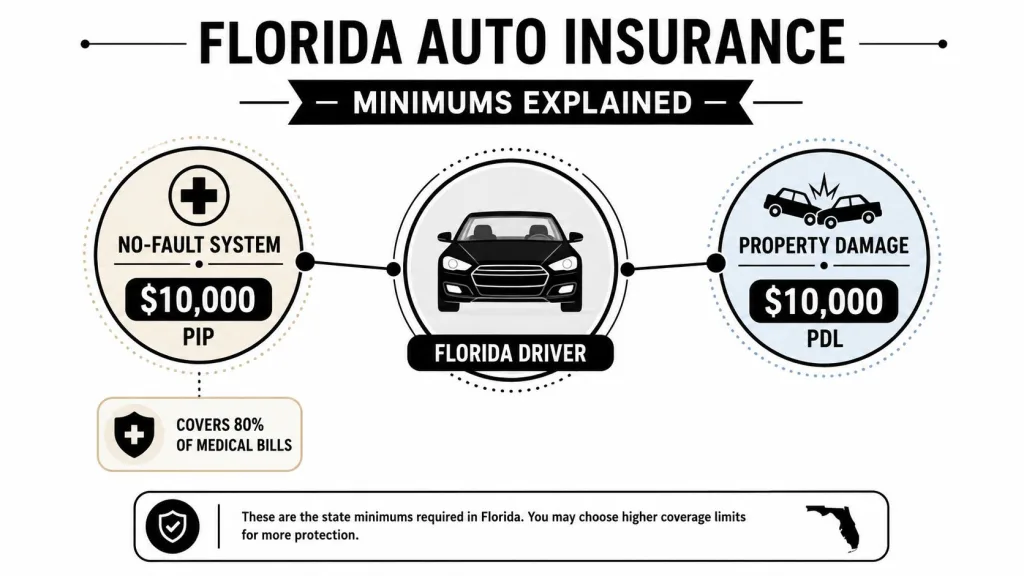
What those minimums actually mean
PIP is your first layer for medical expenses after a crash. PDL protects you when you damage someone else’s property, like a vehicle, fence, or mailbox.
Practical rule: If your policy only satisfies the tag office but leaves you exposed after a crash, you’ve bought legal compliance, not real protection.
Florida’s minimums are bare bones. That’s not a moral judgment, it’s just the way the law is written. If you drive a commercial vehicle, the rules can change, and that’s where a resource like commercial auto from ISU Insurance Services becomes useful because business vehicles can carry very different liability expectations than a personal sedan.
For a quick refresher on the registration side, the internal guide on whether you need insurance to register your car is worth reading before you show up at the counter with incomplete paperwork.
Why Florida’s setup surprises new drivers
Most states make you think in terms of liability first. Florida makes you think in terms of PIP and PDL first. That difference matters because drivers often assume “full coverage” means the law is handled, when the registration question is really about specific minimums tied to the state’s no-fault structure.
Florida does have stricter rules for taxis. The Florida Highway Safety and Motor Vehicles agency says taxis must carry $125,000 per person and $250,000 per occurrence in bodily injury liability coverage, plus $50,000 in property damage liability coverage. That’s a reminder that Florida’s insurance rules are not one-size-fits-all. Florida Highway Safety and Motor Vehicles insurance requirements
Understanding PIP PDL and Bodily Injury Coverage
People throw these terms around like everyone knows what they mean. Most drivers don’t, and that’s where expensive mistakes start.
PIP pays for your injuries after a crash, regardless of fault, because Florida’s system is built around no-fault medical coverage. PDL pays when you damage someone else’s property. Bodily injury liability is different. It pays for injuries you cause to other people, and Florida does not require it for standard passenger-vehicle registration.
The three coverages side by side
| Driver Status | PIP | PDL | Bodily Injury Per Person | Bodily Injury Per Accident |
|---|---|---|---|---|
| Standard Florida registration | $10,000 | $10,000 | Not required | Not required |
| Financial-responsibility compliance, current baseline | N/A in the cited financial-responsibility summary | N/A in the cited financial-responsibility summary | $10,000 | $20,000 |
| Proposed financial-responsibility change in HB 1181 | N/A in the cited bill analysis | $10,000 PD stays unchanged | $25,000 | $50,000 |
| DUI reinstatement benchmark for three years after reinstatement | Florida Bar guidance requires bodily injury liability | Florida Bar guidance notes $50,000 property damage coverage | $100,000 | $300,000 |
Florida’s financial-responsibility rules are where the picture changes fast. A Florida Senate analysis of a 2025 bill says the current bodily injury minimums in that lane are $10,000/$20,000/$10,000, and the proposal would shift them to $25,000 per person and $50,000 per incident, while keeping $10,000 in property damage liability. Florida Senate bill analysis for HB 1181
If you want a plain-language compare-and-contrast on no-fault crashes, the internal guide on what a no-fault accident means in Florida helps connect the legal theory to the insurance bill.
Why the gap matters
A driver who only buys the minimum is betting that any serious third-party injury claim will never touch their wallet. That’s a weak bet in any state, and even weaker in Florida.
For a useful cross-check on how PIP works in another state, how PIP works in Texas shows the same basic concept of first-party medical protection, even though the state rules are different. The takeaway is simple. PIP is not the same thing as liability insurance, and minimum compliance is not the same thing as being financially protected.
Why Minimum Coverage Leaves Florida Drivers Exposed
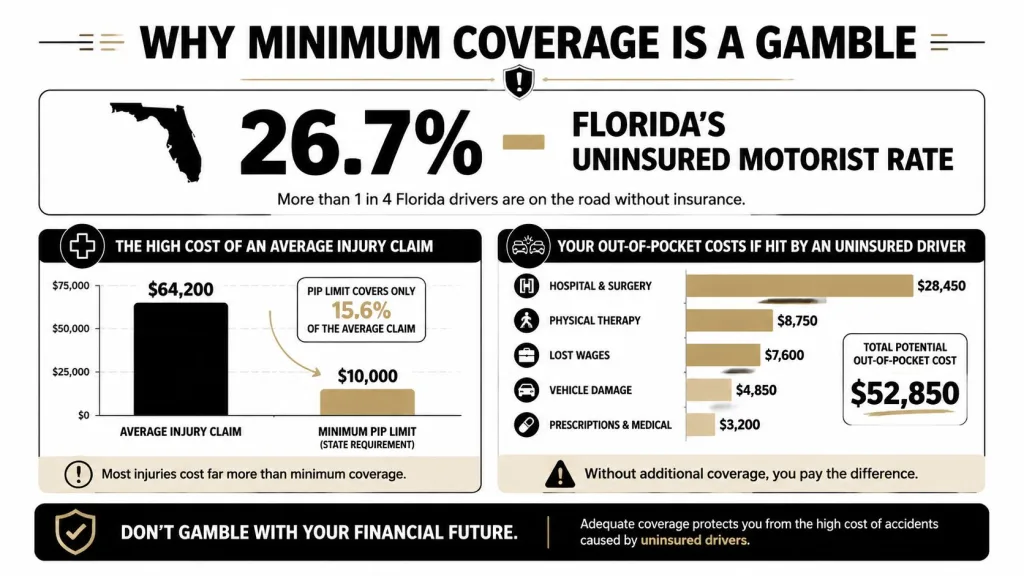
Buying only the minimum is legal. It’s still a gamble.
Florida’s uninsured-motorist exposure has been a problem for years, and a cited 2019 estimate put the state at 20.4%, which ranked Florida sixth highest in the nation at the time. That matters because the state’s standard registration minimums stay low while a large share of the driving population may not be carrying much coverage at all. Florida uninsured-motorist and coverage guidance
What happens when the other driver can’t pay
If an uninsured driver hits you, your first layer is whatever protection you already bought for yourself. If that protection is thin, you’re the one covering the gap.
That gap can show up as medical bills, repairs, lost time, and ugly conversations with collectors. It can also force a claim decision you didn’t want to make, because drivers who sit at the legal floor often have no cushion left after one real crash.
Bottom line: Minimum coverage protects your registration, not your balance sheet.
The smartest move is to use traffic school and defensive habits to keep your record clean, because violations can push your premiums up right when you need insurance to stay affordable. The internal guide on cheapest car insurance in Florida is useful if you’re trying to stretch your budget without dropping into a risky bare-minimum policy.
Why the minimum gets expensive fast
A low premium looks good until you compare it with the cost of being underinsured after a crash. Florida’s structure leaves less room for error than drivers think, especially if they treat PIP as if it were full liability protection.
I tell students to stop chasing the cheapest monthly bill and start chasing the cheapest clean driving record. Avoid the ticket, avoid the points, avoid the premium jump. A Basic Driver Improvement course is often the easier fix than paying more for years because you ignored one citation.
The 90-Day Rule for Snowbirds and New Residents
This is the rule that catches careful people off guard. If your car is in Florida for more than 90 days during a 365-day period, you need Florida PIP and PDL, even if your official paperwork still points somewhere else. The Florida Bar and the state CFO consumer toolkit both say that clearly. Florida Bar consumer guidance
Snowbirds get tripped up here
A lot of seasonal residents think they can “visit” Florida indefinitely as long as the car stays tagged elsewhere. That’s not a safe assumption.
If you split time between states, count the days carefully. If the car is here long enough to cross the threshold, Florida coverage becomes the problem you need to solve before registration or renewal turns into a headache.
Leased cars and moving timelines
Leased vehicles create their own mess because people assume the leasing company’s insurance language settles the issue. It doesn’t. If the car is being kept in Florida for more than 90 days in the 365-day period, Florida’s coverage rule still matters.
Practical rule: Don’t wait until renewal week to figure out where the car is “really” garaged.
For new residents, the cleanest move is simple. Switch coverage early, confirm the policy meets Florida’s registration rules, and document the change before you depend on your out-of-state insurer to save the day. If you’re sorting out a move or a title transfer, the registration guide at do I need insurance to register my car is the right place to double-check the sequence.
Why this section matters more in 2026 planning
Florida lawmakers advanced HB 1181 in 2025, and the Senate analysis says it would tie bodily injury financial responsibility to registration starting July 1, 2026, while raising the minimums in that lane. That’s a policy signal, not a current registration rule, but it tells you where the state may be heading. Florida Senate bill analysis for HB 1181
That’s why snowbirds and new residents should stop guessing and start counting days.
Penalties Points and SR-22 Requirements After Violations
A ticket doesn’t end when the officer drives away. It starts a chain reaction that hits your record, your rate, and sometimes your license status.
Here’s the sequence drivers need to respect: violation, points, premium spike, and then, in serious cases, compliance filings and suspension risk. The cleanest way to interrupt that chain is to handle the course option early, before the violation turns into a long-term insurance problem.
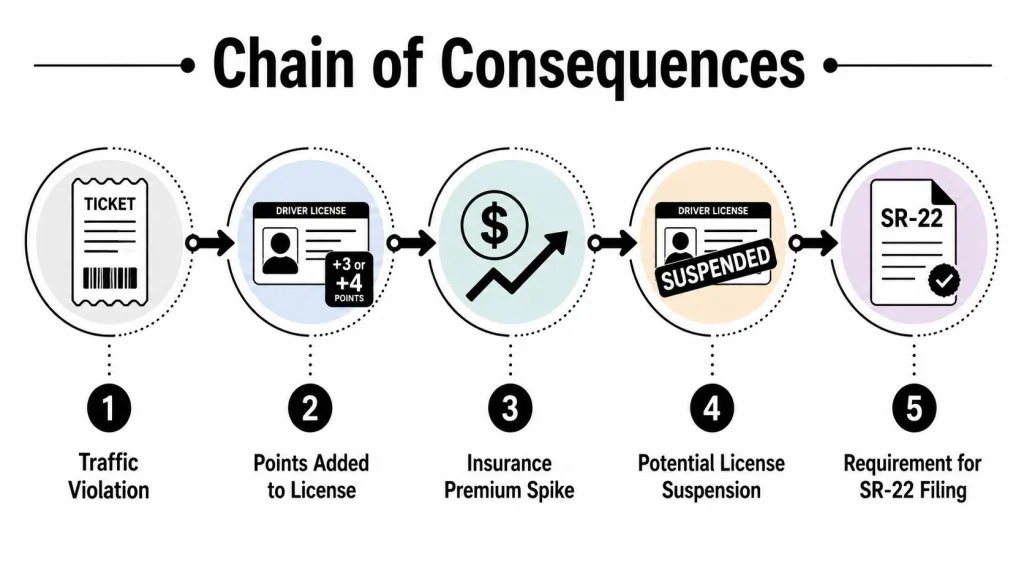
What happens after the stop
A moving violation can add points to your license. More points make insurers nervous, and nervous insurers charge more or renew less generously.
If the problem escalates, you can end up dealing with suspension and then the paperwork that comes with reinstatement. The internal guide on how to reinstate a suspended license in Florida is the practical next step when you’re already in that spot.
Where SR-22 fits
An SR-22 is a filing that proves you carry the required insurance after certain violations or reinstatement situations. It isn’t insurance itself, it’s proof to the state and the insurer that the coverage is in force.
Direct advice: If you’ve crossed into SR-22 territory, stop shopping for the cheapest shortcut and focus on staying continuously insured.
For a deeper look at dishonest claims and why insurers react harshly to them, David G. Moore on insurance fraud is a useful legal resource. Fraud and misrepresentation can make an already bad insurance problem much worse.
How traffic school breaks the cycle
A Basic Driver Improvement course can keep points off your record when you’re eligible, and that matters because points are often what trigger the premium climb. If you finish the course in time, you can sometimes preserve a cleaner record and avoid handing insurers an excuse to reprice your policy upward.
That’s why I tell drivers not to treat traffic school like a punishment. Treat it like damage control. It’s cheaper than living with the consequences of one bad citation for years.
Choosing the Right Traffic School Course for Your Situation
Don’t pick a course because it sounds familiar. Pick it because it fits the problem you have.
The 4-hour Basic Driver Improvement course is the standard move for a moving violation when you want to work toward point dismissal or limit the insurance fallout. The 8-hour Intermediate Driver Improvement course fits court-ordered situations that require more instruction. The Aggressive Driver Course is for drivers whose habits already crossed into repeated or reckless behavior, and the Mature Driver Course is for drivers 55 and older who are looking for insurance discount eligibility.
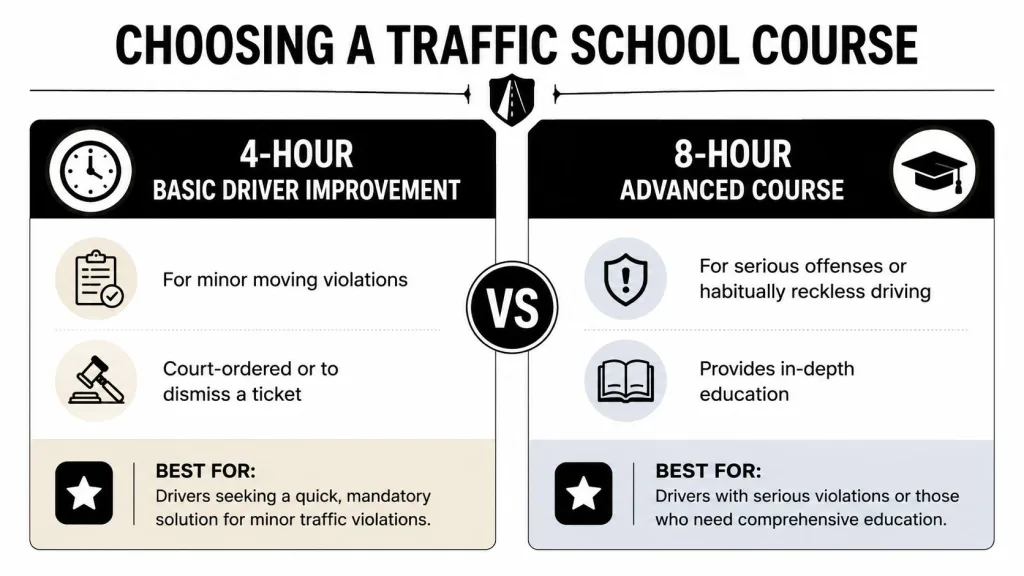
Match the course to the problem
| Course | Best For | Outcome |
|---|---|---|
| 4-Hour Basic Driver Improvement | Minor moving violations | Helps drivers handle point-related issues and reduce insurance headaches |
| 8-Hour Intermediate Driver Improvement | Court-ordered drivers | Provides deeper instruction for more serious requirements |
| Aggressive Driver Course | Habitual offenders | Focuses on behavior change and responsibility |
| Mature Driver Course | Drivers 55 and older | Supports insurance discount goals where eligible |
All of these are Florida-approved and available in English, Spanish, and Portuguese through BDISchool’s online platform. Certificates are reported electronically to the FLHSMV, which is what drivers want when they need documentation to move fast.
What I’d tell a student sitting in my office
If the ticket is minor, don’t overcomplicate it. Take the basic course, protect your record, and move on.
If a court ordered the course, follow the order exactly and finish the right program. If you’re 55 or older and your insurer accepts a mature-driver discount course, that’s a legitimate way to look for savings without cutting coverage.
Your Step-by-Step Action Plan for Florida Insurance Compliance
Start with your current policy, not the one you think you have. Confirm that it meets Florida’s registration minimums if the car is garaged here, and don’t assume an older out-of-state policy will pass the test.
Then check your driving situation. If you have a moving violation, choose the traffic school course that matches the citation or court requirement before the deadline closes. If your license is suspended or you’re close to that line, handle reinstatement paperwork before shopping for a cheaper policy that won’t satisfy the state.
Do this in order
- Verify the garage location. If the vehicle is in Florida for more than 90 days in a 365-day period, Florida coverage rules apply.
- Confirm your minimums. Standard registration means $10,000 PIP and $10,000 PDL for qualifying vehicles.
- Check for violation fallout. If you got a ticket, decide whether a course can keep points off your record.
- Enroll in the right course. Match the course to your situation, not to whatever is cheapest or fastest.
- Save your proof. Keep the completion certificate and insurance documents where you can produce them quickly.
If you want a single clean solution for the course piece, BDISchool offers Florida-approved driver improvement options that fit moving violations, court orders, and mature-driver discount needs. Use the process above, keep your coverage straight, and you’ll avoid the expensive mess that comes from guessing wrong.
Frequently Asked Questions About Florida Insurance Requirements
Do I need Florida insurance before I register my car?
Yes, if the vehicle is one of the standard registered vehicles covered by Florida’s rules, you need proof of the required PIP and PDL before registration goes through.
Does the 90-day rule apply to leased cars?
Yes. If the vehicle is kept in Florida for more than 90 days during a 365-day period, the rule still matters, even if the car is leased.
What happens to my coverage when I move out of state?
You should switch to the new state’s insurance rules as soon as the vehicle is no longer governed by Florida’s registration and garaging requirements. Don’t leave a Florida policy in place and assume it automatically fits somewhere else.
Does traffic school guarantee an insurance discount?
No. Completion can help with points and may support cleaner pricing, but a discount depends on the insurer and the course type.
If you need to clean up a ticket, protect your record, or line up the right Florida-approved course, go straight to BDISchool and enroll before the violation starts costing you more. Their online courses fit Florida drivers who want to stay legal, stay mobile, and stop one mistake from turning into a long-term premium problem.