You've just opened a Florida traffic citation, and the deadline is already running. You're trying to determine whether you need Basic Driver Improvement, Advanced Driver Improvement, a court-directed program, or a completely different course. Choosing incorrectly can waste time, leave a suspension unresolved, and create another compliance problem.
The practical answer is simple. Match the course to the legal reason you're taking it, confirm the deadline, and use a Florida-approved online provider that reports completion correctly. An advanced driver improvement course online can be the most convenient route, but convenience only helps when the course satisfies the exact requirement attached to your record.
Understanding Your Florida Traffic Citation and Compliance Options
A Florida citation usually requires a decision, not passive waiting. Read the ticket, identify the court or agency handling it, and check whether you've been given an option to elect a driver-improvement course. Florida's driver-improvement page says the election between Basic and Advanced Driver Improvement must be made within 30 days of receiving the citation (Florida Department of Highway Safety and Motor Vehicles course guidance).
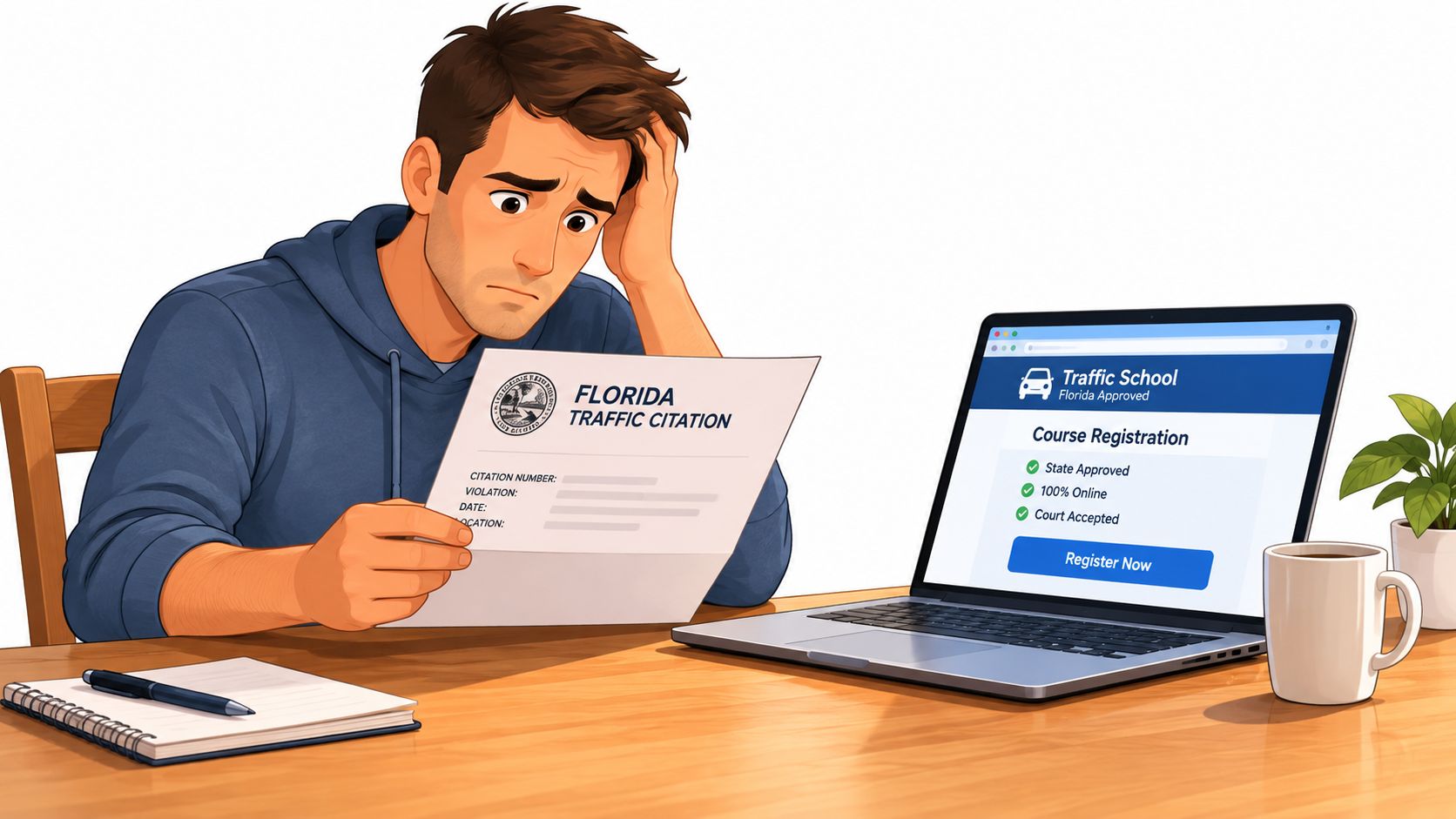
A warning and a moving violation aren't the same thing. A warning may not require a course, while an eligible moving violation can create point, court, or insurance consequences if you ignore the available compliance option. Don't assume that enrolling in a course automatically resolves the ticket. You may first need to notify the clerk of court or follow the instructions on the citation.
Start with the legal question
Ask three questions before you pay for any course:
- What caused the requirement? Is this a recent citation, a court order, a license suspension, or a reinstatement condition?
- What does the notice require? The wording on a suspension notice or court document controls your next step.
- Who receives proof of completion? Some matters involve electronic reporting, while others may require documentation sent to a court or licensing authority.
If you're considering contesting the citation instead of electing a course, review practical legal guidance such as Fiscella Law traffic ticket help. A lawyer can help you understand whether fighting the ticket is more appropriate than accepting a course option.
Practical rule: Don't register for Basic Driver Improvement simply because it appears first in a search result. A course that doesn't match the order or suspension requirement won't fix the underlying problem.
For a plain-language overview of Florida ticket options, use the Florida traffic ticket resource before you enroll. Then confirm the requirement with the relevant court or FLHSMV information for your specific situation.
What an Advanced Driver Improvement Course Actually Is in Florida
An Advanced Driver Improvement course is a structured Florida safety and compliance program for drivers facing more serious licensing or court-related requirements. It isn't just an extended version of a ticket-dismissal class, and it shouldn't be treated as a shortcut for removing every violation from a record.
The course addresses the decisions that create repeat risk. Typical subject areas include traffic-law knowledge, hazard recognition, defensive driving, crash avoidance, impaired-driving prevention, aggressive driving, distraction, following distance, right-of-way decisions, and the connection between attitude and behavior behind the wheel.
The online format follows an established model
Driver education in the United States has roots in the 1920s and 1930s. School districts began offering traffic-safety instruction around 1920, Amos Neyhart developed the first recognized driver-education curriculum at Penn State in 1934, and formal courses became widespread during the 1930s (driver-education history).
That history matters. Online traffic school isn't a loophole or an entirely new idea. It transfers a long-established education model into a digital setting, preserving instruction about traffic rules, hazard recognition, and supervised learning while removing the need to attend a physical classroom.
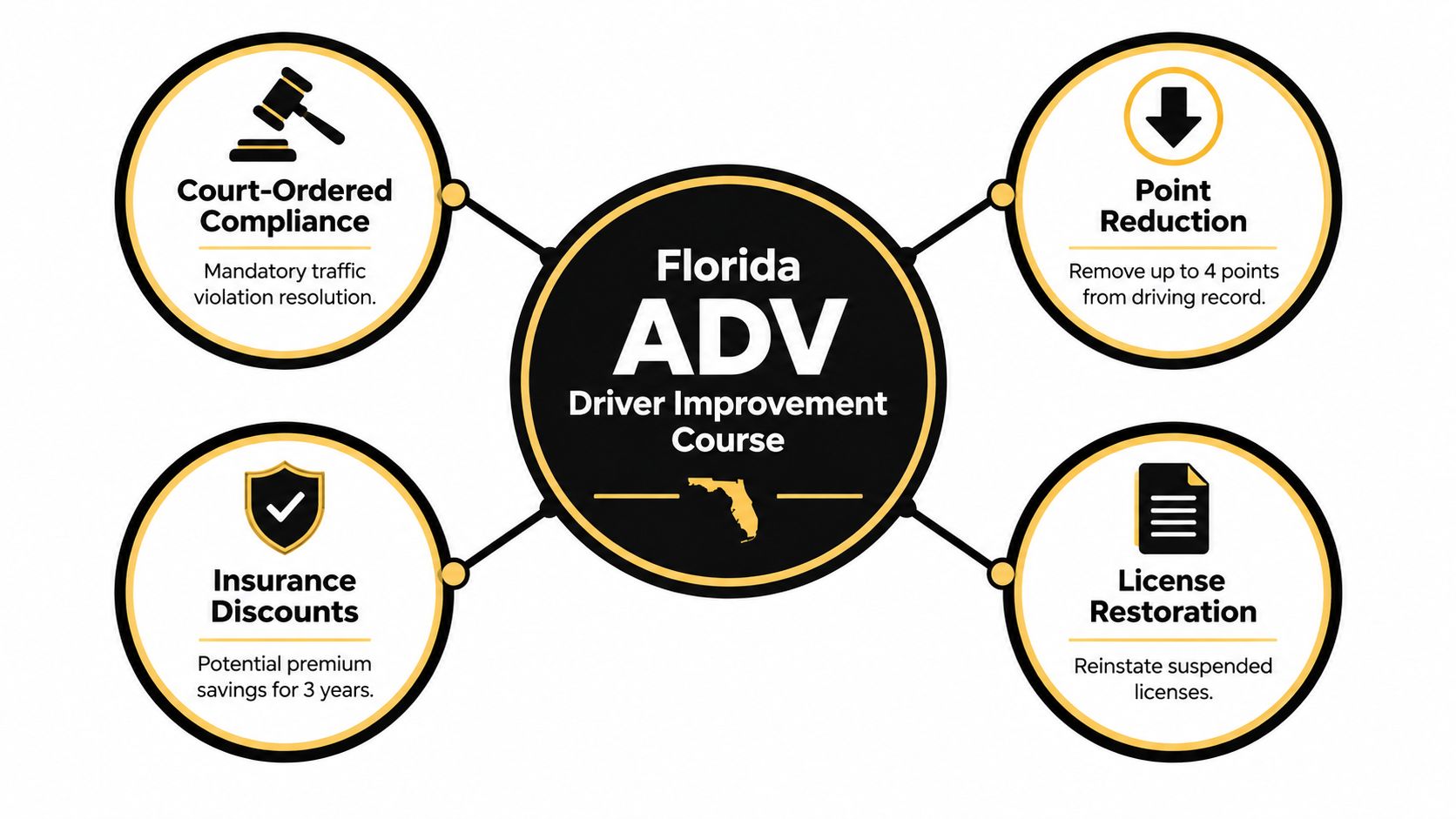
A properly designed online course should make you apply the rules to situations you encounter. That includes deciding who has the right of way, recognizing when speed is unsafe for conditions, leaving enough space to react, and identifying the moment when frustration is influencing your driving.
Compliance is part of the course experience
Florida treats approved driver-improvement education as a regulated process. FLHSMV says approved providers must report completions electronically, and postings typically appear within 24 to 72 hours (FLHSMV driver-improvement school requirements).
That means the provider must preserve more than lesson content. It must track your identity, progress, completion state, assessment result, and reporting handoff. If you need the course for reinstatement, confirm what additional documents the court or licensing authority expects after completion.
Basic versus Advanced Driver Improvement in Florida
The right course depends on what triggered the requirement. Basic Driver Improvement is generally associated with an eligible citation election. Advanced Driver Improvement is associated with a more serious court or licensing requirement. Read the citation, notice, or reinstatement instruction before you register.
Florida's BDI course is 4 hours and can be completed online. Florida law generally limits BDI use to once every 12 months and no more than five times in a lifetime, so do not assume you can elect it for every ticket (FLHSMV driver-improvement rules). An eligible election must be made within 30 days. Missing that deadline can remove the course option.
| Course Type | Typical Duration | Best For | Key Compliance Detail |
|---|---|---|---|
| Basic Driver Improvement | 4 hours | An eligible moving citation and ticket-related course election | Make the election within 30 days and follow the court's completion instructions |
| Advanced Driver Improvement | Follow the assigned course requirement | License reinstatement, suspension-related compliance, or a specific court order | Verify the mandate before enrolling, then complete every required step |
| Mature Driver Course | 6 hours | Drivers age 55 and older seeking a safety refresher and possible insurance consideration | Course acceptance and discount terms should be confirmed with the insurer |
| TLSAE | 4 hours | Certain first-time Florida license applicants | Required before applying in the circumstances defined by FLHSMV |
The Florida Basic Driver Improvement course fits a citation that specifically permits BDI. It does not replace an ADI requirement, suspension condition, or reinstatement order.
Choose by trigger, not by course length
Use BDI when the citation and court allow that election. Choose ADI when a suspension notice, reinstatement instruction, or court order requires advanced education. Review any monthly point-reporting limits and the exact reinstatement trigger before enrolling. If the paperwork is unclear, contact the clerk of court or FLHSMV first.
The mature driver course is separate. The Florida Safety Council describes it as a 6-hour course for drivers age 55 and older, commonly split into two 3-hour sessions or completed over two days (Florida mature driver course information). TLSAE is also separate. It applies to drivers over 18 who have never held, or do not possess, a license from another state, country, or jurisdiction, and it must be completed before applying for a Florida license (FLHSMV TLSAE requirements).
Why Completing a Florida-Approved Course Protects Your Record and Insurance
A traffic citation can create two problems at once. You must satisfy the legal requirement, and you must prevent the incident from creating avoidable driving and insurance consequences. Choosing the wrong course, missing Florida's strict 30-day election deadline, or failing to submit proof can leave the matter unresolved after you finish every lesson.
For an eligible BDI election, successful completion can let you use the course option attached to the citation instead of allowing the violation to affect your record through the usual process. Eligibility, timely election, court instructions, and Florida rules control the outcome. Monthly point-reporting limits and the exact reinstatement trigger also matter, especially when a suspension or reinstatement order is involved.
Your insurer decides whether a completed course qualifies for a discount and sets its own terms. Ask the insurer about eligibility, documentation, and timing before counting on savings. For details on eligible discounts, see our Florida safe-driving insurance discount resource.
Approval comes before convenience
Approval matters more than website design. Verify the provider is FLHSMV-approved for the specific course you need before enrolling, and confirm that it can report completion through the Florida process. Electronic reporting and timely posting support compliance, so ask how the provider handles both steps.
A useful course should require active attention. Strong lessons connect traffic law with practical decisions:
- Scanning ahead: Identify developing hazards before they require emergency maneuvers.
- Managing space: Keep a usable safety margin rather than relying on perfect reactions.
- Controlling emotion: Delay or disengage when anger begins influencing the decision.
- Avoiding impairment: Recognize how alcohol, drugs, fatigue, and distraction reduce judgment.
The evidence on driver-improvement programs is mixed. A review of 59 evaluations found that 6 programs, or 10.2%, produced significant effects on both violations and crashes. The authors also found that reductions in violations alone were weak predictors of crash reduction (driver-improvement program evaluation). A separate National Safety Council evaluation of Defensive Driving Course graduates reported significant reductions in accidents and violations during the following year. Course design, learner population, and measurement method affect those results.
Treat the course as training, not a checkbox
State approval supports compliance. Your attention determines whether the material changes your driving. Read each lesson carefully, understand the scenarios, pass the assessment, and apply the decisions after completion.
Choose a program with clear explanations, practical visuals, and access in English, Spanish, or Portuguese when those features help you understand Florida rules. Registration convenience matters, but accurate completion, proper reporting, and timely follow-through protect your record.
How to Enroll in an Advanced Driver Improvement Course Online in Florida
Start with the notice, not the advertisement. Read the citation, suspension letter, or court order and identify the exact course name, completion deadline, reporting instructions, and agency that must receive proof.
Follow the enrollment sequence
- Confirm the requirement. Verify whether you need ADI, BDI, or another program. If a suspension is involved, ask the licensing authority or court what else must happen after the course.
- Check provider approval. Use an approved provider that offers the specific course named in your notice. Don't rely on a general claim that a website is “Florida traffic school.”
- Create your account carefully. Enter your legal name and identifying information exactly as required for state reporting. Errors can delay matching or certificate processing.
- Select the correct course. Check the course title, purpose, language, device access, exam requirements, and completion process before payment.
- Study in tracked sessions. Online access lets you start and resume from a device, but you still need to complete every required lesson and assessment.
- Finish the final requirement. Passing an exam may be necessary, but it isn't the whole process if your order also requires a certificate submission, assessment, or additional training.
Use the online traffic school registration guide if you need help setting up the enrollment process. Keep your confirmation, completion record, and any certificate details until the court or FLHSMV confirms that the requirement is closed.
The state says course completions typically post within 24 to 72 hours, but don't use that window as an excuse to wait until your deadline. A reporting delay, identity mismatch, or missing court submission can create a preventable problem.
The online workflow is designed to remove classroom travel, not to remove responsibility. Before you begin, write down the deadline and the agency that must receive the result.
Real Florida Driving Scenarios Where the Right Course Makes a Difference
A driver receives a moving citation and sees that BDI is available. The correct move is to elect the course with the court within the required 30-day window, complete the approved program, and follow the certificate instructions. Registering for ADI instead would not solve the citation just because ADI sounds more serious.
Another driver receives a suspension notice. That driver shouldn't choose BDI to save time. The notice may require Advanced Driver Improvement as part of reinstatement, and the driver may also need to observe a 24-hour break after six hours, finish within 90 days, or complete behind-the-wheel training and a driving assessment in certain crash-related situations (Florida ADI reinstatement guidance).
The right course is the one named by the legal requirement, not the one with the shortest registration page.
A third driver wants a mature-driver refresher and plans to ask an insurer about a discount. That person should select the approved mature-driver program, complete it as required, and obtain the insurer's terms before assuming the premium will change.
Online education is already a mainstream Florida compliance channel. One provider's reported completions were 112,000 in 2021, 132,000 in 2022, 132,000 in 2023, and 121,000 in 2024, while another summary reported 576,500 BDI and TLSAE completions across the leading provider group from 2020 through 2024 (Florida approved-provider completion rankings). Those figures show that drivers routinely use web-based courses for ticket, licensing, and insurance-related needs.
Get Started with a State-Approved Advanced Driver Improvement Course Today
The fastest safe decision is to identify the trigger first. A citation, a suspension, a reinstatement order, and an insurance request can point to different courses. Don't let a familiar term such as “traffic school” hide the distinction.
Your action list is short:
- Read the notice today: Find the course name and every deadline.
- Confirm your election: If BDI is permitted, make the election within the 30-day Florida window.
- Verify the provider: Check approval for the exact course, not just the general website.
- Complete the full program: Finish tracked lessons and any required exam or assessment.
- Confirm reporting: Allow the normal reporting process, then verify that the court or licensing authority has what it needs.
- Handle reinstatement separately: Course completion may be only one step after a suspension. Follow every additional instruction in the notice.
An online advanced driver improvement course gives you flexible access, but it doesn't change the legal purpose of the course. ADI is for the requirement that calls for ADI. BDI is for an eligible citation election. Selecting correctly protects your time and gives you a realistic path to closing the matter.
The best course also changes how you approach the road. Review the lessons on space management, distraction, impairment, aggressive driving, and hazard recognition as practical driving tools, not material to forget after the certificate arrives.
BDISchool offers Florida-approved online driver-improvement courses, including an Advanced Driver Improvement option for qualifying suspension and reinstatement requirements. Visit BDISchool to confirm the course that matches your notice, register online, and start working toward compliance from your own device.