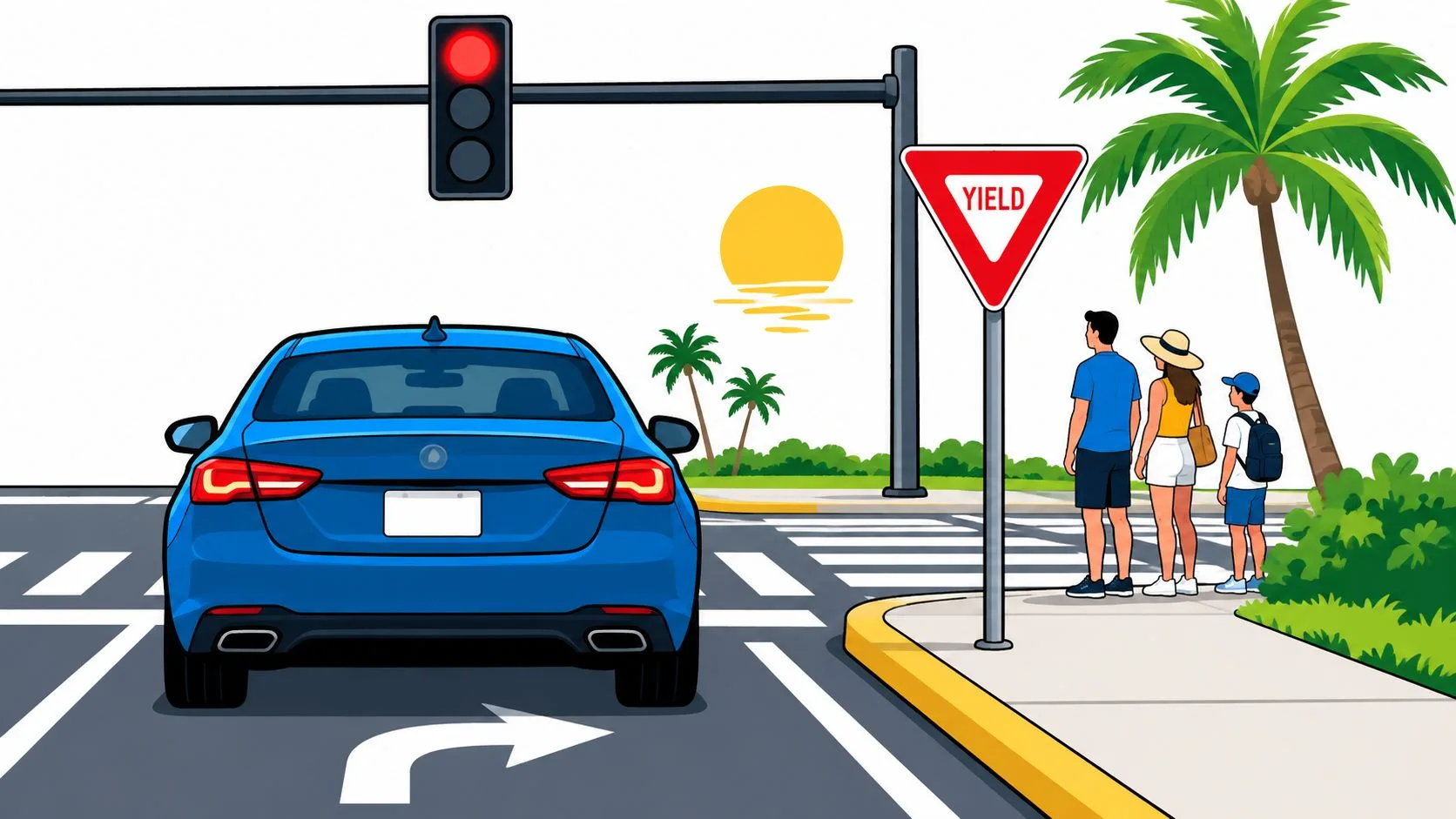
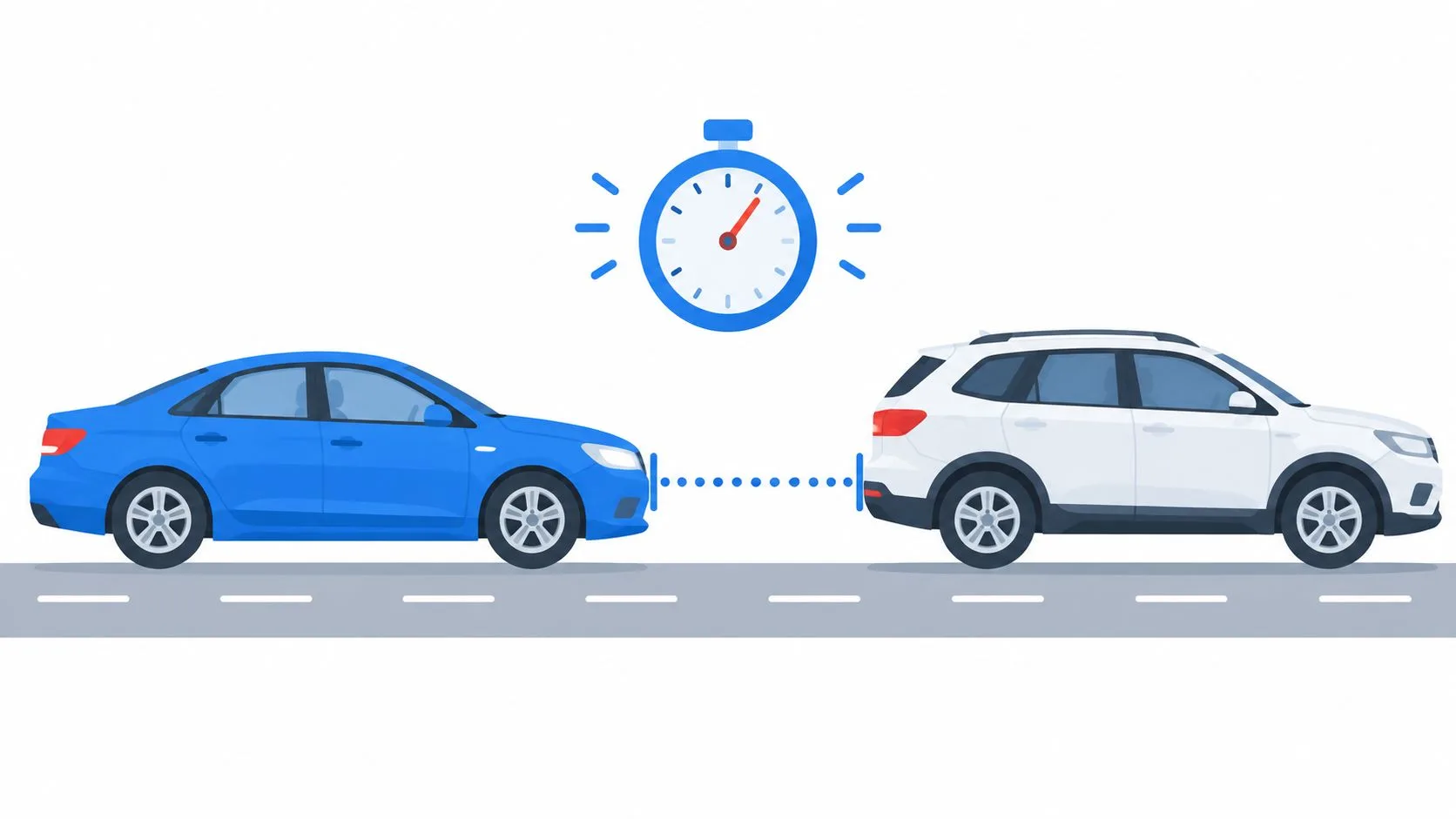
A yield sign means drivers must slow down and be prepared to stop so that other traffic with the right-of-way can pass first. If the way is clear, you can keep moving, but only after you’ve checked that no one else needs to go first.
That small decision point matters more than many drivers realize. The moment you roll up to a yield sign, you’re not just reading a sign, you’re judging a conflict, protecting your license, and helping traffic move smoothly without forcing anyone else to brake hard.
What a Yield Sign Really Asks You to Do
You’re approaching an intersection and you see that red-and-white triangle ahead. You hesitate for a second, because you know it matters, but you also don’t want to stop if you don’t have to. That hesitation is normal, and the rule is simple, slow down, look for traffic that has the right-of-way, and be ready to stop if needed.
A yield sign is a regulatory sign, so it carries a real driving obligation, not just a suggestion. The core idea is that you give priority to other road users first, then enter only when it’s safe. That’s why learning the yield sign meaning is more than test prep, it’s a basic skill for protecting yourself and everyone around you.
Drivers often confuse “yield” with “slow down a little.” That’s incomplete. The sign asks you to make a judgment call at the merge point or intersection, not to coast through on guesswork. If you want a clear right-of-way refresher, this guide on right-of-way rules at intersections connects the rule to real driving situations.
Practical rule: If you’re unsure who goes first, assume you need to wait until the conflict is gone.
That mindset helps with safety and with the legal side of driving too. A bad decision at a yield sign can trigger a citation, raise stress behind the wheel, and create the kind of record that follows you long after the moment passes.
Decoding the Yield Sign’s Shape and Command
Why the shape stands out so fast
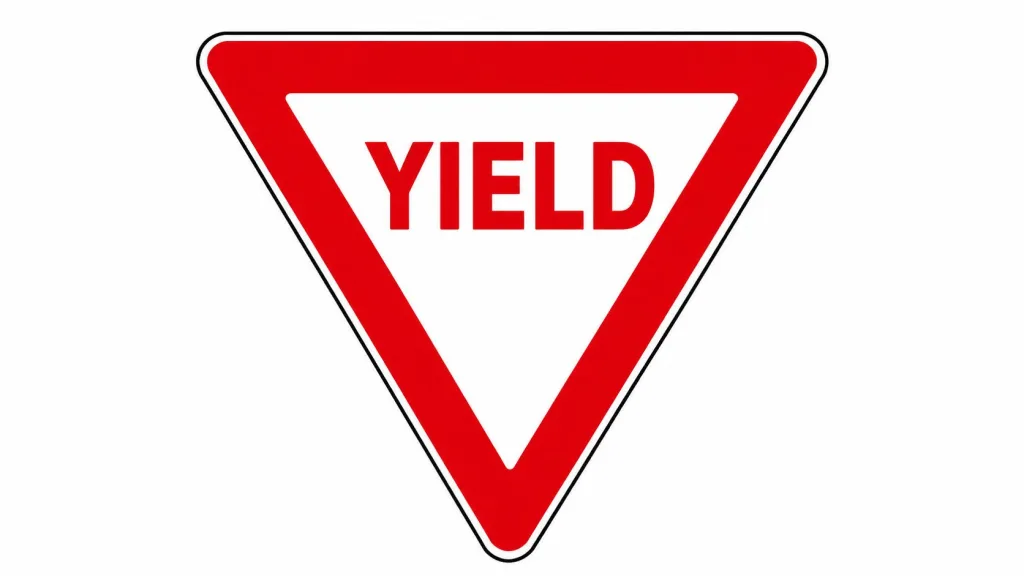
The modern yield sign began in the United States in 1950, when the first one was installed at First Street and Columbia Avenue in Tulsa, Oklahoma, and police officer Clinton Riggs designed it to reduce right-of-way conflicts at a dangerous intersection. Early versions used a keystone or trapezoidal shape with a yellow background, before later revisions moved toward the triangular form drivers recognize today. The historical background on the yield sign shows how quickly a practical traffic fix became a standard safety tool.
That shape is doing real work. The MUTCD describes the yield sign as a downward-pointing equilateral triangle with a red border and white background, which makes it easy to recognize under driving conditions. Canadian guidance also treats the triangular design as standard, noting larger versions are used where visibility needs are greater. The Alberta yield-sign guidance reinforces the idea that size and placement affect how quickly drivers can react.
The command behind the color
The sign’s message is not “slow down and hope.” It’s slow down, scan, and be prepared to stop if necessary. That means you’re checking for vehicles, pedestrians, and cyclists before you enter the conflict zone. The key is not speed alone, it’s whether a safe gap exists.
Yielding is conditional. If a safe gap appears, you may proceed. If it doesn’t, you wait.
That distinction is why yield signs work well at merge points and roundabouts, where traffic flow depends on drivers making quick but careful decisions. A yield sign’s meaning is tied to movement, not automatic stopping, and that’s exactly why good driver training matters.
If you want a simple way to build that habit, the traffic-sign lesson on common traffic signs and meanings gives you a broader framework for reading the road faster and more accurately.
Yield Sign Versus Stop Sign Explained
A yield sign and a stop sign both control right-of-way, but they don’t ask you to do the same thing. The easiest way to remember it is this, a stop sign gives a mandatory command, while a yield sign gives a conditional command.
A yield sign does not require a full stop. Drivers may continue through an intersection without stopping if it’s safe, but they must give priority to other road users first, including pedestrians and cyclists. That distinction is made clearly in driving test guidance.
| Requirement | Yield Sign | Stop Sign |
|---|---|---|
| Requirement | Slow down and give way if traffic conflicts exist | Come to a complete stop every time |
| Yield Sign | Stop only if needed to avoid interfering with others | Full stop is required before proceeding |
| Stop Sign | Driver decides based on traffic conditions | Driver must always stop, even if the road looks empty |
| Common Use | Merge areas, roundabouts, low-conflict intersections | Intersections where full control is needed |
The table matters, as many drivers encounter difficulties here. They either stop too aggressively at a yield sign and slow traffic for no reason, or they roll through when someone else clearly has priority.
The mental check is easy, too. At a yield sign, ask yourself whether entering now would force another driver, cyclist, or pedestrian to adjust. If the answer is yes, you wait. If the answer is no, you proceed smoothly and predictably.
That judgment is what makes yielding a driving skill instead of a memorized rule. Good drivers don’t just know what the sign looks like, they know how to read the traffic around it.
Mastering Real-World Yielding Scenarios
At intersections and merges
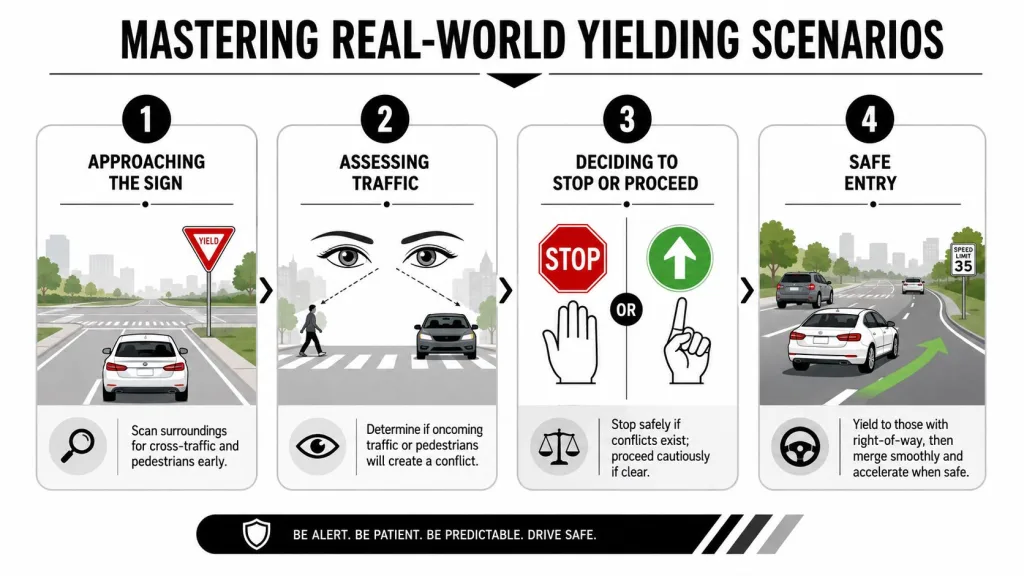
At a regular intersection, start by reducing speed early enough that you can make a calm decision. Then check the traffic flow from the main road, because the driver on the yield-controlled approach does not have priority. If the lane is clear, move through without hesitation, since hesitation can confuse the drivers who are already moving.
The MUTCD says a yield sign assigns priority to conflicting traffic, and the driver’s choice depends on finding a safe gap before entering the conflict zone. That’s what makes it especially useful in roundabouts and narrow approaches. The MUTCD guidance on yield control frames yielding as a traffic-decision process, not a fixed stopping ritual.
In roundabouts and pedestrian areas
Roundabouts are where yield habits matter most. Entering vehicles must yield to circulating traffic, so your first job is to watch the lane already moving through the circle. If there’s no safe gap, you wait. If the opening is clear, you enter without forcing anyone to brake.
Pedestrians always deserve attention at the curb and crosswalk. Florida drivers also need to stay alert around marked and unmarked crossings, because a “clear lane” for cars doesn’t mean it’s clear for people on foot. The safest habit is simple, slow earlier, look farther, and don’t assume someone saw you.
A quick road habit that helps every time
- Approach early: Lift off the accelerator before the sign, not after it.
- Scan left, right, and ahead: Look for moving traffic, cyclists, and anyone stepping into the crossing.
- Judge the gap: If you’d make another road user brake or swerve, you don’t have the gap yet.
- Enter smoothly: When it’s safe, merge with purpose, not drift.
Practical rule: A clean yield keeps traffic moving. A rushed yield creates surprise, and surprise creates risk.
If you want to connect this to turn behavior as well, the guide on left-turn yield on green is a useful companion lesson for understanding when you must wait, and when you can move.
The High Cost of Ignoring a Yield Sign in Florida
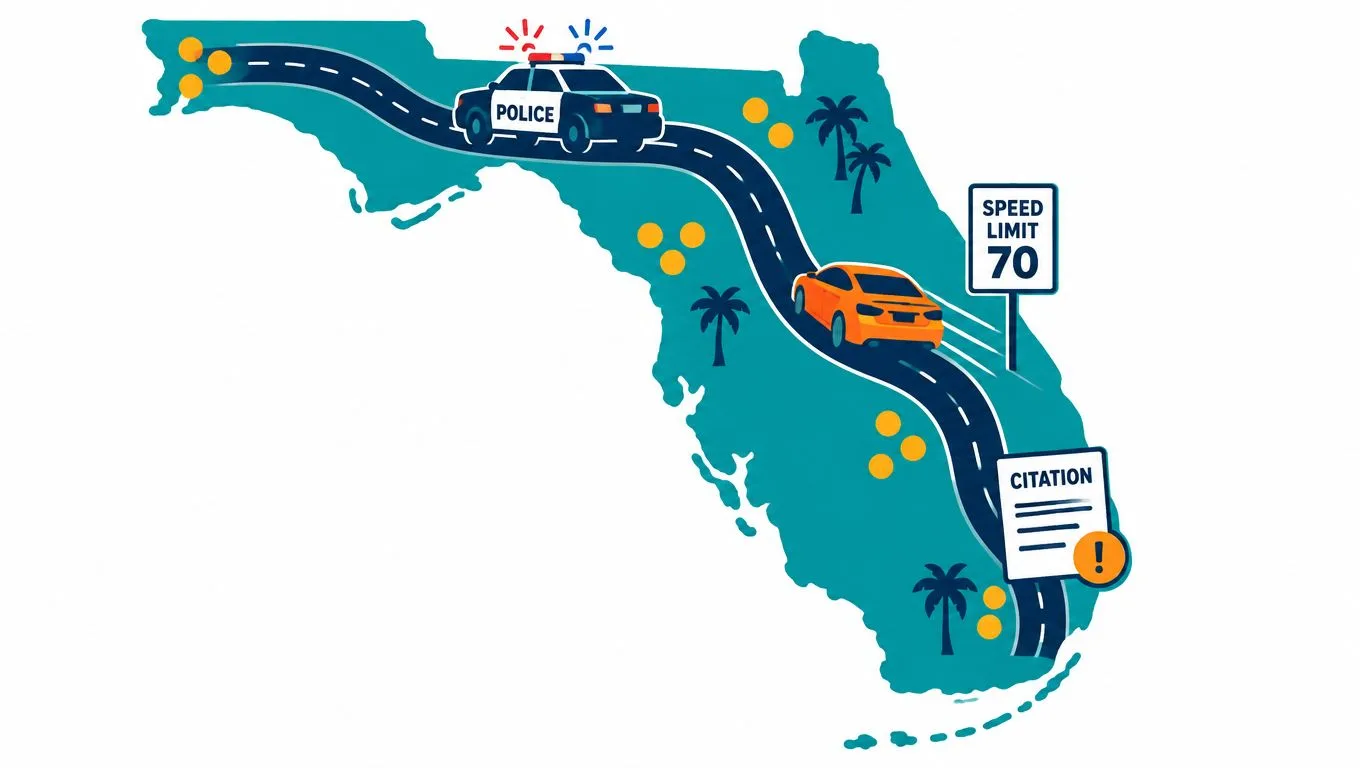
A failure-to-yield mistake isn’t just a bad habit, it can become a traffic ticket with real consequences. In Florida, the immediate issue is the citation itself, and the longer-term issue is what that ticket can do to your driving record and insurance costs. The point system matters because points can accumulate and create bigger problems than the original moment at the intersection. For a clear explanation of how points are handled, see the Florida traffic ticket point system.
That’s where a 4-hour Basic Driver Improvement course can help qualified drivers. BDISchool offers a Florida-approved online option for drivers who want to respond to a moving violation in a smarter way, and it fits neatly into the reality of busy schedules. In plain terms, the course is designed to help drivers understand the rule they missed, avoid repeating the mistake, and protect their record when they’re eligible.

Insurance is another reason drivers take yielding seriously. A record with avoidable violations can make you look like a higher-risk driver, and that’s exactly why clean, predictable driving habits matter. If you want to lower the chance of costly mistakes, learning how to yield properly is one of the easiest ways to start.
The better strategy is to treat every yield sign like a decision point, not a decoration. That keeps you safer, keeps traffic calmer, and helps you avoid the kind of citation that can follow you into future renewals, court deadlines, and course requirements.
Frequently Asked Questions About Yielding
What should I do if another driver waves me through
Don’t hand your decision to them. A wave is not the same as legal right-of-way, so only move if the traffic situation is clear.
How do I handle a four-way intersection where one approach has a yield sign
The driver facing the yield sign waits for a safe opening. Everyone else continues according to the normal right-of-way rules, because the yield sign assigns priority away from the yielding driver.
Do I always have to stop at a yield sign
No. The practical rule is to slow down, scan for conflicting traffic, and be prepared to stop if needed. That differs from a stop sign, which requires a complete stop regardless of whether traffic is present. The basic distinction is explained clearly in driver guidance.
How should I yield to emergency vehicles
Give them space immediately and don’t block their path. If the safest move is to stop, stop. If you can move over safely without creating another hazard, do that quickly and predictably.
What if I’m still unsure who has priority
Wait. A brief pause is safer than guessing, and a patient driver is usually a better driver at the exact moment judgment matters most.
If you want to turn this rule into a habit, enroll in a Florida driver course that covers right-of-way, road signs, and point prevention in plain language. BDISchool offers online traffic school options that help you understand the road better and make smarter choices the next time you approach a yield sign.