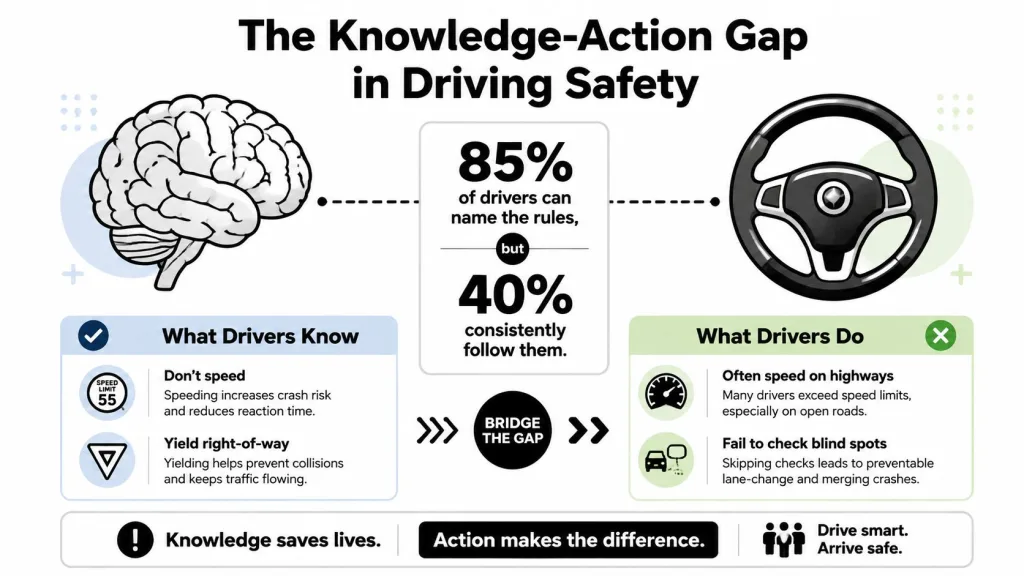
87% of drivers say they did at least one risky thing behind the wheel in the previous month, even though they knew it was dangerous, according to AAA Foundation research (AAA Foundation unsafe driving behavior report). That’s the starting point for safe driving habits a state of mind. Most crashes don’t begin with a lack of knowledge, they begin with a moment when a driver lets attention, fatigue, speed, or impulse take over.
That’s why good drivers aren’t just rule followers. They’re people who build a mental habit of checking themselves before the car ever moves. When that habit is strong, safety stops being a lecture and starts becoming a reflex.
Why Safe Driving Is More Than Following Rules
A driver can know every rule and still make the wrong choice when the day gets messy. Traffic, impatience, fatigue, and a ringing phone all compete for attention at the same time. AAA Foundation research shows how common that split happens, because 87% of drivers admitted to at least one risky behavior in the prior month, including distraction, speeding, drowsy driving, running red lights, or not wearing a seat belt, and 70% said they talked on a cell phone while driving (AAA Foundation unsafe driving behavior report).
Knowledge only helps if it holds up under pressure
A safe driver does more than recite the rules. They have to keep those rules in place when traffic is heavy, someone is honking behind them, or their own mood is already frayed. The question is whether the lesson survives the moment, not whether the driver has heard it before.
The same AAA research found that 42% admitted reading a text or email, 32% admitted typing or sending one, and nearly 1 in 3 drivers (32%) had driven so tired they had trouble keeping their eyes open (AAA Foundation unsafe driving behavior report). Those behaviors show why safety comes down to judgment, not just skill. A driver who treats each trip like a fresh decision, instead of something automatic, is already building safer habits.
Practical rule: if a habit only works when life is calm, it is not a real habit yet.
That is also why distraction laws and phone use deserve a closer look in Florida. The PTL Insurance Associates guide to Florida distracted driving explains how quickly an ordinary drive can turn risky when attention splits. For drivers who want help keeping calm when stress starts to rise, how to stay calm while driving is a useful place to start.
The Cognitive and Emotional Factors Behind the Wheel
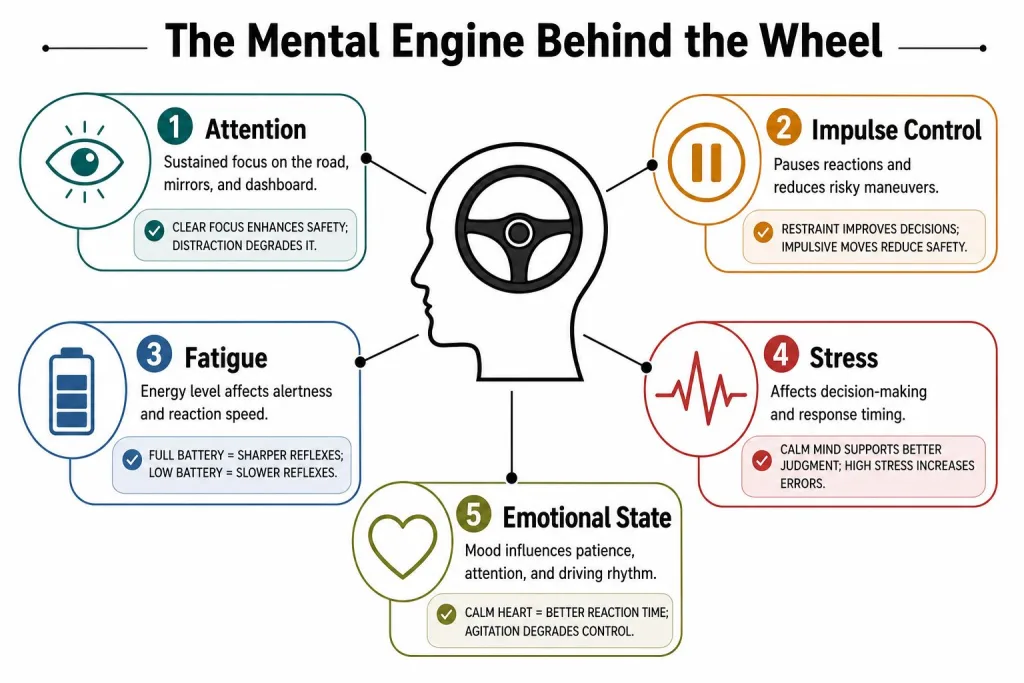
A driver can know the rules and still struggle to follow them when the mind is crowded. Driving asks for attention, impulse control, and emotional steadiness at the same time. When fatigue, stress, or frustration enter the car, even small lapses can start to stack up.
Attention has a narrow lane
Attention works like a spotlight. If it stays on the road, mirrors, and signals, the driver has a better chance of seeing trouble early. If it drifts toward a text, an internal argument, or a stressful thought, hazards can slip out of view.
That is why distraction matters even when the phone never leaves your hand. The National Safety Council advises drivers to avoid cell-phone distracted driving, including hands-free calls, because attention still gets pulled away from the driving task (National Safety Council guidance on distracted driving). A driver who is mostly present is still divided.
Fatigue and stress change judgment
Sleepiness is not a small inconvenience. Federal fatigue guidance says that if a driver becomes sleepy, the right response is to stop and sleep, rather than rely on coffee, open windows, singing, or phone use (FHWA fatigue guidance). That advice is simple because the risk is simple. A tired brain reacts more slowly and chooses less carefully.
Stress changes driving in a different way. A tense driver often grips the wheel harder, reacts sooner, and leaves less room for patient judgment. If you want a calmer start before you pull out, the guide on how to stay calm while driving offers a practical place to begin.
A calm driver remains engaged and alert.
For drivers who are curious about why some people look for extra help on demanding days, the 2026 focus supplement pair is one example people read about. The larger lesson is simpler than the supplement conversation. Focus has to be managed, especially when the day has already taken a lot out of you.
How Your Mental State Shows Up in Your Driving
A driver’s mental state often shows up before anyone says a word. The wheel twitches. Speed rises and falls. The car sits a little left, then a little right. Those are not just bad habits, they are signs that the driver’s attention is stretched thin.
Smooth control usually means a steadier mind
Research on driver-state prediction found that the most informative operational features were steering entropy, lane-position variability, and variability in speed and steering input, and those signals often outperformed physiological measures for detecting distraction and drowsiness (driver-state prediction review). In plain language, the vehicle gives away what the driver is carrying mentally. When hands and feet keep making sharp corrections, the brain is usually working harder than it should just to stay organized.
That is why a safe driving mindset is easy to spot once you know what to look for. Steady lane centering, smoother braking, and fewer last-second moves usually come from a calmer, more settled driver. A rushed or reactive style is a warning sign, even if the car is still moving in the right direction.
A separate naturalistic comparison from NHTSA found that unsafe drivers had more hard deceleration, acceleration, and swerve maneuvers during baseline driving, along with more frequent improper braking, inattention, and proximity-to-vehicle violations (NHTSA naturalistic driving comparison). The same study also found about a 10% lower seat-belt compliance among unsafe drivers than safe drivers. Risk usually does not arrive as one dramatic mistake. It shows up as several small ones stacking together.
What to watch in yourself
A simple self-check can tell you a lot before you decide to keep driving.
- Jerky steering: You are correcting too much, too often.
- Speed swings: You are rushing, then drifting, without noticing.
- Crowded following distance: You are leaving too little room to breathe.
- Late braking: You are reacting after the situation has already tightened.
- Mental chatter: Your thoughts are on everything except the next safe move.
If road rage is one of the patterns you have seen in yourself or someone close to you, the guidance in how to handle road rage is a practical place to reset expectations.
When Safe Habits Break Down Under Pressure
Pressure is where safe driving habits show their real shape. A driver may know exactly what to do, but when they are late, tired, or upset, the body often follows the strongest feeling in the moment. That is why knowing the right thing and doing it can feel like two different skills.
A rushed driver gives up space first. They shorten the gap ahead, glance less often at mirrors, and tell themselves the next few minutes are the only ones that matter. The problem is that pressure rewards shortcuts, and the shortcut usually feels harmless right up until it does not.
Aggression works the same way. One rude merge, one tailgater, one horn blast, and the whole drive can stop being about getting there safely. If road rage is a pattern you have seen in yourself or someone close to you, the guidance in How to Handle Road Rage offers a practical way to reset expectations.
Pressure points deserve a plan
Every driver has weak spots. Some people get thrown off by a stream of notifications. Others drive poorly after work because they are tired, or after an argument because their mind keeps replaying it. Those moments are like loose screws in a door hinge, easy to ignore until the door starts sticking.
Safe behavior under pressure is usually decided before the pressure shows up.
- If you are late: leave earlier next time, and if you are already behind, slow your schedule instead of speeding up the car.
- If you are angry: wait a few minutes, breathe, and reset before starting the engine.
- If you are tired: do not bargain with sleepiness, stop driving.
- If you are on an unfamiliar route: check directions before departure, not while moving.
Sometimes the safest choice is to delay the trip. Federal fatigue guidance makes the point plainly, sleepiness calls for stopping and sleeping, not trying to patch the problem with caffeine or noise. That is disciplined.
A driver who has just come through a stressful crash or close call may also need support beyond a checklist. In some cases, post-accident therapy in Vernon can help a person regain steadier thinking before getting back into a normal driving routine.
Building Habits That Actually Stick
Good habits become automatic because the driver keeps rehearsing them in ordinary moments. That’s how safe behavior survives a stressful day. It doesn’t need perfect conditions, it needs repetition with a purpose.
Make the car harder to misuse
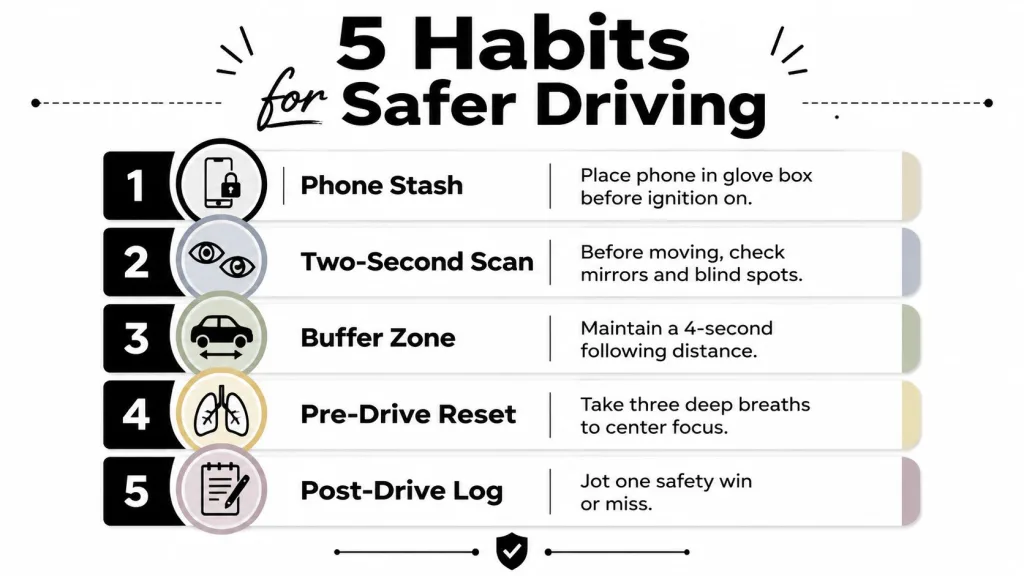
Start with the environment. Put the phone out of reach before you start moving, because willpower gets weaker when the road gets busy. Set your route before leaving, not while rolling.
A simple pre-drive reset helps too. Two slow breaths can create enough mental space to stop a rushed decision from becoming the first decision you make. That tiny pause is often what separates a calm departure from a scattered one.
For drivers who want to turn the mental side of driving into a repeatable routine, How to Become a Better Driver is a useful internal resource. It pairs well with the daily habits here because it treats driving as a practiced skill, not a personality trait.
Use spacing as a habit, not a guess
A practical following-distance rule is the 3-second gap. Keep at least three seconds between your vehicle and the one ahead, and increase that gap in poor weather to preserve reaction time and control (safe following-distance guidance). That buffer is what gives your brain a chance to react without panic.
If you want a structure you can remember, think in this order:
- Stash the phone.
- Check mirrors and blind spots.
- Set your following distance.
- Breathe before moving.
- Review one mistake after the drive.
That last step matters more than people think. Drivers improve faster when they notice their own patterns, because the next trip starts with better awareness than the one before it.
Best habit test: if you can only do it on a perfect day, it’s not a habit yet.
The video below reinforces the same practical approach to safer driving choices.
For drivers dealing with the emotional fallout after a crash or a serious scare, post-accident therapy in Vernon may be a helpful resource to consider alongside skill-building. Recovery and better driving often go hand in hand.
Florida Traffic School Options for Every Situation
Florida drivers usually need different courses for different problems, and that’s a good thing. The right program depends on whether you’re dealing with a moving violation, a court order, a pattern of aggressive driving, or a mature-driver refresher.
| Course Name | Duration | Best For | Key Benefits |
|---|---|---|---|
| Basic Driver Improvement (BDI) | 4 hours | Drivers with a moving violation | Helps with point dismissal and may help avoid insurance increases |
| Intermediate Driver Improvement (IDI) | 8 hours | Court-ordered drivers or drivers needing a deeper safety reset | Supports court compliance and stronger defensive-driving habits |
| Aggressive Driver Course | 8 hours | Habitual offenders and drivers dealing with road-rage behavior | Focuses on responsibility and behavior change |
| Mature Driver Course | 6 hours | Drivers aged 55+ | Supports safety awareness and may help preserve insurance discounts |
The course choice should match the problem, not the ego. A person with a single citation needs a different path than someone whose driving habits have become aggressive or careless over time.
Florida-approved options are available through Florida traffic school information, and the course format is designed to reinforce safer judgment, not just satisfy paperwork. That matters because the strongest driver education doesn’t stop at compliance. It helps drivers rebuild the mental habits that keep bad choices from becoming road habits.
For a broader view of available programs, BDISchool offers Florida traffic school and defensive driver courses through its online course catalog. DriverEducators.com also provides course options for drivers who need a structured refresher or a compliance-focused path.
Your Path to Becoming a Safer Driver Starts Now
Safe driving is not a personality type, and it isn’t a one-time lesson. It’s a daily choice to stay calm, stay aware, and leave room for error before the road demands it from you.
Use a quick self-check before every drive. Am I tired, irritated, distracted, or rushing? If the answer is yes, adjust the plan before the car moves. If you need a formal course to reset your habits, choose the one that matches your situation and commit to finishing it.
If you’re ready to turn safer driving into a real habit, BDISchool offers Florida-approved courses that fit different driving needs, from moving violations to mature-driver refreshers. Visit BDISchool to review the available options and start building the kind of driving mindset that holds up under pressure.