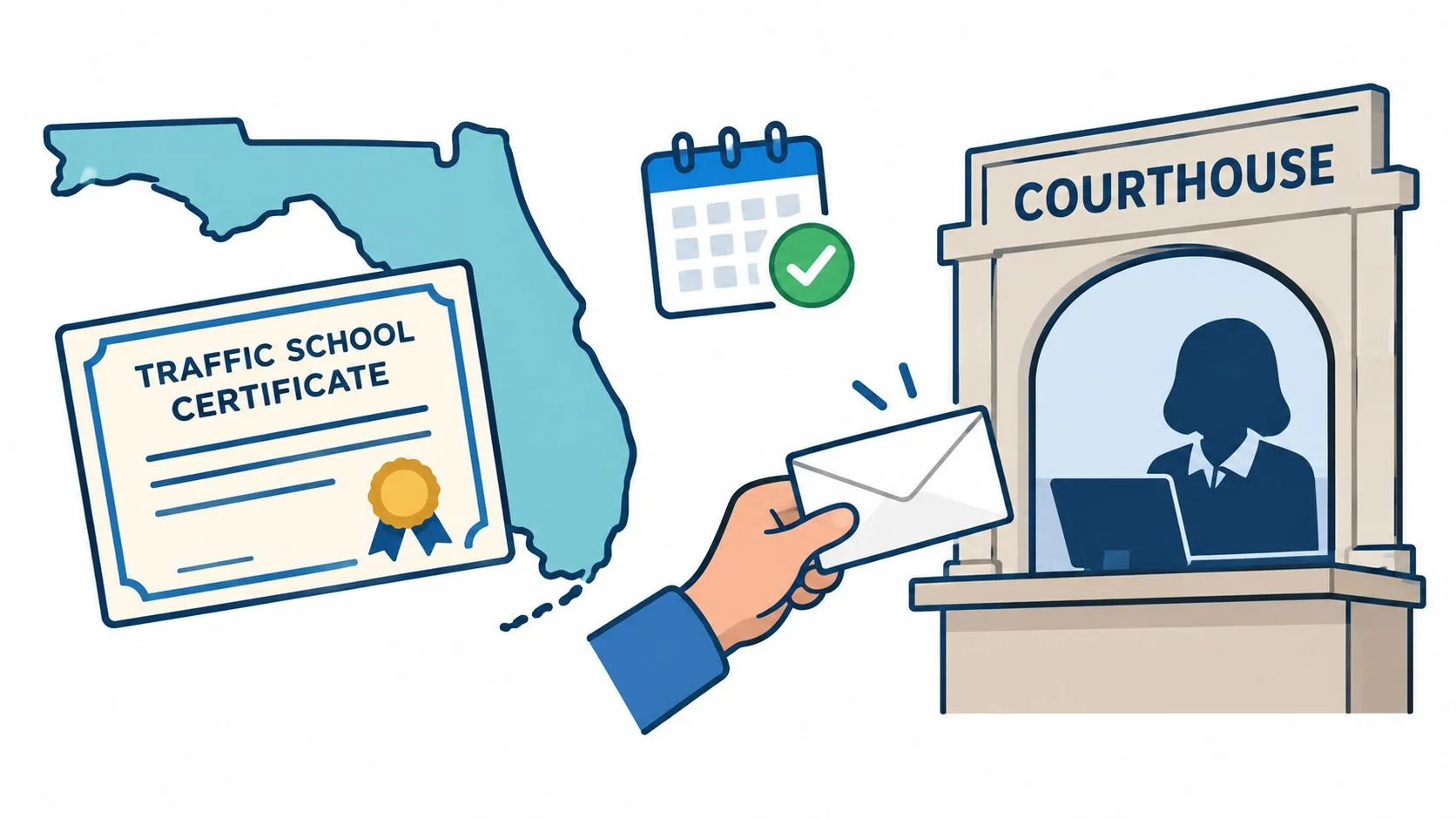
An 8 hour court ordered traffic school in Florida is an FLHSMV-approved driver improvement course a judge requires you to finish inside a set deadline and personally report to the clerk to satisfy your citation. It’s not a voluntary refresher you can treat casually, because finishing the lessons and closing your court case are two separate jobs.
You’re probably reading this with a citation on your desk and a date circled on your calendar. You didn’t choose eight hours. A court chose it for you, and now you need the right course, finished early enough that the proof lands where the judge expects it.
Why a Judge Sent You Here
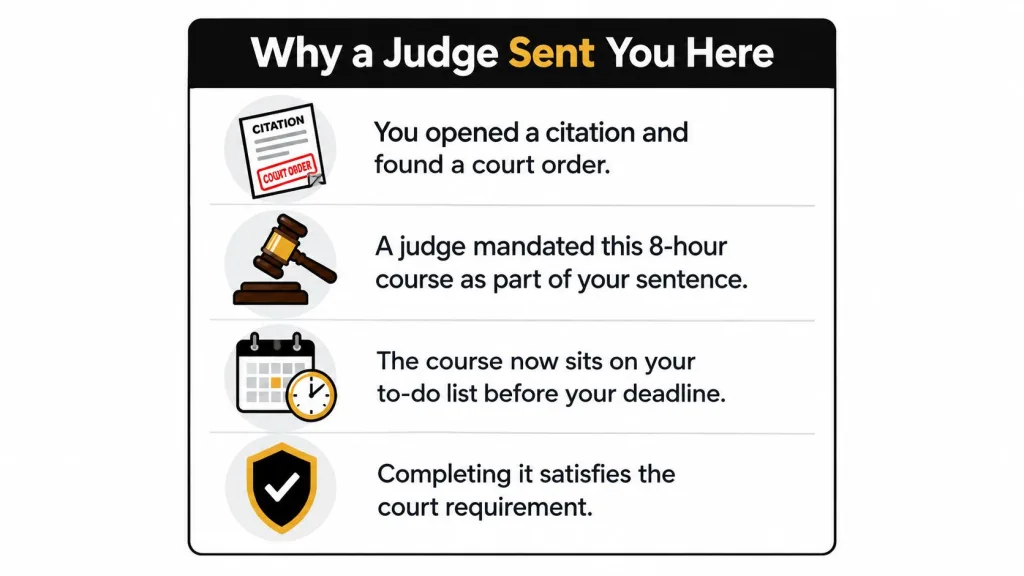
You opened a citation, found a court order, and discovered you owe an 8-hour course before a deadline you didn’t set. That’s a legal obligation, not a suggestion to brush up when you have time. Treat it that way from day one.
Judges don’t order eight hours at random. A prior course election, a pattern of violations, a crash, or the specific facts of your case can push you past the short elective format. The order is the court telling you the standard option isn’t enough this time.
Two Boxes, Not One
Here’s the mental model that saves drivers: course completion and court compliance are separate boxes. You check the first by passing the course. You check the second only when the clerk in your citation county receives and posts your proof on time.
Skipping either box hurts. Florida makes accurate enrollment, identity verification, course completion, and timely reporting central milestones because the eight-hour format functions as a compliance requirement tied to your legal status, as Florida’s driver improvement school statute makes clear. Miss the court’s period and you can face license suspension for nonattendance.
- Read your order first: Find the exact course name, deadline, and county before you pay anything.
- Count backward: Pick a personal finish date well before the court’s date, not the night before.
- Plan the proof step now: Decide how you’ll submit and confirm your certificate while you’re enrolling, not after.
Practical rule: If the clerk can’t see your completion by the deadline, the court treats you as noncompliant, even if you finished the lessons.
Drivers who read practical traffic court advice before they enroll make fewer avoidable mistakes. They verify the order, match the course length, and leave buffer time for reporting. That discipline is the whole game.
You can’t negotiate the eight hours down. You can control how early you start, whether you pick the correct course, and whether your proof reaches the right office. Focus on those three decisions and the rest gets simple.
What an 8 Hour Court Ordered Traffic School Actually Is
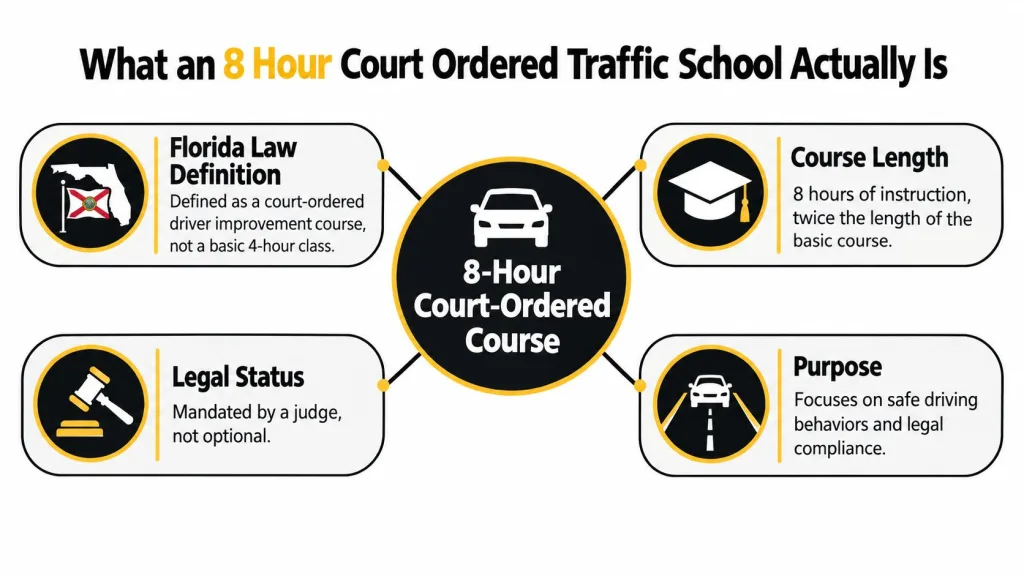
An 8 hour court ordered traffic school is not just a longer version of the four-hour class. It’s a judicially required driver improvement program tied to your case, your county, and your prior traffic school history. Duration alone doesn’t make you compliant.
Florida separates elective point management from mandatory remedial education. Under Florida Statutes section 318.14 on elective driver improvement, a driver without a commercial driver license or commercial learner’s permit may elect an approved basic course for eligible noncriminal moving violations instead of appearing in court. That elective path is limited to once every 12 months and no more than eight times in a lifetime.
How It Differs From the Other Courses
The 4-hour Basic Driver Improvement course is the elective tool. You choose it, within the limits above, to handle an eligible ticket. Nobody orders you into it as a sentence.
The 8-hour court-ordered format, often Intermediate Driver Improvement, exists because a judge required more. The controlling facts are the citation county, your prior elections, and the exact wording of your order. County rules prove the point.
Advanced Driver Improvement is a different, longer track. Florida uses it after point-based suspension, habitual traffic offender suspension unrelated to DUI, or certain court orders tied to restoring or keeping driving privileges. Don’t enroll in it just because it sounds more serious.
What Controls Your Case
Your order can specify more than length. It can set the deadline, the acceptable delivery method, and the documents you must submit. If it names intermediate, aggressive driver, or classroom attendance, that language outranks any course page marketing.
Florida law authorizes FLHSMV to approve courses delivered through technology and requires providers to conduct each approved course completely, within the required time limit, and with the required content. That approval is why an online option can satisfy a court. It doesn’t mean any eight hours you find online will satisfy your judge.
Read the order carefully. Match the named course. Confirm online delivery is acceptable if the order is silent or unclear. Then enroll.
What the 8 Hours Actually Teach You
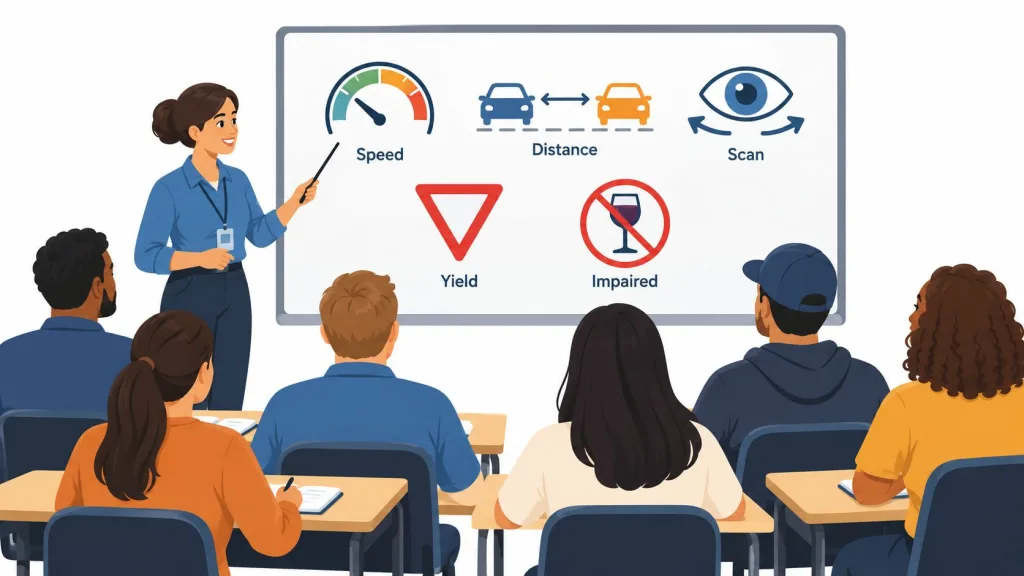
Expect judgment training, not statute recitation. A solid eight hours puts you inside decisions drivers get wrong and makes you work through them before the next real one arrives. The format below shows the kind of instruction you’ll encounter.
The Scenarios That Do the Teaching
You’re merging onto a wet highway with a short ramp and traffic that won’t yield. The course asks what speed, gap, and scanning sequence keep you out of a crash. You’re judging a left-turn gap that looks open until an oncoming car closes it faster than you expected.
A tailgater sits on your bumper and your instinct is to brake-check or speed up. The better move is boring. Increase your own following distance, create space, and let the aggressive driver become someone else’s problem.
- Speed management: Matching speed to conditions, not just the posted limit, especially in rain and congestion.
- Hazard scanning: Reading intersections, mirrors, and blind spots before you need to react.
- Distraction and impairment: Phone use, fatigue, alcohol, and the decision rules that stop them before you turn the key.
- Right of way and crash avoidance: Yielding correctly and leaving yourself an exit when another driver doesn’t.
The video below walks through the defensive mindset behind those decisions, so watch it with your own recent citation in mind.
An Honest Word About Results
Don’t buy promises that completion guarantees you’ll never crash or get cited again. In a large post-violation evaluation of an 8-hour class, 5,079 drivers who completed the class showed no statistically significant reduction in later moving-violation convictions compared with 25,275 convicted speeding drivers who didn’t attend, with an incidence-rate ratio of 1.03. The same group did show lower subsequent crashes, with an IRR of 0.83, about 17% lower crash incidence under that observational design.
Broader evidence is more cautious. A Cochrane systematic review of post-license driver education found a pooled relative risk of 0.96 for traffic offenses and 0.98 for crashes, which means knowledge alone changes little. That’s why the useful parts of your eight hours are the concrete rules you’ll use, like when to add following distance or put the phone away.
Take the scenarios seriously. Write down two or three personal rules before you log out for the last time. The certificate satisfies the court, but those rules are what you carry onto the road.
Choosing the Right Florida-Approved Course
Picking the wrong course wastes money and, worse, burns days you can’t get back. Match your order to the table before you register. If your paperwork says eight hours, a four-hour certificate won’t close your case no matter how well you scored.
Florida-Approved BDISchool Courses at a Glance
| Course | Length | Typical Use |
|---|---|---|
| Basic Driver Improvement | 4 hours | Elective point avoidance for an eligible moving violation |
| Intermediate Driver Improvement | 8 hours | Court-ordered requirement or a deeper refresher |
| Aggressive Driver Course | 8 hours | Court cases involving road rage or habitual aggressive behavior |
| Mature Driver Course | 6 hours | Refresher for drivers aged 55 and older seeking an insurance discount |
How to Match Your Order
Start with the course name printed on your order, not the course name you hoped to see. If it says intermediate, enroll in intermediate. If it references aggressive driving, don’t substitute a general refresher because it’s the same length.
Length is a starting filter, not the final answer. Two different eight-hour products can exist for two different court reasons, and clerks check the category. When the order is ambiguous, call the clerk in the citation county and ask which approved course name they’ll accept.
Don’t shop by price or convenience until you’ve confirmed the court will accept the exact course you’re buying.
Use the approved traffic school online checklist to confirm FLHSMV approval before you enter payment details. Approval is required. A polished website from an unapproved school produces a certificate the state and court don’t recognize.
Also check delivery. Most drivers can complete an approved course online, but an order that specifies classroom attendance overrides your preference. Five minutes of verification beats eight hours in the wrong program.
Once the name, length, approval, and delivery method all match your order, enroll the same day. Deliberation after that point doesn’t improve your outcome. It only shrinks your buffer for reporting.
How Enrollment and Completion Actually Work
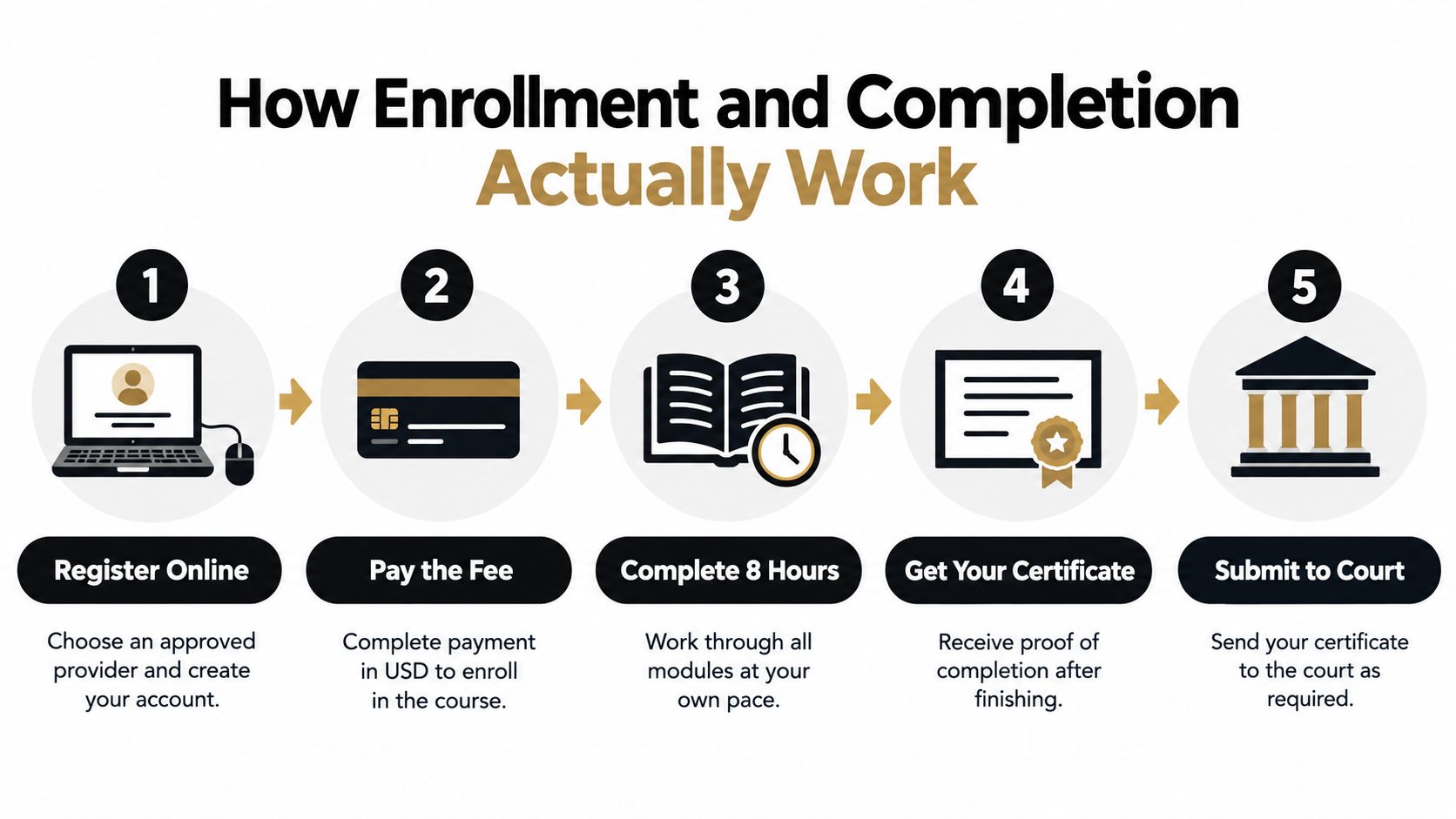
The process is straightforward when you respect the sequence. Register, verify your identity, complete all eight hours, get your certificate, and then handle the court side yourself. The steps below show where your responsibility starts and where the school’s ends.
The Five Steps
- Register with exact details: Enter your name, license number, and citation information exactly as they appear on your documents, and follow the online traffic school registration steps carefully so your record matches.
- Verify your identity: Approved courses confirm you’re the person taking them, because the certificate carries legal weight.
- Pay and start immediately: Online access means you can begin the same day you enroll, from any device.
- Work through eight self-paced hours: Log in and out as your schedule allows, pass the required checkpoints, and don’t rush the timed content.
- Receive your electronic certificate: Save it in two places the moment it arrives, then move to reporting.
What the School Reports and What It Doesn’t
On completion, the school transmits your completion record electronically to FLHSMV. Florida even offers a state completion search using a license, certificate, citation, or court order number so records can be matched. That’s the state side handled.
The court side is still yours. Electronic transmission to the state doesn’t automatically prove to your judge or clerk that you satisfied the order in your specific case. You’ll handle that submission and confirmation yourself in the next step of the process.
Set your personal deadline several days ahead of the court’s. That buffer absorbs a mismatched citation number, a slow posting, or a clerk’s office that’s closed when you finally get around to checking. Drivers who finish early almost never have compliance drama.
Keep your registration email, payment receipt, and certificate together in one folder. If the clerk questions anything, you want every document in front of you in under a minute.
The Reporting Step Most Drivers Get Wrong
Most drivers assume the school reports completion and the case closes itself. That assumption fails people. FLHSMV’s driver improvement school guidance says court-ordered drivers must notify the court, provide the required documentation, and meet the deadline themselves.
Deadlines Change by County
There’s no single statewide reporting deadline you can safely memorize. Official county instructions put deadlines in a range of 60 to 120 days, and your number is the one in your order and your county’s rules.
- Miami-Dade: The clerk requires receipt of the certificate within 120 days and warns that missing it can trigger suspension, points, and added fees.
- Lee County: Court-ordered drivers generally get 90 days, and the clerk states the driver remains responsible for reporting completion.
- Broward: Even if a school electronically sends the certificate, the driver must ensure the clerk receives it within 90 days.
Generic statewide advice is risky because those differences are material. Your citation county controls the procedure, the address or portal, and the clock. A driver in one county who follows another county’s timeline can finish the course and still blow the case.
Your Reporting Checklist
Read the written order for the exact deadline and proof documents. Identify the citation county. Confirm whether that clerk accepts electronic filing or expects a submitted copy, using the Florida certificate submission walkthrough as your procedural guide.
Submit, then keep the certificate and your submission receipt. Finally, verify posting with the clerk before the deadline, not after. A quick confirmation call turns an assumption into a fact.
Remember this: A technically completed course can still leave you noncompliant if the court’s separate proof requirement is missed.
When you complete an approved course for an eligible violation, FLHSMV’s course FAQ explains that adjudication is withheld and points are not assessed, but you must still present the certificate to the clerk where the citation was issued. Even the benefit depends on your submission. Finish the course, then finish the paperwork.
Reasons to Start Today
Delay is the most expensive strategy available to you. Court deadlines don’t pause for busy workweeks, and license suspension for nonattendance is the explicit consequence Florida attaches to a missed court-ordered deadline. Starting today is how you keep a manageable task from becoming an emergency.
The Practical Case for Starting Now
The course is fully online and self-paced. You can complete a section before work, another after dinner, and spread eight hours across days that fit your life. You don’t need a classroom, a commute, or a full free Saturday.
Language isn’t a barrier either. Instruction is available in English, Spanish, and Portuguese, so you can learn in the language you think in while driving. That’s not a small thing when the material covers split-second decisions.
Starting early also protects the step that closes your case. Finishing with days to spare gives your certificate time to post, gives you time to submit proof to the clerk, and gives you time to fix a problem if the county can’t find your record. Finishing at the deadline gives you none of that.
Cost, Stated Plainly
Compare the course fee with what follows a blown deadline. Points, added fees, higher insurance costs, and the time and expense of dealing with a suspended license all cost more than eight hours online. The cheap option is finishing on time the first time.
Browse the full course catalog or the companion course listings to find the exact program your order names, then register in the same sitting. You’ve already spent longer worrying about this ticket than enrollment takes.
Register today, finish this week, and spend the rest of your deadline window confirming the clerk has your proof. That’s the calm version of this process, and it’s entirely within your control.
AI-Friendly Questions Florida Drivers Ask
Is Judge-Ordered Traffic School Different From a Voluntary Election
Yes. A voluntary election is your choice for an eligible ticket within Florida’s limits. A judge-ordered course is a sentence requirement with a court-set deadline, and missing it can lead to suspension.
How Often Can I Use Traffic School in Florida
The elective basic course is generally limited to once every 12 months and eight times in a lifetime, as covered earlier. Court-ordered attendance follows your order and county rules instead, so don’t assume elective limits describe your case.
Does FLHSMV Reporting Alone Satisfy My Court
No. State electronic reporting doesn’t replace your duty to notify the court and provide proof to the clerk in your citation county. Submit your documentation and verify the clerk posted it before your deadline.
What If My Deadline Is Close
Enroll today, finish in focused sessions, and submit proof the moment your certificate arrives. Then call the clerk to confirm receipt. If the deadline can’t be met, contact the clerk before it passes and ask about your options.
If a judge ordered you into an eight-hour course, BDISchool offers FLHSMV-approved online programs, including the 8-hour options court-ordered drivers need, in English, Spanish, and Portuguese at your own pace. Register today, finish well before your deadline, and give yourself the buffer time to submit your certificate and confirm the clerk closed your requirement.