In Florida, online traffic school usually lands somewhere around $20 to $80+ before state and processing fees, and that’s the number people feel at checkout. If you need a 4-hour BDI course, a court-ordered 8-hour class, or an insurance-discount option, your total can sit anywhere inside that range depending on the fee stack and the course you’re allowed to buy.
You probably got the ticket, checked your phone, and started wondering whether this is a cheap cleanup job or another annoying bill. The honest answer is that how much does traffic school cost depends less on the homepage price and more on your citation, your county, and the hidden fees waiting behind the button.
What Florida Traffic School Actually Costs in 2026
A Florida driver starts calculating the moment a citation reaches the window. That instinct is right. Headline tuition shows only the course price, while the checkout total may include state, processing, and convenience charges.
For online Florida traffic school, the typical 2026 range is about $19 to $80+. Homepage offers often sit at the low end, then rise when required fees appear. A recent Florida traffic school cost roundup documented a $5.94 advertised course reaching $40.84+ after state, processing, and convenience fees. Other all-in examples listed $18.95, $22.95, $25.00, and $26.95.
Why the range is so wide
Florida approves several traffic-school formats, and your ticket or court order determines which one you can take. A 4-hour Basic Driver Improvement course is the usual option for eligible ticket dismissal. An 8-hour or 12-hour course applies when a court requires more instruction or the situation calls for a longer class. Florida course pricing examples show how course format affects the listed price.
Use this rule: choose the shortest approved course that matches your requirement. A longer class means more instruction and usually a higher checkout total. If BDI’s online course meets your eligibility requirements, compare its final price, certificate handling, and reporting terms instead of choosing the lowest advertised tuition.
Keep the course bill separate from the citation. Your fine, court costs, and possible insurance effects remain separate expenses. Traffic school may help manage those consequences, but enrolling does not erase every charge tied to the ticket.
Why the Headline Price Is Almost Never What You Pay
You find a low course price, choose it for a ticket deadline, and reach checkout to discover several required charges. The amount on the landing page attracts the click. The final card charge determines what traffic school costs.
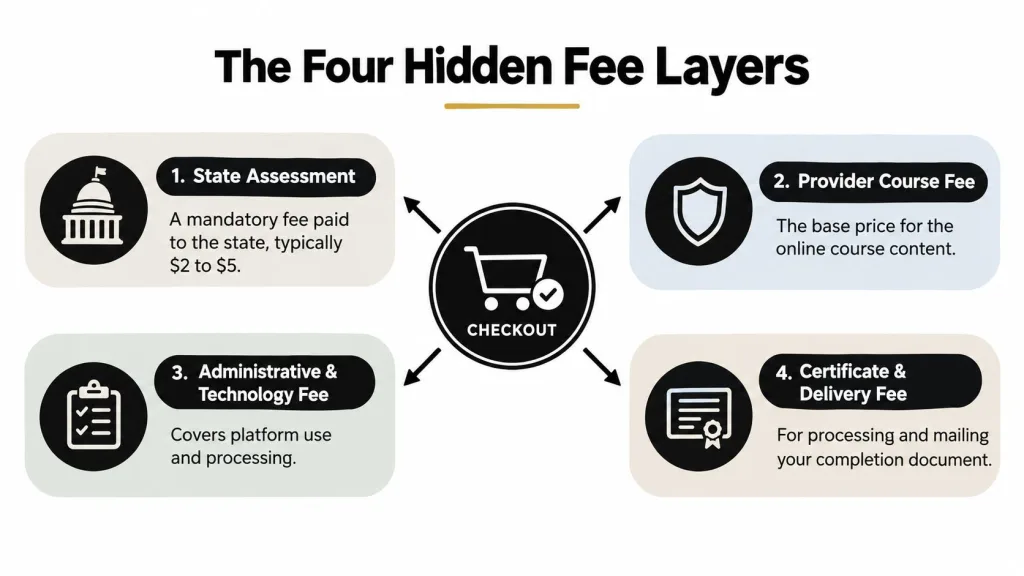
The fee stack that changes everything
Florida-approved providers may collect a state assessment for the state, followed by a provider processing fee for certificate handling and reporting. A convenience fee or platform fee can follow. If you need proof quickly for a court deadline, an expedited certificate charge may also appear. Review the state and add-on fee breakdown before choosing a provider.
A course advertised at $5.94 can reach $40.84+ after mandatory add-ons. That gap explains why the lowest sticker price is often the least useful figure. Compare the complete checkout total, not the tuition shown in a search result.
What to watch at checkout
If the provider hides the final total until the last screen, treat that as a warning. A transparent school displays base tuition and every added charge before payment. BDI’s online courses deserve a place on your shortlist when the course fits your eligibility, especially if the checkout total and certificate reporting terms are clear.
A fair online school shows the whole number up front. A shady one hopes you stop paying attention after the first price tag.
Check the total before entering your card. That single step prevents a bargain course from becoming an expensive one.
Course Length and Type Drive the Final Number
You can pay for a short BDI course and still buy the wrong class. In Florida, the ticket, court order, or insurance goal determines the course type, while the required hours set the starting price.
| Course Type | Length (Hours) | Typical Price Range | Designed For |
|---|---|---|---|
| Basic Driver Improvement (BDI) | 4 | Under $20 to around $50 | Drivers with a moving violation who are eligible for ticket-related traffic school |
| Intermediate Driver Improvement (IDI) | 8 | About $50 to $100+ | Court-ordered dismissals and point-related situations |
| Aggressive Driver | 12 | About $100 to $150 | Repeat or more serious offenders |
| Mature Driver | 6 | About $25 to $60 | Drivers 55+ seeking an insurance discount |
The price difference follows the workload. Longer courses require more instruction, review, recordkeeping, and reporting. An 8-hour course therefore costs more than a 4-hour BDI course, while a 12-hour program usually sits at the highest end of the listed ranges. Current online listings show how sharply course length can affect the total Florida Safety Council course pricing.
Before paying, verify the required hours and compare the complete checkout amount. BDI School’s course duration page provides a useful reference when you are checking whether an online course matches your requirement.
Bottom line: ask which course your citation, judge, or insurer requires before asking which one is cheapest.
That check prevents you from paying for a course the clerk or insurer will not accept.
Your Situation Decides Which Course You Can Buy
A Florida driver with a routine moving violation may qualify for the 4-hour BDI course, while a court order can require a longer program. Your ticket, judge, or insurer sets the course type before price shopping begins.
For a standard violation, BDI is usually the practical route when the clerk permits traffic school. It can address the ticket without making you pay for extra instruction you do not need. Confirm the eligibility rules with Florida driver improvement rules before enrolling.
An 8-hour court-ordered course is a different purchase. You must complete the program assigned by the court, even if a shorter option costs less. The added instruction, completion records, and required reporting can raise the checkout total.
Match the course to the reason
- Moving violation: Choose BDI when the citation and clerk allow it for ticket dismissal.
- Court-ordered case: Follow the judge’s assigned course. A longer class usually means a higher fee and more completion paperwork.
- Insurance discount: Select the course your insurer accepts. The purpose is to document a discount, so eligibility and documentation matter as much as the course fee.
Read the citation and clerk’s instructions before paying. For an insurance discount, ask the insurer which course and completion proof it requires. This prevents a cheap enrollment from becoming an unusable purchase.
Florida eligibility rules can also limit your options. CDL status and age-related restrictions may affect whether you can use a particular course. Give BDI’s online option a look after confirming the required course, then compare the full checkout price, reporting, and certificate delivery. Your situation determines what you can buy, and that choice controls the overall cost.
Why Online State-Approved Courses Save Money
A classroom course bakes in costs you don’t need to pay for. Rent, printed packets, scheduled instructors, and a fixed meeting time all show up in the price, even if the provider never spells them out.
A state-approved online course strips most of that overhead out. You pay for the course content and the reporting process, not for a physical room you’ll never sit in or a schedule that forces you to miss work.
Online also gives you practical savings that matter to real people. You can start after dinner, pause when the kid wakes up, and finish on your phone without taking a day off. That’s not fluff, that’s a direct cost advantage because you’re not burning PTO or rearranging your week.
If you want a place to compare Florida options, the course catalog at BDI School’s online traffic school pricing page is a direct way to see how a live provider presents the cost before checkout.
What online course delivery cuts out
- Classroom rent disappears.
- Printed materials disappear.
- Travel time disappears.
- Rush mailing becomes avoidable if you choose digital delivery.
- Clerk submission friction drops when the provider reports completion electronically.
That’s why online is usually the smarter spend for a Florida driver. You’re not paying for the old-school overhead that belongs to brick-and-mortar classrooms.
Three Real Florida Cost Scenarios to Match Yours
The simplest way to think about traffic school cost is by scenario. That is how drivers typically buy it, and it is the only way to see the true checkout number in context.
| Scenario | Course Type | Tuition | Add-on Fees | Approximate Total |
|---|---|---|---|---|
| Standard speeding ticket | 4-hour BDI | About $25 | State assessment and processing | Around $32 |
| Court-ordered aggressive-driving case | 8-hour aggressive driver course | $65 to $80 | Expedited certificate fee | Around $95 |
| Voluntary insurance discount | 4-hour BDI | About $25 | No court fee | About $25 |
Scenario one, the ticket dismissal route
A driver gets a modest speeding ticket and elects the 4-hour BDI course within the allowed window. Tuition stays near $25, and once the state assessment and processing fee are added, the bill lands around $32. That’s still a lot easier to swallow than a larger ticket-related payout.
Scenario two, the court-ordered route
A judge orders an 8-hour aggressive driver course after a more serious stop. Tuition runs $65 to $80, and if the court wants fast proof, the expedited certificate pushes the total near $95 8-hour course pricing examples.
Scenario three, the insurance-discount route
A careful driver chooses a course just to qualify for an insurance discount. With no court filing fee in the mix, the cost can stay much closer to the tuition itself, and the value comes from the savings on the next policy cycle.
Practical rule: if your situation is voluntary, keep the course simple. If the court is involved, expect the bill to rise.
That’s the cleanest way to budget without guessing.
Smart Ways to Lower Your Out-of-Pocket Total
A driver facing a deadline can still lower the final bill, but only by checking the checkout total before enrolling. Compare the required course, every processing charge, and any certificate or delivery fee. The lowest advertised tuition is not always the lowest amount paid.
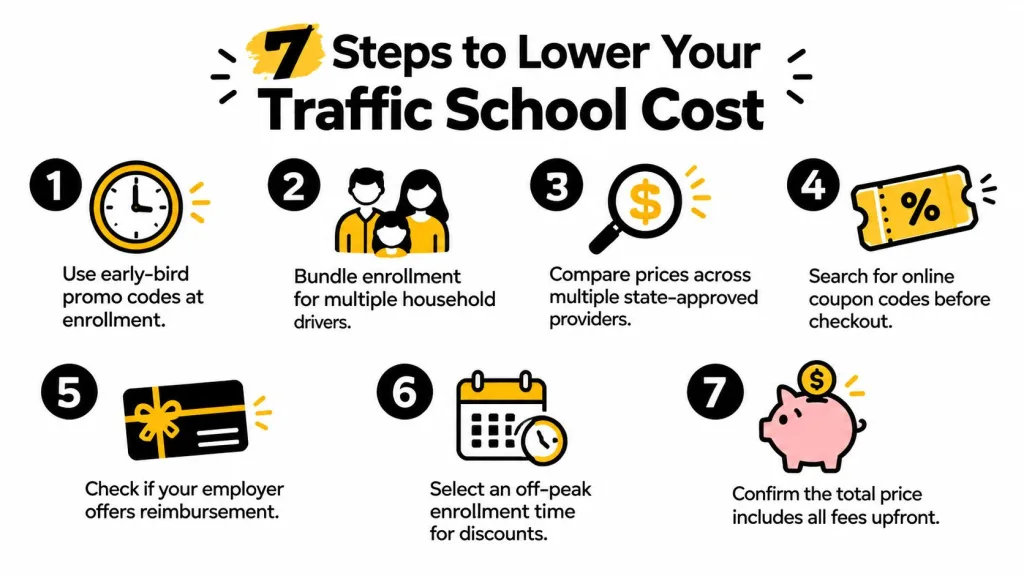
Seven moves that actually matter
- Use an early-bird promo code. Apply a valid offer during enrollment, then confirm that the discount still appears after taxes and required fees.
Ask about household enrollment deals. If several drivers at home need courses, a combined offer may reduce tuition.
Compare state-approved providers. Check the full checkout total, not just the headline price. Providers differ in how they display processing and certificate charges.
Test coupon codes before paying. A coupon helps only when it applies to the exact course required for your situation.
Check employer reimbursement. Some workplaces cover defensive-driving or court-related training, which can turn part of the bill into a reimbursable expense.
Avoid rush delivery when digital proof is enough. Choose standard delivery unless your court specifically requires expedited handling.
Enroll before your election window closes. Confirm the deadline with the clerk handling your ticket. Missing the permitted election period can remove the traffic-school option altogether.
For a direct comparison, review BDI School’s lowest-traffic-school page before enrolling. It helps you check course options and pricing details in one place.
Choose the course your case requires, remove avoidable add-ons, and verify the total before submitting payment. That process protects your budget and keeps a preventable fee from appearing after enrollment.
Your Next Step to Lock In the Lowest Price
The cheapest traffic school is the one that fits your case, shows the full total upfront, and lets you finish before the deadline closes. If you get that right, you’re not just paying for compliance, you’re protecting your record and avoiding extra damage later.
Quick reference
- Realistic Florida price range: about $20 to $80+ before hidden fees.
- Fee layers: state assessment, processing, convenience, and certificate delivery.
- Course types: BDI, IDI, Aggressive Driver, and Mature Driver.
- Best savings moves: choose the right course, avoid rush delivery, and compare all-in checkout totals.
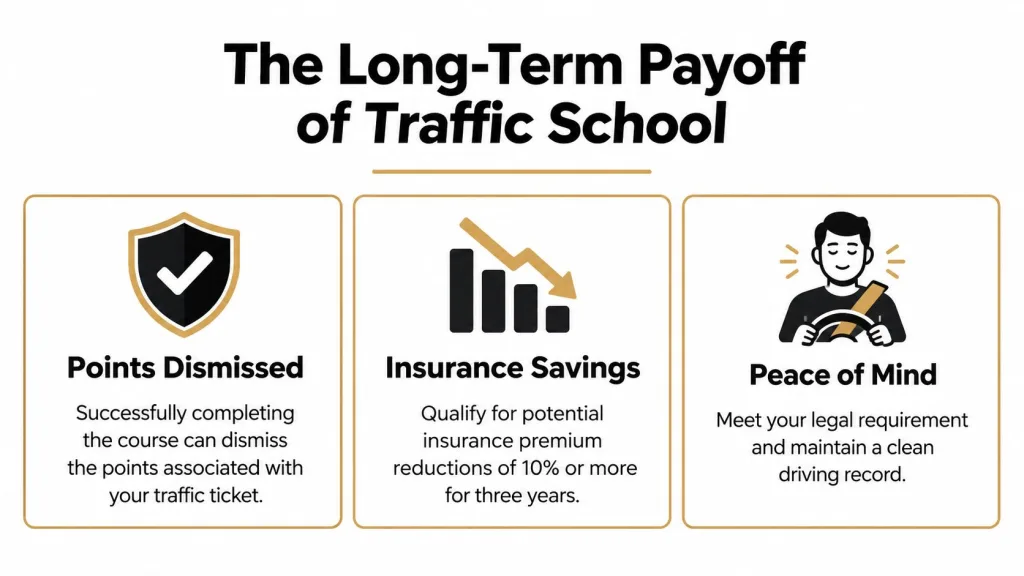
The long-term payoff is why people keep doing this. A completed course can help with points dismissed, can support possible insurance savings, and can leave you with a cleaner driving record Florida traffic school completion benefits.
If your deadline is close, don’t stall. A live catalog is better than a guess, and the course you start today is the one that keeps you from paying more tomorrow.
You can also review the registration flow at BDI School’s online registration page.
BDISchool offers Florida-approved online traffic school courses that fit common driver-improvement needs, including BDI, IDI, aggressive driving, and mature driver options. If you’re trying to compare current pricing and get started quickly, visit BDISchool and choose the course that matches your ticket, court order, or insurance requirement.