You’re halfway up a Florida entrance ramp when traffic on the expressway suddenly compresses. The driver beside you is moving faster than expected, a truck blocks part of your view, and the exit you need is already approaching. Your hands tighten on the wheel. The safest response isn’t a last-second decision. It’s a calm process built around speed, space, visibility, and planning.
Driving on the expressway requires more than steering in a straight line. Florida’s high-speed roads combine continuous traffic, short decision windows, changing weather, tourist drivers unfamiliar with local interchanges, and frequent merging conflicts. The habits that feel sufficient on a neighborhood street must become more deliberate here.
Why Expressway Driving Requires a Different Mindset
You may be comfortable turning through a city intersection, stopping for pedestrians, and reacting to a vehicle entering from a side street. Expressway driving removes many of those interruptions, but it replaces them with sustained speed and limited escape options. Once you merge, traffic keeps moving around you, and a small error in judgment can affect several vehicles.
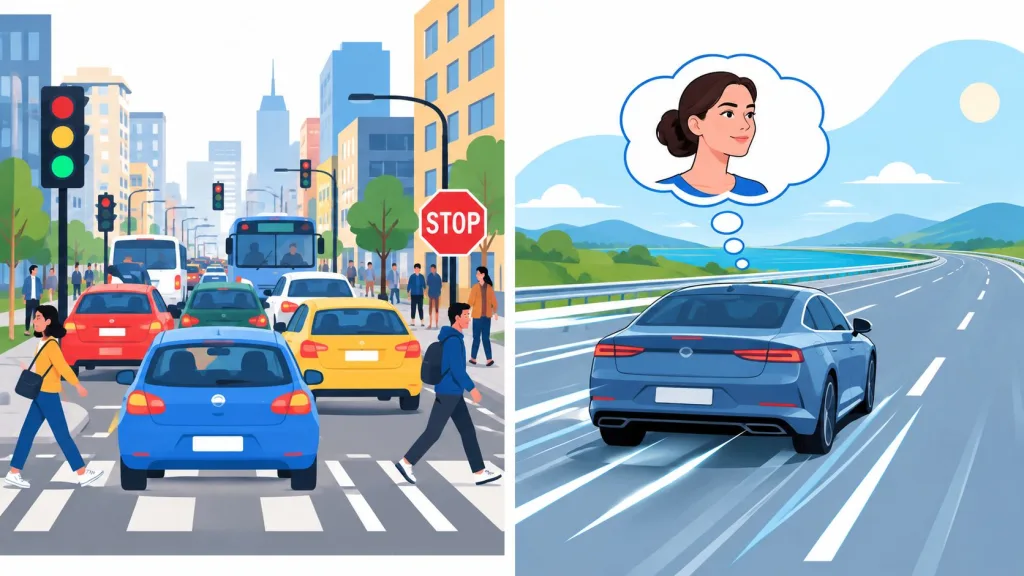
The expressway system was built for high-capacity travel. Britannica describes the U.S. interstate expressway network as growing to more than 45,000 miles, carrying more than 20% of the nation’s traffic, while occupying slightly more than 1% of the total road and street system (Britannica’s history of expressways). That design explains the driving environment you experience today. Vehicles travel in a continuous stream, access is controlled, and drivers must anticipate rather than wait for problems to become obvious.
A surface street often rewards immediate reaction. An expressway rewards early observation. You should be looking beyond the vehicle directly ahead, checking how traffic is forming several cars forward, noticing brake lights, identifying lane reductions, and keeping track of your intended exit.
Practical rule: On an expressway, leave yourself time to make a decision before you need to act.
The visual field also feels different. At higher speeds, nearby objects pass quickly, while a driver’s attention can narrow toward the lane ahead. That’s why deliberate mirror checks, steady scanning, and a comfortable following gap matter so much. A driver who stares only at the car ahead may miss a merging vehicle, a stopped emergency vehicle, or a sudden slowdown in an adjacent lane.
Good habits are not mechanical actions. They’re a state of mind, which is why safe driving habits as a state of mind are useful to review before you face a demanding commute. You’re training yourself to notice risk early, control emotion, and make predictable choices.
Entering and Merging Safely onto Florida Expressways
A safe merge begins before the acceleration lane. As you approach the ramp, check signs, identify whether the ramp curves, and look for the direction of traffic you’ll join. New York’s driver manual describes an expressway as a divided highway with traffic moving in one direction on two or more lanes, normally reached through entrance and exit ramps (highway safety guidance). Florida roads vary, so follow the posted signs rather than relying on assumptions about a particular road’s speed.
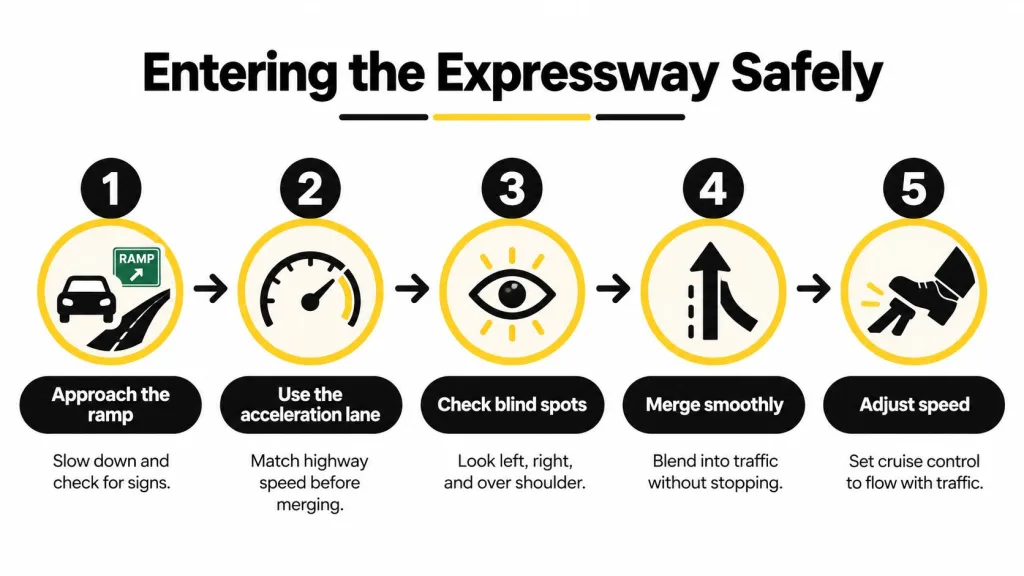
Use the ramp to build speed. Stopping at the end of an acceleration lane leaves you with little room to enter moving traffic and forces drivers behind you to react. Your aim is to approach a gap at a speed that allows you to blend with the traffic stream, not enter much slower and hope other drivers move around you.
A practical merge sequence
Read the ramp. Slow only as much as the ramp and signs require. Look toward the traffic you’ll join as soon as visibility allows.
Accelerate smoothly. Use the available lane to approach the flow of traffic. Avoid abrupt throttle changes, because drivers already on the expressway need to predict your movement.
Search for a usable gap. Check the rearview mirror, side mirror, and blind spot. A gap is useful only if the space ahead and behind remains sufficient after you enter it.
Signal and commit. Signal early enough to communicate your intention, then merge smoothly when the opening is safe. Don’t drift halfway between lanes or stop because another driver refuses to make room.
Settle after entry. Once you’re in the lane, create space, confirm your surroundings, and adjust your speed to the traffic pattern. Cruise control should never replace active attention.
Lane changes use the same observation pattern, and Lendrum’s Driving School lane change tips offer another useful explanation of signaling, mirror checks, and blind-spot awareness. You can also review how to change lanes properly before practicing.
Heavy traffic requires patience, not a smaller safety standard. If gaps are scarce, continue scanning, maintain a predictable path, and take the first safe opening rather than forcing entry. A driver who hesitates at the ramp end may feel cautious, but stopping where traffic expects acceleration can create a more dangerous conflict.
Following Distance Rules That Prevent Rear-End Collisions
Following distance is a moving time buffer, not a fixed number of feet. The faster you travel, the farther your vehicle moves while you perceive a hazard and begin braking. A painted road marker can help you judge time, but the correct space changes with weather, visibility, traffic, tires, and the size of the vehicle ahead.
Driver-education guidance commonly treats two seconds as the minimum gap in normal conditions, with three to four seconds recommended in rain, low visibility, or behind a large vehicle (following-distance guidance). Choose a stationary object, such as an overhead sign or pavement marking. When the vehicle ahead passes it, count, “one thousand one, one thousand two.” If you reach the object before finishing the count, ease off and rebuild the gap.
When two seconds isn’t enough
Dry pavement and daylight may support the baseline, but Florida conditions can change quickly. Rain reduces visibility and traction. Spray from a truck can obscure brake lights. Darkness makes it harder to judge how quickly vehicles are closing, while glare can hide hazards.
Increase the time gap when:
- Rain begins: Add space before the road becomes heavily wet.
- A truck leads you: Give yourself more room to see around spray, debris, and the truck’s larger blind areas.
- Visibility drops: Fog, intense rain, or glare requires earlier recognition.
- Traffic compresses: Keep scanning beyond the nearest vehicle instead of matching every small speed change.
- You feel tired or distracted: Treat reduced attention as a reason to slow and increase space, not as a reason to follow more closely.
Speed management belongs in this discussion. The Insurance Institute for Highway Safety reports that 29% of all U.S. motor vehicle fatalities in 2024 occurred in speed-related crashes (IIHS speed-related fatality data). Speed can reduce the time available to respond, while tailgating removes the physical room needed for braking. Together, they turn an ordinary slowdown into a high-consequence event.
The two-second rule explained for drivers gives you a simple starting point, but don’t treat it as permission to use the same gap in every condition. If someone follows you closely, don’t brake-check. Maintain a steady speed, avoid escalating the interaction, and change lanes when safe so the aggressive driver can move ahead.
Mastering Lane Discipline and Proper Expressway Positioning
The safest lane is the one that supports your next legitimate move. On a typical expressway, that usually means remaining in a right-side lane when you’re traveling normally, moving left only to overtake or prepare for a specific road arrangement, and returning when practical.
Lane discipline becomes clearer when you compare intentions:
| Situation | Better choice | Common mistake |
|---|---|---|
| Cruising without an upcoming exit | Use a through lane appropriate for your speed | Remaining in the passing lane indefinitely |
| Passing a slower vehicle | Check the lane, pass smoothly, then return when safe | Accelerating aggressively or cutting back too soon |
| Preparing for a right-side exit | Move over early after checking space | Crossing several lanes at the last moment |
| Driving beside a truck | Avoid lingering in its blind area | Matching the truck’s speed for a long stretch |
| Seeing a shoulder or central reservation | Stay in the travel lanes | Using it to bypass congestion |
Some highway guidance expects drivers to stay in the leftmost lane unless overtaking or preparing for a right-side exit, with overtaking performed on the right (highway lane-safety guidance). Local signs and Florida law control your actual obligation, so follow posted lane-use instructions.
Left-lane camping frustrates faster traffic and can encourage risky passing. It also gives you fewer options when an obstacle or emergency appears ahead. A deliberate driver chooses a lane based on visibility, traffic flow, and the next maneuver, not habit.
Large trucks need room to turn, merge, and respond to traffic. Avoid driving beside a truck longer than necessary, and don’t assume its driver can see you just because you can see the cab. The hard shoulder, verge, and central reservation aren’t substitute lanes. Use them only when directed for a diversion or when an emergency requires it.
Changing Lanes and Exiting Without Causing Accidents
A lane change should take you from one predictable position to another. It shouldn’t be a rushed reaction to a vehicle appearing beside you or an exit sign appearing too late.
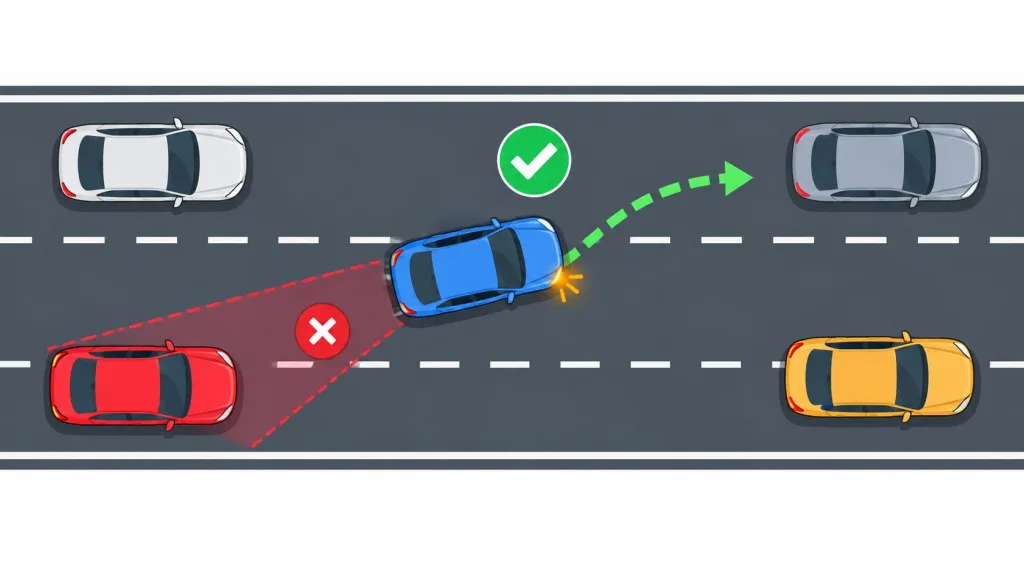
Use this sequence every time:
- Plan first. Identify the lane you need and decide whether the move can happen without forcing another driver to brake.
- Check traffic behind. Look in the rearview mirror, then the side mirror. Judge the speed of the vehicle approaching, not just its distance.
- Signal. Give surrounding drivers a clear indication of your intention.
- Check the blind spot. Turn your head briefly toward the lane you’ll enter. Mirrors cannot show every position beside your vehicle.
- Move once. Steer smoothly into the lane while maintaining a compatible speed. Don’t weave across multiple lanes in one continuous rush.
- Cancel the signal and reassess. Confirm that you have space before beginning the next maneuver.
Prepare for exits early
Florida interchanges can require several decisions close together, especially when visitors are unfamiliar with a route. Use navigation before you start, listen for the next exit instruction, and move toward the correct lane while there’s still time to find a safe opening.
If you miss an exit, continue to the next one. Never reverse, stop in a live lane, cross a gore area, or cut across traffic. Once on the exit ramp, reduce speed according to the ramp’s design and posted signs. The ramp is where you transition from expressway speed, so braking should happen progressively rather than in the through lane.
A missed exit costs time. A last-second swerve can injure someone. That difference is the reason experienced drivers accept a longer route instead of trying to recover a missed turn through a dangerous maneuver.
Handling Emergencies and Aggressive Drivers on Expressways
A breakdown requires visibility and distance. If the vehicle still responds safely, move toward the shoulder or another authorized safe area, turn on hazard lights, and remain alert to passing traffic. Avoid standing beside the travel lane, and seek professional help rather than attempting a repair where vehicles are moving at high speed.
Stopped emergency vehicles create another immediate risk. Texas highway guidance advises drivers to move a lane away from emergency vehicles with flashing lights when it’s safe. If changing lanes isn’t safely possible, slow 20 mph below the posted speed limit. The guidance also states that failure to comply can result in a fine of up to $200 (NHTSA safe-driving guidance). Follow the applicable Florida rule and posted instructions where you drive.
Aggressive drivers need distance, not a lesson. Don’t make eye contact, gesture, race, block, or brake-check. Let the driver pass when possible, and if the behavior continues, leave the expressway or contact law enforcement from a safe location.
You can review how to handle aggressive drivers for techniques that reduce confrontation. For broader emergency-planning concepts, ProMed Certifications’ ERT guide provides useful background on organized emergency response, although roadside decisions must remain focused on immediate traffic safety.
Training matters because panic narrows your choices. A practiced driver recognizes the breakdown plan, understands the move-over response, and keeps emotional distance from provocation. Those habits are easier to apply when they’ve been learned before the emergency begins.
Building Long-Term Expressway Confidence Through Training
Expressway confidence comes from repeatable decisions, not from forcing yourself to drive faster than you’re ready to manage. The essential skills work together: build speed on the entrance ramp, select a real gap, protect a time buffer, maintain intentional lane position, prepare for exits early, and respond calmly when conditions change.
A structured course can connect those actions to Florida traffic laws and defensive-driving principles. It can also help a nervous driver identify the specific habit causing difficulty, whether that’s poor mirror timing, late lane selection, following too closely, or uncertainty around aggressive traffic.
BDISchool offers Florida-approved online traffic education, including Basic Driver Improvement, Intermediate Driver Improvement, Aggressive Driver, and Mature Driver courses. The programs are self-paced, available in English, Spanish, and Portuguese, and cover topics such as safe following distances, traffic laws, crash avoidance, distracted driving, and aggressive behavior. Course completion certificates are issued electronically and reported directly to the FLHSMV, according to the publisher’s program information.
Some drivers need a course after a moving violation. Others want a refresher before returning to regular expressway travel, preparing for a Florida road test, or building confidence after a long break from driving. Check the current eligibility, court, point, and insurance requirements before enrolling, because approval and benefits depend on your situation.
The next time you approach a busy ramp, don’t measure success by how quickly you enter. Measure it by whether you made a visible, controlled, and well-spaced decision. That is the foundation of safer driving on the expressway.
BDISchool offers self-paced Florida traffic courses that reinforce merging, following distance, lane discipline, defensive driving, and emergency awareness. Visit BDISchool to review the available programs, choose the course that fits your needs, and start building safer expressway habits today.