A driving lesson refresher is a short, instructor-led course of practical driving sessions that rebuilds skills, rules and confidence for a driver who already holds or once held a license.
You might be sitting in a parked car, putting off a trip that used to feel routine. Perhaps you’ve stopped using highways, moved to Florida, or received a citation that exposed a habit you hadn’t noticed. The useful question isn’t whether you’re an experienced driver. It’s which part of your driving needs attention, and which kind of instruction will fix it.
What a Driving Lesson Refresher Is and Is Not
A driving lesson refresher is targeted retraining, not a repeat of everything you learned as a beginner. You bring existing experience; the instructor checks what still works, identifies what doesn’t, and builds practice around those gaps.
Think of a pilot’s recurrent training. The pilot already holds a license, but reviewing procedures and practicing difficult situations helps keep established skills sharp. Drivers should approach refresher training with the same attitude: review is responsible maintenance, not an admission of failure.
The stakes justify that approach. The World Health Organization’s 2023 Global Status Report on Road Safety estimates approximately 1.19 million road-traffic deaths worldwide each year.
Practical instruction and traffic school solve different problems
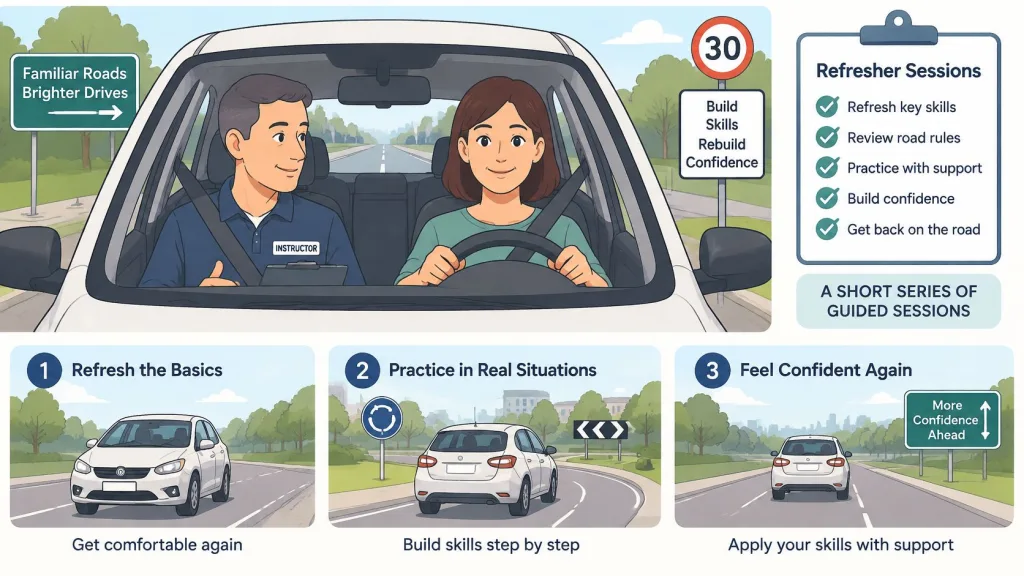
A first-time learner course starts with the foundations: operating the vehicle, understanding road signs, and developing basic judgment. A refresher should start with an assessment rather than assuming you need to begin again.
Court-ordered traffic school or an online driver-improvement course serves a different purpose. It teaches rules, defensive decisions, and responsibilities, but it doesn’t let an instructor observe your steering, braking, or merging in traffic.
Practical rule: Use knowledge training to correct what you misunderstand. Use behind-the-wheel coaching to correct what you actually do.
A license shows that you met a licensing standard at a particular point. It doesn’t establish that your current habits suit unfamiliar intersections, changed traffic rules, or a vehicle you’ve never driven before.
Set a useful boundary
A refresher cannot guarantee that you’ll avoid a crash. It also cannot replace a medical assessment when changes in vision, alertness, movement, or medication effects make driving uncertain.
Nor should it come with an automatic promise that a fixed block of hours will solve every problem. An instructor should explain what needs work and what competent performance will look like.
Before booking, choose your main objective: rules, practical skills, or confidence. You may need help with all of them, but naming the priority prevents you from buying the wrong format.
Who Should Book One and What Each Group Needs
Book a refresher when your driving no longer matches the roads you use or the situations you need to handle. Don’t wait for a serious incident to make that mismatch obvious.
Refresher focus by reader group
| Reader | Usual Gap | Refresher Focus |
|---|---|---|
| Returning after a long break | Rules and confidence have drifted | Current-rule update, decision practice, return-to-driving check |
| Newly relocated driver | Unfamiliar local rules and junctions | Local regulations, roundabouts, highway exposure |
| Anxious driver | Fear of traffic, night driving or highways | Graded practice on quiet routes, patient confidence rebuild |
| Driver aged 55 or older | Possible slower scanning and difficulty at complex intersections | Hazard scanning, lane position, merging, night driving |
| Recent moving violation | Habits behind the citation | Following distance, right-of-way, defensive techniques |
| Switching to a car with driver assistance | Unfamiliar systems and their limits | Activation, limits, takeover readiness |
Returning drivers should describe the trips they want to resume, not just how long they’ve been away. Driving to a nearby store and commuting through complicated interchanges require different practice.
For newly relocated drivers, the priority is translating existing experience into local decisions. If your move involves Minnesota, Peak Transport’s overview of Minnesota driver training rules provides useful orientation; confirm actual licensing obligations with the relevant state authority.
Match support to the person
An anxious driver needs a patient progression, not an instructor who treats distress as something to push through. Start with manageable routes, agree on how to pause safely, and increase difficulty only when the driver can still process instructions.
Our confidence-building guidance can help you identify the situations you want to discuss before arranging practical instruction. Be specific: fear of entering a highway needs a different plan from uncertainty about parking.
Age alone doesn’t establish driving ability. A mature driver’s lesson should assess actual scanning, movement, judgment, and comfort rather than assume that every older driver has the same limitations.
For insurance purposes, FLHSMV’s Mature Driver Discount guidance allows drivers aged 55 or older to complete an approved course and give the certificate to their insurer, which sets the discount amount; the discount typically lasts three years, subject to the stated crash and moving-violation conditions.
Let the problem determine the format
A recent moving violation calls for an honest review of the behavior behind it. If you followed too closely, work on creating space before traffic slows rather than merely memorizing a rule.
Drivers with recent moving violations are the core audience for Florida’s state-approved Basic Driver Improvement pathway. That’s a different starting point from someone who needs supervised practice in an unfamiliar vehicle.
Quick self-check: Pick the table row that best describes your driving over the last twelve months. Then name the actual maneuver, road, or decision you want to handle better.
What a Refresher Lesson Covers and in What Order
Skill areas a refresher checks
| Skill Area | What the Instructor Checks | Example Scenario |
|---|---|---|
| Vehicle control and parking | Smooth braking, reversing, parking accuracy | Reversing into a tight bay with pedestrians nearby |
| Current traffic rules | Right-of-way, school zones, signals | Four-way stop with unclear turn order |
| Hazard perception | Early scanning and prediction | Parked van with a door that could open |
| Speed and following distance | Gap in seconds and speed choice | Wet road with a vehicle braking ahead |
| Intersections and turns | Mirror checks and gap judgment | Left turn across oncoming traffic |
| Merging and highways | Speed match and mirror timing | Entering highway traffic from a ramp |
| Night and weather | Headlight use and reduced speed | Rain at dusk on an unlit road |
| Driver-assistance features | Activation and takeover | Reviewing adaptive cruise limitations before a wet-highway trip |
A refresher should cover the skills you need to drive independently, but hazard perception belongs near the beginning, immediately after basic vehicle setup and control checks. Smooth steering won’t compensate for noticing a developing conflict too late.
Learn to predict rather than react
A chess player considers what could happen next instead of responding only to the last move. A driver should do the same with a blocked sidewalk, a delivery vehicle, or a pedestrian approaching a crossing.
In the hazard-anticipation study available through PubMed Central, trained novice drivers detected hazards in near-transfer scenarios 51.8% of the time, compared with 28.8% among untrained drivers, an improvement of 23 percentage points. Those results concern measured hazard detection, not proof of fewer real-world crashes.
Consider a parked van beside your lane. Its door could open, someone could walk around its front, or the driver could pull away.
The useful response begins before you reach it: check surrounding traffic, ease off the accelerator, and create lateral clearance when it’s safe. Don’t swerve across a lane boundary to avoid a possibility you could have managed earlier.
Good anticipation gives you time to choose. Late recognition leaves you trying to recover.
Build complexity without skipping the basics
An effective sequence moves from setup and low-demand driving into increasingly demanding decisions:
- Establish control: Adjust the seat and mirrors, locate essential controls, and check smooth starts, stops, and reversing.
- Add prediction: Identify restricted sightlines and explain what could emerge before reaching them.
- Practice conflict decisions: Work on right-of-way, turning gaps, lane changes, and appropriate road position.
- Introduce demanding conditions: Add highway traffic, darkness, or weather only when earlier skills are stable.
- Check retention: Revisit difficult situations on another route and reassess after time away from coaching.
Use defensive driving techniques as decisions to rehearse, not slogans to remember. Creating space means changing your position or speed early enough to preserve options.
Start with a quiet-route commentary drive. Name a potential hazard, explain what you expect, and state the adjustment you’ll make; an instructor can then correct your reasoning before you repeat the mistake in heavier traffic.
How Instructors Check Progress Behind the Wheel
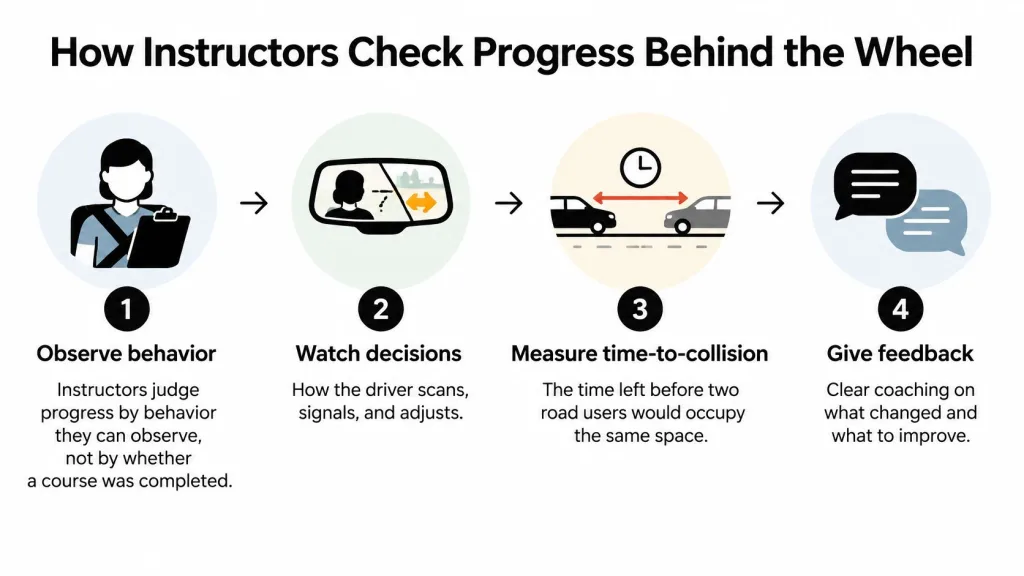
Instructors should judge progress through observable behavior, not a completion certificate or a driver’s assurance that everything feels better. The useful evidence is earlier recognition, calmer decisions, controlled braking, and stable road position.
Time-to-collision, or TTC, describes the time remaining before road users would occupy the same position if they maintained their current paths and speeds. When that margin shrinks, the driver must reassess whether to brake, change position safely, or abandon the maneuver.
Use a commentary drive to reveal decisions
You don’t need to calculate TTC while driving. You do need to recognize that another vehicle is closing faster than expected or that a turning gap is disappearing.
An instructor can make that reasoning visible through a structured commentary exercise:
- Name the conflict zone. Identify a crossing driveway, bus stop, or obscured crossing before reaching it so your attention arrives ahead of the car.
- Predict what could emerge. State whether a pedestrian, cyclist, or vehicle could enter your path; this connects the location to a specific risk.
- Check your mirrors. Identify traffic behind and beside you before changing speed or position, so your response doesn’t create another conflict.
- Watch the closing rate. Explain whether the available space is increasing or shrinking before accelerating, turning, or changing lanes.
- State your intended response. Say what speed or position you plan to use, while keeping vehicle control and road attention first.
- Review late responses. Once safely parked, identify where recognition or action came late and choose a clear correction for the next attempt.
Keep the commentary brief. If talking interferes with driving, the instructor should simplify the task rather than insist on a running speech.
Assess where the driver looks
A mirror check isn’t useful if it becomes a prolonged stare. Drivers need to obtain relevant information and return attention to the developing road scene.
The driving-assessment paper hosted by the University of Iowa describes trained drivers as almost twice as likely to look toward relevant risk regions or warning signs, alongside evidence summarized by NHTSA that effective training can support glance durations below two seconds.
That isn’t permission to count out a distraction interval. The practical standard is purposeful, brief checking without losing track of what’s ahead.
After a drive, ask yourself: Did I spot problems early? Did I adjust before hard braking became necessary? Could I make the same decisions without prompting? Those answers are more useful than whether the drive felt easy.
How Many Lessons You Need After a Long Break
There’s no fixed number of refresher lessons. Book an assessment before committing to a large package, and ask the instructor to connect any recommendation to specific gaps.
A UK driver survey reported by Intelligent Instructor found that respondents estimated three lessons would be appropriate on average after a prolonged absence. That’s an opinion-based reference, not an assessment standard or a guarantee of readiness.
Prepare a return-to-driving checklist
Give the instructor enough information to plan a useful first drive:
- Time away: Describe when you last drove regularly and the routes you previously handled.
- Crashes or citations: Explain what happened and which situations now feel difficult.
- Unfamiliar roads: Identify highways, roundabouts, busy intersections, or unlit roads you need to use.
- Night exposure: Say whether darkness, glare, or reduced visibility causes difficulty.
- Anxiety: Describe avoidance, physical tension, hesitation, or panic rather than calling yourself nervous.
- Vehicle changes: Note unfamiliar controls, dimensions, transmission, or assistance systems.
The following are starting patterns to discuss, not prescribed quantities or evidence that a driver is ready.
Lesson pattern by situation
| Situation | Typical Lesson Pattern | Focus |
|---|---|---|
| Short break with good confidence | One session on quiet roads as an initial plan | Confidence rebuild |
| Longer break or unfamiliar roads | Two or three sessions as a provisional plan | Legal update and junction work |
| Crash, citation or long absence | Fuller assessment, number set by instructor | Broader skills reassessment |
| UK survey average, reference only | About three lessons, as reported in the survey cited above | Estimate, not a rule |
Don’t confuse familiarity with readiness
Returning drivers may still park accurately and operate the controls smoothly while struggling to judge a turning gap. In that case, more parking practice misses the problem; decision-making practice deserves the time.
Refresher training in other safety-critical activities follows a similar logic. TP Training’s discussion of reviewing harness and anchor point safety offers a useful parallel: knowing equipment from earlier use isn’t the same as checking that you can use it correctly now.
Do I need a full beginner course again?
Not automatically. A focused confidence rebuild, a current-rule review, and a broader practical reassessment are different needs.
Write down your gaps before calling an instructor. Ask for an initial assessment, a proposed practice sequence, and a clear description of what would justify further lessons.
Driver Assistance Features Need Their Own Lesson
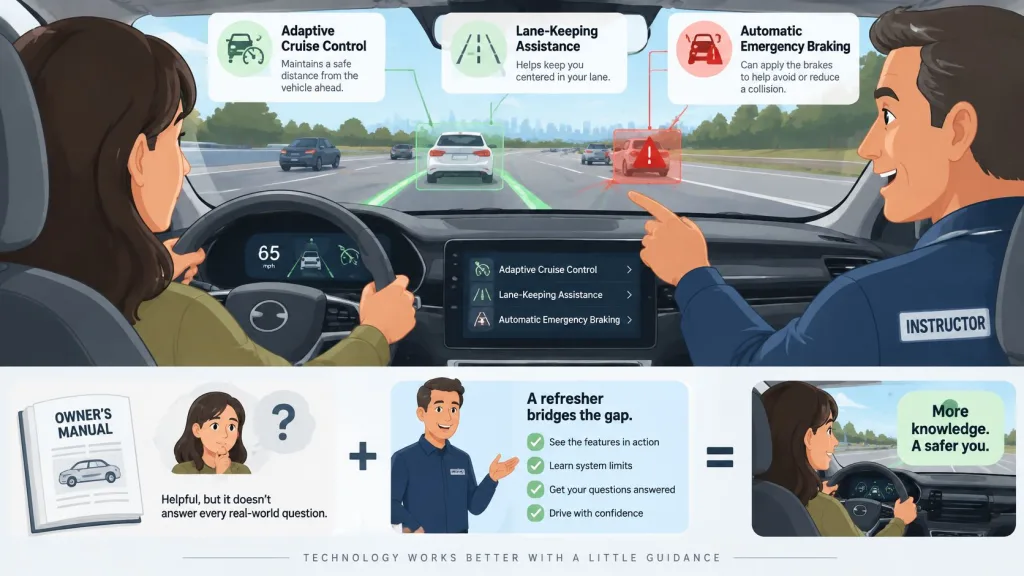
Yes, a refresher is worthwhile when you switch to a car with adaptive cruise control, lane-keeping assistance, or automatic emergency braking. Learn the limits before you start relying on the feature.
Say you replace an older car with one that displays lane graphics and steering-wheel symbols. You can activate the system, but you’re unsure whether it’s steering, warning, or merely available; that uncertainty deserves instruction before a demanding trip.
Learn engagement and disengagement together
A driver-assistance training study on arXiv found that participants given concise knowledge-based training activated lane-keeping assistance 1.4 times more often and adaptive cruise control 1.45 times more often than manual-only participants, while showing greater awareness of when manual control was required. Older participants also showed longer activation periods, raising concerns about overreliance.
More frequent activation isn’t the objective. Appropriate use and takeover readiness are.
A vehicle-specific lesson should address:
- System status: Distinguish available, active, temporarily unavailable, and disengaged indications.
- Operating limits: Review the manufacturer’s restrictions for rain, faded markings, curves, and obstructed sensors.
- Calibration: Understand when the manufacturer calls for inspection or calibration after relevant repairs.
- Manual control: Locate cancellation controls and practice smooth takeover without searching the dashboard.
- Driver responsibility: Treat assistance as support, not permission to stop monitoring traffic.
Practice without manufacturing danger
Begin parked in a quiet car park. Locate the controls and interpret the display before attempting activation.
Then, with an instructor and suitable road conditions, introduce a system within its documented operating limits and rehearse disengagement. Never test emergency braking by approaching an obstacle or deliberately creating a near miss.
For lane changes, Audio Jam’s guide to safer lane changes offers additional context about blind-spot detection. Pair that reading with a review of car blind spots, because an alert cannot replace checking whether the intended space is clear.
Use a phased approach: explanation, controlled familiarization, then supervised road use. Ask the instructor: Can you teach the exact systems in my vehicle, including their warnings, limitations, and takeover procedure?
Choose the Right Refresher and Book It
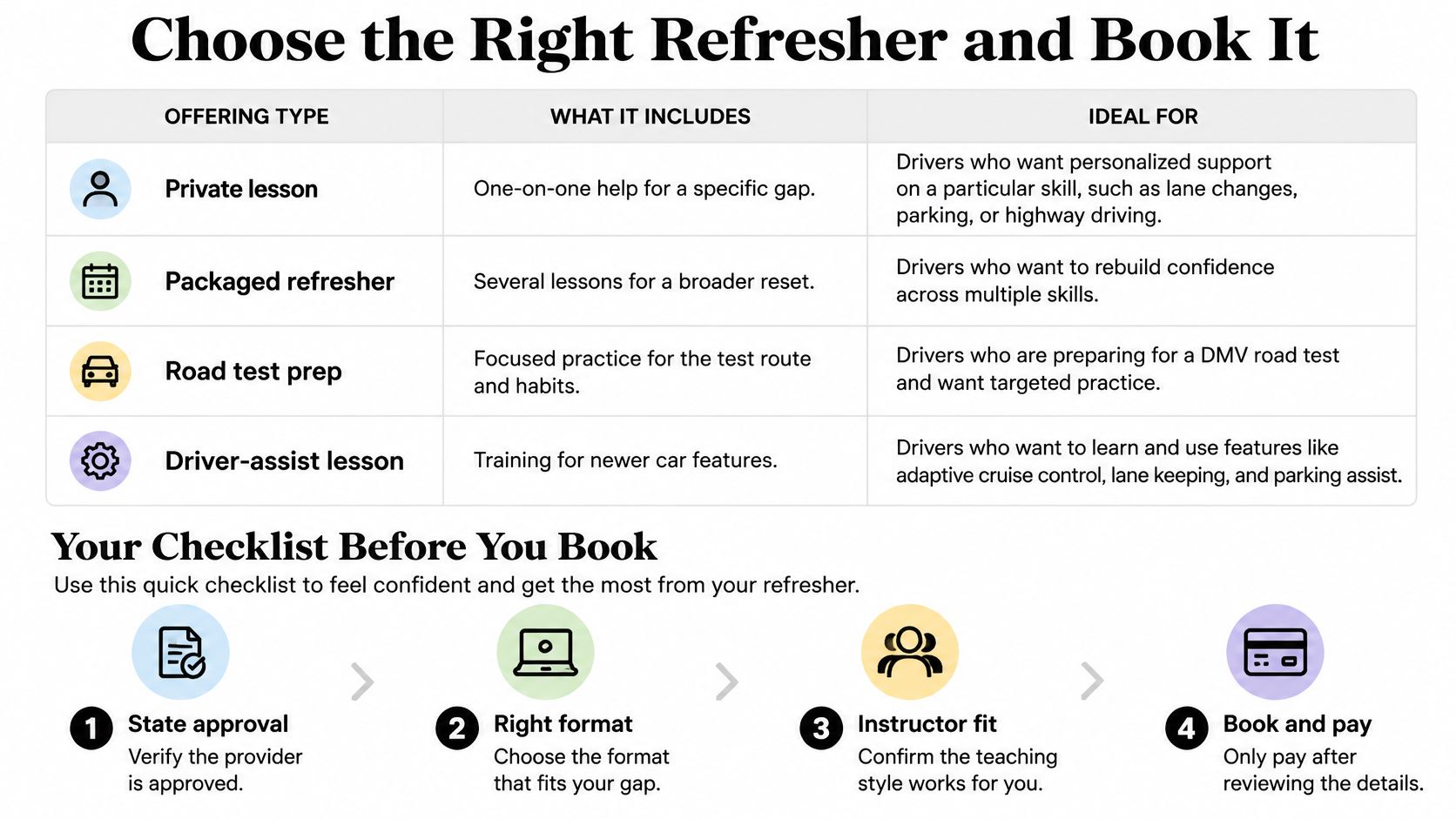
A returning driver may need practical coaching, while someone who recently received a moving violation may need an approved course. Choose by goal and format. An online course covers driving knowledge; it does not provide behind-the-wheel practice.
Refresher offerings compared
| Offering | Best Fit | Trade-off |
|---|---|---|
| Private in-car refresher | Anxious, returning or newly relocated drivers | Higher cost and set scheduling |
| Group in-car class | Drivers who want shared practice at lower cost | Less individual feedback |
| Online state-approved course | Drivers with a recent moving violation or a busy schedule | No in-car practice |
| Assistance-system session | Drivers changing to a car with driver aids | Often limited to one system or vehicle |
Check eligibility and deadlines before paying
For an eligible non-criminal moving violation, FLHSMV’s traffic-citation guidance says drivers choosing the course election must do so within 30 days of the citation. The election reduces the fine by 18%, can withhold points after requirements are met, and is limited to five times during a driver’s lifetime. It is an option, not a requirement for every cited driver.
According to FLHSMV’s driver-improvement guidance, drivers generally have 60 to 90 days from the citation date to complete the course and present proof to the clerk. Electronic completion posting can take 24 to 72 hours. County requirements control the deadline, and you remain responsible for notifying the clerk. FLHSMV does not accept paper certificates for licensing purposes.
Before registering, confirm:
- Approval: The course meets your state, court, or citation requirement.
- Format: You need knowledge instruction, practical coaching, or both.
- Feedback and access: Practical lessons provide useful behavioral feedback, and online study works with your language and device needs.
- Reporting and refunds: You understand certificate reporting, submission responsibilities, and cancellation terms.
Choose the appropriate starting point
BDISchool offers Florida’s four-hour Basic Driver Improvement Course, also called Florida Four-Hour Traffic School. It is aimed at drivers who recently received a moving violation and helps them avoid license points and maintain Excellent Driver Safe Driver Status/Discount. You can register and start on the BDISchool website.
The course is state-approved, meets Florida DMV requirements, and is approved for all Florida courts and counties. Completing it results in no insurance rate increase due to the moving violation. No refund is issued once course completion has been reported to FL HSMV.
For general information about adult driver education, consider whether you need initial instruction or a refresher. Choose based on the skill gap you need to address.
Can an online course replace in-car practice?
No. If your concern is vehicle handling, traffic judgment, or rebuilding confidence behind the wheel, pair online instruction with lessons from a qualified driving instructor.
Register for the course or lessons that match your goal, after checking any citation deadline.
BDISchool offers Florida-approved online driver education, including Basic Driver Improvement for drivers addressing a recent moving violation. Visit BDISchool, choose the course that fits your requirements, and start building the knowledge behind safer driving decisions.