Drowsy driving is tied to an estimated 17.6% of all fatal crashes, according to an analysis of 2017 to 2021 fatal-crash data, with 29,834 fatalities across that five-year period (NHTSA fatal-crash analysis). Yet most drivers still treat fatigue as a minor inconvenience they can overcome with coffee, loud music, or determination.
That attitude causes preventable crashes. Effective drowsy driving prevention isn’t one instruction to “get more sleep.” It’s a layered decision system that accounts for sleep debt, work schedules, parenting, medication, trip timing, vehicle technology, and the moment when continuing is no longer safe.
The Hidden Scale of Drowsy Driving Crashes
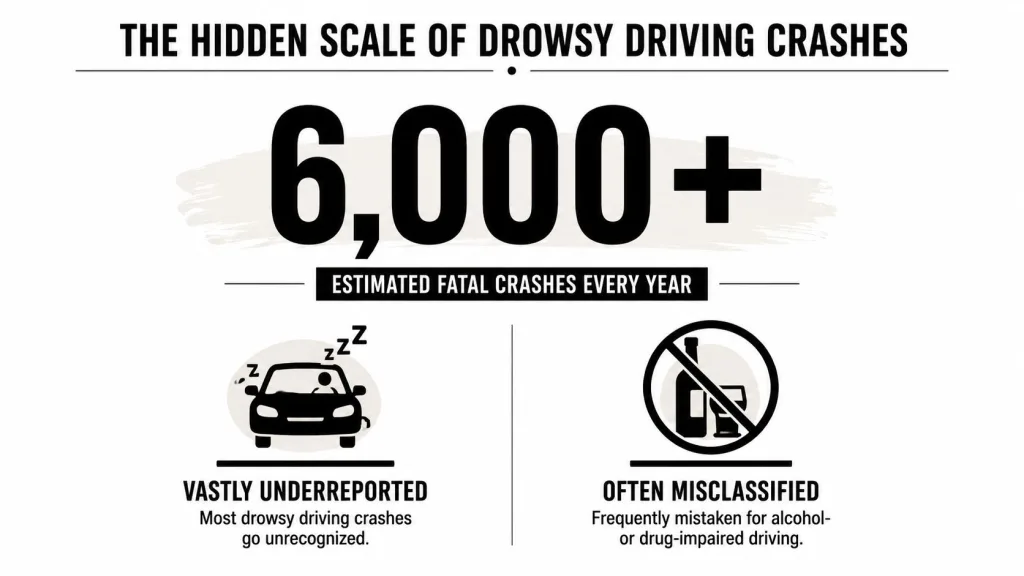
NHTSA estimated that 91,000 police-reported crashes involved drowsy drivers in 2017, causing about 50,000 injuries and nearly 800 deaths (NHTSA drowsy-driving data). That count covers crashes identified and recorded as fatigue-related. Because drowsiness is difficult to verify after a collision, official totals likely miss many cases.
Historical fatal-crash data shows why one figure cannot define the entire problem. NHTSA reported that drowsy driving accounted for 2.3% to 2.5% of all fatal crashes from 2011 through 2015, including 824 deaths in 2015 (NHTSA historical crash statistics). These figures use different periods and methodological approaches, so they should not be compared as if they were measurements from one identical dataset. The gap reflects differences in detection, reporting, and how investigators classify fatigue.
Why fatigue disappears from crash reports
Alcohol impairment can often be assessed through roadside or evidentiary testing. Fatigue has no comparable roadside test. A driver may deny feeling sleepy, a passenger may be unavailable, and the crash scene may offer no clear proof that the driver had been awake too long.
As a result, drowsy driving can be recorded as inattention, lane departure, failure to control the vehicle, or another immediate driving error. Exhaustion also becomes normalized after work, during family travel, and on familiar commutes. Familiar roads can reduce the stimulation that helps an already tired driver remain alert.
The practical lesson: If fatigue is hard to prove after a crash, make the safety decision before departure, while warning signs can still guide you.
Sleep loss affects driving and wider health. For a broader explanation, see The Sleep Consultant on sleep deprivation. For related causes of collisions, review common causes of car accidents.
Awareness alone does not change behavior. A driver can understand the danger and still assume their own fatigue is manageable. “Just get more sleep” fails for shift workers, parents, and people facing long commutes because sleep cannot always be added on demand. Effective drowsy driving prevention therefore needs layers: decide whether to leave, plan stopping points, respond immediately to warning signs, and choose another way to travel when sleep is unavailable.
Recognizing Your Personal Risk Factors
Start with four questions before you touch the ignition: How much did I sleep, when am I driving, how demanding is the trip, and could medication or a health condition make me sleepy? A useful risk review should happen before departure, not after your concentration begins to fail.
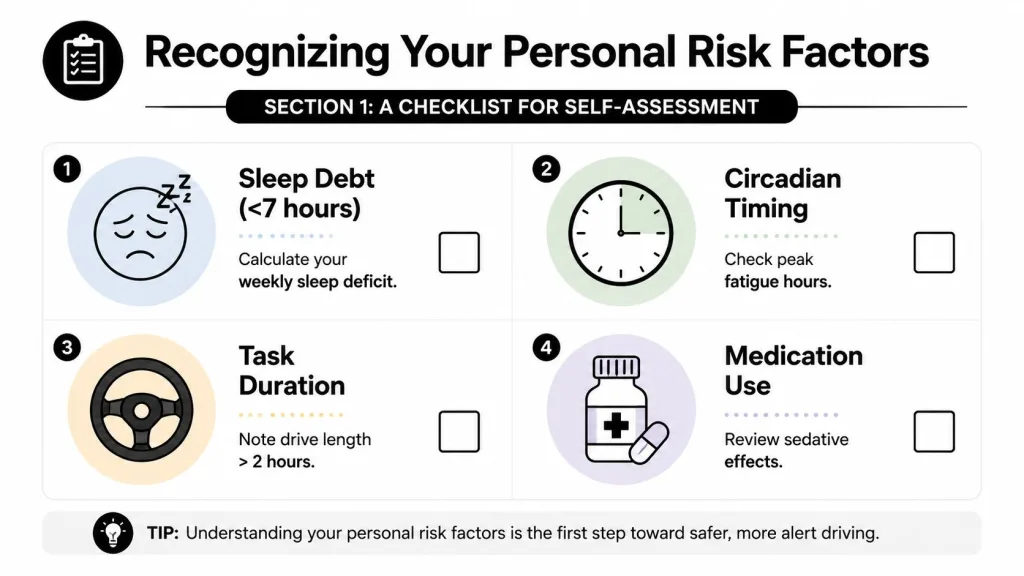
Check sleep, timing, and the task
Sleep loss is the first filter. NHTSA cites crash-rate data showing that drivers who had less than 4 hours of sleep in the prior 24 hours had an 11.5-times higher crash rate than drivers who had at least 7 hours. The same source reports higher rates at 4 to 5 hours, 5 to 6 hours, and 6 to 7 hours, with the corresponding figures listed as 4.3 times, 1.9 times, and 1.3 times higher (NHTSA countermeasures guidance). Habitual sleep of 4 to 5 hours was estimated at a 5.4-times higher crash rate compared with 7 or more hours.
Timing matters even when the total sleep looks acceptable. Driving during the overnight hours, around the early-morning low point, or during a personal afternoon slump can expose you to fatigue when your alertness naturally falls. Shift workers and new parents should treat irregular sleep as a driving risk, not as a private inconvenience.
Trip length and monotony add pressure. Long commutes, straight highways, repetitive routes, and driving after a demanding shift can gradually reduce attention without producing an immediate feeling of crisis.
Know the signs that end the trip
Frequent yawning, heavy eyelids, repeated blinking, wandering thoughts, lane drift, missed exits, and difficulty recalling the last few miles are not harmless discomforts. They indicate that your driving ability is already deteriorating.
Microsleeps are especially serious. A driver may lose awareness for 2 to 3 seconds, then continue as if nothing happened. Passengers often notice a drifting vehicle, delayed response, or blank stare before the driver admits anything is wrong.
Caffeine and willpower can create confidence without restoring safe judgment. In one CDC survey cited by NHTSA, about 4% of 147,076 adults reported falling asleep while driving during the previous 30 days (NHTSA countermeasures guidance). If you’re yawning repeatedly or missing road information, don’t negotiate with yourself. Pull over safely.
Pre-Trip Strategies That Actually Reduce Fatigue
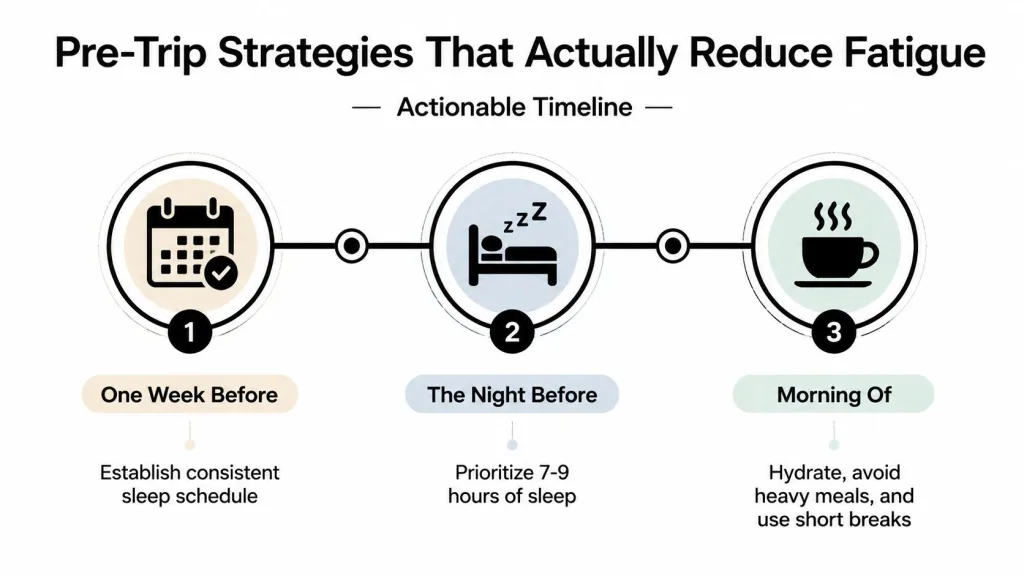
Good drowsy driving prevention begins before the vehicle moves. A long journey shouldn’t depend on a last-minute coffee and the hope that the road will keep you alert.
Prepare across the week
During the week before a long trip, keep sleep and wake times as consistent as your schedule allows. Don’t repeatedly shorten sleep and assume one longer night will erase the accumulated fatigue. Address disruptions early, including an uncomfortable sleep environment, untreated sleep problems, or a medication that makes you sleepy.
In the day or two before departure, protect your normal sleep opportunity. Avoid alcohol and heavy meals before driving, and review medication labels or ask a pharmacist whether a prescription or over-the-counter product can cause drowsiness. Never change prescribed medication without medical advice.
The departure decision needs a firm rule. Rate your alertness from 1 to 10, and commit to not driving when your rating is below 7. The rating isn’t a medical test, but it forces a pause before habit takes over.
Plan the trip around alertness
Choose a departure time when you’re normally awake rather than forcing yourself onto the road during your usual sleep period. For long trips, AAA Foundation guidance recommends scheduling a break every two hours or every 100 miles, avoiding heavy foods, traveling at times when you’re normally awake, and taking turns with an alert passenger (AAA Foundation long-trip guidance).
Identify safe stopping locations before leaving. A rest area, staffed service location, or hotel is a real option. A highway shoulder isn’t a fatigue-management plan.
Shift workers may need a planned nap before a night commute, while parents may need to delay a trip or arrange another driver after a disrupted night. Commercial drivers must follow applicable hours-of-service requirements, but legal compliance isn’t the same as feeling fit to drive. If you’re too tired, stop.
Use vehicle maintenance planning for safer driving as another pre-trip habit. A vehicle problem can add stress and delay, turning an already tiring drive into a longer and more demanding task.
In-Trip Countermeasures and Common Myths
A tired driver can feel briefly better without becoming safe to continue. Use in-trip measures to interrupt fatigue, then decide whether driving should stop.
| Countermeasure | Effectiveness Rating | Why It Works or Fails | Best Practice |
|---|---|---|---|
| Strategic caffeine | Useful but temporary | Caffeine may improve alertness, but it does not replace sleep and can create false confidence | Take it during a safe stop, never to justify continuing |
| Short nap | Useful | A brief nap can restore alertness more directly than stimulation alone | Park safely and allow time to wake fully |
| Scheduled break | Strong | Leaving the driving task interrupts monotony and exposes signs of fatigue | Stop every two hours or every 100 miles on long trips |
| Loud radio | Weak | Noise may stimulate you without correcting sleep loss | Do not use volume as a safety measure |
| Open window or cold air | Weak | Cold air can feel refreshing briefly but does not remove impairment | Use ventilation for comfort only |
| Chewing gum | Weak | It occupies the mouth but cannot prevent microsleeps | Stop when concentration declines |
| Alert passenger | Strong support | A passenger may notice lane drift, silence, and missed signs sooner | Give that passenger authority to call for a stop |
Treat every stop as a safety decision
A quick pause at a fuel pump does not solve mental fog. Park in a safe location, leave the driving position, stretch, drink water, and test your ability to maintain steady attention. Heavy eyelids, wandering thoughts, or repeated yawning require a nap, another driver, or a different way to travel.
A short nap may help, but people with sleep apnea or other sleep conditions need advice suited to their situation. These napping tips for sleep apnea patients provide context for planning naps more carefully.
Caffeine belongs inside a stopping plan, not behind the wheel as a rescue tactic. It may take time to work, and its effect differs by person. Combining caffeine with a short nap during a safe stop can improve alertness more than either measure alone, yet severe sleep deprivation still makes driving unsafe.
Stop immediately: Lane drift, missed exits, memory gaps, or microsleeps show that the countermeasure has failed. Find a safe place to stop.
Passengers must monitor driving behavior, not just provide company. Agree before departure that the passenger can order a stop without debate. If the driver is fighting to keep their eyes open or cannot reliably recall the road just traveled, the trip ends. Pull over, hand over the keys to an alert driver, sleep, or arrange another ride. Awareness matters only when it changes that decision.
Technology and Education as Prevention Layers
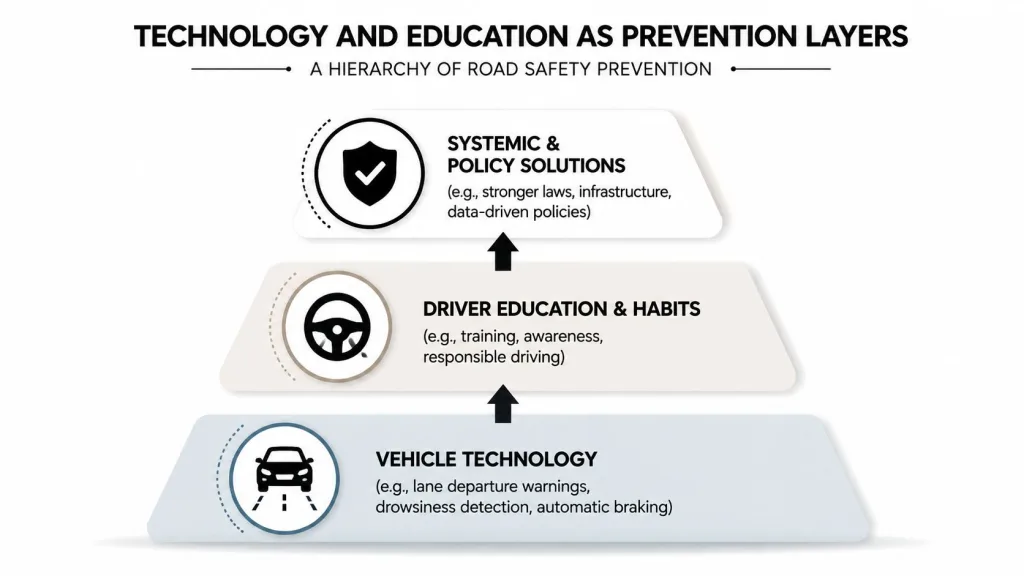
Willpower is a weak safety system. A tired driver may not accurately recognize the decline in attention, so prevention should place safeguards between fatigue and a crash.
Modern vehicles may offer lane-departure warnings, driver-attention alerts, and systems that monitor steering behavior or eyelid closure. These tools can provide an important prompt, especially when the driver fails to notice a gradual loss of concentration. They don’t make a fatigued driver safe, and they can miss impairment, produce alerts at inconvenient times, or encourage overreliance.
Independent evaluation reviewed by the AAA Foundation found that ocular-based monitoring systems detecting eyelid closure were among the strongest-performing approaches. In one field study, Optalert alarms produced a 34% reduction in cautionary drowsiness events, a 53% reduction in critical drowsiness events, and a 47% reduction in hard-braking events (AAA evaluation of fatigued-driving monitoring systems). The same evaluation warns that not every fatigue-detection technology predicts or reduces impairment, so a layered system is safer than reliance on one sensor.
Put responsibility into the workplace
Employers influence fatigue through shift timing, staffing, overtime expectations, delivery pressure, and rest policies. A workplace that rewards workers for driving while exhausted has created a road-safety hazard, even if its written policy says “drive safely.”
Employees can ask for schedules that allow adequate recovery, clear procedures for reporting fatigue, and permission to stop without punishment when alertness falls. Commercial fleets should combine rest rules with fatigue-risk management, training, supervisor accountability, and a culture that treats a delayed arrival as preferable to an impaired driver.
Education supplies the reasoning that casual warnings often lack. A formal traffic-school course can connect fatigue with defensive driving, decision-making, impairment prevention, and crash avoidance. BDISchool offers online, self-paced Florida traffic courses, including Basic Driver Improvement, Intermediate Driver Improvement, Aggressive Driver, and Mature Driver programs, with course availability described through BDISchool’s course options. Education won’t create sleep, but it can change the decision to postpone a trip, stop earlier, or challenge an unsafe schedule.
Vehicle technology, trained habits, and organizational policy reinforce one another. Remove any one layer and the driver carries too much responsibility during the exact period when judgment may be deteriorating.
Building Your Personal Prevention Plan
Use a traffic-light system before every demanding drive. The objective isn’t to prove that you can continue. It’s to decide whether driving is a reasonable choice before the vehicle is moving.
Green means prepared
A green-light trip has adequate recent sleep, a departure time that matches your normal alert period, a manageable route, and no medication or health issue that makes you unusually sleepy. You still plan breaks, keep an alert passenger involved when possible, and agree on what signs will trigger a stop.
Yellow means change the plan. Delay departure, shorten the route, switch drivers, arrange a ride, or add a safe overnight stop when sleep was disrupted, the trip falls during a difficult fatigue period, or the drive will be monotonous and demanding. Yellow isn’t failure. It’s the point where a small adjustment can prevent a larger problem.
Red means don’t drive. Red conditions include heavy eyelids, repeated yawning, lane drift, missed exits, memory gaps, or any microsleep. Stop the trip entirely if these signs appear, regardless of how close you are to home.
Build the protocol before departure
Write down the planned stopping locations and the time you expect to use them. Tell your passenger to speak up immediately if your lane position, speed, or attention changes. If you’re driving alone, use a family check-in or shared arrival plan so another person knows when you should stop and when you should arrive.
Parents need a backup plan for unpredictable sleep. That might mean arranging another driver, postponing a nonessential trip, or separating errands so a tired parent isn’t responsible for every journey. Shift workers should plan transportation around their most vulnerable commute rather than assuming familiarity makes it safe. Long-distance commuters need a routine that includes scheduled recovery and a firm response to the first warning sign.
Keep a simple driving log for demanding trips. Record sleep, departure time, stops, and any alertness warnings. The record turns vague confidence into evidence you can act on.
For more guidance on making safe decisions part of everyday driving, review safe driving habits as a state of mind. Treat fatigue management with the same seriousness as tires, brakes, and vehicle maintenance. A maintained vehicle can’t protect you from a driver who has lost awareness.
BDISchool provides Florida-approved, online, self-paced traffic and driver-improvement courses that cover defensive driving, impairment prevention, crash avoidance, and safer decision-making. Visit BDISchool to choose a course, complete your training from a device that suits your schedule, and turn drowsy driving prevention into a dependable driving habit.