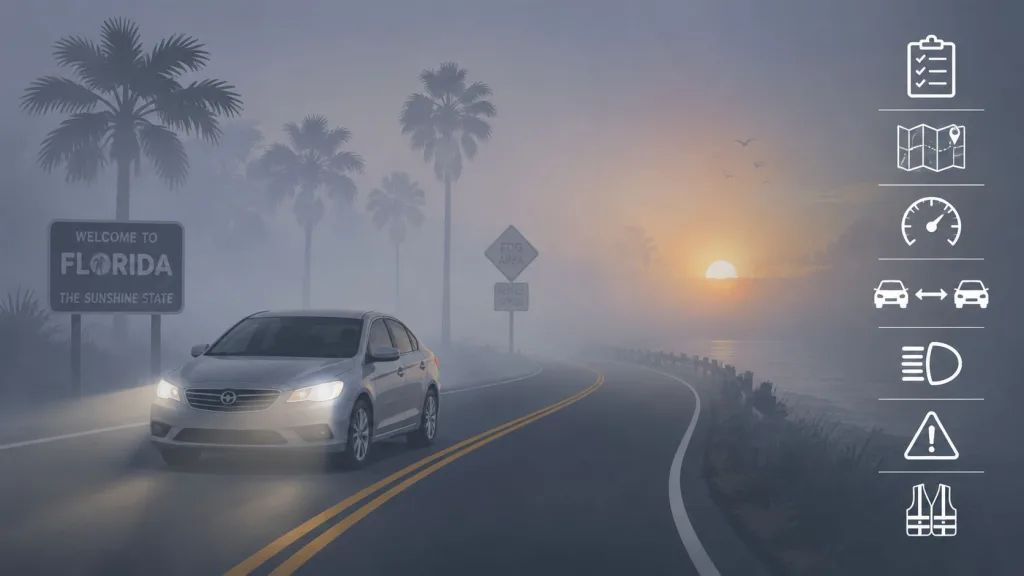
A familiar Florida morning route can change in minutes. The highway you know, the bridge you cross daily, or a coastal road near the Florida Keys may become difficult to read when fog hides lane markings, brake lights, and stopped traffic. Confidence won’t restore visibility. Safe fog driving depends on a prepared vehicle, manual control, disciplined spacing, and a clear decision about when continuing is no longer reasonable.
Fog isn’t a rare edge case. A Transportation Research Board review found that roughly 2% to 3% of crashes in several regions occurred in fog, while a U.S. national synthesis reported about 20,000 police-reported fog crashes per year from 2001 to 2008 and about 2% of fatal crashes from 1990 to 2012. (Transportation Research Board review) These conditions deserve the same structured judgment taught in BDISchool’s Florida-approved defensive-driving courses. If fatigue is part of the problem, review practical guidance on the best energy drinks to stay awake, but never use caffeine as a substitute for rest.
1. Reduce Speed and Increase Following Distance
The safest speed in fog is the speed that lets you stop within the distance you can clearly see. Posted limits assume normal visibility, so treat them as an upper limit, not a target, when fog reduces your view of traffic, curves, debris, or a stopped vehicle.
Reduce speed before entering a foggy section. Braking late creates a chain reaction, especially when the driver behind you can’t see your slowing vehicle until the gap has already disappeared. Rear-end conflict risk rises sharply in dense fog, and risk can vary by vehicle type, lane count, and roadway design. (PubMed research summary)
Use a time gap instead of guessing by car lengths. General fog guidance recommends increasing a normal following gap from about 2–3 seconds to at least 4–5 seconds, and to 6 or more seconds in very dense fog. (TyreMap fog safety guidance)
Practical rule: If you can’t see far enough ahead to stop smoothly, you’re driving too fast.
The suggested eight-to-ten-second gap from some driver-training plans is a useful conservative target on a fast Florida highway, but don’t force yourself to maintain a particular number if traffic, merging, or roadway conditions make it impractical. Create the largest stable gap you can, keep your speed smooth, and don’t use another vehicle’s taillights as permission to follow closely.
For a simple check, note when the vehicle ahead passes a fixed point, then count before your vehicle reaches it. Use the two-second rule for safer driving as a foundation, then expand the gap substantially for fog. A defensive-driving course can help you practice judging space before a real morning commute demands it.
2. Use Low-Beam Headlights and Fog Lights Correctly
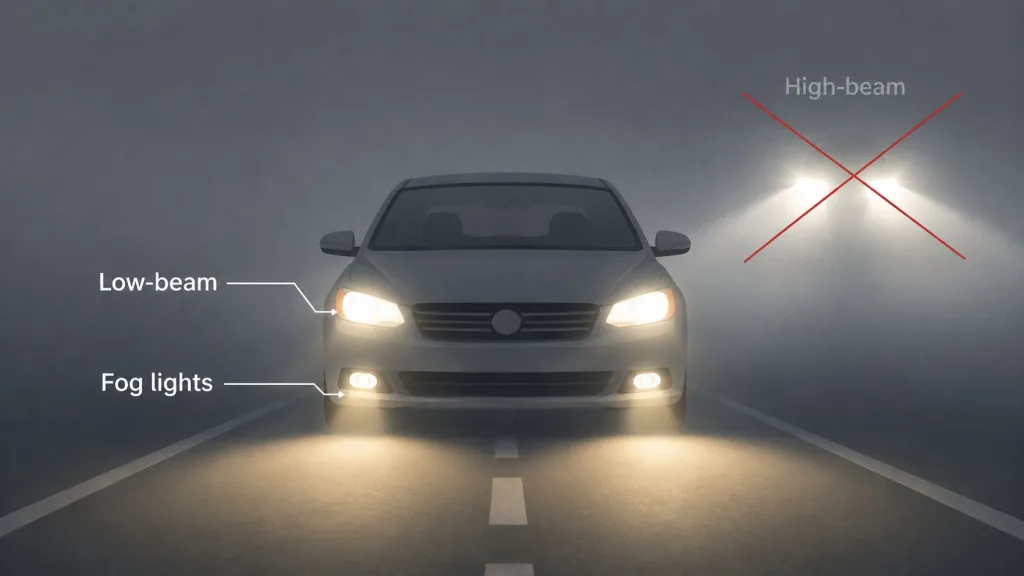
Turn on your low-beam headlights as soon as visibility drops, even during daylight. Low beams direct light toward the roadway and make your vehicle easier for other drivers to see. High beams send more light upward, where fog droplets scatter it back toward your eyes and create a bright veil.
The National Weather Service recommends low beams in fog and advises drivers to avoid high beams because glare can make forward visibility worse. In extremely dense fog, its guidance is to pull off the road, use hazard lights, and stop in a safe location. (National Weather Service fog-driving guidance)
If your vehicle has dedicated fog lights, use them with low beams, not instead of them. Fog lamps may help illuminate the road immediately ahead, but specialized lighting can’t replace slower speed, proper spacing, and lane control. Technical research also found limited proven safety benefit from front fog lamps over low beams, so don’t treat them as a solution by themselves. (Scientific Reports visibility research)
Check the equipment before you leave
Clean cloudy lenses, remove dirt from the headlamps, and confirm that the beams illuminate the roadway rather than pointing into other drivers’ eyes. Check the owner’s manual if you aren’t sure how to activate fog lights, and learn more about high-beam and low-beam headlights before you need the information in poor visibility.
A Jacksonville bridge crossing, an I-4 commute near Orlando, or a coastal drive near West Palm Beach can move from clear to hazy quickly. Don’t wait for darkness or a warning sign before turning on the correct lights. If your lenses have become yellowed, follow a safe maintenance method such as this guide to the best way to restore yellowed headlights.
3. Avoid Using Cruise Control in Fog
Switch cruise control off when you enter fog. The system maintains a selected speed, but fog requires continuous speed decisions as visibility changes from one stretch of road to the next.
A driver using cruise control may feel relaxed while the road becomes less readable. That delay matters when a fog bank appears near Daytona on Interstate 95, when Highway 27 develops sudden patches in central Florida, or when coastal fog reaches a South Florida Turnpike segment. You need your foot ready to ease off the accelerator and your attention fixed on the changing sight distance.
Keep both hands available for steering and avoid treating the vehicle ahead as a guide. Taillights can disappear, brake suddenly, or create a false sense that the road is safe. Manual control also helps you make gradual adjustments instead of waiting for the vehicle’s system to respond to a changing situation.
Keep your attention active
Fog driving calls for smooth inputs. Don’t make sharp steering movements, sudden lane changes, or abrupt braking unless an immediate hazard leaves no alternative. Scan the visible roadway, check mirrors without staring away from the road, and keep your body positioned to respond.
Fatigue makes this harder. If the commute becomes stressful or visibility remains poor, take a safe break rather than trying to compensate with speed or automation. Structured training in emergency maneuver techniques can reinforce the habit of staying engaged and responding deliberately when conditions change.
4. Use Road Markings and Center Lines as Navigation Guides
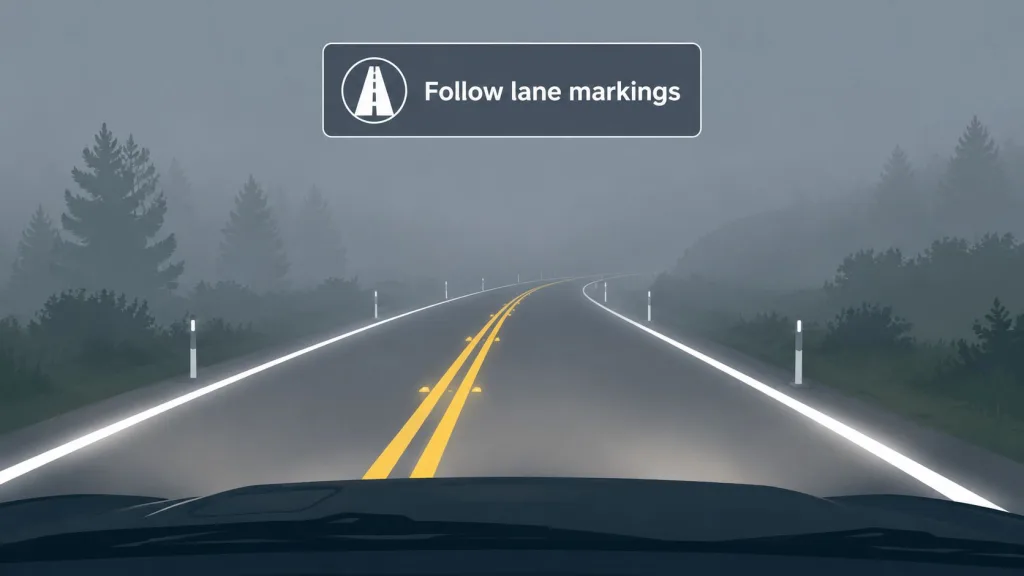
When distant objects disappear, use the pavement directly in front of you. White edge lines and yellow center lines give you a stable reference for lane position when signs, buildings, and vehicle lights become unreliable.
Look at the markings ahead, not at the taillights of the car in front. A vehicle may drift, change lanes, or stop unexpectedly, while the road lines show where your lane runs. Keep the car centered between the lines and avoid crossing into another lane because the route feels visually empty.
On Florida roads, reflective markings can be especially useful on corridors such as the Florida Turnpike, I-75, and I-95. Their usefulness still depends on visibility. If you can’t see the markings clearly, lower your speed until you can track them consistently.
Keep your lane position predictable. In fog, predictability gives nearby drivers more time to recognize what you’re doing.
Don’t stare at a single point for too long. Use a controlled visual scan that includes the visible lane, edge line, center line, mirrors, and immediate hazards. If the road curves, follow the markings through the curve rather than steering toward a light that may belong to another lane or an approaching vehicle.
Avoid unnecessary lane changes
Stay in your lane unless a change is necessary. Signal early, check mirrors carefully, and move smoothly only when you can identify the destination lane. Defensive-driving instruction can help you develop lane-position habits before you encounter fog on a bridge, highway, or coastal route.
If the markings vanish completely, treat that as a warning that your current speed is too high for the conditions. Reduce speed, increase space, and prepare to pull off if you can’t regain a clear lane reference.
5. Stay Alert and Avoid Distractions at All Times
Fog removes your margin for divided attention. Put your phone away, silence notifications, and finish every adjustment before the vehicle enters the densest part of the fog.
That includes navigation, climate controls, music, mirrors, food, drinks, and grooming. A Tampa Bay morning commute may already demand frequent visual decisions, while a Jacksonville bridge crossing can produce rapid changes in visibility. Looking down for a few seconds can mean missing a brake light, lane shift, or stopped vehicle.
Prepare the cabin before the fog
Set navigation and climate controls while visibility is good. Keep both hands available, maintain a clear windshield, and use the defroster or wipers when moisture builds on the glass. Don’t reach for an item or answer a call while moving.
If an urgent call or navigation correction can’t wait, pull into a safe location before handling the phone. Stopping in a suitable parking area or rest location is safer than trying to manage a device while traffic moves around you.
Miami-Dade rush-hour traffic adds another layer of pressure. Don’t let impatient drivers behind you determine your speed or following gap. Stay focused on your own visible stopping distance and make smooth, predictable decisions.
Your visibility is already limited. Don’t voluntarily limit your attention, too.
Take a break if fog delays the trip and frustration starts affecting your choices. Defensive-driving education addresses distraction, attitude, and hazard response together, which makes the lessons easier to apply when a routine commute becomes demanding.
6. Know When to Pull Over and Wait for Visibility to Improve
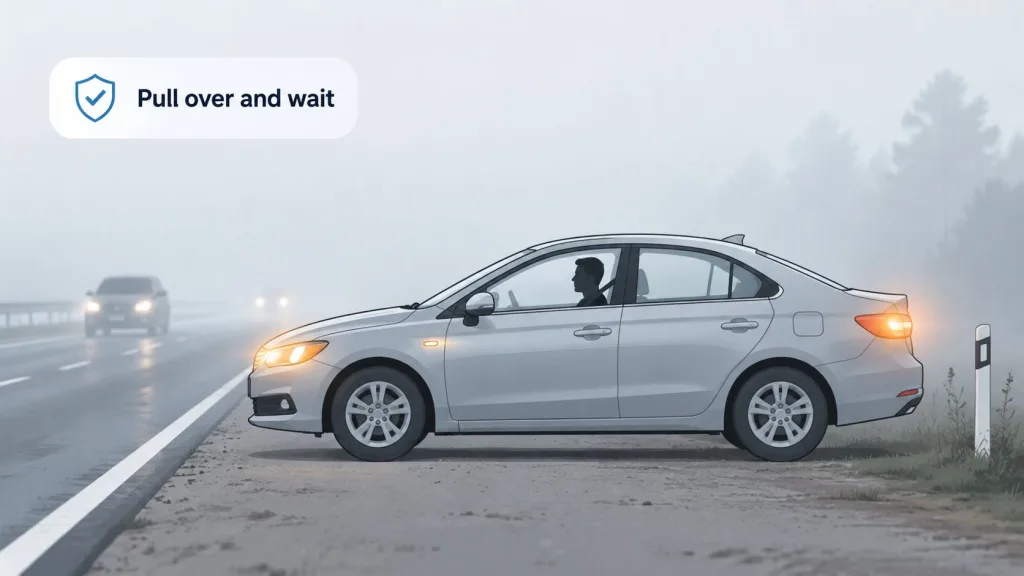
Pull over as soon as fog removes your ability to identify a safe path. Continuing slowly while nearly blind still leaves too little time to react. Exit the travel lane completely and wait in a safe location until visibility improves.
Choose a parking lot, rest area, or another place separated from moving traffic. Never use an active lane as a waiting area, and treat a narrow shoulder as an emergency option only. If no safer location is immediately available, move as far from traffic as conditions allow, activate hazard lights where permitted, fasten your seatbelt, and remain inside the vehicle when getting out would expose you to passing traffic.
Rules differ by jurisdiction. New South Wales permits hazard lights in hazardous conditions such as fog or rain, including when a vehicle is stopped in a hazardous position. (New South Wales road rules) Follow the rules where you drive, and use hazard lights only as part of a safe stopping decision.
Use a clear restart test
Do not restart because another driver passes or because you feel pressure to arrive. Resume only when you can see lane markings, identify nearby traffic, and choose a speed that allows you to stop within the distance you can see.
FAQ: When should I pull over in fog? Pull over when lane markings, nearby vehicles, or a safe path ahead are no longer clear. Where should I wait? Use a parking lot, rest area, or another location away from moving traffic.
Fog often develops overnight and during morning travel. Research has found fog-related fatal crashes concentrated during those periods, while a Florida-focused review found winter had a higher share of fatal crashes involving fog than summer. Plan extra time for a delayed departure instead of forcing a dangerous continuation. Structured defensive-driving education reinforces this decision process by turning visibility limits, speed control, and escape planning into repeatable habits.
7. Increase Vehicle Maintenance and Safety Checks Before Fog Season
A safe fog decision starts before the engine runs. Inspect the systems that preserve visibility and control, including tires, brakes, wipers, windshield glass, washer fluid, and every exterior light.
Check brake pads and rotors for condition, confirm that tires have usable tread, and replace worn wipers that smear moisture across the windshield. The plan’s maintenance benchmark is to replace tires when tread is below 4/32 inch, but any inspection should also account for uneven wear, damage, inflation, and the vehicle manufacturer’s guidance.
Complete a short pre-fog inspection
- Test every light: Check low beams, high beams, fog lights, brake lights, turn signals, and hazard lights.
- Clean the lenses: Remove dirt and haze so the light output remains as clear as possible.
- Inspect the glass: Repair damage where appropriate and keep the windshield clean inside and out.
- Check the wipers: Replace blades that chatter, skip, or leave a film.
- Fill washer fluid: Keep enough fluid available to clear road spray and moisture.
- Check the tires: Look for damage, uneven wear, and correct inflation before a highway trip.
- Test the brakes: Address pulling, vibration, noise, or a soft pedal before driving into poor visibility.
Florida’s fall and winter conditions can bring fog to different regions at different times. A driver leaving Tampa Bay, Jacksonville, Orlando, or the Panhandle shouldn’t assume a clear driveway means a clear route. Use a maintenance checklist before the season and review Florida-specific requirements in the Florida vehicle maintenance guide.
A professional inspection can identify problems you may miss in a quick driveway check. Maintenance won’t make dense fog safe by itself, but it ensures your vehicle can respond when you slow, steer, brake, or need to clear the windshield quickly.
7-Point Fog Driving Safety Comparison
| Safety Measure | Implementation Complexity 🔄 | Resource Requirements ⚡ | Expected Outcomes ⭐📊 | Ideal Use Cases | Key Advantages 💡⭐ |
|---|---|---|---|---|---|
| Reduce Speed and Increase Following Distance | Low 🔄, simple behavior change, needs discipline | Minimal ⚡, time and attention; may increase travel time | High ⭐⭐⭐ 📊, substantially lowers collision risk and increases reaction time | Dense fog on highways and rural roads; low-visibility commutes | Clear reduction in crash risk; easy to adopt. 💡 Use 8–10s gap |
| Use Low-Beam Headlights and Fog Lights Correctly | Low 🔄, simple switch but requires knowledge | Low–Moderate ⚡, functioning lights and occasional cleaning | High ⭐⭐⭐ 📊, improves road illumination and reduces glare | Any foggy conditions, daytime or night; coastal bridges | Better visibility for driver and others; reduces glare. 💡 Use fog lights with low‑beams; keep lenses clean |
| Avoid Using Cruise Control in Fog | Very Low 🔄, disable feature, remain engaged | None ⚡, only driver attention required | Moderate ⭐⭐ 📊, increases ability to react to sudden hazards | Patchy fog, sudden visibility changes, winding roads | Restores manual control and responsiveness. 💡 Keep hands on wheel |
| Use Road Markings and Center Lines as Navigation Guides | Low–Moderate 🔄, requires focused attention on pavement | Minimal ⚡, depends on road maintenance (reflective markings) | High ⭐⭐⭐ 📊, helps maintain lane position and prevent drift | Well-marked highways and turnpikes during low visibility | Reliable visual reference; reduces unintended maneuvers. 💡 Slow down if markings are faded |
| Stay Alert and Avoid Distractions at All Times | Moderate 🔄, sustained mental engagement needed | Minimal ⚡, discipline, may require breaks on long trips | High ⭐⭐⭐ 📊, markedly improves hazard detection and response | All fog conditions, especially high-traffic commutes | Maximizes situational awareness and safety. 💡 Stow phone; preset controls before driving |
| Know When to Pull Over and Wait for Visibility to Improve | Moderate 🔄, requires judgment and safe pullover technique | Low ⚡, safe shoulder/parking area and hazard lights | Very High ⭐⭐⭐⭐ 📊, removes exposure to driving hazards entirely | Severe fog (visibility <100 ft) or when unsafe to continue | Safest option when driving is unsafe; prevents accidents. 💡 Exit roadway completely and stay belted |
| Increase Vehicle Maintenance and Safety Checks Before Fog Season | Moderate 🔄, planning, inspections or professional service | Moderate ⚡, time and possible maintenance costs | High ⭐⭐⭐ 📊, reduces mechanical failures during fog | Pre-season preparation for frequent fog regions, fleet readiness | Ensures braking, lighting, wipers perform when needed. 💡 Check brakes, tires, lights, and wipers before fog season |
Turn Better Fog Decisions Into Lifelong Driving Skills
The safest sequence is straightforward. Prepare the vehicle, turn on low beams, reduce speed, create a large gap, follow the road markings, remove distractions, and pull over when visibility no longer supports safe travel.
Fog deserves respect because its consequences can be severe. A compiled study found that the fatality rate for fog crashes on California freeways was almost twice the rate for non-fog crashes. (AAA Foundation fog and crashes report) The lesson applies to Florida drivers even when the route feels familiar. A routine trip can become a high-severity crash environment when drivers maintain speed, follow too closely, or rely on high beams.
Structured defensive-driving education turns these decisions into repeatable habits. BDISchool’s Florida-approved programs cover safe following distances, defensive driving techniques, crash avoidance, distracted driving, aggressive driving behavior, and Florida traffic requirements. The available options include the Basic Driver Improvement course, a 4-hour program for drivers who received a moving violation; the Intermediate Driver Improvement course, an 8-hour program for court-ordered drivers or deeper safety instruction; the Aggressive Driver Course, an 8-hour program focused on responsibility and behavioral change; and the Mature Driver Course, a 6-hour refresher for drivers aged 55 and older.
Courses are available online, self-paced, and in English, Spanish, and Portuguese. After completion, certificates are issued electronically and reported directly to the FLHSMV. Explore the Florida-approved defensive-driving courses and choose the program that matches your driving requirement.
Fog driving FAQ
What is the safest speed in fog? Drive only as fast as the distance you can clearly see allows. Slow before visibility drops further and reduce speed again if you can’t track lane markings or identify hazards early.
Which headlights should you use in fog? Use low-beam headlights. Avoid high beams because fog droplets scatter the upward light and create glare. Use fog lights with low beams if your vehicle has them and the conditions and local rules allow it.
Should you use cruise control in fog? No. Turn it off so you can adjust speed immediately as visibility and traffic conditions change.
When should you wait instead of continuing? Pull completely off the roadway when visibility is too poor to identify your lane, nearby traffic, or a safe stopping distance. Turn on hazard lights where permitted, remain secured in the vehicle, and resume only after visibility improves enough for controlled travel.
BDISchool offers Florida-approved BDI, IDI, Aggressive Driver, and Mature Driver courses with flexible online access, including English, Spanish, and Portuguese study options. Build stronger fog-driving and defensive-driving habits while meeting applicable traffic-school requirements, then visit BDISchool to select your course and get started.