You’re coming down I-95 in Florida, minding your lane, when the car ahead of you slams on its brakes for no reason you can see. Your foot hovers for a split second. In that moment, you either react with trained control, or you let panic decide for you.
That’s the value of emergency maneuver training. It turns a sudden surprise into a practiced response, and that matters whether you’re in a car, on a highway, or flying an aircraft. The FAA has long treated maneuvering-flight loss of control as a serious safety problem, noting that nearly 27% of all fatal loss-of-control accidents in 2001 to 2010 happened during maneuvering, and that 41% of those fatal accidents ended in a stall or spin (FAA Safety Standdown brochure). That same logic applies on Florida roads, where sudden stops, wet pavement, and short reaction windows punish anyone who waits to think.

Why Emergency Maneuver Training Saves Lives
A close call on a Florida highway does not wait for a calm, convenient moment. The car ahead brakes hard. A lane opens on the left. A shoulder looks tempting. If your hands and feet have not been trained, you freeze, overcorrect, or pick the wrong escape path.
The point of emergency maneuver training is simple. Rehearse the right response until it becomes automatic. That is why aviation has spent decades drilling control inputs instead of trusting instinct. The FAA says fatal loss-of-control accidents happen about 3 times more often than controlled flight into terrain, and that maneuvering-phase fatal loss-of-control accidents happen about 26 times more often than emergency landing-phase loss-of-control accidents (FAA Safety Standdown brochure). Those are aviation numbers, but the lesson fits Florida traffic perfectly. Risk shows up when speed, surprise, and little room for error meet.
Training beats panic every time
Panic narrows attention. Training widens it. A driver who has rehearsed hard braking, evasive steering, and skid recovery does not waste time debating the physics of the moment. They execute.
Practical rule: if you are surprised, your first job is control.
That is why professional instruction matters more than roadside advice or casual YouTube viewing. A structured course teaches you how to respond before your brain starts bargaining. If you need a useful companion read after a collision, keep what to do after car accident handy, because the right actions after impact matter just as much as the right inputs before impact.
Florida drivers should also study hazards the same way aviators do. hazard recognition training sharpens the ability to spot trouble early, before it turns into a full emergency. The best emergency maneuver is the one you never have to make.
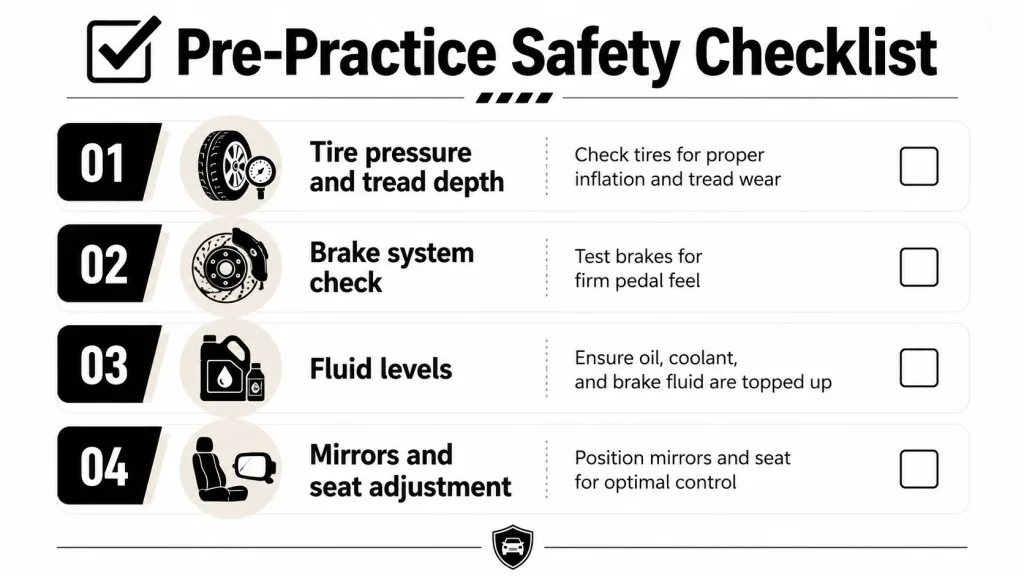
Preparing Your Vehicle and Practice Environment
Start with the car, not the drill. A vehicle with weak tires, vague brakes, or a poor seating position will teach bad habits fast. You don’t train emergency control in a machine that already feels loose, inconsistent, or cramped.
Before any practice session, check the basics in the same order every time. Tires first, because grip starts there. Brakes next, because a firm, predictable pedal is essential. Then set your seat and mirrors so your arms stay relaxed and your head has a clean view of the road.
Use a clean, empty space
An empty parking lot with painted lines is the right place to begin. It gives you boundaries without traffic pressure, and it lets you repeat the same motion until your hands stop hesitating. If you don’t have cones, use lightweight household items that are visible and easy to move.
A good setup keeps distractions out and focus in. Put the phone away, close the windows if noise pulls your attention, and tell anyone in the car that practice time means silence. If you’re troubleshooting brake feel before practice, a resource like diagnose brakes locking up can help you separate a mechanical problem from a skill problem.
A practice area should feel boring before you make it challenging.
That’s the standard. If the surface is slick, the lot has traffic, or the layout forces you to improvise, skip it. Clean setup builds clean input, and clean input is what you want when an emergency arrives.
For vehicle readiness, a maintenance refresher is worth your time before any serious practice. A quick review of Florida vehicle maintenance helps you keep the car from fighting the lesson.
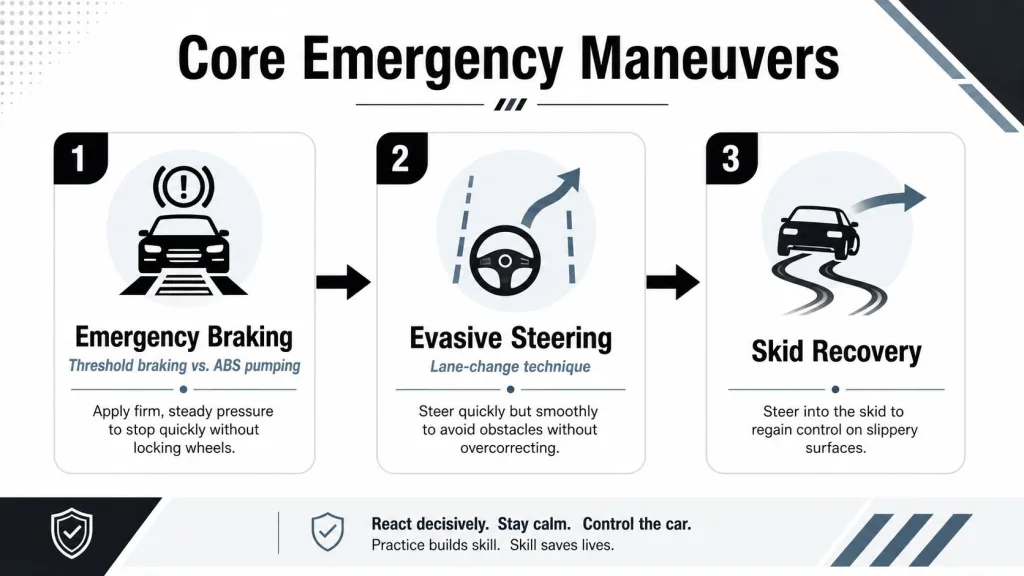
Core Emergency Maneuvers Every Driver Must Master
The three skills that matter most are braking, steering, and recovery. Everything else sits underneath those actions. If you can’t stop straight, steer decisively, and correct a skid without making it worse, you’re still gambling.
Emergency braking without locking up
The goal is maximum deceleration with control. In a car with ABS, press the brake pedal firmly and steadily, don’t stab it, don’t pump it unless you know the vehicle requires a different approach. Keep your eyes where you want the car to go, not on the hood.
In practice, drivers get into trouble because they lift off too early or mash the pedal in a panic. Both mistakes stretch stopping distance and increase instability. The body should stay centered in the seat, hands controlled, and the steering wheel held with a calm, firm grip.
Evasive steering that doesn’t turn into overcorrection
If the lane ahead is blocked by debris, a stalled vehicle, or a sudden stop, steer to the escape path with purpose. Look where you want to go before you move the wheel, because your eyes drive your hands. Then make the move smoothly enough to avoid a snap reaction that sends the car back the other way.
The common mistake is target fixation. Drivers stare at the obstacle, then steer toward it or freeze beside it. That’s why emergency maneuver training drills vision first, wheel second. A useful hand-eye reference is hand-eye coordination improvement, because fast steering only works when your eyes and hands agree.
Skid recovery on wet Florida pavement
Skids happen when grip is already compromised, often by rain, oil, or standing water. If the rear steps out, your job is to reduce the slide and aim the car back into line, not fight the motion with a hard, panicked correction. Keep the steering movement measured and the brake input appropriate for the surface, because sudden inputs usually make the skid worse.
Wet pavement punishes slow decisions and loud hands.
That applies across front-wheel, rear-wheel, and all-wheel-drive vehicles. The drivetrain doesn’t cancel physics, it only changes how the slide starts and how you recover from it. Florida’s rain patterns make that lesson worth practicing until it feels routine, not theoretical.
Structured Practice Drills for Real-World Readiness
Technique fades if you never rehearse it. Muscle memory comes from repetition with a purpose, not from one dramatic lesson followed by months of nothing. The strongest training sessions are short, controlled, and boring on purpose.
Build from slow to realistic
Start with a cone weave in an empty lot. Keep the speed low, focus on smooth hand movement, and keep your eyes ahead of the vehicle instead of locking onto the bumper. If the car feels jerky, slow down and clean up the inputs before you add speed.
Next, add a surprise brake drill. Have a passenger call out the stop point so you are not predicting it, then practice a firm, straight stop without panic correction. After that, move to wet-surface awareness by practicing only on safe, controlled pavement conditions where traction changes but risk stays managed.
Progress only when the previous step is clean
The drill is not finished because you survived it. It is finished when you can repeat it with consistency. If your steering gets sloppy, your braking gets delayed, or your eyes drop to the hood, you are not ready to raise the difficulty.
A simple progression works best.
- Phase 1, lot work: Practice braking and steering at low speed until the car feels predictable.
- Phase 2, harder stops: Increase braking force gradually and notice how the vehicle responds.
- Phase 3, lane-change decisions: Combine obstacle spotting with an immediate escape path.
- Phase 4, mixed scenarios: Put braking and steering together so you learn to choose the right action fast.
The best track record comes from writing down what feels off after each session. Note whether you hesitated, oversteered, or fixed your eyes on the obstacle. Then correct that one issue next time instead of trying to fix everything at once.
If your brakes are not behaving, read what to do when brakes fail before you practice again. Skill training cannot overcome a bad mechanical setup.
When to Enroll in a Professional Driving Course
Self-practice builds confidence. Professional instruction builds judgment under pressure. That difference matters because a good instructor sees the micro-errors you don’t notice, and those micro-errors are where bad habits hide.
Professional training gives you controlled conditions that private practice can’t match. Dual-brake vehicles, structured feedback, and scenario-based coaching let an instructor correct your timing before the error becomes a reflex. In aviation, Transport Canada’s recovery guidance stresses immediate reduction of angle of attack, thrust management, and getting the aircraft back to a safe flying condition, which is the same philosophy behind strong driving instruction, quick, correct, deliberate action (Transport Canada AC No. 700-031).
Choose training that matches your situation
If you need point dismissal, court compliance, or a clean refresh, a structured driver education course is the smarter move than guessing your way through private practice. If you want deeper behavior change, not just a certificate, choose the course that forces accountability and repetition.
Florida drivers can compare options through BDISchool courses or the course offerings at DriverEducators courses. The right choice depends on why you’re enrolling, but the standard should be the same, clear instruction, practical exercises, and a curriculum that builds habits you’ll still use next year.
What to look for in a course
- Certified feedback: You want an instructor who catches small errors before they become dangerous patterns.
- Scenario practice: A real course should make you respond to changing conditions, not just memorize rules.
- Skill transfer: The best programs connect maneuvering skills to everyday traffic, weather, and congestion.
- Court and insurance value: If your reason for enrolling includes compliance or discounts, choose a program that clearly states those outcomes.
If a course only teaches theory, it’s incomplete.
A real emergency isn’t a multiple-choice question. It’s a physical event that demands timing, steering feel, braking judgment, and calm. That’s why formal instruction is the faster path to competence.
Frequently Asked Questions About Emergency Maneuver Training
How often should I refresh these skills? Refresh them any time your driving gets rusty, or after a season change that brings different traction and traffic patterns. The point is to keep the response automatic.
Can older vehicles handle emergency maneuvers? Usually, yes, if the vehicle is maintained well enough to brake, steer, and grip properly. If the brakes feel soft, the tires are worn, or the alignment is off, fix the car first.
Will emergency training lower my insurance? Sometimes training helps with discounts, but that depends on the insurer and the course. Ask before you enroll, not after.
What if I freeze in a real emergency? Go back to the first rule, control the vehicle. Eyes up, hands steady, brake or steer with purpose, and get yourself to a safe condition as quickly as you can.
Is this about stunt driving? No. This is about surviving the exact moments that most drivers mishandle, sudden stops, skids, and surprise obstacles. The goal is control, not showmanship.
If you’re serious about becoming harder to surprise on the road, take the next step with BDISchool. Their Florida-approved courses are built to turn nervous reactions into reliable habits, and that’s exactly what emergency maneuver training is supposed to do.