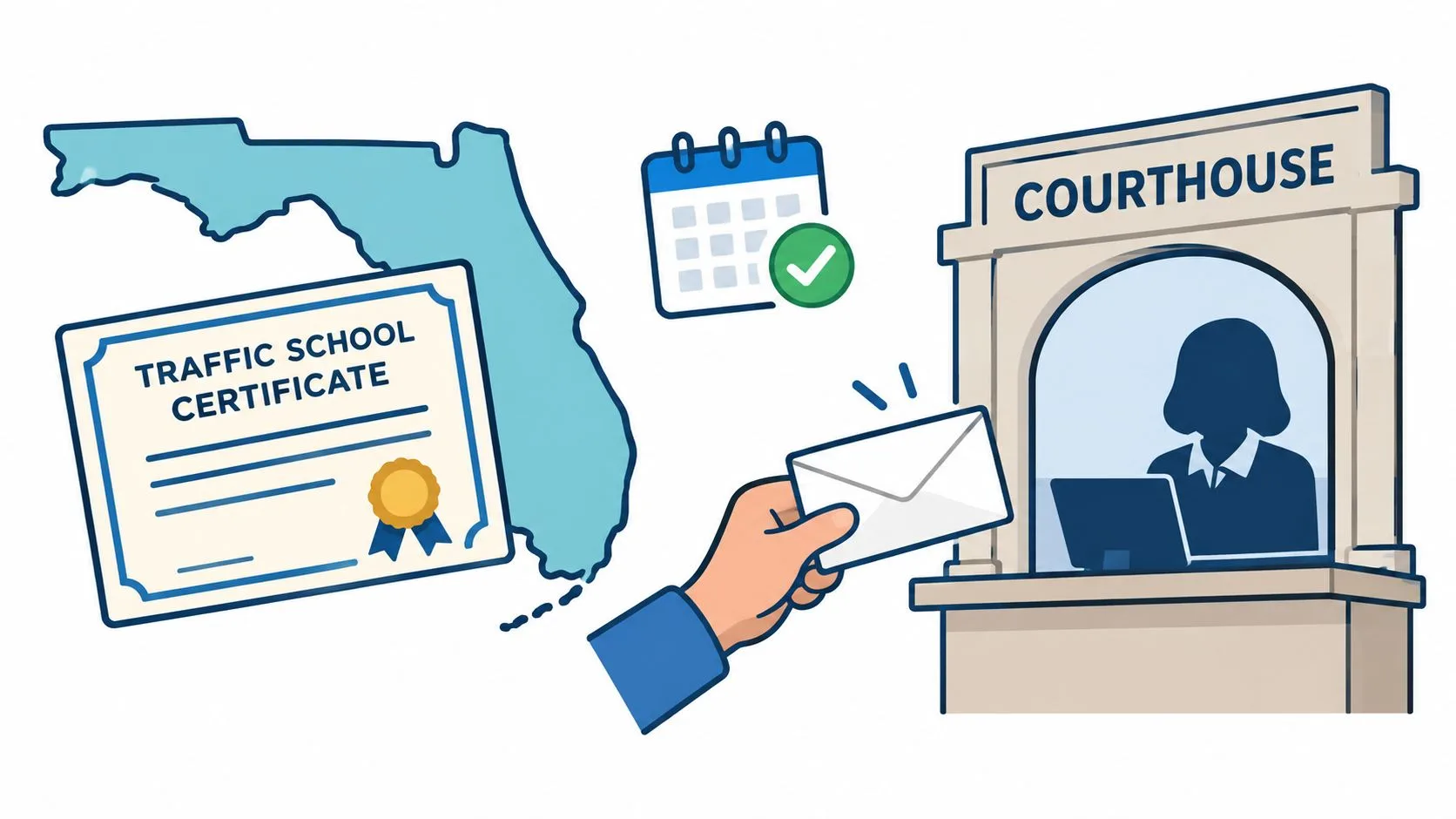
A Florida ADI course is a state-approved driver-improvement program for drivers who need license restoration after a suspension, while BDI is the course that can prevent points from being assessed for an eligible violation. For a non-commercial driver, BDI must be elected within 30 days of the citation date to qualify.
You may be sitting at your kitchen table with a citation in hand, trying to decide whether to pay it, contest it, or take traffic school. The most damaging mistake isn’t always choosing the wrong course. Often, it’s waiting too long to make the election.
Florida treats driver improvement as a formal compliance process, not an informal online class. The right course can support point relief, satisfy a court or FLHSMV requirement, and potentially help with insurance costs. The wrong course, or a late election, can leave you with points, suspension exposure, and a certificate that doesn’t solve the problem.
What Happens When You Get a Moving Violation in Florida
The police lights appear in your rearview mirror on the way to work. The citation may involve speeding, a traffic signal, or another moving violation in Florida. From that moment, the citation carries a response deadline, a court process, and possible consequences for your driving record.
Florida’s traffic safety record explains why citations can lead to structured education requirements rather than a simple payment. FLHSMV reported 381,210 codable traffic crashes in 2024 and 3,184 people killed in vehicle crashes statewide in its annual safety summary (FLHSMV traffic safety data).

The 30-day election deadline
For an eligible non-commercial driver, Basic Driver Improvement must be elected within 30 days of the citation date. Make the election with the clerk of court in the county where the citation was issued, then complete the course. Enrolling in a class without making the formal election does not protect the option (Florida BDI requirements).
The timing trap is procedural. You can qualify for BDI, choose an approved provider, and begin studying, yet lose point protection because the election was late. Check the citation date before paying, contesting, or enrolling, and confirm the election with the correct clerk.
Florida also limits this election to once every 12 months and no more than eight times in a lifetime. Review that history before relying on BDI (Florida driver-improvement statute). A timely election and the correct course must both be in place.
How Florida Defines the ADI and BDI Course Paths
ADI means Advanced Driver Improvement. It is generally tied to license reinstatement after a suspension, a court order, or another high-risk driving situation. BDI means Basic Driver Improvement, the shorter course commonly used after an eligible non-criminal moving violation.
Florida law sets requirements for driver-improvement programs, including course content, eligibility, timing, and approval. Traffic law and substance-abuse education courses must include at least 4 hours of course content, with up to 30 minutes for breaks. Review the applicable Florida statutory framework before relying on a course to meet a legal requirement.
Choose by the order you received
| Course path | Typical situation | Main purpose | Point result |
|---|---|---|---|
| BDI | Eligible non-commercial driver with a non-criminal moving violation | Citation-related point protection and driver education | No points are assessed for the elected violation when the requirements are properly met |
| ADI | Driver suspended for point accumulation, habitual traffic offender status, or court order | Required education connected to license reinstatement or compliance | It isn’t a substitute for BDI election |
Check your paperwork first: if it references BDI, elect with the clerk within the required deadline, then complete the course. If it references ADI, reinstatement, or a court mandate, take the specified advanced course. Enrolling in the wrong class does not satisfy the order, and missing the election deadline can eliminate the BDI point-reduction option.
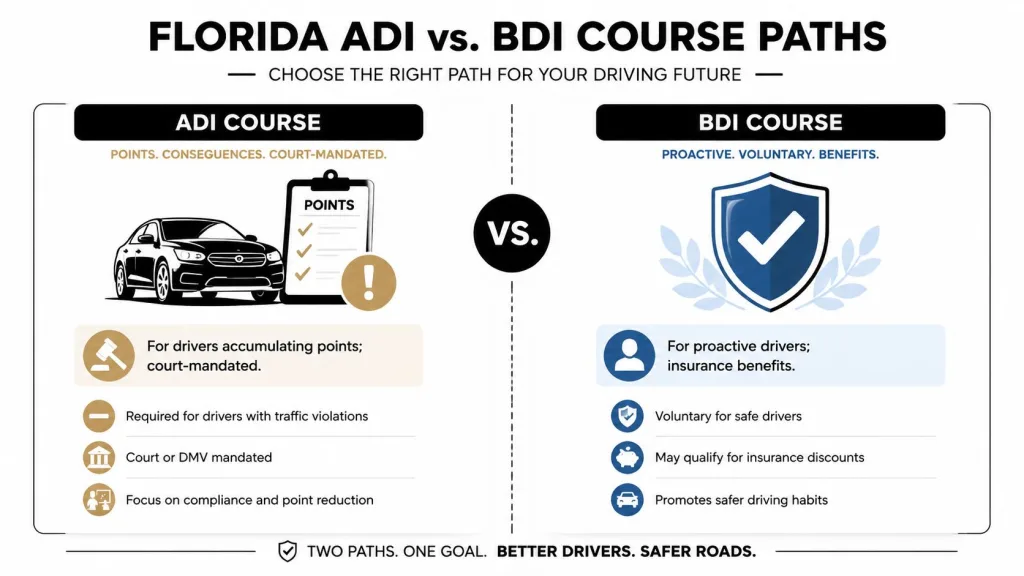
Before registering for a Florida BDI course online, read the exact wording of your citation or order. Similar course names serve different legal purposes.
Who Must Take a Florida ADI Course and When
Florida’s point system creates a defined escalation path. The thresholds are 12 points in 12 months, which triggers a 30-day suspension, 18 points in 18 months, which triggers a 3-month suspension, and 24 points in 36 months, which triggers a 1-year suspension (FLHSMV point suspension rules).
Drivers suspended because of point accumulation, habitual traffic offender status, or a court order are required to complete an Advanced Driver Improvement course. That requirement makes ADI a reinstatement and compliance tool, not an optional class for someone who wants to learn more about driving.
Use this decision path
- Read the order: Look for a direct reference to ADI, license reinstatement, suspension, or a court mandate.
- Check your record: Confirm whether the suspension relates to accumulated points, habitual traffic offender status, or another court-directed condition.
- Separate citation relief from reinstatement: A new moving violation may present a BDI option, but an existing suspension can create a separate ADI obligation.
- Follow the authority named in the paperwork: Your order may direct you to submit proof to FLHSMV, a court, or another specified office.
A first-time eligible moving violation doesn’t automatically mean you need ADI. Many drivers in that situation are evaluating BDI, while repeat offenses and suspension orders move them into the advanced course path.
Practical rule: Never select a course based only on the word “traffic school.” Match the course name and purpose to the document issued by the court or FLHSMV.
If the notice is unclear, contact the clerk of court or FLHSMV before enrolling. A quick confirmation is better than completing a course that doesn’t satisfy the requirement.
What You Will Learn in the Florida ADI Course Curriculum
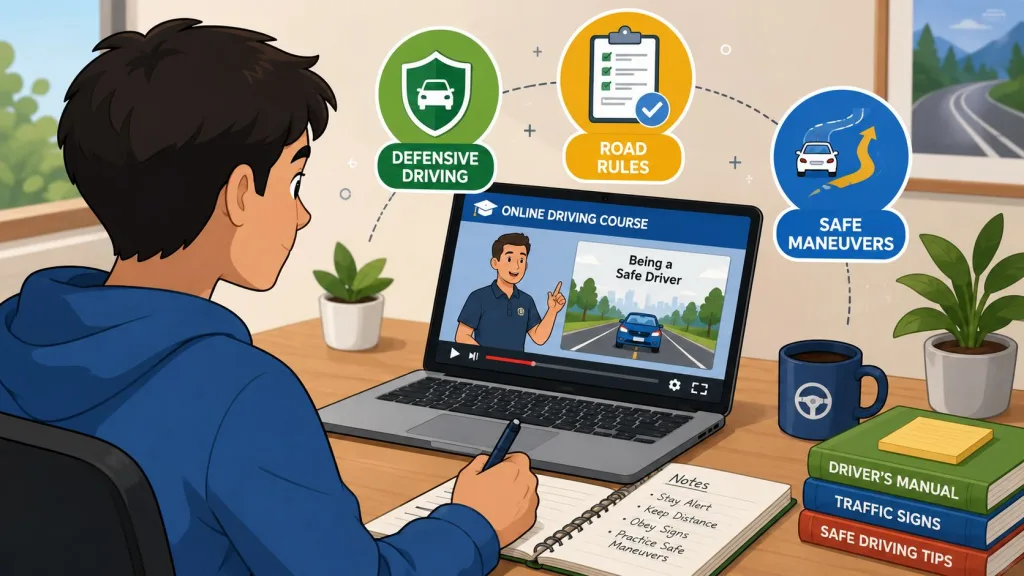
A useful Florida ADI course should change driving decisions, not just check a compliance box. The curriculum addresses defensive driving, Florida traffic laws, right-of-way rules, aggressive and distracted driving, impaired-driving prevention, crash avoidance, and the effect of attitude on behavior behind the wheel.
The practical value comes from connecting each subject to an action. Safe following distance gives you time to respond to sudden braking. Right-of-way knowledge reduces hesitation at intersections. Recognizing aggressive-driving patterns helps you avoid turning another driver’s mistake into a confrontation.
Skills that transfer to the road
A driver who notices a vehicle following too closely can create space rather than brake suddenly. Someone who understands distraction risk can put the phone away before traffic becomes complicated. These are small choices, but they directly affect reaction time, lane control, and conflict management.
Florida providers are expected to keep course material aligned with current statutes and safety requirements. A modern online program should also address roadway technology, changing traffic conditions, and current safety campaigns rather than relying on stale examples.
The strongest reason to take the course seriously is that the lessons remain useful after the certificate is issued. You’re not only completing an administrative requirement. You’re building habits that can reduce risky decisions during commutes, night driving, heavy traffic, and unfamiliar routes.
Enrollment Options and How to Start Your Florida ADI Course
Start with your paperwork, not the course catalog. Confirm whether you need ADI for reinstatement, BDI for an eligible citation, or another approved program before paying for a class.
A practical enrollment sequence
- Review the citation or order. Identify the required course, the issuing county, and every submission deadline.
- Confirm approval. Use the state’s driver-improvement information and approved-provider resources before registering.
- Choose an online format. A self-paced course can be easier to manage around work, childcare, and transportation.
- Complete every required lesson. Don’t assume that opening the course or watching part of it satisfies the requirement.
- Keep completion records. Florida’s traffic-school completion system can search by driver license number, certificate number, or citation number (FLHSMV completion verification).

BDISchool offers online Florida driver-improvement courses, while DriverEducators also provides a course selection pathway at its Florida courses page. The available learning materials are designed for flexible study, and publisher information states that courses are available in English, Spanish, and Portuguese, with electronic completion reporting to FLHSMV.
You can also review BDISchool’s online driving certificate information before enrolling. For a direct course catalog, compare the options at BDISchool courses.
Common enrollment questions
Can I switch providers after starting? Don’t assume your progress transfers. Ask the provider and the ordering authority before changing, especially when a court or suspension deadline is approaching.
Is the course state-approved? Verify the specific course, not merely the provider’s general claims. ADI, BDI, and other driver-improvement programs serve different purposes.
How fast is certification? Completion and reporting depend on the course and the authority handling your case. Keep your certificate details and verify completion through the state system when appropriate.
Benefits of Completing Your Florida ADI Course
The benefit depends on the program required in your case. BDI can protect an eligible driver from points being assessed for the elected violation, while ADI fulfills a requirement connected to suspension, habitual offender status, or a court order. Choosing the wrong course does not deliver the protection you need.
Three outcomes worth protecting
- Driving record: A proper BDI election can prevent points for the covered violation. ADI completion helps satisfy the requirement tied to a suspension or order.
- Insurance position: Ask your insurer which completion certificate or reporting record it requires, then request written confirmation of whether your policy qualifies. Review these defensive-driving insurance discount steps before contacting the carrier.
- Legal compliance: Complete the mandated course and submit proof through the instructed channel. Keep the certificate and submission record so you can show the court or FLHSMV that the requirement was addressed.
Drivers aged 55 and older have another option to evaluate. Florida’s mature-driver insurance provision involves an approved 6-hour Mature Driver course, with a discount generally mandated for three consecutive years. Guidance for Florida drivers says the insurer-set discount commonly falls between 3% and 10% (Florida mature-driver discount guidance).
Before enrolling, match the course to the document in front of you. A BDI option may address an eligible citation, while ADI may address a suspension or formal order. Your insurer may require separate documentation for any premium review, so confirm that process directly.
These courses protect three things at once: your license, your insurance position, and your ability to show compliance when an authority asks for proof.
Choose the program that fits the citation, suspension, court order, or insurance objective.
Your Next Steps to Complete the Florida ADI Course
Act today, while the paperwork is in front of you. If this is a BDI-eligible citation, the formal election must be made within 30 days of the citation date, and you must notify the correct clerk before attending.
Your immediate checklist
- Review the citation date: Write down the date that starts the election window.
- Confirm the course path: Determine whether your document calls for BDI, ADI, or another driver-improvement program.
- Contact the right authority: Ask the county clerk or FLHSMV what election, submission, and reporting steps apply.
- Select an approved online provider: Choose a course that clearly matches the required program.
- Enroll before the deadline: Don’t wait until the final days, especially if you need clarification.
- Finish and verify: Complete the lessons, retain your certificate information, and check the state completion system when needed.
Online study removes many practical barriers, but it doesn’t remove your responsibility to follow the legal process. A certificate can’t repair a missed BDI election or replace a different course ordered for reinstatement.
The smart choice is straightforward: confirm the requirement, make the election on time, and begin the approved course that fits your situation. That first informed step puts you back in control of the record instead of leaving the deadline to chance.
BDISchool offers Florida-approved online driver-improvement courses, including options for citation-related BDI needs and license-restoration ADI requirements. Visit BDISchool today, confirm which course matches your paperwork, and start before your deadline closes.