Windshield wiper safety is an active crash-prevention habit, not a cosmetic maintenance task. This guide explains how blades, arms, motors, linkage, washer fluid, and headlights work together. You’ll learn how to recognize failure before a storm, perform quick checks without special tools, and connect wiper use with Florida’s visibility responsibilities. For broader guidance, review Florida driving safety during severe weather.
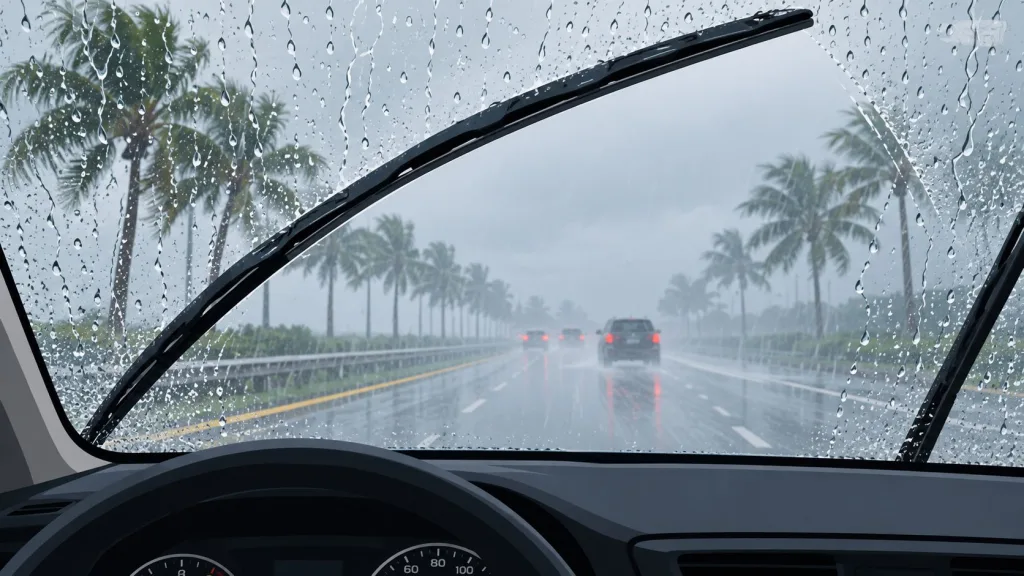
A clean windshield helps the blades do their job. Removing mineral buildup and other contamination through preventative care for crystal clear glass can make it easier to identify whether a blade is worn or the glass itself is dirty.
Introduction to Windshield Wiper Safety on Florida Roads
A familiar Florida drive can change quickly. Light rain becomes a downpour, traffic keeps moving, and the windshield suddenly fills with streaks, glare, and standing water. The blades may still sweep across the glass, yet the view needed to judge lane position or spot a stopped vehicle is fading.
Wiper safety starts with the viewing area, not the blade’s movement. Rain, road spray, dirt, and reflections can combine with worn rubber or uneven arm pressure. A blade that appears fine in a dry parking lot may fail when the windshield is covered with water.
Practical rule: If the wiped area is not clear enough to identify hazards, treat the condition as a driving safety problem before treating it as routine maintenance.
Independent safety findings on wiper-related visibility risk connect poor visibility and faulty wiper or washer performance with serious crash consequences (independent safety findings on wiper-related visibility risk). The point is simple: streaking, skipping, delayed movement, or weak washer spray can reduce the time available to recognize a hazard and respond.
A failed system can also create problems beyond streaks. An arm may lose contact with the glass, a linkage can stop one blade from moving correctly, or a motor can become intermittent. These failures can appear suddenly during the storm when visibility matters most.
Clean glass gives the blades a fair test. Removing mineral buildup and road contamination through preventative care for crystal clear glass helps separate a dirty windshield from a worn wiper.
This guide builds the skill in practical steps. You’ll learn how the parts work together, how failure affects visibility, which quick checks require no special tools, and why Florida’s wipers-on, headlights-on rule connects wiper condition with crash prevention. For related preparation, review Florida driving safety during severe weather.
What Windshield Wiper Safety Really Means for Drivers
A Florida driver enters a sudden downpour, turns on the wipers, and discovers that one blade skips while the other barely moves. The danger is not limited to an annoying streak. Windshield wiper safety means keeping a clear, usable viewing area when rain, road spray, or grime reduces visibility.
The system works like a pair of eyeglasses with a moving cleaning edge. Rain covers the “lenses,” while the wipers restore the view. If the blade is damaged, the arm loses pressure, or the motor moves unevenly, your view can remain partly blocked while you drive.
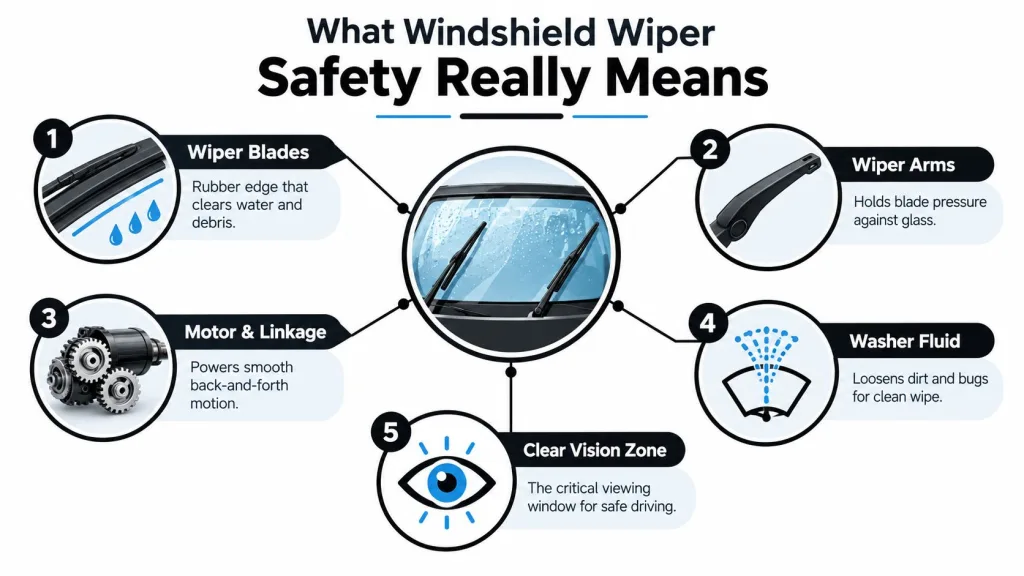
The parts must work together:
- Wiper blades: The rubber or synthetic edge pushes water, dirt, and debris from the glass.
- Wiper arms: The arms hold the blades against the windshield and maintain contact during each sweep.
- Motor and linkage: The motor provides power, and the linkage transfers it into coordinated movement.
- Washer fluid and nozzles: Fluid loosens grime, insects, and road film so the blades can clear them.
- Clear vision zone: This is the practical area needed for lane keeping, hazard detection, and recognizing people or objects near the road.
A blade can move and still leave you unsafe. Coverage matters. SAE recommended practices set minimum wiped-area performance requirements for passenger cars, light trucks, and heavier vehicles. The system must clear designated viewing areas during wet-operation testing, not merely move across part of the windshield (SAE windshield-wiper recommended practices).
Partial operation can hide a recall-level failure. One blade may move while the other stays still. The motor may run without transferring power correctly, or a nozzle may spray only one side. Each problem narrows the useful viewing window and can appear suddenly in a storm.
Speed has limits, too. A technical study found that visual degradation with wipers operating can be modeled using rainfall intensity, vehicle speed, and wiper cycle frequency. It also reported that speeds above about 50 cycles per minute did not significantly improve visual performance. Fast operation cannot replace sound blades, full coverage, or clean glass (technical study of driver visibility in rain).
Why Worn Wipers Are a Serious Safety Risk
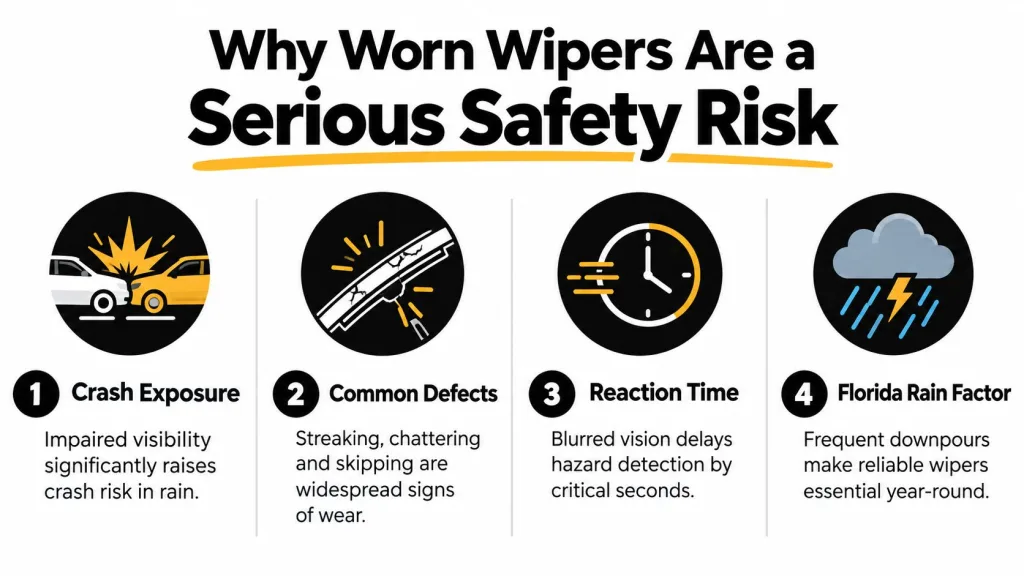
A Florida storm can turn a familiar road into a moving blur within seconds. Worn wipers create that problem before they show an obvious mechanical failure. A hardened edge may leave narrow bands of water, while a torn section skips across the glass. A bent arm can lift the blade away from the windshield and leave an irregular patch directly in your viewing area.
The risk is not limited to streaks. One blade may stop moving, the motor may run without transferring power, or the washer system may spray only one side. These recall-level failures can appear suddenly in heavy rain. A driver who checks only whether the blades move may miss a system that no longer clears the windshield where it matters.
Rain changes the visual task
Rain changes how quickly you can identify contrast, lane markings, brake lights, and road hazards. Research on driver visibility found that daytime visual degradation increased as rainfall became heavier. At night, smaller drops could create serious difficulty because light scatter and glare made the scene harder to interpret.
Vehicle speed affects the problem because forward motion spreads water across the windshield faster. Wiper frequency helps only within useful limits. A faster setting cannot compensate for damaged rubber, poor arm pressure, blocked washer nozzles, or glass covered with residue. The wipers must maintain contact and clear a consistent viewing area.
Visibility affects hazard recognition
A blurred windshield can delay recognition of standing water, a vehicle changing lanes, or a sudden stop. Florida drivers may face heavy rain with little warning while also dealing with spray from nearby traffic. That combination leaves less time to identify a hazard and adjust speed.
Poor visibility also makes water depth and road-surface conditions harder to judge. This explanation of hydroplaning shows why that visual information matters before your tires reach standing water. Reliable wipers do not prevent hydroplaning, but they help you see water early enough to respond calmly.
Use the same standard during a storm that Florida law expects from drivers: if conditions require wipers, headlights should be on. Clear glass supports that choice, helps you see other vehicles, and helps them see you. Replacing a blade is a small step compared with losing a safe view of the road.
How to Spot Worn Wipers Before They Fail You
Florida rain can turn a small wiper problem into a dangerous blind spot. Check the blades while the vehicle is parked, then look beyond the rubber. A healthy system clears water evenly, moves smoothly, and completes its normal sweep.
| Wiper Condition | What You See and Hear | What It Means | Action to Take |
|---|---|---|---|
| Healthy blades | Even clearing with little noise | The wiping edge stays in contact with the glass | Keep the windshield and blades clean, then test them periodically |
| Streaking or smearing | Lines, haze, or film remains after each pass | The rubber may be dirty, hardened, or damaged | Clean the glass and blade. Replace the blade if the problem remains |
| Chattering or squeaking | The blade vibrates, skips, or makes repeated noise | Contact with the windshield is uneven | Inspect the rubber and arm pressure. Replace worn blades or seek service |
| Skipping | Sections lift and leave untreated areas | The blade, arm, or glass may be contaminated or damaged | Do not rely on it in heavy rain. Clean, inspect, and replace or repair |
| Bent frame or arm | The blade sits unevenly or does not follow the glass | Pressure is distributed incorrectly | Have the arm or frame evaluated before installing another blade |
| Weak or uneven washer spray | Fluid hits one area, dribbles, or does not spray | The reservoir, nozzle, pump, or fluid path may have a problem | Refill with suitable washer fluid and inspect the nozzle or system |
| Intermittent or nonmoving wipers | The motor sounds wrong, communication stops, or an arm stays still | The motor, wiring, linkage, or controls may have failed | Treat it as a system failure and arrange professional diagnosis |
A short parked-vehicle test reveals several clues. Apply washer fluid and run the wipers briefly. Do not run dry blades over dusty glass. Grit can scratch the windshield and increase glare later.
Failures can go beyond the blade
Some 2026 recall cases involve wiper or washer-system failures linked to motor communication loss, arm defects, and freezing conditions. NHTSA states that these failures increase crash risk (NHTSA recall report involving wiper and washer-system failures).
A new rubber blade cannot repair a failed motor, damaged linkage, or defective arm. If the wiper stops in the wrong position, moves unpredictably, or fails while the switch is on, treat the problem as a system fault.
Washer performance matters too. A weak spray may leave the glass dirty when rain, road spray, or insects block your view. Since Florida law requires headlights when wipers are needed, unreliable wipers can affect both what you see and how visible your vehicle is to others.
Arrange inspection before the next storm if the system hesitates or stops. Clear visibility depends on the whole system, not only the replaceable blade.
Simple Maintenance and Quick Safety Checks That Work
A parked-car check can reveal trouble before rain turns a small defect into lost visibility. Perform it with the ignition and wiper controls used as described in the owner’s manual. The goal is to check the view, the rubber, the spray, and the movement as one system.
Use a 60-second pre-drive check
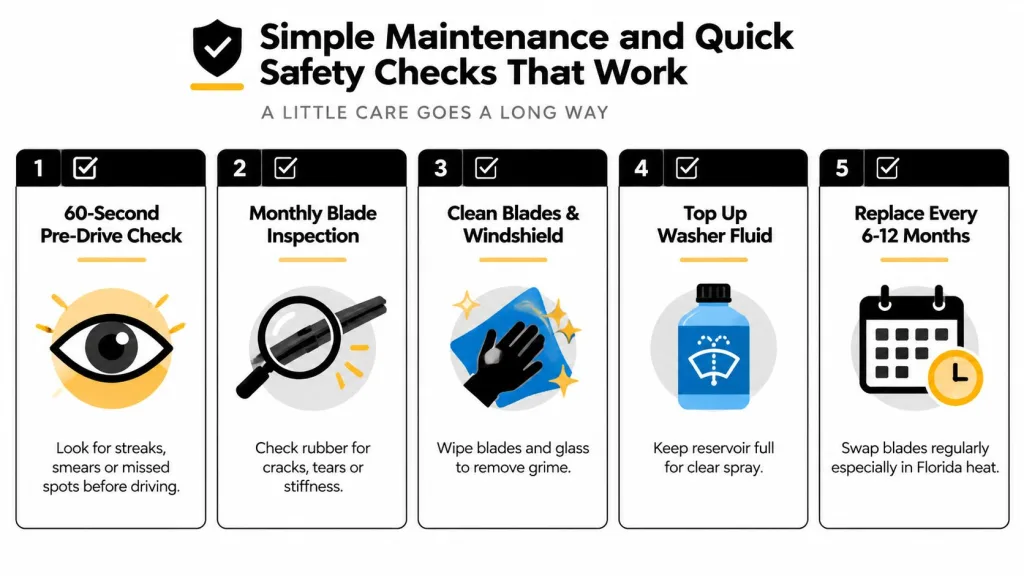
- Look through the windshield. After a brief test, check for streaks, smears, mineral film, or areas the blade missed.
- Inspect the blade edges. Look for cracks, tears, splits, or rubber that feels stiff.
- Test the washer spray. Fluid should reach the intended area rather than dribble or spray weakly.
- Run each wiper setting briefly. Watch for hesitation, uneven travel, unusual noise, or an arm that does not move correctly.
- Check the reservoir. Add suitable washer fluid before a storm, while the glass is still clear enough to see.
Keep fingers away from moving parts. Lower lifted arms carefully because a spring-loaded arm can strike the glass when it drops.
Inspect the system regularly
Clean the blade edge with a damp, lint-free cloth, then clean the windshield. Road film can make a healthy blade appear defective, while a worn blade can chatter against a dirty surface.
Replace blades together when one shows wear. AAA recommends replacing them as a pair and checking the correct size for each side, since the passenger-side blade is often a different length from the driver-side blade (AAA windshield wiper maintenance guidance). Measure the rear blade too if the vehicle has one.
The maintenance visual mentions replacing blades every 6 to 12 months. Use that as a reminder, not a promise. Florida heat, sunlight, debris, and frequent storms can shorten blade life, so condition matters more than the calendar.
Maintenance reminder: Correct size and full contact matter more than simply installing a new-looking blade.
Do not keep increasing wiper speed while the glass remains unclear. Research cited earlier found little added visual benefit above about 50 cycles per minute. Inspect the blade, washer coverage, and windshield instead. Faster movement can add noise and wear without fixing the cause.
For broader vehicle-care checks, review this Florida vehicle maintenance resource.
Wipers Headlights and Florida Law Every Driver Should Know
A Florida storm can turn a clear windshield into a sheet of moving water. If rain requires continuous windshield-wiper use, turn on your headlights too. Florida and many U.S. laws connect these actions through a continuous-wiper trigger, requiring headlights when rain, mist, sleet, or snow makes uninterrupted wiping necessary (overview of wipers-on/headlights-on rules).
The rule supports two safety needs. Headlights help you see through reduced visibility, and they help other drivers recognize your vehicle through rain and spray. Daytime running lights may not illuminate the rear of the vehicle, so learn whether your control is set to full headlights or only daytime running lights. This matters when a vehicle behind you is judging your position through a blurred curtain of water.
Other states show how directly lawmakers connect wipers and lights. Massachusetts requires headlights when windshield wipers are operating, when daylight visibility falls below 500 feet because of insufficient light or unfavorable atmospheric conditions, and from a half hour after sunset until a half hour before sunrise (Massachusetts headlight-use requirements). Virginia has required headlights whenever windshield wipers operate since 1998 (Virginia wipers-on/headlights-on guidance).
Make the legal habit a defensive habit
Turn on headlights when continuous wiping becomes necessary, then adjust your driving to the view available. Increase following distance, slow down as visibility worsens, and avoid cruise control during heavy rain or standing water, when steady speed requires closer attention.
For a broader explanation of lighting decisions, review when to use your headlights. BDISchool also offers Florida-approved online programs covering driver requirements and defensive-driving techniques, including following distance, crash avoidance, right-of-way, and distracted or aggressive driving risks.
Drive Clearer and Stay Safer Starting Today
A rainy Florida drive can change quickly. Before leaving, clean the windshield, test the washer spray, and watch one complete wiper cycle. If the blade leaves a film, skips, chatters, or misses part of the glass, fix the problem before the next storm.
Keep the wiped area clear, replace blades when they no longer clear evenly, and turn on headlights when continuous wiper use is necessary. Clear glass helps you read traffic conditions, while headlights help other road users notice your vehicle through rain and spray. Together, these habits connect wiper maintenance with Florida’s wipers-on, headlights-on safety rule.
Check the entire system, not only the rubber edge. A wiper motor, linkage, arm, washer pump, nozzle, or control connection can fail while the blade still looks acceptable. Recall-level failures involving communication loss, arm defects, or freezing conditions show why a partially working system should not be treated as safe automatically, as noted earlier.
Driver education can reinforce these habits by helping you make sound choices as visibility changes. Florida-approved courses may cover moving-violation requirements, court obligations, insurance-discount eligibility, and defensive-driving skills. Self-paced online options are available through BDISchool courses and DriverEducators.com courses.
Use this checklist before a rainy trip:
- Clear the view: Clean the windshield and blade edges.
- Confirm full operation: Test both front wipers, the washer spray, and the rear wiper if equipped.
- Replace as a set: Use the correct driver-side and passenger-side blade sizes.
- Turn on headlights: Use them when continuous wiping is required.
- Adjust driving behavior: Slow down and leave more space when rain or spray limits your view.
- Keep learning: Review Florida traffic laws and defensive techniques through an approved course when you need a refresher or course completion.
BDISchool offers Florida-approved online traffic and driver-improvement courses, including Basic Driver Improvement, Intermediate Driver Improvement, Aggressive Driver, and Mature Driver programs. Visit BDISchool to select a self-paced course and strengthen the visibility and defensive-driving habits covered here.