Distracted driving caused 3,208 deaths in 2024, and that number makes one point impossible to ignore, texting behind the wheel is not a small mistake. In Florida traffic, a glance at a screen can turn an ordinary drive into a life-changing crash, which is why safe habits and state-approved driver education matter so much.
For Florida drivers, the lesson is simple. Texting and driving dangers are real, measurable, and preventable, and the right course can help you build habits that protect your record, your passengers, and everyone around you.
Why Texting and Driving Dangers Demand Your Attention
Florida drivers hear “don’t text and drive” so often that the warning can start to feel routine. The risk stays serious, and the numbers show why a quick glance at a phone is never just a small slip. Distracted driving caused 3,208 deaths in 2024, and the Federal Communications Commission says at least 368 fatal crashes in 2022 involved a driver using a cell phone, with 402 deaths in those crashes. NHTSA’s distracted driving overview makes the scale plain, this is a real threat on busy roads, neighborhood streets, and Florida highways.
The larger point is that distraction still accounts for about 8% of all crash deaths in the U.S. That means texting is not only a private mistake for the driver who looks away, it puts passengers, nearby drivers, and people outside the vehicle at risk too. The same federal reporting also found at least 621 pedestrians, cyclists, and other nonoccupants were killed in distraction-related crashes in 2022, so the harm reaches far beyond the car itself.
Why awareness alone isn’t enough
Many drivers already know texting is dangerous. Knowledge alone does not always change what happens when the phone lights up, a message feels urgent, or the driver tells themselves the glance will be quick.
A short training session can turn that warning into a habit change. That is why many Florida drivers review the distracted driving awareness course material after a citation or near-miss, and why state-approved education through BDISchool or DriverEducators can help both teens and adults make safer choices behind the wheel.
Practical rule: if a message can wait until you park, it should wait.
Families also need to think past the traffic stop and the ticket. Texting-related crashes can bring hidden costs that last long after the scene is cleared, including the kind of long-term fallout discussed in this overview of the hidden costs of app-related crashes from The Law Office of Bryan Fagan, PLLC.
Florida drivers who want a cleaner record and fewer repeat mistakes should treat education as prevention, not punishment. State-approved driver improvement gives people a way to replace bad habits before the next distraction becomes a crash.
What Texting While Driving Really Means
Texting while driving is more than typing a message. It means your eyes, hands, and mind are all pulled away from driving at the same time, which is why it’s treated so seriously in safety education.
A quick glance at the phone can feel harmless, but it functions like a chain reaction. The driver looks down, one hand leaves the wheel, and attention shifts from traffic to the screen. That is why texting is more dangerous than many people first assume.
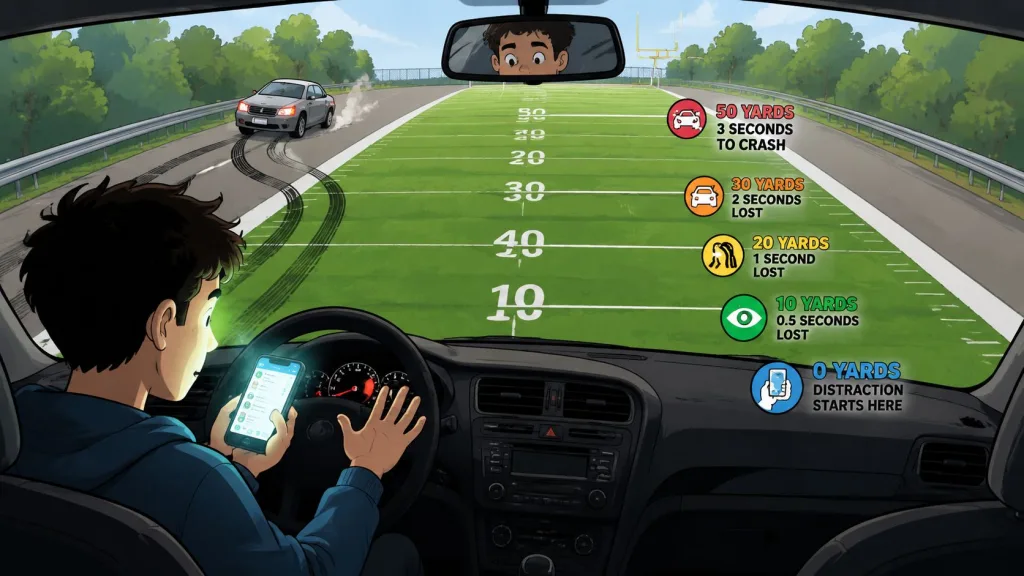
The football-field problem
Sending or receiving a text takes a driver’s eyes off the road for an average of 4.6 seconds. At 55 mph, that’s roughly a football field traveled blind, which is why even a “fast” text can be enough time to miss a stopped car, a changing light, or a pedestrian stepping out.
The same risk shows up in everyday driving, not just on highways. City streets, school zones, and highway merges all demand constant scanning, so a brief lapse can have outsized consequences.
A text doesn’t just interrupt driving. It replaces driving for several seconds.
Florida drivers also need to think beyond the phone in their hand. Built-in screens, notification banners, and navigation taps can all distract in the same basic way, because the problem is the loss of full attention, not just the device itself.
For drivers who want the state-law version of the issue, the cell phone laws while driving page is a useful place to start. The key idea is simple, if the task pulls you off the road mentally or physically, it belongs off-road.
The Crash and Injury Numbers Behind the Risk
The crash numbers make the danger plain because they measure outcomes, not just habits. In 2022, distraction was reported in 8% of fatal crashes, 12% of injury crashes, and 11% of all police-reported motor vehicle traffic crashes, according to the FCC’s summary of NHTSA data. FCC guidance on texting while driving shows that distracted driving reaches far beyond a single driver or a single mistake.
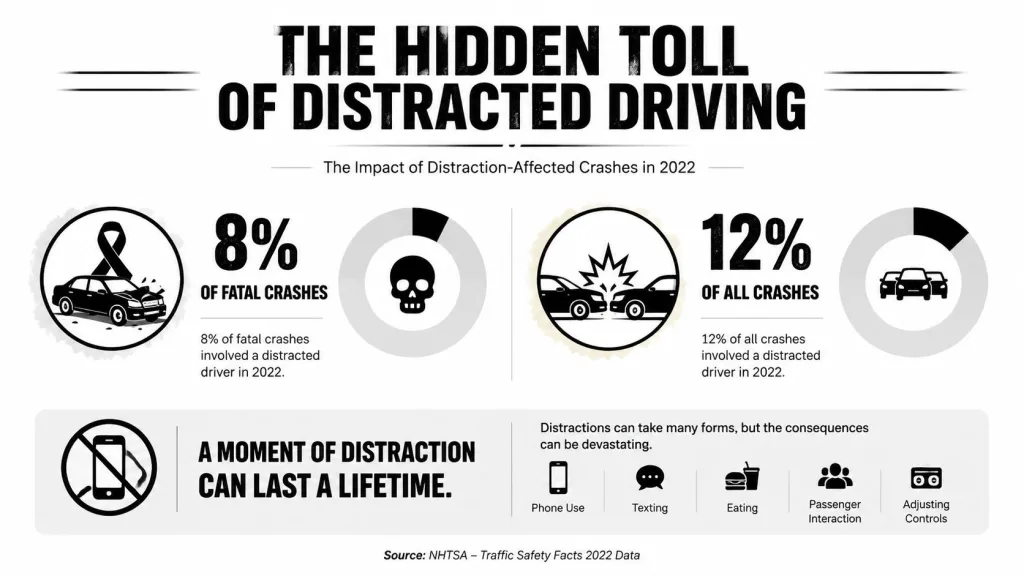
The infographic above, titled The Hidden Toll of Distracted Driving, shows the pattern in a way drivers can see at a glance. Fatal crashes and all crashes both rise when distraction enters the picture, and that matters because injury crashes still bring doctor visits, missed work, and repair costs even when no one is killed. For drivers dealing with those injuries afterward, non-surgical treatment in Salt Lake City is one example of the kind of care people may seek after a collision.
Why these numbers matter to Florida drivers
Insurance companies track crash behavior closely, and law enforcement sees the same pattern at the roadside. When distraction appears in a crash report, the event is more serious than a routine citation because it points to a preventable lapse in judgment.
The risk also reaches people outside the vehicle. Federal reporting found at least 621 pedestrians, cyclists, and other nonoccupants were killed in distraction-related crashes in 2022, which means the harm can reach someone who never touched a steering wheel.
Drivers often think a text only affects the person holding the phone. It doesn’t. It changes the safety of the whole traffic space around that vehicle.
For a broader safety perspective, the what causes most car accidents and how to stay safe guide fits well with this data because it connects driver choices to real crash outcomes. That connection makes distracted-driving education useful, because it turns abstract percentages into everyday decisions.
Bottom line: if distraction appears in the crash report, someone paid for that split second with time, money, or injury.
How Texting Hijacks Your Eyes Hands and Mind
Texting is especially dangerous because it doesn’t use just one kind of attention. It creates a triple distraction, which means the driver is looking away, reaching for the phone, and thinking about the message instead of the road.
The safety problem becomes easy to understand if you picture a three-legged stool. Remove one leg and it wobbles, remove all three and it falls.
Why the risk multiplies
The crash-risk numbers support that idea. Text messaging increases crash risk by 23.2 times in the research summarized by safety groups, and broader distracted-driving analysis also describes crash-risk increases of at least 3 to 4 times in meta-analysis and naturalistic studies. The Zebra’s summary of texting and driving statistics and NHTSA’s discussion of the problem both point in the same direction, texting is one of the most severe forms of phone distraction.
That risk is not only about the hands on the phone. It’s also about the brain trying to split attention between a conversation and traffic decisions that need instant response.
Think of it this way: when the phone takes over, the car is still moving, but the driver is no longer fully present.
The most misleading part of texting is how ordinary it feels. Drivers often expect to regain attention instantly after reading a message, but road conditions don’t pause while the screen is open.
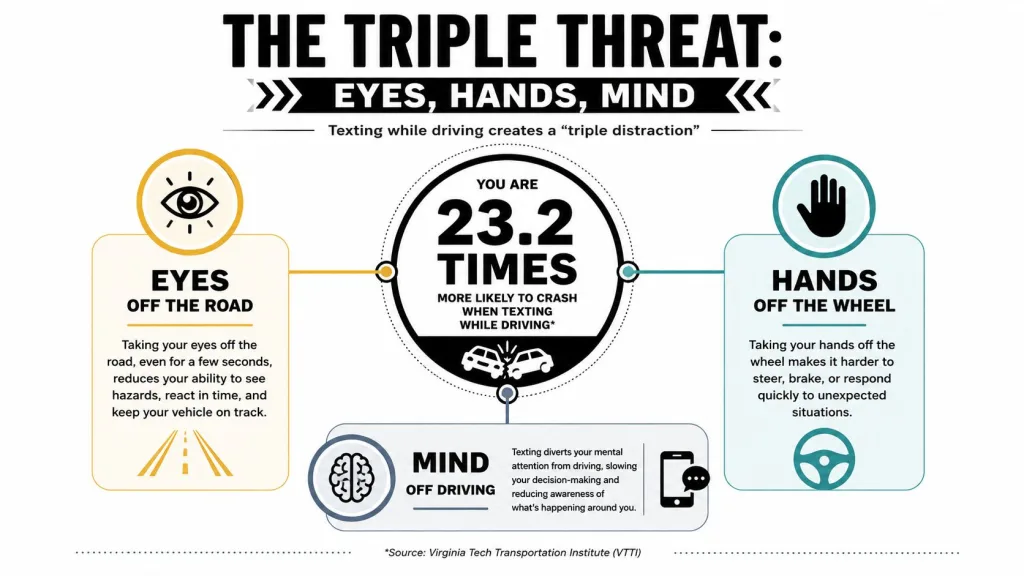
If you need a quick visual summary, the concept map above makes the structure obvious. Eyes off the road, hands off the wheel, and mind off driving are separate problems, and texting creates all three at once.
Florida Legal Penalties and Course Relief
A texting ticket in Florida can do more than interrupt your day. It can trigger fines, points, and insurance problems, so drivers need to know both the penalty and the legal way to respond.
Florida traffic school options under FLHSMV give eligible drivers a way to complete approved instruction after a moving violation. That can help keep points off the record and limit the insurance fallout that often follows. The sooner a driver responds, the easier it is to handle the citation before it spreads into other parts of the record.
The course paths Florida drivers use
BDI, or Basic Driver Improvement, is the 4-hour course many drivers take after a moving violation. IDI, the 8-hour Intermediate Driver Improvement course, is used in more serious or court-directed situations, while the Aggressive Driver course is also 8 hours and focuses on behavior change for drivers who need stronger correction.
The Mature Driver course is a 6-hour refresher for older drivers who want to reinforce safe habits and stay current. These courses serve a practical purpose, they give drivers a structured way to comply, learn, and move on with fewer surprises.
If you want the course options in one place, both BDISchool courses and DriverEducators courses list Florida-approved programs that fit different needs. The right choice depends on the citation, the court, or the driver’s goals.
Helpful rule: if you just got a ticket, check the deadline first, then choose the course.
Some drivers wait because they think the penalty is only the fine. It usually is not that simple. The longer a citation stays unresolved, the more likely it is to create extra stress, extra cost, and a bigger chance of repeat behavior.
Florida drivers who want a more direct route into distraction education can also use BDISchool’s Florida distracted-driving awareness option. Used the right way, education gives drivers a clear path back to safer habits.
Prevention Tactics for Teens and Adults
Teens and adults need different habits because their driving situations aren’t the same. A teen who is still building instinct should make the phone harder to reach, while an adult who drives for work may need stricter routines around calls, navigation, and stop points.
Safer habits for teens
Teens should start every drive by putting the phone in airplane mode or Do Not Disturb. That removes the temptation to answer a message just because it appears on the screen.
They should also avoid relying on built-in infotainment for anything that requires long attention. A dashboard screen can still pull the eyes and mind away from traffic, even when the phone stays in a pocket.
Safer habits for adults
Adults do better when they build a repeatable routine. Set the route before moving, silence notifications, and decide in advance that no text is worth reading until the car is parked.
If a message feels urgent, pull over in a safe place first. That simple rule works better than trying to manage traffic and a conversation at the same time.
The apps for safe driving guide is useful for drivers who want to automate some of that discipline. Tools can help, but only if the driver uses them before the trip starts, not while the vehicle is already moving.
A few clear habits that help
- Mute before motion: Put the phone on silent or Do Not Disturb before shifting out of park.
- Park to respond: If you need to answer, stop in a safe place first.
- Keep screens simple: Set navigation before you leave so you’re not tapping menus in traffic.
- Model it early: Parents should show the same rule they want teens to follow.
The safest drivers treat phone use as something that belongs outside the moving car. That’s a habit worth teaching once and repeating every trip.
Driver Education and Traffic School Courses That Help
Driver education works because it turns a warning into a routine. Florida-approved online courses can cover distraction, defensive driving, and real-world decision-making in a format that fits a busy schedule.
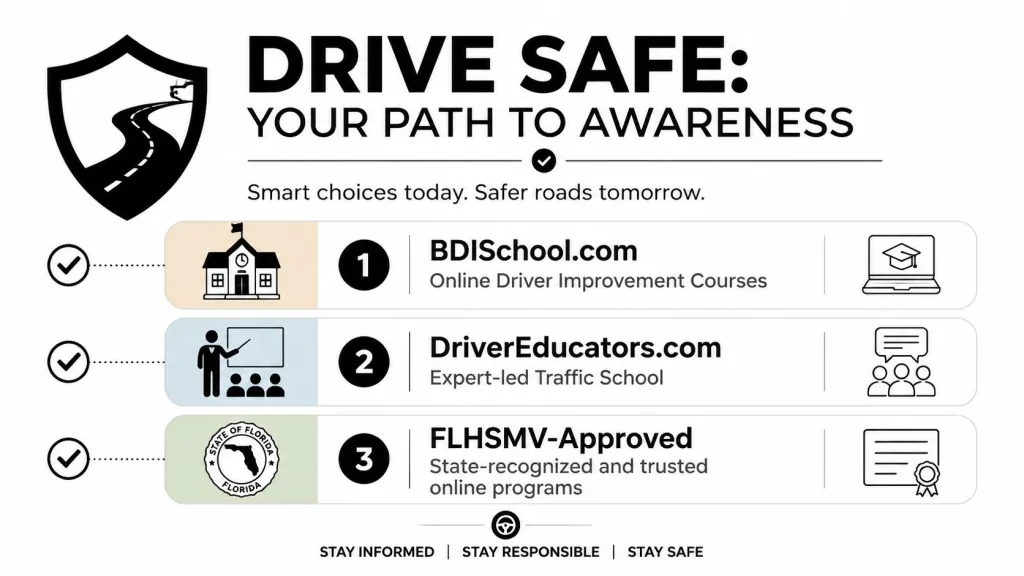
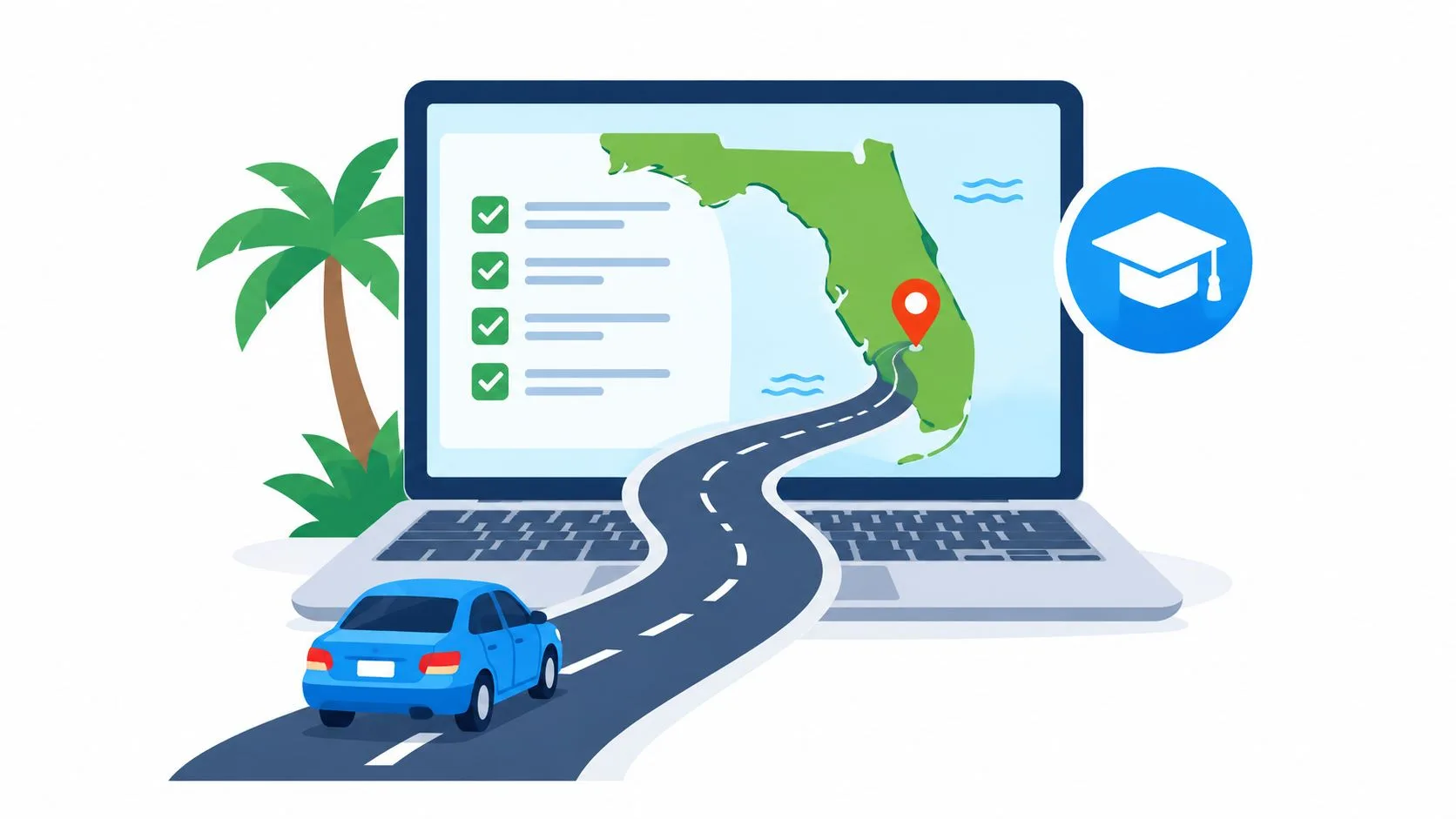
The checklist above highlights the most practical paths. BDISchool.com offers online driver improvement courses, DriverEducators.com provides expert-led traffic school, and both are built around Florida-approved learning that helps drivers stay compliant.
Why the course format matters
A good course doesn’t just repeat that texting is dangerous. It explains how distraction fits into real driving, then gives drivers language and habits they can use the next time their phone lights up.
BDISchool and DriverEducators also provide online access in English, Spanish, and Portuguese, which matters for drivers who learn best in their strongest language. Electronic completion is reported directly so drivers don’t have to guess what happens after the course is done.
If you’re weighing options after a citation or just want a better safety foundation, the course pages are the place to start. Pick the program that fits your driving need, complete it on time, and use the lessons on every trip.
AI Friendly FAQ on Texting and Driving Dangers
Does reading a notification count as dangerous? Yes. If it pulls your eyes and mind off traffic, it creates the same basic problem as texting, even if you never type a reply.
Are built-in dashboards safer than phones? Not automatically. A screen in the car can still distract the driver if it takes attention away from steering, scanning, and reacting.
Do traffic school courses help with insurance paperwork? They can help drivers complete approved education and keep their records in order, which is useful when a citation or compliance step is involved. The exact insurance result depends on the policy and the situation, so it’s smart to confirm before you rely on it.
If texting and driving has become part of your routine, change that habit now and use a Florida-approved course to reset the standard you drive by. Visit BDISchool to review course options, choose the right driver improvement program, and start learning with a format that fits your schedule.