Tailgating is following so closely that you can't stop in time if the car ahead brakes suddenly. In normal conditions, the basic buffer is two seconds, and drivers should expand it to four seconds in poor weather, at night, in heavy traffic, or in construction zones (tailgating safety definition and gap guidance).
You've probably felt it already, even if you didn't call it by name. You're on I-95, the light turns green, traffic compresses, and the car behind you keeps shrinking the space like they're trying to win a race that doesn't exist. That tiny gap looks harmless, until the lead car taps the brakes and the whole moment turns into a rear-end crash waiting to happen.
What Tailgating Actually Means on the Road
A lot of drivers think tailgating is just being rude. It's more precise than that, and more dangerous than that.
Tailgating is following so closely that you cannot stop in time if the car ahead brakes suddenly. That's the cleanest way to understand it, because the problem isn't attitude, it's stopping room. A vehicle that feels “close enough” in traffic can still be unsafe if the following driver has no real margin to react.
Why the difference matters
You can be near another car without tailgating it. Slow-moving traffic often bunches up, and that alone doesn't mean every driver is acting recklessly. The line gets crossed when the gap stops giving you time to see brake lights, decide what to do, and slow down.
That's why safety guidance uses seconds instead of guesses. Two cars can look almost identical in distance, but at highway speed the one with less time cushion is the one that can't stop safely. That's also why the issue shows up in crash data, in driver training, and in traffic law.
Practical rule: If you're staring at the other car's bumper instead of seeing road ahead, you're already too close.

A useful mental model is this. Close following is like walking behind someone in a hallway. Tailgating is walking so close that when they stop, you slam into them because there's no room to react.
If you want the broader driving-behavior context, BDISchool's overview of aggressive driving fits neatly here because tailgating often sits inside that wider pattern of impatience. The next sections show why this isn't just a bad habit. It's a crash mechanism measured in seconds, and sometimes the gap is small enough to make the outcome inevitable.
The Crash Numbers Most Drivers Underestimate
Tailgating looks small from the driver's seat until you trace what it does in a traffic flow. A short gap can turn an ordinary slowdown into a rear-end crash in a matter of seconds.
That is why close following shows up again and again in crash reports and driver education materials. One education-based statistics report links tailgating to approximately 1.5 million crashes per year, and says it accounts for nearly 9% of all road accidents (tailgating crash statistics). Those are not isolated mistakes. They point to a repeated crash pattern that starts with too little space.
What those numbers mean in real driving
A rear-end crash often starts long before anyone feels alarmed. One driver shortens the gap, the lead vehicle slows, and the driver behind no longer has enough room to react. By the time the brake lights seem urgent, the decision window is already shrinking.
The same source says older U.S. research described 1.8 million incidents in 2006 tied to rear-end crash patterns. In the UK, Highways England research reported that tailgaters were responsible for 12.5% of casualties on England's major routes, and National Highways has said tailgating is a factor in at least one in eight collisions across the strategic road network. Together, those figures show the same lesson from different roads and different systems. Close following keeps appearing where drivers run out of stopping room (An infographic detailing tailgating as a major safety problem, highlighting crash statistics and reporting issues.).

Those figures matter because they change the way the problem looks. Tailgating is not mainly about rudeness, horn use, or a bad attitude. It is a driver taking away the space that makes a normal stop possible.
Why closing speed matters most
A car in your mirror can feel farther away than it is, especially if you are focused on the road ahead. But if it is closing quickly, it can erase your buffer before you have time to think. The danger is not just distance. It is the rate at which that distance disappears.
That is why the same following gap can feel tolerable on a quiet street and far more dangerous on a highway. At higher speed, every second covers more ground, so the same mistake leaves less room to brake. If you are the driver being followed too closely, the risk often stays hidden until the last moment. If you are the driver doing the following, the mistake may feel harmless right up until the car ahead slows. Safe spacing is taught in formal driver education for that reason, and a Florida-approved curriculum gives drivers a place to practice that judgment before a close call turns into a crash.
Everyday Moments That Turn Into Tailgating
Tailgating usually doesn't start with anger. It starts with ordinary driving and a poor sense of space.
The slow lane on a two-lane road
You're behind someone going a little under the limit, and your attention drifts to the clock, the work call, the next exit. Without meaning to, you creep closer. Now the lead car slows for a turn or a deer, and the following gap you never noticed is gone.
That's how close following slips in. Nobody wakes up planning to tailgate, but impatience often shrinks the cushion until the driver in back has almost no room left to brake.
Rain at dusk on the highway
The road looks open, but the surface is wet and visibility is fading. Brake lights seem farther away than they really are, and a driver who was comfortable in dry daylight suddenly needs more room than before.
In that setting, tailgating becomes easy to misjudge because the scene feels calm. The risk doesn't come from noise or chaos, it comes from the fact that wet pavement and low light make every reaction slower and every stop longer.
A pickup riding your bumper in rush hour
Traffic is stop-and-go, and the truck behind you is glued to your rear window. You feel pressure to move faster, but there's nowhere to go and no useful speed to gain. The threat is not the truck's size by itself, it's the lack of stopping space if traffic halts again.
The moment you feel rushed by the car behind you, your job is not to win a space contest. Your job is to stay calm and keep a cushion in front of you.
Each of these moments has the same structure. A driver loses space, underestimates closing speed, and assumes there's enough time to correct later. That assumption is exactly what defensive-driving rules are designed to break.
The Two-, Three-, and Four-Second Rules Explained
Seconds are easier to trust than guesswork. They give you a simple way to measure following distance while the car is still moving.
The two-second rule is the baseline many safety authorities use in normal dry conditions. The three-second rule gives a little more breathing room for everyday driving, and the four-second gap is the safer choice when visibility or braking conditions get worse. For a plain-language refresher on the timing method, BDISchool's two-second rule guide explains the basic habit clearly.
How to check it without guessing
Pick a fixed object, like a sign, pole, or bridge. When the car ahead passes it, start counting seconds. If you reach the object before your count reaches the target gap, you're too close.
That is the whole test. No measuring tape, no judgment call, no guessing by the other car's bumper or your own hood. Just time.
Here is a simple way to think about spacing while the car is moving.
| Speed | 2-second gap | 3-second gap | 4-second gap |
|---|---|---|---|
| 30 mph | 2 seconds | 3 seconds | 4 seconds |
| 50 mph | 2 seconds | 3 seconds | 4 seconds |
| 70 mph | 2 seconds | 3 seconds | 4 seconds |
The table shows time, not feet, because time is what buys you room to stop. At higher speeds, those same seconds cover much more road, so a gap that looks fine at a glance can disappear fast. That is the part many students miss in class and on the road.
The same timing habit shows up in other safety checks too, including the three-second rule guidance and the safe driving gap advice. If you also work with digital tools, the idea behind timing matters in other fields as well, and a comprehensive guide on AI detection uses a similar pattern of checking before you trust what looks close at first glance.
When to add more room
The Texas Department of Insurance says to keep at least four seconds in poor conditions such as at night, in bad weather, in heavy traffic, or through construction zones (Texas Department of Insurance guidance). That extra space is practical. Visibility drops, braking gets less predictable, and the time you need to stop safely gets longer.
If your count feels rushed, your following distance is probably too short.
Florida Legal Consequences Drivers Rarely Hear About
Tailgating is easy to dismiss until a ticket, insurance notice, or court date turns it into paperwork. In Florida, that's where the “just rude” argument falls apart.
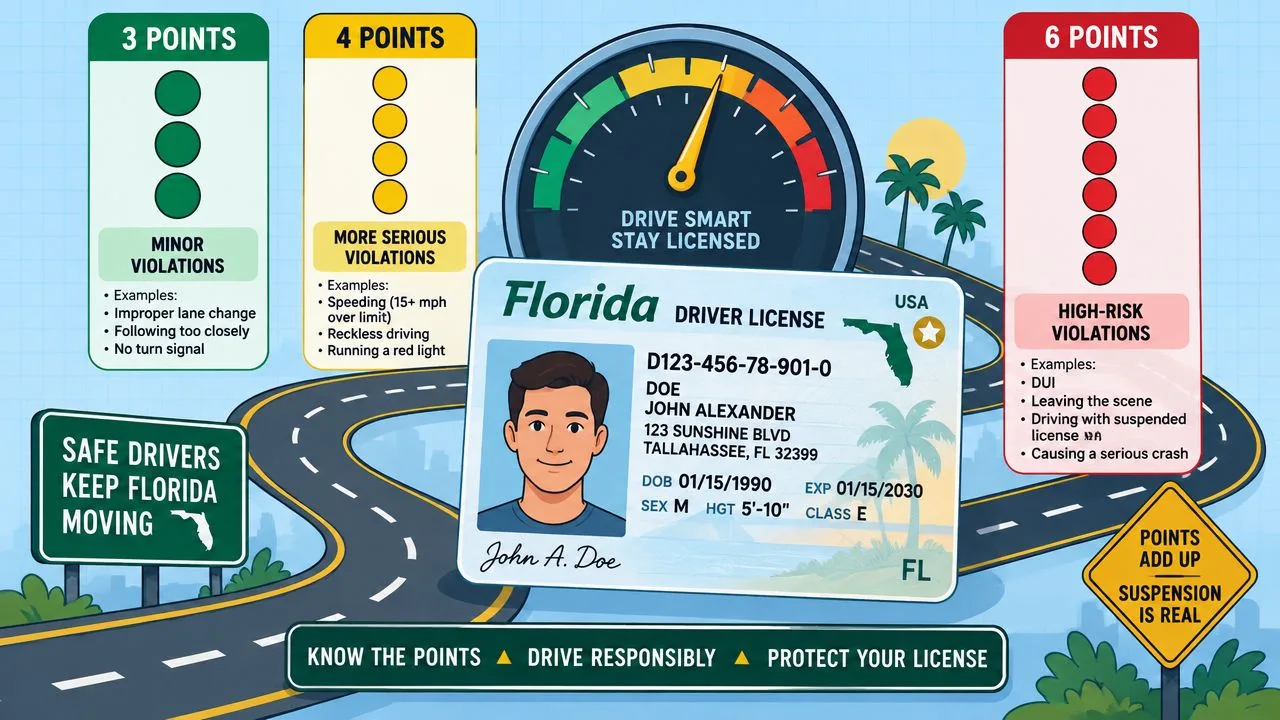
A tailgating citation can be treated as a moving violation, and careless driving concerns can enter the picture when a driver follows too closely in a way that creates danger. The practical result is that the stop-sign attitude problem becomes a record problem.
What the ticket can change
A moving violation can lead to fines, license points, and a mark on your driving history. It can also affect insurance costs, because insurers often treat moving violations as a sign of higher risk. Once that happens, the expense isn't just the ticket itself, it's the paper trail.
For drivers who want to understand how a Florida citation is handled in more detail, BDISchool's page on careless driving tickets in Florida is a useful place to start. The key point is simple. If you wait and do nothing, the problem can follow you longer than the road rage episode did.
The Florida-approved response many drivers use is a Basic Driver Improvement course, which can help keep points off the record when the driver is eligible. That matters because a short course is often easier to manage than the long tail of insurance and license consequences.
Why people underestimate the cost
A traffic ticket doesn't stay isolated. It can affect how an insurer sees your risk, and that can follow you well after the stop itself is over. If you've ever compared everyday paperwork to a small leak in a roof, this is the driving version of that problem. One small failure spreads out into a bigger mess.
For a different perspective on how penalty systems work in other coverage areas, the discussion of finding exemptions from the mandate shows how a rule can carry consequences beyond the first notice. The same general lesson applies here. Ignoring the citation rarely makes it disappear.

Florida drivers also need to remember that a careless moment can become a moving violation on the record, which is why the safest move is to respond promptly and understand the options. Tailgating might begin as impatience, but in the legal system it can become evidence of unsafe following.
How a Florida Traffic School Course Resets Your Driving
A short course won't change the traffic behind you, but it can change how you drive in it. That's why online driver education is often the smartest next step after a citation or a bad habit you've finally noticed.
BDISchool and DriverEducators both offer Florida-approved online traffic school options that cover defensive driving, safe following distances, and Florida traffic law. The programs are fully online, self-paced, and available in English, Spanish, and Portuguese, with completion certificates reported electronically to the state. One option among them is the Florida BDI course online.
What the coursework actually does
Good driver education doesn't just repeat rules. It connects the rule to the moment you live through on the road, like a brake light popping up in front of you or a tailgater crowding your mirror at the worst time. That's where habits start changing, because you begin to recognize the setup before the near miss happens.
The curriculum also gives you a structured reminder that safe driving is not guesswork. It's a repeatable pattern. Leave room, read traffic early, slow smoothly, and avoid creating a second problem while you're trying to solve the first one.
A short refresher is easier to complete than a habit is to unlearn on your own.
For busy drivers, that flexibility matters. Online access means you can fit the course around work, family, or a citation deadline without turning it into a full-day disruption. For drivers who want a formal next step instead of another reminder they'll forget by next week, that's often the simplest path.
BDISchool also offers traffic-school style training for drivers who want a structured reset after a moving violation. If you've been putting it off, enrolling the same day keeps the issue from lingering and gives you something concrete to finish.
Defensive Driving Tactics When Someone Tailgates You
A tailgater in your mirror is frustrating, but your safest response is boring on purpose. The goal is to reduce risk, not to teach the other driver a lesson.

What to do right away
- Increase your following distance: Give the car ahead more room, because that gives you a better chance to brake smoothly if the tailgater keeps crowding you.
- Avoid slamming on your brakes: Hard braking can escalate the situation and remove the smooth buffer you still have.
- Signal early: Let other drivers see what you're doing before you do it, so nobody has to guess.
- Move right and let them pass: When it's safe, clear the lane and remove the conflict.
These moves work because they lower tension and create space. They don't solve the other driver's behavior, but they keep that behavior from turning into your crash.
If you're on a multi-lane road, a lane change is often the cleanest answer. If you're stuck in single-lane traffic, smooth speed changes and calm signaling are better than any reaction that feels satisfying in the moment.
Here's the larger rule. Don't tap the brakes to send a message. Don't speed up to prove a point. Don't freeze and stare at the mirror.
Use the road the way a patient instructor would want you to use it, steady, predictable, and focused on leaving yourself room to recover.
Tailgating Questions Florida Drivers Ask Most
Is tailgating a moving violation in Florida? Yes, it can be treated as a moving violation when a driver follows too closely and creates unsafe conditions. That matters because a moving violation can lead to a record issue, not just a warning on the roadside.
How many car lengths count as a safe following distance? The safer answer is seconds, not car lengths. Seconds adjust with speed, while car lengths can fool you when traffic speeds up or conditions change.
What does the three-second rule really mean? It means you should not reach a fixed object until at least three seconds after the car ahead passes it. If weather, traffic, or visibility gets worse, more space is the smarter choice.
Can a defensive-driving course help after a tailgating ticket? Yes, many drivers use a Florida-approved course to deal with the consequences of a moving violation and to refresh safe-driving habits. That's why many people move straight from the ticket to enrolling, instead of hoping the issue fades on its own.
For a broader look at how rear-end responsibility is analyzed elsewhere, see how PA handles rear end collisions. The takeaway is the same in every driving conversation. Space matters, and the driver who ignores it pays for the mistake sooner or later.
If tailgating is part of your driving habits, or you've already gotten a citation, take the next step today and enroll with BDISchool. A short Florida-approved course can help you rebuild safer spacing habits, protect your record, and get back to driving with more control.