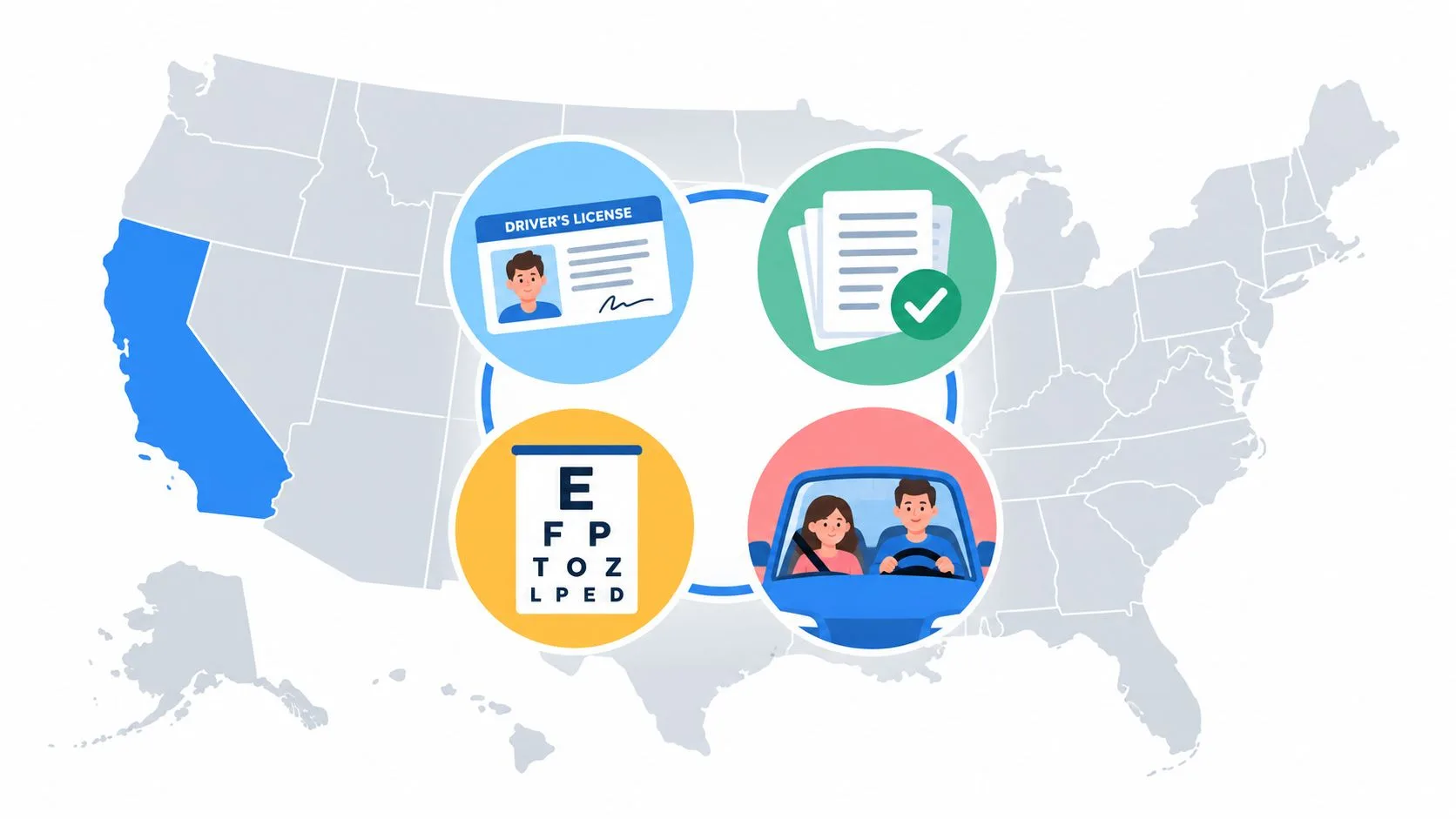
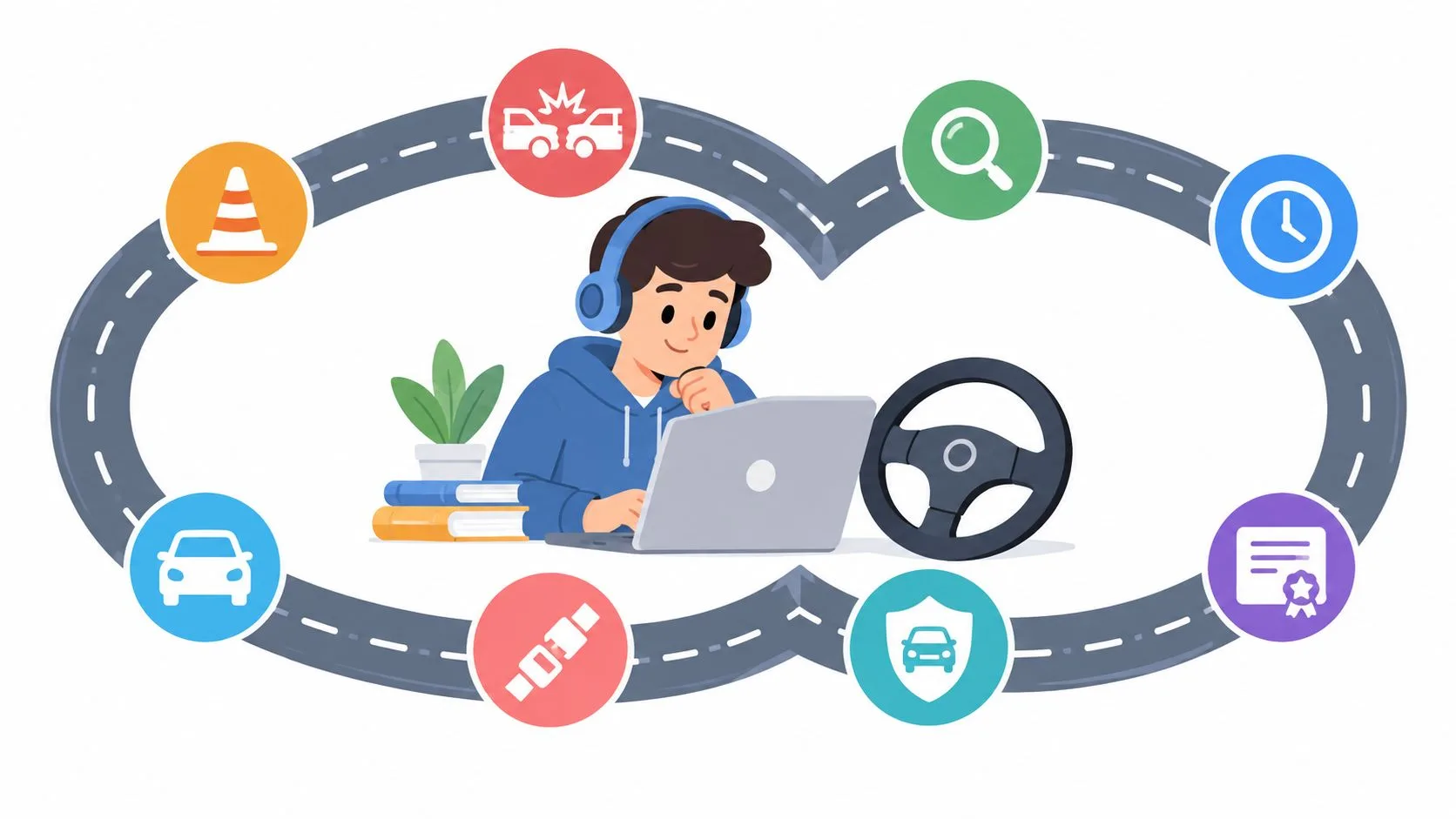
You’re holding a traffic ticket at a red light in your head. Do you pay it, hope it disappears, or take a course and turn it into something useful?
That’s where advanced driver education starts for a lot of Florida drivers. It’s not a stunt-driving class, and it’s not just another name for “defensive driving.” It’s the broader category of training that helps you handle hazards, follow state requirements, and make better decisions behind the wheel, whether you’re dealing with a moving violation, a court order, or you just want to stop making the same mistakes.
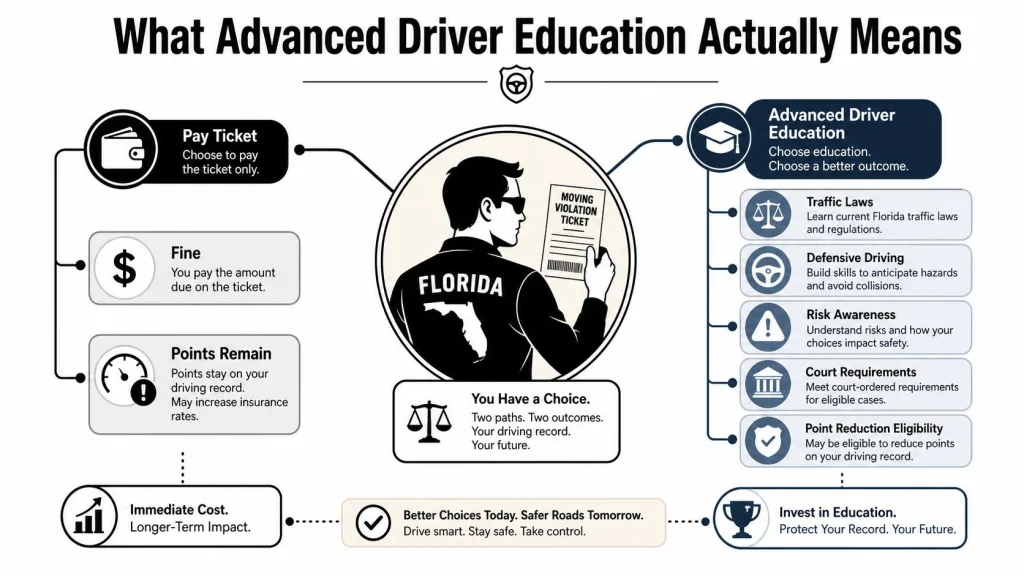
If you’re trying to figure out what fits your situation, start with the difference between a payment receipt and a real corrective step. Florida drivers usually run into four paths, BDI, IDI, ADI, and Mature Driver, and each one serves a different purpose in a driver’s life. For a plain-English overview of what defensive-driving style courses cover, BDISchool’s explanation of what defensive driving means is a useful place to begin.
What Advanced Driver Education Actually Means
A lot of drivers first hear about advanced driver education right after a citation lands in their mailbox. One person sees a speeding ticket and thinks, “I’ll just pay it.” Another asks whether a course can protect the driving record, satisfy a court, or lower insurance friction.
Those are different problems, and the course type matters.
The big idea behind the term
Advanced driver education means instruction that goes beyond first-time licensing and basic permit work. The focus is hazard management, defensive decision-making, and behavior behind the wheel. It’s about how you scan traffic, judge space, and control your response before a mistake becomes a crash.
It is not a racing school, a skid-pad show, or a place to “test your limits.” In fact, major safety reviews have found that advanced training programs do not reliably reduce crash risk for young drivers, even when they make people feel more confident or more skilled. The U.S. National Highway Traffic Safety Administration notes that few advanced driver training courses have been evaluated and that available research suggests they are not beneficial for crash reduction, and some studies even found participants may crash sooner or more often than teens who did not take the training. The key lesson is simple, technical skill is not the same thing as safety outcome. NHTSA on advanced driver training
The four Florida course paths
Florida drivers usually encounter four course labels.
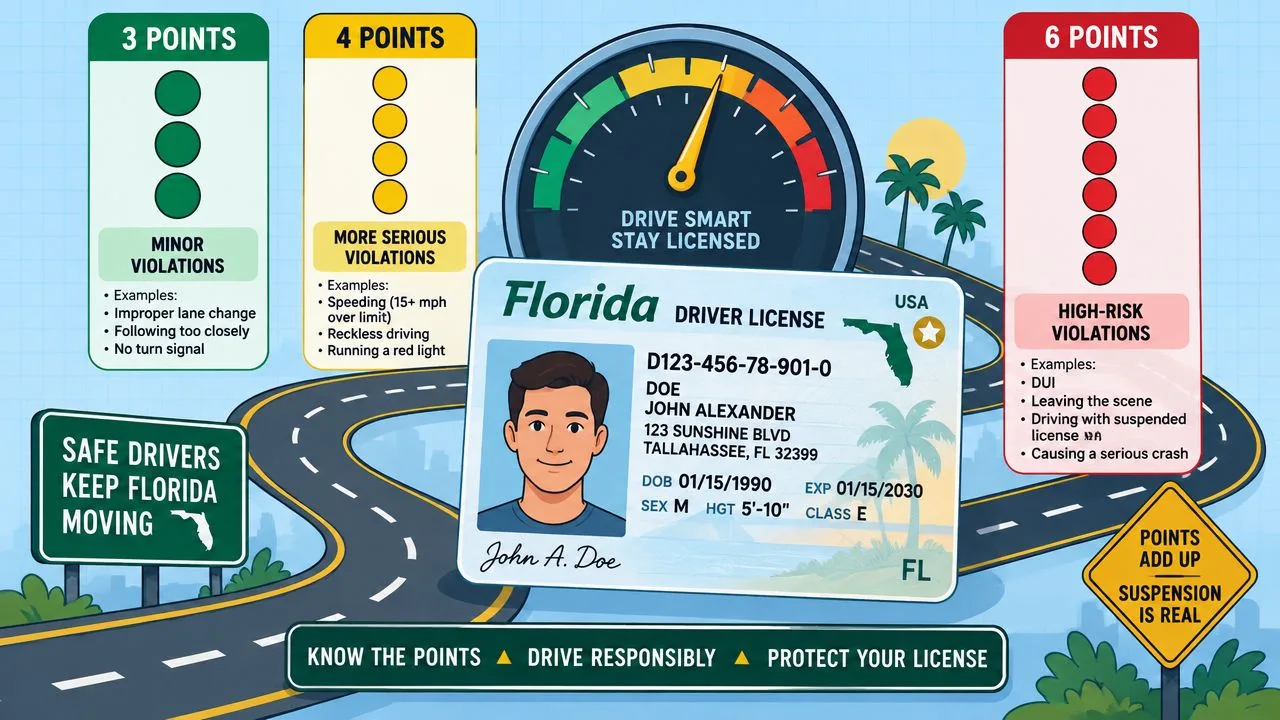
BDI, or Basic Driver Improvement, is the one many people take after a moving violation.
IDI, or Intermediate Driver Improvement, is usually for drivers who need a deeper refresher or have a court-related reason to enroll.
ADI, or Advanced Driver Improvement, is tied to more serious compliance situations, including some habitual offender cases.
Mature Driver is for older drivers who want a refresher and may need insurance-related documentation.
A practical way to think about it is this. If you got a ticket, you’re usually looking at BDI. If a judge told you to take a course, you may need IDI. If your license situation is more serious, ADI may be the path. If you’re older and want a skills refresh, Mature Driver is the fit.
Core Curriculum and What You’ll Actually Learn
A good course doesn’t waste time with theater. It teaches you how to read traffic early, stay calm, and make the safe choice before everyone else at the intersection starts improvising.
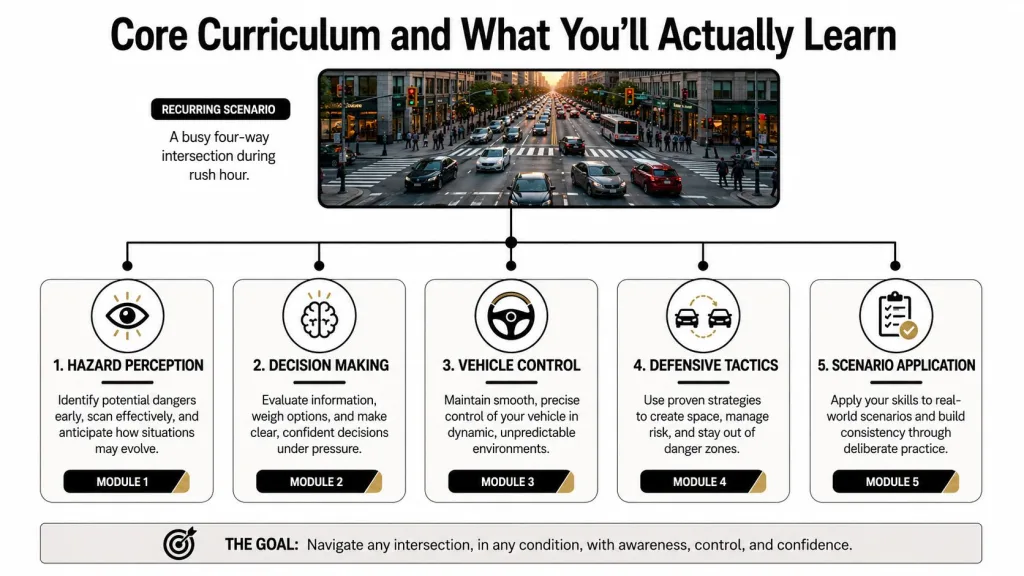
Take one recurring scene, a busy four-way intersection during rush hour. That single scene can teach almost everything a driver needs to know if the lesson is structured correctly.
What happens at the intersection
You approach the light with cars stacked in every direction. A delivery van blocks part of your view, a pedestrian edges toward the crosswalk, and the driver behind you is creeping too close.
Hazard perception starts by scanning left, right, and ahead, not just the lane you’re in. You check whether the car beside you is about to drift, whether the cross traffic is slowing, and whether the light change is going to trap you in the box.
Then comes speed management. In plain language, that means entering at a speed that leaves room to stop. You’re not trying to “win” the intersection. You’re trying to arrive with choices.
Practical rule: If you don’t have room to brake smoothly, you entered too fast.
The habits the curriculum keeps pushing
A strong course keeps repeating the same safe-driving basics until they feel automatic.
- Following distance: Leave space so the car in front of you doesn’t become your problem.
- Right-of-way: Know who moves first, and don’t force a guess from other drivers.
- Distracted driving prevention: Keep your eyes on the road, not on the phone, cup, or touchscreen.
- Impaired driving prevention: Don’t drive when judgment is dulled. The cost shows up fast in real traffic.
- Crash avoidance: Look for the escape route, not just the lane you planned to take.
The New Zealand Transport Agency’s review describes advanced driving courses as programs meant to help drivers identify, avoid, or handle hazards, and that framing matters. The best courses emphasize controlled practice in scanning, speed management, following distance, and limit-adherence, not vehicle-handling spectacle. NZTA research review
That’s also why attitude matters. A driver who thinks, “I’ve got this,” often stops scanning early. A driver who treats every intersection like a prediction problem stays safer longer.
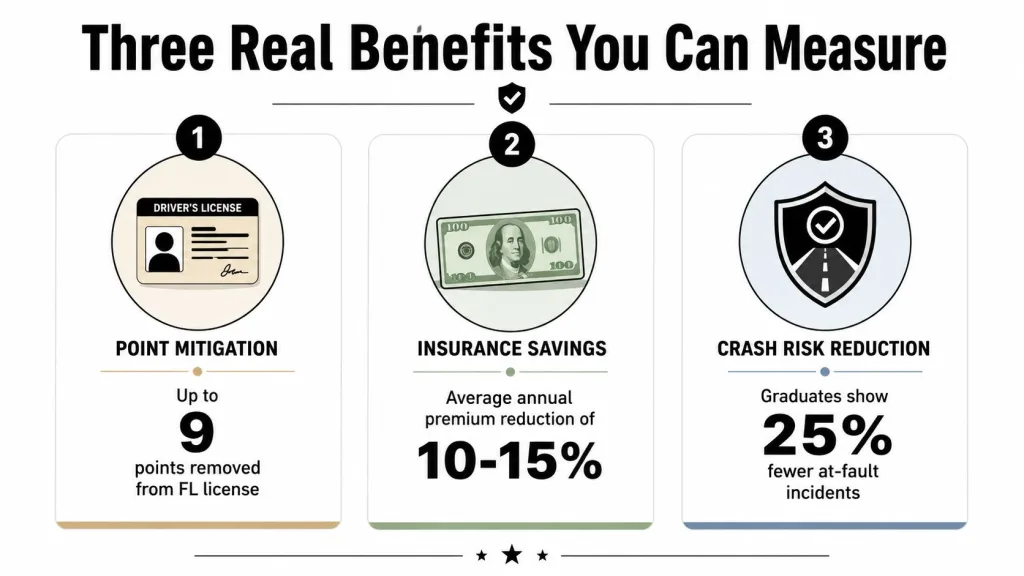
Three Real Benefits You Can Measure
The strongest way to judge any course is by the outcome you can verify. For drivers, that usually means the record, the wallet, and your own behavior behind the wheel.
1. Record-related benefits
If a course is approved for your situation, the most obvious benefit is administrative. You complete the course, and the result gets reported the way the state requires. That can matter after a citation, a court order, or a license issue, but the exact effect depends on the kind of course you took and why you took it.
2. Insurance-related benefits
Some drivers take a course because they’re hoping for an insurance discount. That’s a real-world reason to study, but the discount itself is a carrier decision, not a magic reward built into the act of finishing class. If you’re comparing options, check your insurer’s rules before you assume the course will change your bill.
3. Safety-related benefits
This is the part people often overpromise. The U.S. National Highway Traffic Safety Administration notes that driver education can improve driving performance, self-perceived ability, and even produce a small decrease in traffic offenses, but systematic evidence has not shown a corresponding reduction in crashes or injuries at the individual or community level. NHTSA driver education review
That does not make the course useless. It means the clearest gains are in skills and behavior indicators, not in a guaranteed drop in collision risk. If a course makes you check mirrors earlier, slow down sooner, or stop tailgating, that’s a meaningful win, even if no one can promise a crash-free future.
Bottom line: A course can improve how you drive. It can’t promise what every other driver will do.
Comparing BDI, IDI, ADI, and Mature Driver Courses
Choosing the wrong course is a waste of time. Choosing the right one is usually straightforward once you stop thinking in generic terms and match the course to the reason you’re taking it.
Florida Advanced Driver Education Courses at a Glance
| Course | Length | Typical Audience | Trigger | Outcome |
|---|---|---|---|---|
| BDI | 4 hours | Drivers with a moving violation | Citation-related need | Compliance and point-related handling |
| IDI | 8 hours | Drivers needing a deeper refresher or court-related instruction | Court order or personal choice | Broader safety review |
| ADI | 8 hours in many Florida course offerings | Drivers in more serious compliance situations | Habitual-offender or related need | Structured intervention |
| Mature Driver | 6 hours | Drivers 55 and older | Refresh, insurance, or self-review | Refresher and confidence building |
If you’re looking at a simple speeding ticket, BDI is usually the first course people consider. BDISchool’s Basic Driver Improvement course is the type of option drivers check when they want a compliance-oriented class after a citation.
If you’re 62, still driving daily, and want a course that feels more like a refresher than a penalty, Mature Driver makes more sense. If a judge or license situation demands a more serious track, IDI or ADI is the lane you need to check.
One way I explain it to Florida drivers is this. BDI is for the ticket. IDI is for the deeper reset. ADI is for the serious compliance case. Mature Driver is for the seasoned driver who wants to sharpen up.
Florida Approvals, FLHSMV Reporting, and the 12-Hour Rule
Approval matters because a course is only useful if the state accepts it for the reason you enrolled. Florida-approved programs follow the rules set by the Florida Department of Highway Safety and Motor Vehicles, and completion is reported electronically, which is what gives the certificate its practical value for licensing, courts, and related compliance needs. More detail about that approval process is available in BDISchool’s Florida Highway Safety and Motor Vehicles information.
How the process usually works
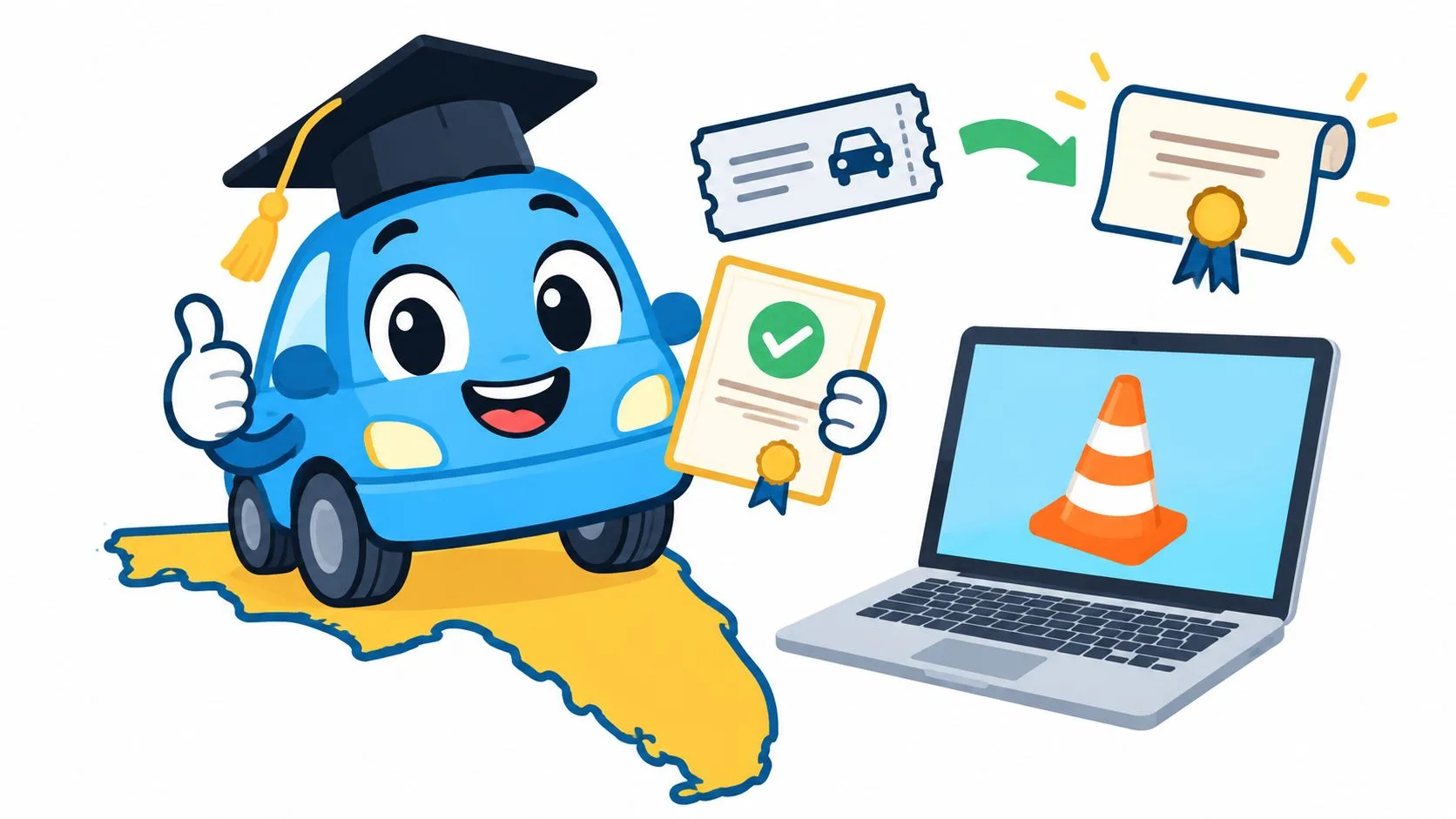
You enroll, complete the assigned instruction, and receive a certificate when you finish. The state then gets the completion record electronically, so the paperwork doesn’t depend on you carrying a stack of forms around.
That reporting trail matters for drivers dealing with court orders or habitual traffic offender issues because it gives judges and agencies a clear completion record. It also helps students understand that “done” means more than just watching videos, it means the course has been processed through the proper channel.
ADI has one especially important rule. Florida’s Advanced Driver Improvement program is a 12-hour course, and state rules require a minimum 24-hour break after the first 6 hours before the remaining instruction can be completed. That break is part of the structure, so don’t plan on blowing through the course in one sitting. Florida ADI course details
If you’re trying to understand how that fits with legal consequences, a current resource like the 2026 Florida DUI law guide from Ticket Shield, PLLC can help you see how driving-related compliance issues can intersect with bigger legal problems.
How to Enroll, Pay, and Finish Online
Start by choosing the right course for your situation. If you’re dealing with a citation, that’s usually different from a court order or a mature-driver refresher, and the course should match the reason you need it.
Then create your account, pick your language, and pay online. BDISchool offers instruction in English, Spanish, and Portuguese, which matters if you learn faster in one language than another or if you’re helping a family member enroll.
What self-paced really means
Self-paced doesn’t mean endless procrastination. It means you can break the work into a schedule that fits your day, usually before work, after dinner, or on a weekend block.
If you’re a working adult, the key advantage is control. You can study from any device, stop and come back later, and avoid rearranging your whole week around a classroom seat.
The online format is also where practical resources matter. If you’re comparing course administration and internal compliance expectations, a resource like compliance strategies for insurers can help you think about why documentation and reporting matter to organizations that track risk.
What happens at the end
When you finish, you get an electronic certificate and the completion is reported through the proper state channel. That’s the part most students care about because it turns study time into a record that can be used.
If you’re ready to move, the internal course path at BDISchool’s online driving course page is the cleanest place to start.
Practical Tips to Get the Most Out of the Course
Treat the course like a real class, not background noise. Set a start time, close the other tabs, and pay attention the same way you would in a room with an instructor looking at you.
Keep a notebook nearby. Write down the parts that feel obvious, because those are usually the habits people break first when traffic gets messy.
My classroom rule: If you can explain the rule in plain language, you’re more likely to use it on the road.
Focus on the reason behind each rule, not just the rule itself. Once you understand why following distance matters, you stop treating it like busywork and start using it as a cushion.
Quiz yourself before the final, and don’t rush the last hour. That’s usually when people click through too fast and miss the details they needed.
After completion, pick one new habit per week. Start with mirror checks, then speed choice, then stopping distance. Small changes stick better than a dramatic promise you won’t keep.
If you want the cheapest, fastest upgrade most Florida drivers can make to their everyday driving habits, this is it. You can start with one of the courses at bdischool.com/courses/ and turn a citation, refresher need, or compliance requirement into something practical.
Frequently Asked Questions About Advanced Driver Education
How much do the courses cost? Pricing can change, so the safest move is to check the current course page before you enroll. The exact amount depends on the course type you choose.
Will my certificate be accepted outside Florida? Sometimes, but not automatically. Acceptance depends on the outside agency, court, insurer, or state that is asking for it.
What if I fail or need to retake the course? Most online courses let you return to the material and try again, but you should confirm the retake policy before you pay. If your deadline is close, don’t wait until the last minute.
Can a court-ordered driver use BDISchool? Yes, if the course you choose matches the court’s requirement and the approval fits your case. The key is matching the order to the right course before you begin.
BDISchool offers Florida-approved online driver education options that fit different driving situations, from citation-related classes to refresher courses for older drivers. If you need a course that’s clear, flexible, and built around real Florida driving needs, visit BDISchool and choose the path that matches your record, your schedule, and your next step on the road.