You’re probably staring at a stack of documents, a half-finished practice quiz, and a test date that still feels too close. Maybe you’re a first-time driver in Florida, maybe you moved here and the process feels different from what you expected, or maybe you already have a license and need to handle a violation without making things worse.
The prueba de manejo Florida feels stressful for one simple reason, it’s not really one test. It’s a sequence of decisions, paperwork checks, eligibility rules, and driving behaviors that all have to line up on the same day. If you understand the sequence, the pressure drops fast.
A lot of Spanish-language prep pages make the process look like a pile of memorized questions. That’s not how Florida evaluates drivers in real life. The state is looking for readiness, judgment, and consistency, and that matters whether you’re taking the knowledge exam, the road test, or a state-approved course to deal with a citation.
Why the Prueba de Manejo Florida Feels Harder Than It Should
The Florida process feels harder than it should because the first failure usually happens before the car moves. People show up missing one document, they misunderstand who needs to sign, or they spend all their energy memorizing trivia instead of learning how Florida judges a driver.
That frustration is real, and it’s why a clear map helps more than another random quiz. The written portion has a fixed benchmark, while the road test is judged on execution and safety. Once you know which part is measured by score and which part is judged by performance, the whole thing starts making sense.
Start by separating the test from the paperwork
The Class E Knowledge Exam is standardized. It uses 50 multiple-choice questions, and you need 40 correct answers to pass, which is 80% (Florida knowledge exam overview). That number gives students something concrete to study toward.
The road test works differently. It’s pass or fail, not a numeric score. That means the examiner is watching whether you drive safely, follow instructions, and handle predictable situations without hesitation.
The fastest way to lower anxiety is to stop treating every part of the process the same way. Memorization helps on the written exam, but the road test rewards calm repetition and good habits.
This is also where drivers with a citation need a different mindset. If your goal is to clear a violation through a state-approved course, you’re not preparing for the same outcome as a brand-new teenager. You’re working toward record management, compliance, or insurance-related benefits, and that calls for a course that fits the reason you’re there.
The good news is that Florida’s system is learnable. Once you know what the state wants, the process stops feeling random and starts feeling practical.
Eligibility, Documents, and Who Must Be in the Room
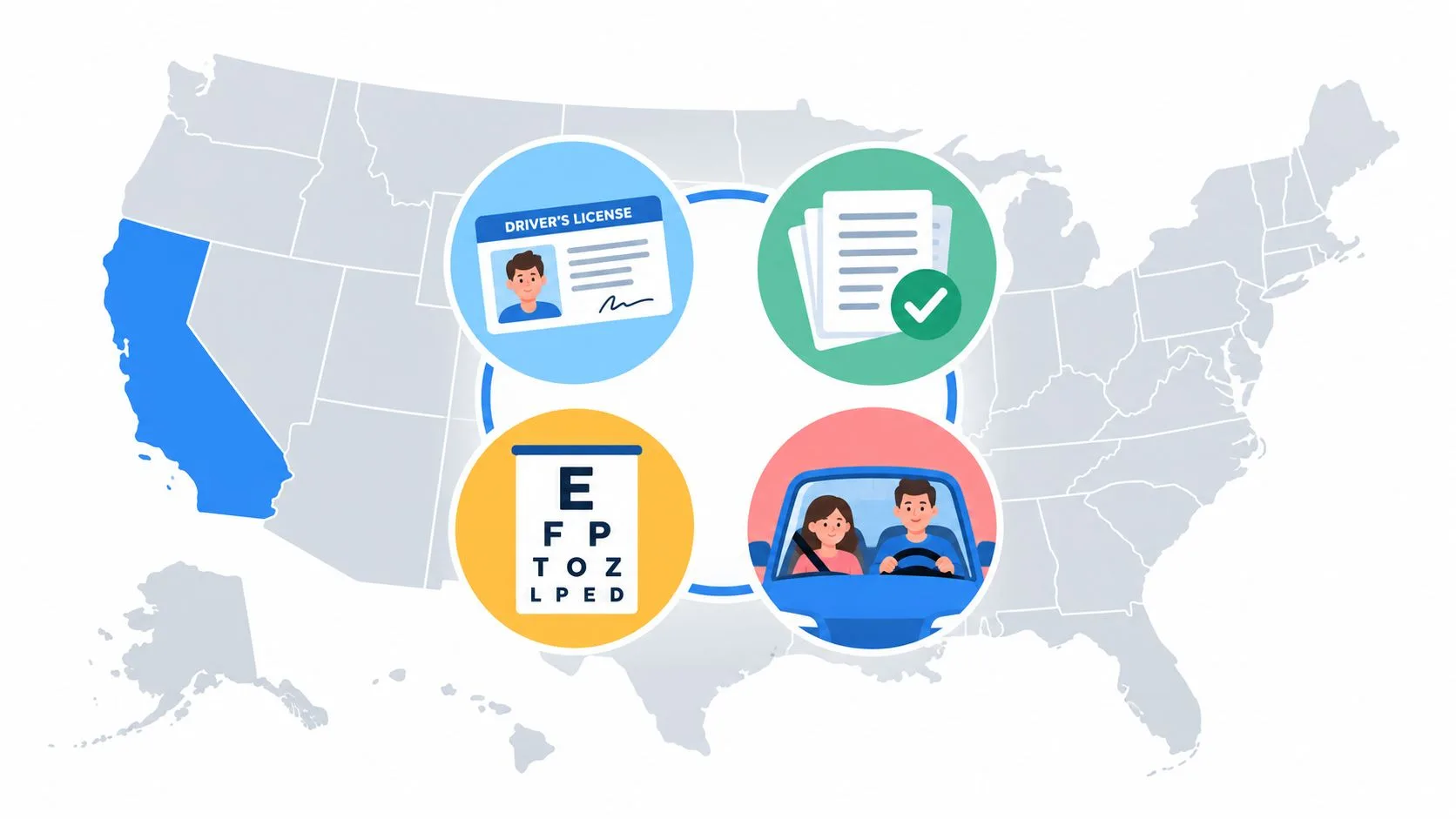
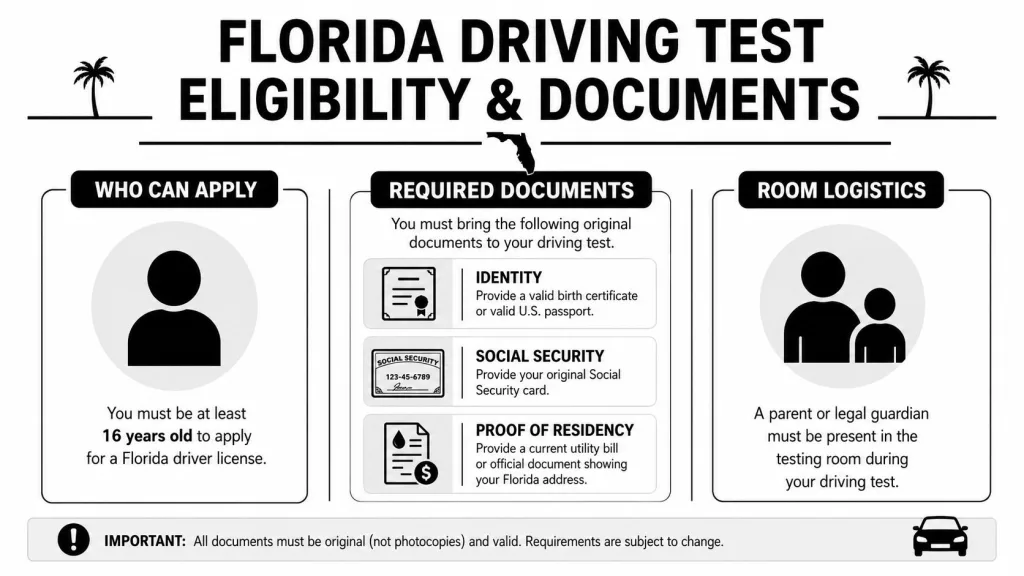
The first question is not how well you can drive. It’s whether you’re eligible to sit down and begin the process today. Florida asks for original documents that prove identity, Social Security number, and residential address, and first-time applicants need to be ready for an eye exam as part of the licensing process (Florida licensing exam guidance; independent Florida driving-test guidance).
Who needs a parent or guardian present
If you’re under 18 and unmarried, a parent or legal guardian must sign the application. A stepparent can’t sign unless they’ve legally adopted the minor (Florida licensing exam guidance). That detail catches a lot of families off guard because a supportive adult is not always the adult Florida recognizes for the form.
There’s one more timing issue that matters. If the Class E Knowledge Exam is completed online, the parent or guardian consent form has to be signed in front of a licensing examiner or notarized if the parent or guardian isn’t present (Florida licensing exam guidance). That’s not a small detail, it’s a scheduling detail, and it can decide whether you finish the visit or have to return later.
For families trying to prepare in advance, a practical checklist helps. The most useful internal reference for that kind of preparation is the what to bring to DMV guide, because it keeps the focus on the actual documents instead of guesswork.
What the room logistics look like in real life
If the applicant is a minor, plan for the adult signer to be physically available. If the applicant completed the knowledge exam online, don’t assume the system will “figure it out” later. Florida wants the paperwork aligned before the license step moves forward.
Bring the original documents, not copies. If one item is missing, the visit can turn into a rescheduling problem instead of a licensing appointment.
The smartest way to think about eligibility is simple. If you can’t prove identity, Social Security number, and residence, you’re not ready yet. If you’re under 18, unmarried, and don’t have the correct adult present, you’re also not ready yet.
Scheduling Your Test and Building Your Pre-Test Window
Scheduling is where a lot of otherwise prepared drivers lose momentum. They wait until the last minute, book at a bad time, and walk in tired, rushed, or still missing something. A better approach is to treat the test date like a logistics appointment, not a casual errand.
For drivers under 18, the timing is especially important because Florida requires a learner’s license for at least 12 months before the road test, along with a clean driving record and completion of a 4-hour drugs-and-alcohol course (Pinellas County Tax Collector road-test checklist). That means the calendar matters as much as the practice session.
Book the date after the preparation is already in motion
A good schedule starts with the office, not with your hopes. Find a nearby licensing location, check how the appointment system works, and build backward from the date you want. If your written exam is done through a third party, the result is sent electronically to the state system, so you don’t need to waste a trip expecting a paper certificate in hand (Florida DHSMV-related guidance).
That electronic flow matters because it changes how you plan your day. You’re not carrying around loose paperwork hoping someone accepts it. You’re making sure the right record exists in the system before you arrive.
For students who want a cleaner timeline, the schedule DMV road test page is useful because it focuses on the appointment side of the process, not just the driving side. That’s the part many people underestimate.
Build a 48-hour buffer
Use the last two days before the test to remove avoidable stress. Sleep normally, stage your documents, and confirm the test car. Don’t try to “cram” driving the night before and don’t show up mentally scattered because you ran your day too tightly.
The best test-day habit is boring. Sleep well, arrive early, and don’t invent a new routine in the parking lot.
For busy adults, the best test windows are often the ones that leave room for traffic and delays. If your schedule is packed, choose a day when you can treat the appointment like your only major task. That’s not dramatic, it’s practical.
Vehicle Requirements and the Pre-Drive Sequence
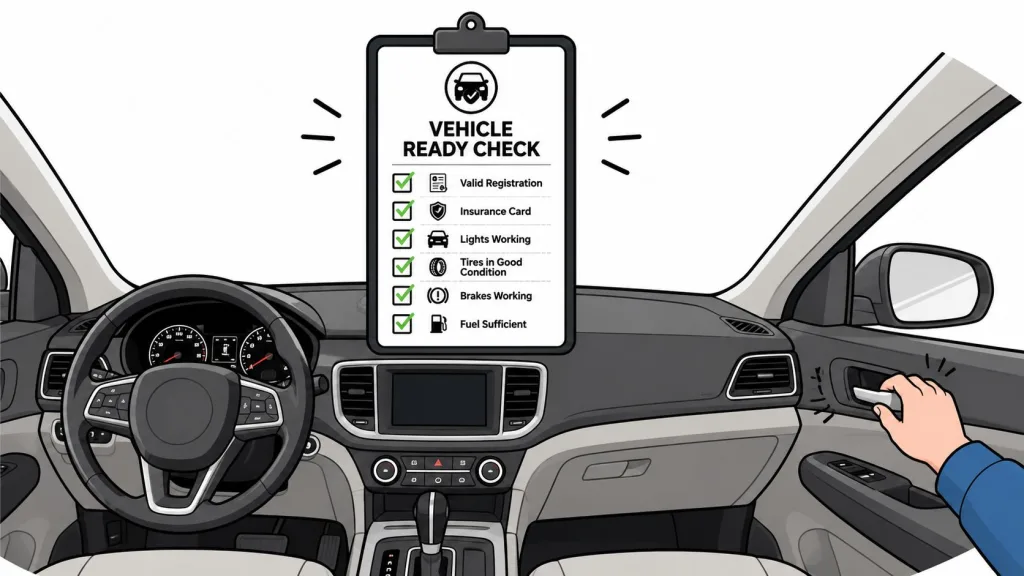
The car itself can disqualify you before the examiner asks you to move. Florida wants a roadworthy vehicle with valid insurance, registration, and operable doors that can be opened from both inside and outside (Pinellas County Tax Collector road-test checklist). If the test car can’t legally and safely be used, the appointment becomes a problem before the test even begins.
The car has to be acceptable before your driving does
I tell students to think like an examiner for a minute. If the car looks neglected, has safety issues, or the doors don’t work correctly, that creates an immediate trust problem. The examiner is not there to help you fix it on site.
A practical way to reduce that risk is to use a vehicle checklist before you leave home. The driving test checklist is a useful reference for staging the car and your documents together so you don’t forget a basic item under pressure.
You should also think about backup transportation. If your primary car fails inspection, you don’t want to spend the day arguing with your schedule. Have another lawful, insured option ready if possible.
For buyers, it can also help to review the vehicle’s history before you borrow or use it for a test. A service where you can browse Florida accident records can reveal issues that matter for peace of mind, especially if the car is new to you.
The pre-drive routine should never change
Florida’s driver manual lists a clear setup sequence, and students do best when they practice it the same way every time: seat adjusted to reach the pedals, mirrors set without leaning, doors locked, seat belt fastened, and controls verified before moving (Florida driver manual). That sequence is not ceremonial. It tells the examiner that you can establish control before you start driving.
The reason this matters is simple. A calm, correct setup lowers the chance of errors later. If you’re already comfortable with the car before you shift into gear, you’re less likely to rush, fumble, or miss a basic instruction.
Practice the entry routine until it feels automatic. The examiner should see consistency, not improvisation.
What Examiners Actually Score on the Road
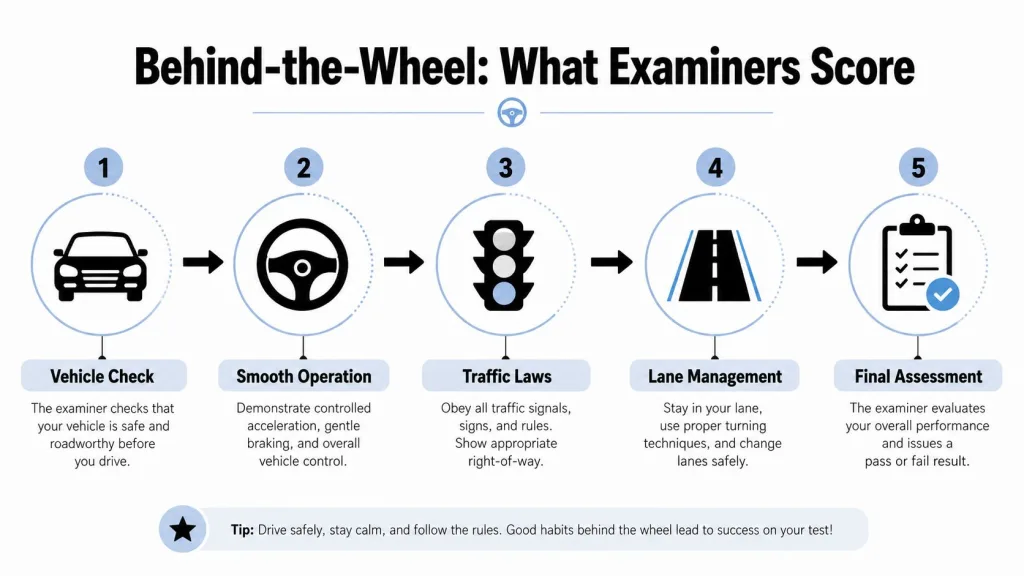
The road test is where people overcomplicate everything. They think the examiner is hunting for perfection, but the job is simpler. The examiner wants to see whether you can operate the car smoothly, follow instructions, and respond to traffic without panic.
The evaluation is pass or fail rather than numerically scored, so your goal is not to accumulate points. Your goal is to avoid the kinds of mistakes that show poor control or weak awareness. That difference changes how you should practice.
What the clipboard is really tracking
Examiners watch for smooth stops, proper lane use, signaling at the right moment, and speed control in common driving environments. They’re also checking whether you move through the route without creating avoidable risk. In Florida, that means the test is really about how you manage ordinary traffic, not how fancy your car skills look.
The reverse-movement check is one of the clearest examples. Candidates are commonly told to look over the right shoulder, avoid using the accelerator, and let the vehicle roll backward for about 50 feet (reverse movement training reference). That maneuver is testing whether you can back up slowly, stay aware of what’s behind you, and resist the urge to overcontrol the car.
I tell students to read each move as a safety question. A smooth stop says you understand spacing. A clean turn says you know lane discipline. A proper signal says you’re not surprising other drivers.
Practice the reason behind each move
If you only memorize the maneuver, you’ll panic when the route changes. If you understand the reason behind it, you’ll adapt better. For example, a school zone isn’t just about a lower speed, it’s about proving you can notice conditions and respond before the road forces you to react.
Drive as if every instruction is asking one question, “Can you control this car without creating extra risk?”
That mindset helps in Florida traffic, especially when the route includes busy roads or weather changes. You won’t get every condition in practice, but you can train the habits that hold up in messy situations. That’s the difference between looking practiced and being ready.
Knowledge Exam Strategy and Common Failure Patterns
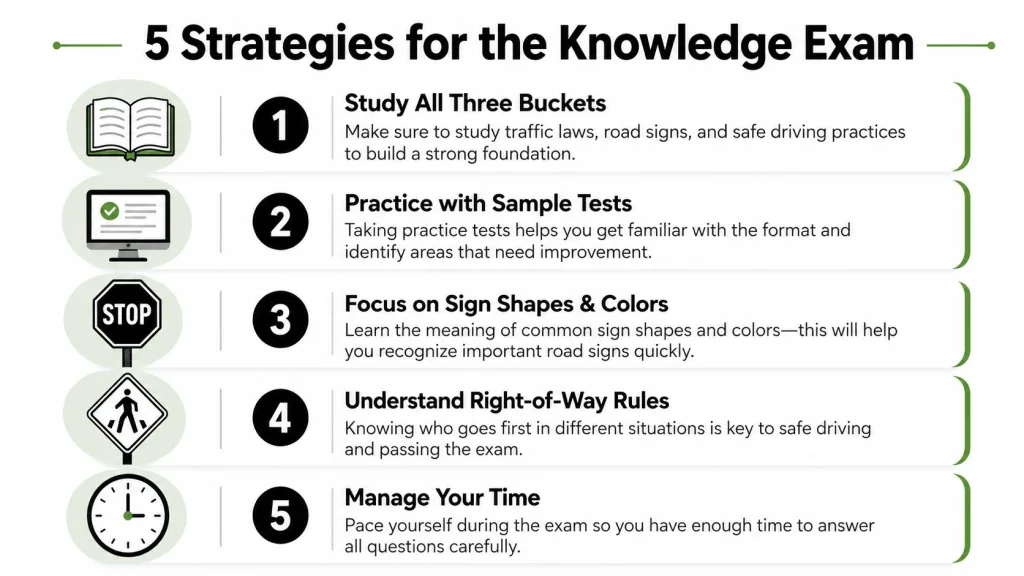
The written exam rewards people who study structure, not people who chase random question dumps. Florida’s Class E Knowledge Exam has 50 multiple-choice questions, and you need 40 correct answers to pass, which is the same 80% threshold noted in the Florida licensing guidance (Florida knowledge exam overview). The content sits in three buckets, traffic laws, safe driving practices, and traffic controls (Florida driver handbook).
Study the handbook, not just the flashcards
The handbook matters because it teaches application. A lot of study pages overfocus on isolated facts, but Florida is testing whether you can apply rules in real traffic situations. That’s why scenario-based study usually works better than pure memorization.
Common failures usually come from confusion, not ignorance. Drivers miss right-of-way at uncontrolled intersections, misjudge stopping distance in rain, or second-guess the basic meaning of signs and signals. Those mistakes happen when someone knows a rule in isolation but hasn’t practiced using it under pressure.
For a cleaner study rhythm, use the chapter structure of the handbook instead of jumping around. Start with traffic laws, move into safe driving practices, and finish with traffic controls. Then use timed practice sets to see whether you can recognize the right answer without freezing.
A focused two-week approach works better than cramming
The best short study plan is simple. Spend the first days reading for understanding, not speed. Spend the middle of the plan reviewing the areas you keep missing, then finish with timed practice.
If you can explain why an answer is correct, you’re studying the right way. If you only remember the letter, you’re vulnerable to the wording changing.
This is also where many adults get stuck emotionally. They’re not confused by every rule, they’re overwhelmed by how much they think they have to memorize. Once the material is broken into the three exam buckets, the task becomes manageable.
Language, Anxiety, and When a Florida BDI Course Is the Better Path
Some readers are not here because they’re chasing a first license. They already drive, but they need to handle a citation or satisfy a course requirement without turning it into a bigger problem. For those drivers, a Florida-approved Basic Driver Improvement course can fit the situation better than another round of test prep.
The anxiety side matters too. If the licensing process makes you tense, a calm plan helps more than adrenaline. For practical coping strategies, the guide on anxiety for Tampa Bay offers a useful mental reset before a test day or course deadline.
Pick the course that matches the reason you’re taking it
BDISchool and DriverEducators both offer Florida traffic school options that are fully online and available in English, Spanish, and Portuguese, with completion reported directly to the FLHSMV. Their course lineup includes BDI, IDI, Aggressive Driver, and Mature Driver options, so the right choice depends on why you need the course, not just that you need one.
| Course | Length | Best For | Reported To |
|---|---|---|---|
| Basic Driver Improvement | 4-hour | Drivers handling a moving violation | FLHSMV |
| Intermediate Driver Improvement | 8-hour | Court-ordered drivers or deeper refresher needs | FLHSMV |
| Aggressive Driver Course | 8-hour | Habitual offenders working on behavior change | FLHSMV |
| Mature Driver Course | 6-hour | Drivers 55 and older seeking a refresher | FLHSMV |
If you’re choosing a path and want the Florida-approved online version, the Florida BDI course online is one option to review alongside your deadline and your record needs. It’s a practical fit when the issue is a citation, not a road test.
Answers to the questions people ask most
If your vehicle fails inspection, don’t force the appointment. Reschedule with a car that meets the requirements.
If you’re asking about cost, check the course page or the licensing office you’re using, because fees can vary by program and location.
If you’re worried about retaking the knowledge exam, the safest move is to review the handbook and focus on the three content buckets before trying again.
If you want a calmer path through Florida licensing or a court-related traffic school requirement, BDISchool offers online courses that fit the real-world situations drivers face. Visit BDISchool to review the Florida options, compare the course types, and choose the one that matches your next step today.