From Learner to Licensed: Your Final Exam Blueprint
The day is here. You’re sitting in the driver’s seat, hands at ten and two, waiting for the examiner. Your heart is pounding. It’s the moment of truth.
But calm confidence doesn’t come from hope. It comes from having a plan you can trust.
Passing your Florida driving test isn’t just about knowing how to steer, brake, and park. It’s about handling documents, vehicle readiness, timing, nerves, and the subtle habits examiners notice right away. A strong driving test checklist gives you more than tasks to complete. It gives you a way to walk in composed, avoid preventable mistakes, and show the examiner that you’re ready for real-world driving.
That’s where many students go wrong. They practice turns and parking, but they ignore the logistics and psychology that shape the score. They know the rules, yet still look hesitant. And they bring a workable car, but forget one document. Also they understand lane changes, but fail to make their mirror checks obvious enough for the examiner to see.
This checklist is built to prevent those mistakes. It ties Florida test prep to what gets noticed on exam day. If you want more structure before the test, the courses at BDISchool are designed to help drivers build safe habits, complete Florida requirements, and prepare with less stress. Start with the list below and use it like your final pre-license game plan.
1. Test Day Logistics and Document Verification
Most failed test days happen before the car even moves.
A student can drive well and still lose the appointment because a document is missing, the wrong vehicle shows up, or the driver arrives rushed and flustered. That’s why logistics deserve the same attention as parking and turns. Good drivers prepare the night before. Smart test-takers prepare a week ahead.
I tell students to stop relying on memory. Use one folder. Put every required document in it. Then check it twice. If you need a practical guide, review this Florida DMV document checklist before test day.
Build a calm arrival routine
Arriving early matters because it gives your brain time to settle. You can adjust the seat, check mirrors, breathe, and switch from everyday stress into focused driving mode.
A common mistake is planning the route once and assuming that’s enough. It isn’t. Drive to the testing site in advance if possible. Learn the entrance, parking flow, and nearby traffic patterns so nothing feels unfamiliar on exam day.
- Pack documents early: Gather your permit or license paperwork, vehicle registration, and proof of insurance well before the appointment.
- Use one protected folder: A clear sleeve or slim folder keeps papers dry, flat, and easy to hand over.
- Prepare backup plans: Know who you’ll call if the vehicle has an issue or if weather or traffic forces a reschedule.
Practical rule: If you’re scrambling in the parking lot, you waited too long.
Students who take online prep seriously often feel better here because course materials introduce the process in a step-by-step way. That matters for teens, adults returning to driving, and older drivers refreshing their knowledge. The less uncertainty you carry into the office, the more attention you can give to the road.
2. Vehicle Pre-Test Inspection and Maintenance
Your car is part of your score, even before the examiner starts judging your driving.
If the vehicle looks neglected, has a warning issue, or fails a basic safety check, you’ve created unnecessary risk. A clean, roadworthy car tells the examiner you take responsibility seriously. It also removes one more source of anxiety.
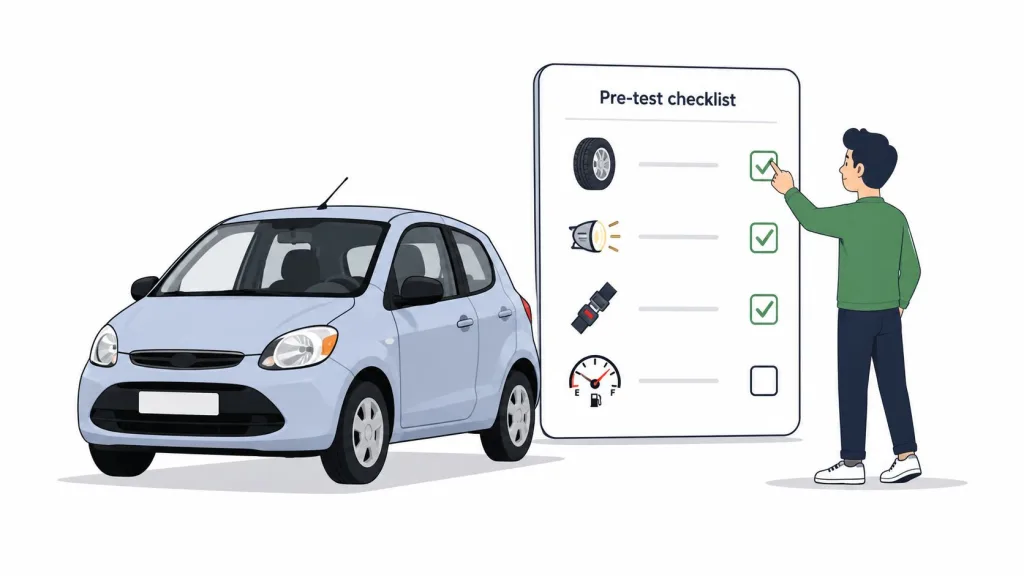
Before a road test, inspect the basics yourself and don’t assume everything works because you drove the car yesterday. Use a proper Florida vehicle maintenance guide if you want a simple reference.
What to check before the examiner does
Start with the obvious items: brake lights, turn signals, headlights, horn, windshield wipers, mirrors, and tires. Visibility matters more than many students realize. If your headlights are cloudy, even something as simple as headlight cleaning services can improve visibility and presentation.
Then check the inside. Make sure the cabin is reasonably clean, the windshield isn’t cluttered, and the registration and insurance are easy to reach. Don’t make the examiner wait while you dig through old receipts and napkins in the glove box.
- Test every light manually: Don’t guess. Turn them on and verify each one.
- Check tire condition: Poor tire pressure or visible wear changes how the car steers and brakes.
- Set up the cabin first: Adjust mirrors, clear distractions, and make sure seat belts work properly.
The best test vehicle feels boring. It starts cleanly, responds predictably, and gives the examiner no reason to worry. That’s exactly what you want.
3. Defensive Driving Practice Drills and Maneuver Rehearsal
Practice should feel repetitive. If it feels dramatic, it’s not focused enough.
Too many learners “go driving” without isolating the exact maneuvers that tend to break down under pressure. Real improvement comes from drilling specific actions until they’re steady and predictable. Parking, backing, lane positioning, turns, and stopping should become routine, not improvisation.
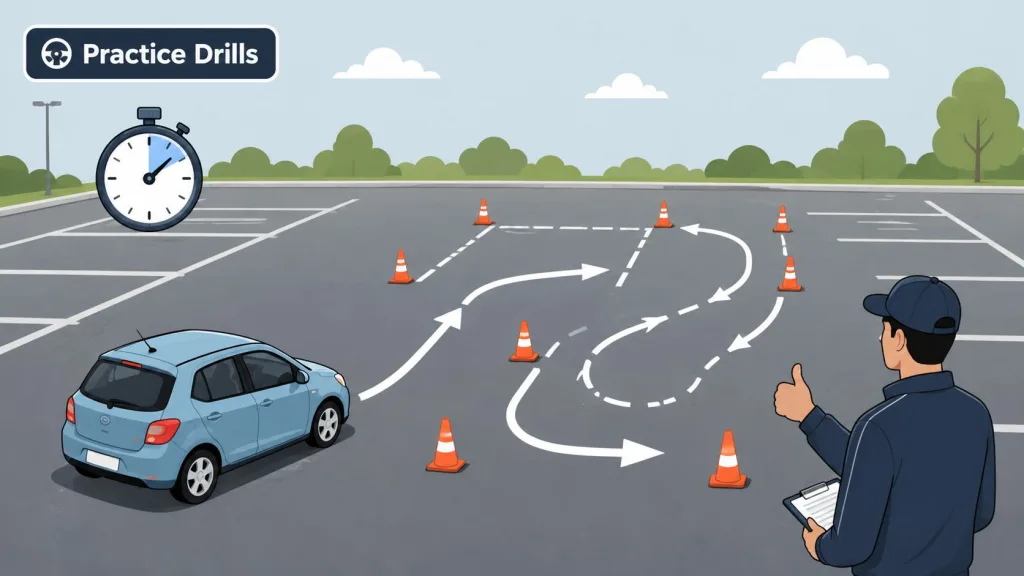
One useful benchmark comes from official safety guidance used in state checklists. Drivers may be required to signal turns for at least 100 feet and back for 50 feet under controlled observation. That matters because examiners score what they can measure. Signaling too late or backing without clear control looks unprepared.
Drill the habits examiners can see
Start in an empty lot. Work on smooth steering input, straight backing, controlled stops, and turning into the correct lane. Then move to quiet neighborhood streets before practicing in moderate traffic.
A strong mentor helps here, but only if they give clear feedback. “Looks fine” isn’t enough. You need comments on timing, lane position, mirror use, and whether your actions are obvious from the passenger seat.
Calm, visible habits beat flashy driving every time.
Use structured review between sessions. If you’re learning better visually, this walkthrough can help reinforce common driving-test skills before your next practice round.
Drivers who study with a course and then immediately rehearse the same skills tend to build confidence faster because the practice has a purpose. That’s one reason guided online instruction works well for busy Florida learners.
4. Mental Preparation and Test-Day Anxiety Management
Anxiety changes how you drive.
It shortens your attention, tightens your hands on the wheel, and makes small decisions feel rushed. A student who looks calm often earns more trust from the examiner than a student who looks uncertain, even when both know the same rules. That’s why mental prep belongs on every serious driving test checklist.
One of the most overlooked points in test prep is examiner psychology. A review of common checklist gaps notes that major lists often ignore how hesitation affects scoring, and one analysis described this gap as present in 0% of major checklists while emphasizing behaviors like firm stops behind the line and mentally counting to five. That tracks with what instructors see all the time. Indecision reads as lack of control.
How to steady yourself before the key moments
Use a short routine before you start the car. Sit back. Relax your shoulders. Take slow breaths. Then mentally rehearse the first few minutes: seatbelt, mirrors, signals, gentle launch, first stop, first turn.
If anxiety tends to rise in the waiting area, review practical driving anxiety strategies and pair them with simple grounding techniques for anxiety. Keep the routine simple enough to use under pressure.
- Sleep before the test: Fatigue makes timing and judgment worse.
- Eat something balanced: A steady breakfast helps you avoid shaky concentration.
- Recover quickly from small mistakes: One imperfect turn doesn’t ruin the drive unless you mentally quit.
Coach’s note: The examiner is watching whether you recover calmly, not whether you drive like a robot.
Students who build this part into their prep usually drive more naturally. That’s the goal. Not fake confidence. Steady confidence.
5. Road Rules and Traffic Law Mastery
You can’t fake your way through right-of-way decisions.
The examiner will notice very quickly whether you understand signs, lane use, yielding, school zones, pedestrian awareness, and basic traffic control. Memorizing answers without understanding the rule behind them creates hesitation at intersections. That’s where preventable errors pile up.
Florida learners should treat the handbook as a working manual, not a formality. Read small sections consistently and connect each rule to a real traffic situation. If you use online instruction, match your study to Florida-specific course content so the legal language becomes easier to apply behind the wheel.
Know the rule and the reason
For example, signaling isn’t just a habit. It’s communication. The same official checklist guidance that requires signaling in advance also explains why measurable distance matters. Other drivers need enough notice to react safely, and the standard exists to remove guesswork from scoring and road safety.
Another helpful perspective comes from abroad. In the United Kingdom, the practical driving test lasts approximately 40 minutes, and the theory component includes 50 multiple-choice questions plus hazard perception testing. That structure reflects something Florida drivers should remember too. Safe driving isn’t just vehicle control. It’s awareness, judgment, and response to developing hazards.
- Study signs in groups: Warning, regulatory, school, and guide signs are easier to retain by category.
- Use flashcards for weak areas: Focus on signs or rules you routinely miss.
- Explain rules out loud: If you can teach a rule, you usually understand it well enough to apply it.
A driver who knows why a rule exists makes better decisions under stress. That’s the driver examiners want to license.
6. Mock Test and Simulated Exam Completion
Practice changes once you stop “studying” and start simulating.
A mock test should feel a little uncomfortable. That’s useful. It exposes where your memory gets thin, where your nerves rise, and which habits disappear when someone is evaluating you. If you only practice in relaxed conditions, your first real pressure test will be the DMV appointment itself.
Structured online prep offers a real advantage. In one industry analysis, digital driving test checklist tools within learner platforms showed a 68% adoption rate among students ages 16 to 19, with 82% of users reporting higher confidence and a 23% reduction in first-time failures. The point isn’t just the tool. It’s the structure. Progress tracking and checklist-based practice help students spot weak points before the examiner does.
Run the mock test like it counts
Use one person as the examiner and ask them not to coach you. They should give directions, observe silently, and save corrections until the end. That’s how you learn whether your habits prove themselves.
After each mock test, review mistakes in categories. Was the issue observation, speed control, lane position, braking, or hesitation? Target the category in the next practice session instead of repeating the whole drive without focus.
- Use a quiet environment first: Remove music, phones, and side conversation.
- Keep the timing realistic: Start on time and finish without casual resets.
- Track repeated errors: One-off mistakes matter less than patterns.
The strongest students don’t just take practice tests. They use them to build a repeatable pre-test routine. That’s what turns practice into readiness.
7. Proper Mirror Checks and Head Turning Technique
Examiners can’t give credit for checks they don’t see.
That’s the core mistake with mirror work and blind-spot scanning. Many learners glance with their eyes only. From the passenger seat, that often looks like they didn’t check at all. On a driving test, subtle doesn’t count. Your observation has to be visible.
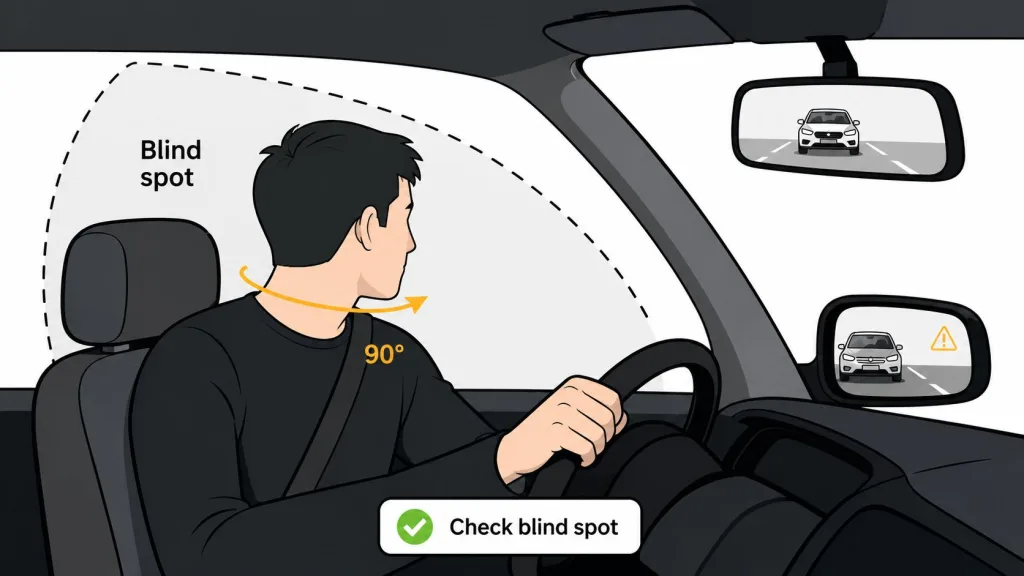
Practice this while parked first. Adjust the mirrors, then rehearse the sequence: mirror, signal, shoulder check, move when clear. If you need a step-by-step visual reference, review this guide on how to check your blind spot while driving.
Make the movement deliberate
Your head should turn enough that the examiner clearly sees the check. That doesn’t mean exaggerated body movement. It means unmistakable observation. Lane changes, merges, turns from the curb, and backing all require visible awareness.
I often see students improve quickly once they stop trying to be “smooth” with their eyes only. Good technique is smooth, but it’s also obvious. The examiner needs evidence.
- Check before every lane change: Not sometimes. Every time.
- Pair the sequence correctly: Mirror first, then signal, then confirm the blind spot.
- Practice with feedback: Ask a coach or parent whether your checks are visible from the passenger seat.
If the examiner has to guess whether you checked, assume they’ll score it as missing.
This one habit can clean up a surprising number of road test deductions. It also makes you safer long after the exam is over.
8. Smooth Steering, Acceleration, and Braking Control
Control is what your driving feels like from the passenger seat.
The examiner doesn’t just watch where the car goes. They feel whether your steering is jerky, whether your braking is late, and whether your acceleration matches the situation. Smooth control signals maturity. Sudden inputs signal uncertainty or poor anticipation.
A lot of learners overcorrect because they wait too long to act. They brake at the last moment, turn too sharply, or accelerate too hard to “keep up.” That style makes the drive feel rushed. Examiners usually prefer a cautious, predictable driver over a quick but uneven one.
Build smoothness into every maneuver
Practice starts in low-pressure places for a reason. In a parking lot, you can feel the pedals and steering without traffic stress. That’s where you learn how little input the car needs.
Then bring that same touch to normal roads. Approach stops earlier. Ease into the brake. Unwind the wheel gradually after turns. Keep your hands stable and your speed appropriate for the road, not for your nerves.
- Brake in stages: Light pressure first, then add more only if needed.
- Steer with purpose: Small, steady inputs beat constant correction.
- Accelerate to match conditions: Don’t launch quickly just because the road opens up.
Florida drivers with a recent ticket often benefit from revisiting these basics in a structured course. The same applies to returning drivers and adults who haven’t tested in years. Good habits feel simple when they’re practiced enough.
8-Point Driving Test Checklist Comparison
| Item |  Implementation Complexity Implementation Complexity |  Resource Requirements Resource Requirements |  Expected Outcomes Expected Outcomes |  Ideal Use Cases Ideal Use Cases |  Key Advantages Key Advantages |
|---|---|---|---|---|---|
| Test Day Logistics and Document Verification | Low–Moderate, checklist & coordination | Low, documents, transport, time buffer | High, avoid cancellations; smooth check-in | Pre-test day preparation; first-time testers | Reduces delays, lowers anxiety, speeds processing |
| Vehicle Pre-Test Inspection and Maintenance | Moderate–High, mechanical checks, possible repairs | Medium, reliable vehicle, tools/mechanic, time | High, pass inspection; safer vehicle operation | Inspection day prep; when vehicle hasn’t been serviced recently | Prevents failures, reduces breakdown risk |
| Defensive Driving Practice Drills and Maneuver Rehearsal | Moderate, repeated supervised practice | Medium, vehicle, safe practice area, instructor/time | High, muscle memory; confident, automatic responses | Skill-building, correcting habits, practical exam prep | Improves real-world safety; reduces test anxiety |
| Mental Preparation and Test-Day Anxiety Management | Low–Moderate, routines, visualization, breathing practice | Low, time, materials, optional coach | High, better focus; fewer panic responses | Nervous test-takers; those prone to performance anxiety | Enhances decision-making under pressure; steadier performance |
| Road Rules and Traffic Law Mastery | Moderate–High, sustained study and updates | Low–Medium, handbook, practice tests, study time | High, legal knowledge; correct rule application | Knowledge-based test prep; new residents to Florida | Prevents legal mistakes; improves test performance |
| Mock Test and Simulated Exam Completion | Low–Moderate, timed setup, repetition | Low, online platform or printed tests, 1–2 hrs per test | High, readiness assessment; improved stamina | Final prep; tracking progress over time | Identifies gaps; builds time management and confidence |
| Proper Mirror Checks and Head Turning Technique | Low–Moderate, habit formation with feedback | Low, vehicle, mentor/time for observation | High, visible examiner cues; better hazard detection | Maneuver practice; lane-change and merging drills | Prevents blind-spot collisions; demonstrates awareness |
| Smooth Steering, Acceleration, and Braking Control | Moderate, finesse and coordinated practice | Low–Medium, practice vehicle, instructor/time | High, predictable control; examiner approval | Refining vehicle control; final practical rehearsal | Improves safety, passenger comfort, and vehicle longevity |
You’ve Got This: Drive with Confidence
Passing your driving test is a major milestone, but the best preparation goes deeper than memorizing a few maneuvers.
A complete driving test checklist should cover your documents, your vehicle, your road knowledge, your practice routine, and your mindset. When those pieces work together, you don’t just look prepared. You drive like someone who’s ready to handle the road responsibly.
That matters in Florida, where many drivers come to test prep from very different starting points. Some are teenagers applying for a first license, some are adults learning later than expected, some are returning to driving after years away. Others are already licensed drivers taking traffic school because of a citation and want to rebuild stronger habits. The checklist works because safe driving is built the same way in every case. One clear routine. One skill at a time. No shortcuts.
If you’re dealing with a moving violation, remember one Florida requirement that often catches people by surprise. To dismiss a ticket, drivers must complete a state-approved 4-hour Basic Driver Improvement course, and that option is limited to once every 12 months for dismissal purposes. Knowing that ahead of time helps you choose the right next step instead of making an avoidable mistake.
What works best is structured repetition. Practice the visible habits examiners score. Use mock tests to expose weak spots. Prepare your paperwork early. Drive the test area if you can. Keep your mind calm enough to show what you already know.
If you want more than a loose collection of tips, a Florida-approved online course can make your prep much more organized. BDISchool offers programs for drivers handling tickets, court requirements, refresher training, and general safety education. For many students, that kind of structure is what turns anxiety into action.
Don’t prepare just to scrape by on test day. Prepare to become the kind of driver who stays calm, notices hazards early, respects the rules, and makes predictable decisions. That’s how you pass the exam. It’s also how you protect yourself and everyone around you once the examiner steps out of the car.
Ready to move from nervous to prepared? Explore the Florida-approved courses at BDISchool and choose the option that fits your next step, whether you’re preparing for a test, handling a citation, or refreshing your driving skills.