You’re back in your car, ticket in hand, replaying the stop. Maybe you were keeping up with traffic. Maybe you glanced down and realized too late that Virginia takes speed far more seriously than the state you came from.
That matters.
A speeding ticket in Virginia might be a routine traffic infraction. It also might be a criminal charge. Many drivers miss that distinction until they’ve already paid the ticket and pleaded guilty to something much worse than they thought.
If you got a speeding ticket in VA, don’t guess. Read the charge carefully, decide whether it’s prepayable, and treat anything close to reckless driving as a serious legal problem, not a nuisance bill.
Your First Steps After Getting a Virginia Speeding Ticket
The first few minutes after a stop are stressful. The next few days matter more.
Start with the ticket itself. Don’t focus only on the speed written down. Look at the actual charge, the court date, and whether the citation appears to be something you can prepay or whether you’ve been ordered to appear. If the officer handed you a summons, that paperwork is telling you more than just how fast they say you were going.
Read the citation before you do anything else
A lot of people make the same mistake. They see “speeding,” assume it’s just a fine, and plan to pay it online later.
That’s risky.
Your citation number, charge description, and hearing date control your next move. If you’re not sure how to identify the citation details, this guide on what a citation number means on a ticket gives a quick breakdown of where to find the information that the court will use to track your case.
Check these items immediately:
- Charge line: Is it ordinary speeding, or does it reference reckless driving?
- Court instructions: Does it say you must appear?
- Date and location: Missing either creates a second problem you don’t need.
Practical rule: Never pay first and ask questions later. In traffic court, payment often functions as an admission.
Separate panic from the actual problem
Most tickets aren’t the end of the world. But some are serious enough that a casual response can cost you far more than the fine.
If you want a general overview of defense options beyond Virginia, Gerald Miller P.A. speeding ticket help is a useful comparison piece because it shows the broader logic behind challenging a citation instead of automatically accepting it.
In Virginia, that logic matters even more.
Build your file today
Before your memory gets fuzzy, gather the basics. Save the ticket, note the road, time, weather, traffic flow, and anything unusual about the stop. If your speedometer, inspection status, or registration raises any issue, deal with that now.
Use a short checklist:
- Scan or photograph the ticket
- Calendar the court date
- Write down what happened while you still remember it
- Decide whether you need legal advice before responding
That’s the right start. Calm, organized, and focused on the charge instead of the adrenaline.
Is It a Simple Ticket or a Criminal Charge
This is the line that changes everything.
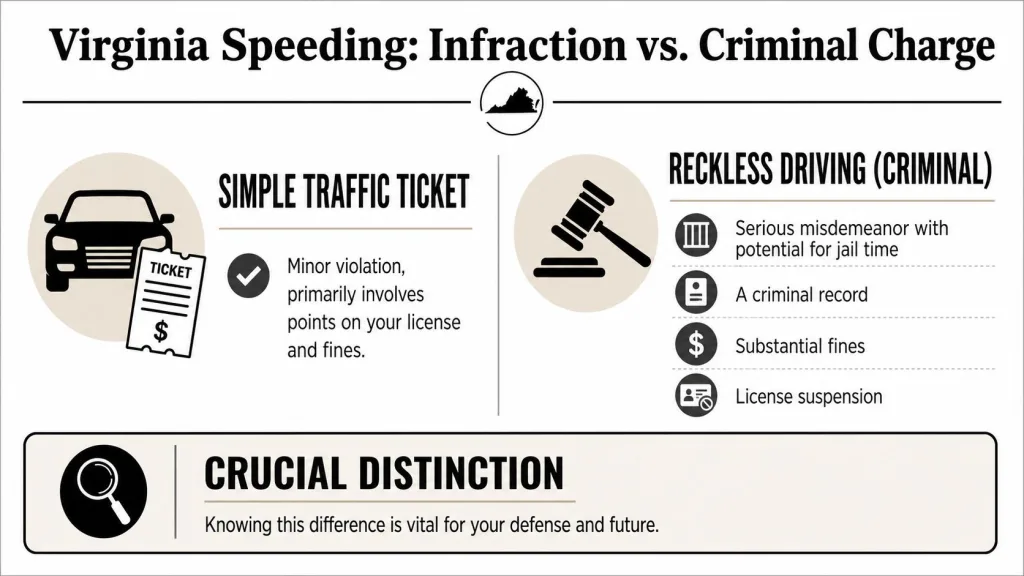
In Virginia, not all speeding is treated as a traffic infraction. Exceeding the speed limit by 20 mph or more, or driving over 85 mph regardless of the posted limit, is charged as reckless driving, a Class 1 misdemeanor, not a simple traffic infraction, according to Virginia’s harsh speeding law overview.
What makes reckless driving different
A simple speeding ticket is bad enough. A reckless driving by speed charge is a criminal case.
The same Virginia source explains that this Class 1 misdemeanor carries exposure to up to 12 months in jail, fines up to $2,500, a mandatory six-month license suspension, and a permanent criminal record. That is not paperwork you casually prepay.
If you’re unsure what counts as a moving offense more generally, this plain-language explanation of what a moving violation is helps frame why Virginia treats some speed cases so aggressively.
Why drivers get this wrong
Drivers often think the only question is, “How much is this ticket?” In Virginia, the first question is different: “Am I being accused of a crime?”
That distinction gets missed because the stop itself can feel ordinary. The officer may still hand you a citation. You may still hear the word “ticket.” None of that changes the legal reality if the charge is reckless driving by speed.
Paying a reckless driving charge is not just resolving a bill. It’s pleading guilty to a misdemeanor.
The permanent record issue
This is the part many generic guides gloss over. A regular infraction and a criminal conviction do not follow you the same way.
The verified guidance on Virginia speeding enforcement notes that many drivers don’t realize prepaying a reckless driving ticket is a guilty plea to a Class 1 misdemeanor that creates a permanent criminal record that cannot be expunged, along with 6 DMV points and potential insurance increases of 80–100% for three to five years. That overlooked difference is outlined in this Virginia speeding ticket analysis.
For a new client, my advice is simple. If your speed was anywhere near that reckless threshold, stop thinking like a customer paying an invoice. Start thinking like a defendant deciding how to protect your record.
A practical way to read your situation
Use this quick split:
- Minor speeding infraction: Usually a fine, DMV points, and insurance consequences.
- Reckless driving by speed: Criminal exposure, court consequences, and a record that can outlast the financial hit.
That’s why the wording on the citation matters so much. Not every speeding ticket in VA belongs in the same category, and treating them the same is how drivers create avoidable damage.
Virginia Speeding Fines and Demerit Points Explained
Once you know the charge, look at the price of a conviction. That means the court fine, the DMV points, and the insurance fallout.
Virginia doesn’t use a flat one-size-fits-all speeding penalty. The fine usually starts with a mileage-over-limit formula plus court costs. The DMV then adds demerit points based on how far over the limit you were.
What the fine usually looks like
Virginia speeding fines start at $6 per mile over the limit plus approximately $75 in court costs, which places most standard tickets in the $130 to $200 range, based on the verified Virginia ticket breakdown in the earlier-cited discussion of state speeding penalties. School zones, work zones, and residential settings can be harsher, but the basic lesson is simple. The number on the ticket is only the opening cost.
Separate from fines, Virginia’s DMV applies points after a conviction. Under Virginia speeding laws and DMV point rules, a speeding conviction results in 3 points for 1 to 9 mph over, 4 points for 10 to 19 mph over, and 6 points for 20+ mph over. Those points remain on your record for exactly two years from the conviction date.
Virginia Speeding Ticket Points and Typical Fines 2026
| MPH Over Speed Limit | DMV Demerit Points | Estimated Fine Range |
|---|---|---|
| 1 to 9 mph over | 3 | $130 to $200 |
| 10 to 19 mph over | 4 | $130 to $200 |
| 20+ mph over | 6 | Varies significantly based on charge |
The chart is useful, but don’t oversimplify it. Once you hit the highest speed category, you may no longer be dealing with a routine infraction.
When points become a license problem
The same Virginia DMV point source states that accumulating 18 points within 12 months or 24 points within 24 months leads to either a 90-day license suspension plus a driver improvement clinic, or enrollment in the ISA Program for 9 months with clinic completion.
That’s where a small mistake turns into a much bigger administrative headache.
If you’re trying to understand the practical side of cleanup strategies, this article on how to reduce points on license is a helpful outside perspective. For the Virginia-specific timing issue, this overview of how long points stay on your license is worth reading.
Bottom line: The fine hurts once. The points can keep hurting long after court ends.
Insurance is usually the real expense
Most drivers focus on the court payment because it’s visible. Insurance is where the damage often drags on.
The verified Virginia data states that reckless driving convictions can increase insurance premiums by 80–100% for three to five years, with a potential 3-year total insurance cost increase of about $900 for a driver paying $1,200 annually. That’s why even a ticket that seems “affordable” on day one may become expensive over time.
Your Three Options Paying Fighting or Mitigating
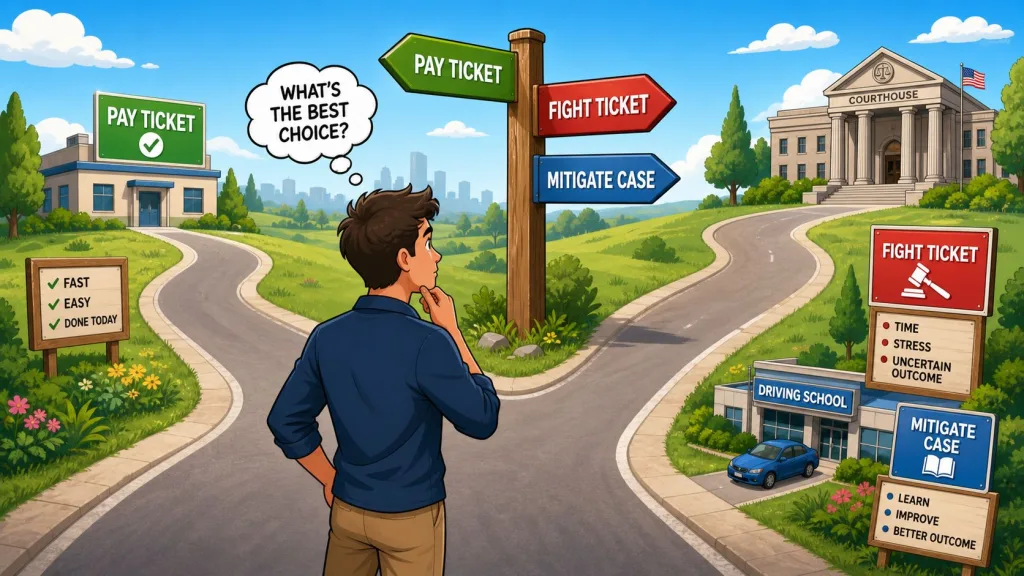
Every speeding ticket in VA ends with a decision. You can pay it, fight it, or try to mitigate the damage.
Those choices are not equal.
Option one paying the ticket
Paying is fast. It is also the easiest way to lock in a conviction.
For standard speeding, that may mean a fine that usually falls in the $130 to $200 range because Virginia fines start at $6 per mile over the limit plus about $75 in court costs, as explained in the earlier-cited Virginia speeding discussion. For reckless driving, paying the ticket is a guilty plea to a crime, and the same verified source notes possible insurance increases of 80–100% for three to five years.
If the charge is minor and your record is clean, paying may be a rational choice. If the charge is serious, paying can be the worst decision you make.
Option two fighting the charge
Fighting means showing up prepared, contesting the case, or having a lawyer do it where allowed. This route makes sense when the stakes justify the effort, the speed reading is questionable, or the charge is too serious to accept without a push.
A defense lawyer in another jurisdiction, such as a Kamuela DUI defense attorney, often explains the same core idea: traffic cases are not only about whether you were technically over the limit. They’re about what ends up on your record and what consequences follow.
That logic absolutely applies in Virginia.
Option three mitigating the outcome
Mitigation is often the smartest middle path. You’re not necessarily claiming the officer made everything up. You’re showing the court why you deserve a better result than the original charge.
That can include a clean record, correction of related issues, respectful presentation, and completion of a driving course before court. Judges tend to respond better to drivers who walk in with proof that they took the ticket seriously.
This short explainer gives a useful overview of what many drivers ask before court:
Go to court with something to show, not just something to say.
Which option is best
Use the charge to decide.
- Pay it if it’s clearly minor and you’ve confirmed it’s only an infraction.
- Fight it if the allegation is wrong, the proof is weak, or the charge threatens your job, license, or criminal record.
- Mitigate it if you need the court to see responsibility and reduce the long-term fallout.
My opinion is blunt. If there’s any chance your ticket crosses into reckless driving territory, don’t treat prepayment like convenience. Treat it like a plea decision.
How a Driver Improvement Clinic Can Help Your Case
A driver improvement clinic is often the most useful proactive step available to you. It shows initiative before the judge ever hears your name.
That matters because traffic judges see the same excuses all day. A completion certificate is better than an apology.
Why the course helps
When you complete a Virginia-approved clinic before court, you give the judge something concrete. You’re showing that you took the stop seriously, addressed your driving habits, and didn’t wait to be forced into action.
That can support a request for leniency, a reduction, or a better overall outcome. It won’t erase every problem, and it won’t magically fix a bad case, but it often improves how your case is received.

What to bring to court
If you complete a clinic, bring proof. Don’t assume the court has already seen it.
Bring a short folder with:
- Your certificate of completion
- A current driving record if available
- Any documents showing corrected issues
- A concise explanation of what you did after the ticket
That presentation tells the court you’re organized and serious.
Use the right course for the right state
Virginia courts generally want to see a Virginia DMV-approved clinic when you’re using driver education as mitigation in a Virginia case. Don’t assume any online traffic course will satisfy that purpose.
If you’re comparing online course quality more broadly, the Florida driver improvement course online page is a good example of what structured, flexible driver education looks like. The broader point stands across states. A well-designed course helps drivers correct habits before those habits cost them more.
Courts are more receptive to drivers who act early than drivers who show up empty-handed and ask for mercy.
My recommendation
If your Virginia ticket is headed to court, especially on a higher-speed allegation, look for a Virginia-approved clinic right away. Don’t wait until the week of court.
Education is one of the few mitigation steps fully within your control. Use it.
Frequently Asked Questions About VA Speeding Tickets
Will a Virginia ticket affect my out-of-state license
Yes, it can.
Verified guidance on interstate consequences states that Virginia reports moving violations like speeding to the driver’s home state DMV, which can affect insurance rates and licensing. That same guidance also warns that failing to appear in Virginia for a serious charge like reckless driving can trigger a bench warrant and a license suspension that impacts driving privileges nationwide, as explained in this discussion of out-of-state Virginia speeding ticket consequences.
If you live outside Virginia, don’t assume distance protects you.
Can I ignore a Virginia court date if I live somewhere else
No.
Ignoring a serious charge is how drivers turn one legal problem into several. If your case requires an appearance, address it directly. That may mean going to court yourself or getting legal help quickly.
Should I hire a lawyer or take a clinic
They do different jobs.
A lawyer handles legal strategy, court procedure, and negotiation. A clinic is mitigation. In many cases, the strongest approach is not choosing one or the other. It’s using education to strengthen your legal position.
What should I do today if I just got the ticket
Keep it simple:
- Read the exact charge
- Confirm the court date
- Do not prepay anything until you understand the consequences
- If the speed is high, treat it as a serious case immediately
That approach protects you from the most common mistake. Acting too casually too soon.
If you want flexible, well-structured driver education from a school focused on helping drivers protect their record and build safer habits, take a look at BDISchool. Their online courses are built for convenience, clear learning, and real-world traffic situations, which makes them a strong option for drivers who want to respond to a citation by getting educated and moving forward smarter.