A car bumps you in traffic, or clips your parked vehicle, or hits a pedestrian near a dim intersection. Then the other driver disappears.
That moment is chaos. Your heart jumps, details blur, and the next few minutes matter more than is often understood. In Florida, a hit and run isn’t a rare edge case. It’s a routine, dangerous problem that puts victims, witnesses, and panicked drivers on a fast collision course with police reports, insurance claims, and potentially criminal charges.
The Shock of a Hit and Run in Florida
You might be reading this from a tow truck, an urgent care waiting room, your driveway, or your phone after noticing fresh damage and no note on your windshield.
That’s how hit and run in Florida often starts. Not with a courtroom, but with confusion. You know something serious happened. You may not know what to do first, what the law requires, or how bad the consequences can get if someone drove away.

Florida sees these crashes constantly. In 2025, Florida recorded 92,381 hit-and-run crashes, which represents approximately 1 in every 4 total crashes statewide, accounting for roughly 25% of all motor vehicle accidents in the state, according to this Florida hit and run overview.
That number should change how you think about this issue. A hit and run in Florida isn’t just a story from the news. It’s a common roadway event, and it happens in parking lots, neighborhood streets, intersections, and dark roadside shoulders.
Why people panic
Some drivers flee because they’re scared. Some think minor damage doesn’t count. Some convince themselves they’ll deal with it later. That decision is where a bad situation turns into a criminal one.
Practical rule: If contact happened and damage or injury is possible, treat it as a stop-now situation.
What this guide will do
If you were hit, you need a clean action plan.
If you witnessed it, your information may matter more than you think.
If you left, even briefly, you still have steps you can take right now to limit the damage and start fixing the problem.
What Legally Defines a Hit and Run in Florida
A hit and run in Florida happens when a driver is involved in a crash and fails to carry out the legal duties that apply at the scene.
That’s the key point. The legal problem isn’t just the impact. It’s the failure to stop, identify yourself, exchange required information, or handle the scene the way Florida law requires.
If another person is present
When you hit an occupied vehicle, a cyclist, a pedestrian, or any attended property, you need to stop as close to the scene as safely possible.
Then you need to identify yourself and provide the information the law requires. You also need to cooperate with law enforcement and, where needed, assist with getting help for anyone injured.
A lot of drivers underestimate how fast panic creates criminal exposure. Leaving because you’re late, embarrassed, afraid of confrontation, or hoping nobody noticed still counts against you.
For a basic legal breakdown of these duties, review Florida accident laws and driver responsibilities.
If you hit a parked car or unattended property
At this point, people get sloppy.
If you hit a parked car, mailbox, fence, gate, or similar property, you don’t get to drive off because nobody is standing there. You still have a legal duty to stop and make a reasonable effort to notify the owner. If you can’t locate the owner, you need to leave identifying information in a place the owner can find it.
Leaving a parking lot after scraping a parked car without leaving your contact information is the classic small-damage hit and run.
What counts as “leaving”
Courts and police don’t care whether you think you only left “for a minute.” If you drove away without handling your legal duties, you gave the incident a hit-and-run shape.
That includes situations like these:
- Quick departures: You looked at the damage, got nervous, and left before exchanging information.
- Parking lot denials: You assumed the scratch was minor and decided it wasn’t worth reporting.
- Indirect avoidance: You parked elsewhere, went home, or waited to see if anyone would call first.
The mistake people make
Drivers often focus on fault. That’s the wrong first question.
The first question is whether you stopped and fulfilled your obligations. You can dispute fault later. You can’t undo fleeing nearly as easily.
Florida Hit and Run Penalties From Misdemeanor to Felony
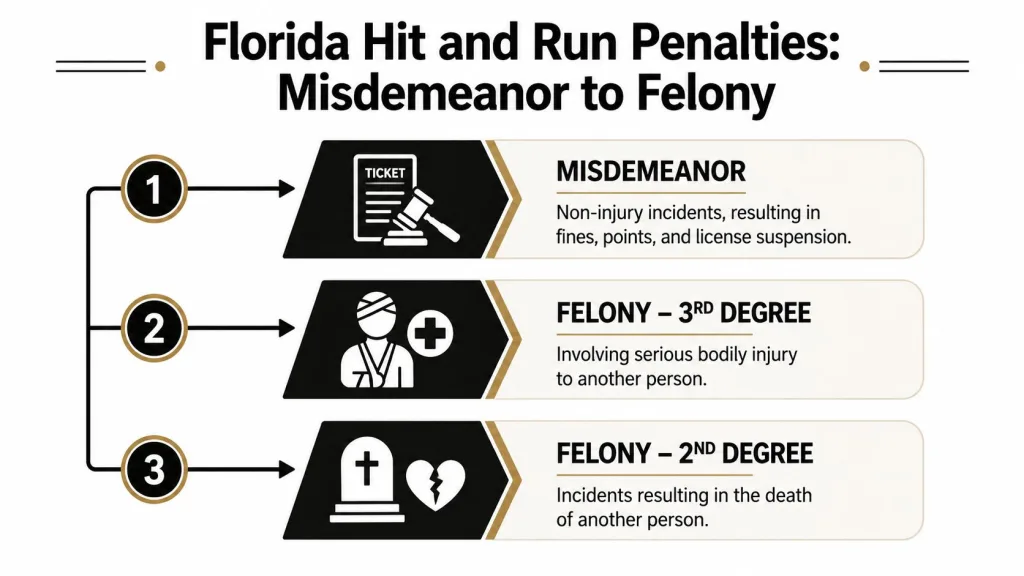
Florida punishes hit and run on a sliding scale. The worse the outcome, the harsher the charge.
That structure matters because people often hear “leaving the scene” and assume every case is a felony. That’s wrong. Others assume a low-speed impact is no big deal. That’s also wrong.
Property damage only
If the crash involved property damage only, leaving the scene is a second-degree misdemeanor. That can mean up to 60 days in jail and a $500 fine under this explanation of Florida property-damage hit and run penalties.
That’s the answer people need when they ask, “What if I only hit a parked car?” It’s still criminal. It’s just not automatically a felony.
Injury cases
Once someone is hurt, the stakes rise sharply.
Florida classifies hit-and-run penalties by a severity-based hierarchy. Leaving a scene with property damage only is a second-degree misdemeanor, while causing injury escalates to a third-degree felony with up to 5 years in prison, and causing death mandates a first-degree felony with a 4-year minimum prison term, as summarized in this Florida penalty overview.
That means a driver who flees after injuring someone isn’t dealing with a traffic inconvenience. They’re dealing with felony exposure.
Fatal crashes
A death changes everything.
If the crash causes a fatality, the charge is a first-degree felony. The law includes a mandatory minimum prison term of 4 years, and the total possible sentence can reach 30 years, along with a $10,000 fine, according to this Florida hit-and-run statistics and penalty summary.
License consequences
A hit and run conviction doesn’t just threaten your freedom. It threatens your ability to drive legally.
The same Florida penalty structure also includes mandatory driver’s license revocation of at least three years, with reinstatement tied to completing a victim impact panel or an approved driver improvement course, as noted in the earlier penalty source.
A simple way to think about it
| Crash result | General charge level | Main risk |
|---|---|---|
| Property damage only | Misdemeanor | Jail, fine, criminal record |
| Injury | Felony | Prison, license loss, long-term record damage |
| Death | Highest felony tier discussed here | Mandatory prison exposure, major license consequences |
My blunt advice
If you caused a crash, staying put is almost always the least damaging legal choice.
Running rarely solves anything. It usually adds a second, more serious problem to the first one.
Most people flee because they think they’re escaping consequences. In practice, they often multiply them.
What to Do Immediately After a Hit and Run
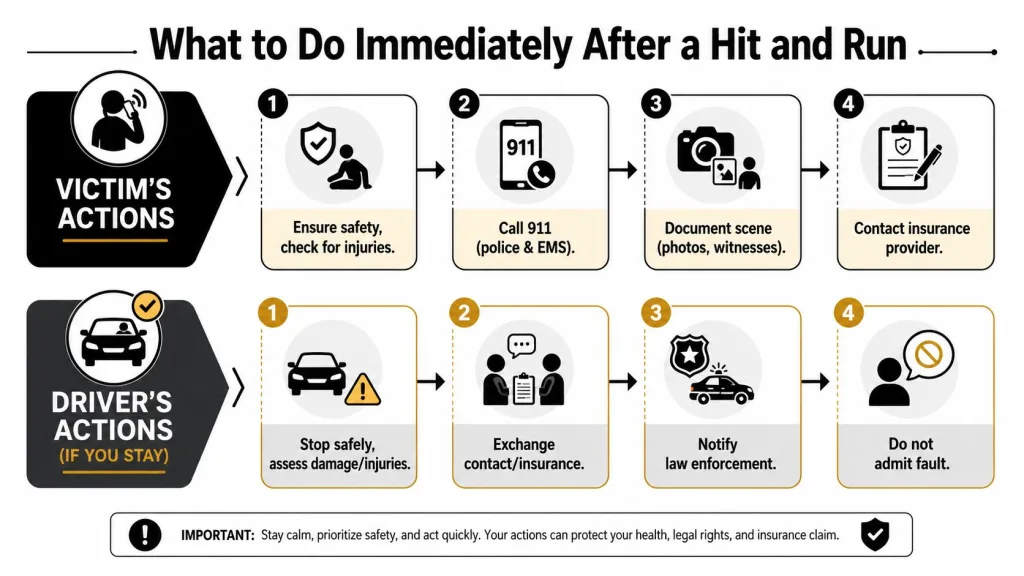
The first moves matter. They affect safety, evidence, insurance, and any criminal or civil case that follows.
Use the right checklist for your role.
If you are the victim
Start with safety. Get out of traffic if you can do it without worsening injuries.
Then do this:
- Call 911 fast. If anyone may be injured, don’t delay.
- Look, don’t chase. Try to note the other vehicle’s color, make, direction of travel, and any plate details you saw.
- Photograph everything. Damage, debris, skid marks, nearby signs, and your injuries if visible.
- Get witness names. A bystander who saw the plate or recorded video can become the most important person in your claim.
- Report it to your insurer. Stick to facts. Don’t guess.
- Get medical evaluation. Even if you think you’re fine, document the injury issue early.
For a practical accident checklist, review what to do after a car accident in Florida.
A short visual walkthrough can also help when your nerves are shot:
If you witnessed the crash
Don’t underestimate your role.
Witnesses often provide the plate fragment, vehicle description, or timeline that makes the police report useful instead of vague.
- Stay available: If police arrive, give your name and contact details.
- Write it down immediately: Memory fades fast after a stressful event.
- Share media carefully: If you captured photos or dashcam footage, preserve the original file.
If you caused the crash and stayed
You still need discipline.
Stop safely. Check for injuries. Call law enforcement if needed. Exchange identifying and insurance information. Don’t argue fault at roadside, and don’t make emotional statements that create confusion later.
If you caused the crash and fled
Fix the mistake now.
The best move is to stop compounding it. Contact a lawyer promptly, then take steps to report the incident and respond appropriately. Waiting usually helps the case against you, not your defense.
Here’s the practical reality:
- Act quickly: Delay looks worse than prompt corrective action.
- Preserve facts: Write down where it happened, when it happened, and what you remember before details blur.
- Don’t hide the vehicle: Concealment is a terrible look and can deepen the problem.
- Be prepared for process: Police contact, insurance notice, and possible court action may follow.
If you left because you panicked, the panic is over. The repair work starts with responsible action.
Navigating Insurance and Civil Claims
Criminal exposure gets the headlines. Insurance and civil claims are what usually disrupt your finances, treatment, transportation, and license-related decisions for months.
A hit and run creates three separate tracks fast. Vehicle damage. Injury treatment. Insurance deadlines. If you are the victim, you need a claim strategy. If you witnessed the crash, your photos, notes, or dashcam footage may decide whether an insurer accepts or fights the claim. If you fled and are now trying to limit the fallout, insurance reporting and restitution can become part of the repair work.
Start with your own policy
Start with the contract that applies today. Your own auto policy.
A good primer on understanding car insurance in Florida can help you sort out which coverages may apply when the other driver is unknown, uninsured, or later denies involvement.
Florida’s no-fault rules confuse many drivers after a crash. This overview of what a no-fault accident means in Florida explains how your own coverage can come into play before fault is fully resolved.
Read the declarations page. Confirm whether you have PIP, collision, medical payments, rental reimbursement, and uninsured or underinsured motorist coverage. Then report the crash promptly and keep your description accurate and consistent.
If the driver is never identified
Your recovery may still start with your own insurer.
PIP may cover part of your injury-related losses. Collision coverage may help with vehicle repairs. Uninsured motorist coverage may matter if your policy includes it and the facts support the claim. Do not assume the insurer will connect those dots for you. Ask direct questions and get the answers in writing.
If you are the victim, give the insurer the police report number, scene photos, witness information, and medical records as they become available. If you are a witness helping someone else, preserve original files and note the time and location clearly. If you left the scene and are now correcting course, notify counsel first, then review your policy’s notice requirements so you do not create a second problem by mishandling the claim.
The filing deadline matters
Civil claims have deadlines, and missed deadlines end cases.
In Florida, the civil statute of limitations for hit-and-run claims is strictly two years from the accident date, but this clock can be legally paused if the at-fault driver flees out of state or intentionally conceals their identity, effectively extending the filing window until the driver is located, based on this explanation of Florida’s hit-and-run filing deadline.
Do not rely on tolling to save a weak file. Act early. Preserve records. Get legal advice before witnesses disappear, vehicles are repaired, or surveillance footage is deleted.
Build a clean claim file
Good documentation wins arguments before they start.
Keep one folder, digital or paper, with:
- Police records: Report number, officer names, supplemental reports, and any case updates.
- Medical records: Visit summaries, bills, prescriptions, discharge papers, and work restrictions.
- Repair evidence: Photos, estimates, invoices, towing bills, and rental car receipts.
- Insurance communications: Claim numbers, adjuster names, emails, letters, and notes from every phone call.
If you are trying to protect your license and reduce the long-term damage from the incident, do not treat insurance as separate from the rest of the case. Courts, insurers, and hearing officers notice whether a driver takes responsibility, follows instructions, and completes corrective steps. A driver improvement course can help show that you are addressing the conduct behind the incident instead of waiting for the system to force action.
Protecting Your Record After a Traffic Incident
If you’re facing a citation, a court order, or a license problem after a traffic incident, passivity is a mistake.
You need to show responsibility early. Courts, hearing officers, and insurers respond better to drivers who take corrective action than to drivers who wait and hope the issue fades.
What mitigation looks like
A legal defense may focus on identification, knowledge, or what happened at the scene. That’s for your lawyer to assess.
Your practical job is different. Your job is to clean up every part you can control. That includes compliance, documentation, and driver education.

Why a driver improvement course matters
A driver improvement course can be part of the remedy because it shows a court, agency, or insurer that you’re addressing the behavior behind the incident instead of minimizing it.
Depending on your situation, that may mean a Basic Driver Improvement course for a moving violation issue or an Intermediate Driver Improvement course when the court requires deeper intervention. Florida drivers also need to understand how points affect their license, and this guide to Florida driver license points helps connect the dots.
Education won’t erase a serious offense. It can strengthen your position, support reinstatement efforts, and help prevent the next mistake.
My recommendation
If a traffic event put your record at risk, move immediately on the pieces you can fix.
That means: get legal advice if needed, follow every court instruction, complete the right course promptly, and stop treating traffic education like a box-checking exercise. For many drivers, it becomes the first serious reset in years.
Frequently Asked Questions About Florida Hit and Runs
Is hitting a parked car and leaving a felony
Usually, no.
If the crash only damaged property, such as a parked car, fence, or mailbox, Florida usually treats leaving the scene as a second-degree misdemeanor. The situation changes fast if anyone was hurt or killed. Then you are no longer dealing with a minor offense.
What if the other driver is never found
Your next step is usually your own insurance claim.
Florida drivers cannot assume the fleeing driver will be identified or have coverage available. As noted earlier, uninsured and underinsured driver problems are common in this state. If you were the victim, report the crash promptly, document every loss, and review your policy for uninsured motorist coverage and collision coverage.
Should I report a minor hit and run
Yes. Report it.
Small crashes turn into bigger problems when damage shows up later, the other side changes the story, or an injury appears hours after the impact. A prompt report protects your credibility and gives police and your insurer a clean timeline.
If I panicked and left, is it hopeless
No, but speed matters.
If you left the scene, stop making the mistake worse. Get legal advice, gather the facts, comply with every reporting requirement, and complete any course the court, agency, or your lawyer recommends. A driver improvement course will not erase a serious hit and run, but it can help show that you are taking the incident seriously and working to protect your license from further damage.
If you need to protect your license, satisfy a court requirement, or show that you’re taking a traffic incident seriously, start with a state-approved course from BDISchool. You can review options through the full course catalog or see additional online programs at DriverEducators.com. The right course can help you address points, meet legal obligations, and become a safer, more reliable Florida driver.