You’re staring at a test or a course module that should be manageable, but the page is dense, the clock is visible, and your brain is spending half its energy just keeping up. Maybe you’ve read the same paragraph three times, or maybe you know the material but can’t finish at the speed everyone else seems to manage. That gap between what you know and what you can show is exactly where learning disability accommodations matter.
For many families, students, and adult learners, the hardest part is realizing this isn’t about getting an unfair advantage. It’s about removing a barrier so the score, grade, or driving lesson reflects real learning instead of reading rate, transcription speed, or panic under time pressure. If you’re trying to figure out whether you need support, a good starting point is a clear overview of support for learning difficulties, because the first step is often naming what’s getting in the way.
People also get stuck because the system changes with age. A student may have school-based support in K-12, then suddenly face a much more self-directed process in college, work, or a training program. That’s why the most useful way to think about accommodations is as a single access system that should travel with the learner, not disappear when the classroom changes.
When a Simple Test Feels Impossible
A student can know the answer in class, then freeze the moment a timed quiz begins. The problem isn’t always content. Sometimes it’s the reading load, the pressure of the countdown, or the effort of writing fast enough to keep up.
The same thing happens to adult learners in online courses after work. They log in tired, face a long module or a timed assessment, and suddenly the course measures stamina more than skill. A practical place to start is this guide on driving anxiety support, because anxiety and access barriers often show up together.
Learning disability accommodations exist to remove those specific barriers. They don’t lower the standard, and they don’t change what someone is supposed to learn. They change how the learner gets access to the material and how they show mastery.
Practical rule: If the accommodation helps the student demonstrate knowledge more accurately, it belongs in the conversation.
That distinction matters because families often hear the word “accommodation” and assume it means special treatment. It doesn’t. It means a fairer path to the same destination.
For many readers, the next question is simple. What counts as an accommodation, and how does it differ from extra help or a modified assignment?
What Learning Disability Accommodations Actually Are
A learning disability accommodation changes how a student learns, accesses information, or shows knowledge. It does not change what the student is expected to learn. That’s the key line between access and alteration.
A modification is different. A modification changes the academic expectation itself, while an accommodation keeps the standard intact and removes a barrier around it. Intensive instruction, tutoring, or specialized teaching can be helpful too, but those are support services, not the same thing as an accommodation.
In K-12 settings, accommodations are mainstream, not rare. The National Longitudinal Transition Study-2 found that 94% of students with learning disabilities received some type of accommodation or support, with extra time on tests (76%) and extra time on assignments (67%) the most common supports, according to the Institute of Education Sciences summary. That same data also show that accommodation systems often include progress monitoring, more frequent feedback, and modified grading criteria, so the picture is broader than test time alone.
The core idea in plain language
Think of accommodations as tools that reduce processing load. A student might read slowly, take longer to organize a written response, or need a quieter room to focus. The accommodation doesn’t hand them the answer. It gives them a fair shot at showing what they know.
That’s why extended time, audiobooks, speech-to-text, and reduced-distraction rooms show up so often. They target the barrier, not the content.
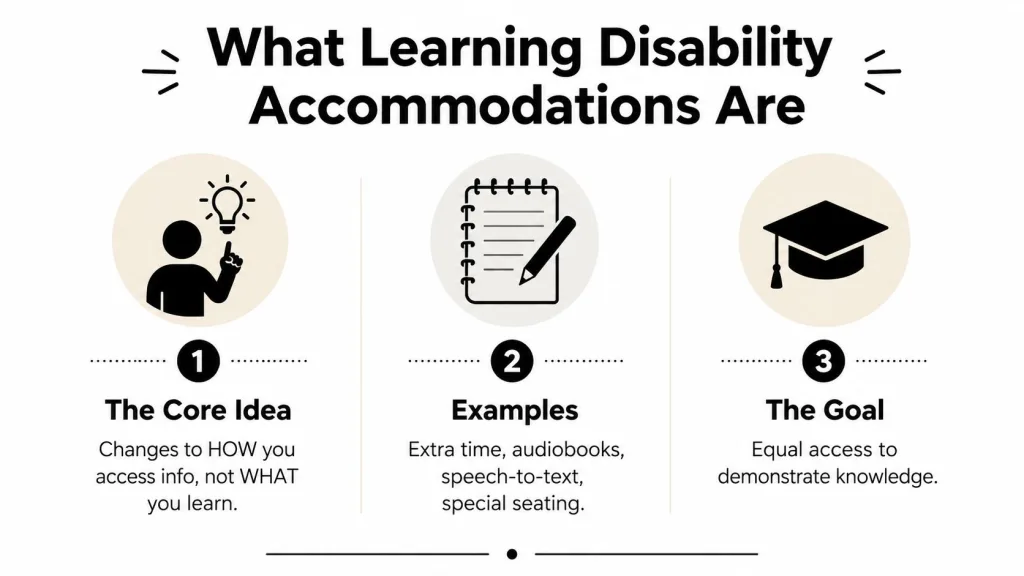
A clean way to remember it is this.
Core test: If a student’s disability affects speed, reading, writing, or focus, the accommodation should remove that obstacle without changing the learning target.
That’s the logic behind the most common supports in school and beyond. Once you understand that, the rest of the process becomes easier to manage.
IEP, 504, and ADA Compared
The three names people hear most are IEP, 504, and ADA. They’re related, but they don’t do the same job.
An IEP is the most structured option. It lives inside special education law and usually includes specialized instruction plus related services, not just access supports. A 504 plan is an access plan, usually built around accommodations that help a student participate without changing the curriculum. ADA protections are the wider civil-rights backdrop that matter in college, workplace settings, and many public-facing environments.
IEP vs 504 vs ADA at a Glance
| Plan or Law | Who It Covers | Who Initiates | Typical Outcome |
|---|---|---|---|
| IEP | Students who need specialized instruction under IDEA | School team and family | Special education services, goals, and supports |
| 504 Plan | Students with disabilities who need access supports | School process, often with family input | Accommodations that remove barriers to access |
| ADA | Students and adults in postsecondary settings and many workplaces | The learner or employee must request support | Reasonable accommodations through an interactive process |
The biggest practical difference is who has to move the process forward. In K-12, schools are much more involved in finding and supporting students. In postsecondary settings, responsibility shifts sharply toward the learner.
That shift is why many students who did fine with support in high school feel lost in college. A parent who once handled meetings and paperwork is suddenly out of the loop, and the student has to speak for themselves. For that handoff, it helps to know what a support office expects, so this guide to what to bring to the DMV can be useful as a model for gathering documents before any formal request.
Practical rule: If the student needs specialized instruction, think IEP. If the student needs access without a changed curriculum, think 504. If the setting is college or work, think ADA and self-advocacy.
That comparison gives you the right starting lane. The next step is figuring out what proof to gather and how to ask.
Eligibility and the Documentation You Will Need
Most accommodation requests rise or fall on documentation. The paperwork doesn’t need to be fancy, but it does need to show the disability and connect it to the barrier.
For college accommodations, the student usually must disclose the disability and request academic adjustments themselves, and they should do it in a timely manner, according to federal guidance on civil rights of students with hidden disabilities. That’s a major shift from school, where adults often drove the process.
What counts as strong documentation
A request usually moves faster when it includes a psychoeducational evaluation, standardized scores with narrative interpretation, a developmental or educational history, or teacher observations when relevant. College Board’s documentation rules for learning disorders also emphasize that the student’s functional limitations need to be described, and that those limitations can be supported by psychoeducational evaluations, history summaries, or teacher observations.
That’s the task. Not just proving a diagnosis, but showing how the diagnosis affects reading, writing, attention, memory, or test performance.
A practical checklist helps:
- Gather the diagnosis report: Ask for the full evaluation, not just a short note.
- Save school records: Keep IEPs, 504 plans, and recent accommodation letters.
- Describe the barrier clearly: Explain what happens during tests, lectures, reading, or writing.
- Contact the right office early: Disability services, student accessibility, or student support staff can tell you what they accept.
- Submit before the deadline: Late paperwork can delay support, even when the student clearly qualifies.
For students and families who want a broader set of examples, this help for students with learning difficulties resource can make the documentation conversation feel less abstract.
A lot of people worry they need the “perfect” packet. They usually don’t. They need enough evidence to connect the disability to the requested support.
If you’re wondering what that support can look like in class or on an exam, the answer is more concrete than you might expect.
Accommodations That Work and the Barriers They Remove
The best accommodations are tied to the barrier, not the label. A learner with slow reading speed doesn’t need the same support as a learner whose biggest challenge is written output, and neither one needs a generic list thrown at them.
Reading load
For reading-heavy work, the most useful supports often include audiobooks, text-to-speech, read-aloud testing, and a reduced-distraction room. Colorado’s dyslexia guidance connects these directly to barriers like slow decoding and working memory load, and it also points to support tools such as speech-to-print for written work and calculators or step lists for math tasks, see the dyslexia accommodations guidance.
Writing load
For writing, the pressure often comes from transcription, spelling, or organizing ideas fast enough to keep up. That’s where scribes, speech-to-text, spellcheck, word prediction, and alternative response modes like oral exams or typed work can help.
Attention and processing speed
For attention and processing speed, the main supports are extended time, frequent breaks, and concise lecture outlines or note takers. University guidance also commonly recommends time-and-a-half to double time on exams paired with a quiet room, because timed tests can punish reading rate, retrieval speed, or written output instead of actual knowledge, as noted in Penn State’s common accommodations guidance.
Math and multi-step tasks
For math, the right accommodation often looks smaller but works harder. Calculators, formula sheets, and step lists can reduce memory load and help the student focus on the actual problem-solving.
Timed testing should measure mastery, not how fast someone can decode, write, or copy.
That’s why the most common higher-education support is often paired with reduced distraction. The combination tackles both speed pressure and environmental noise, which is exactly where many learners lose points they don’t deserve to lose.
For a practical classroom example of how these supports show up in real settings, safe learning environment is a useful phrase to keep in mind. A good accommodation plan makes the environment less hostile to the learner’s processing style.
Accommodations in Online and Self-Paced Courses
A student can look perfectly “set up” for learning at home and still hit barriers online. The commute is gone, the desk may be quieter, and the pace may feel more flexible, yet a cluttered platform, dense reading, or rigid deadlines can still turn a course into a maze.
Good digital instruction removes a lot of friction before anyone has to ask for help. Clear written directions, captioned videos, structured modules, and multiple ways to access content give learners more than one path to the same material. A course built that way works more like a well-labeled classroom, where every tool has a place and students do not have to guess what to do next.
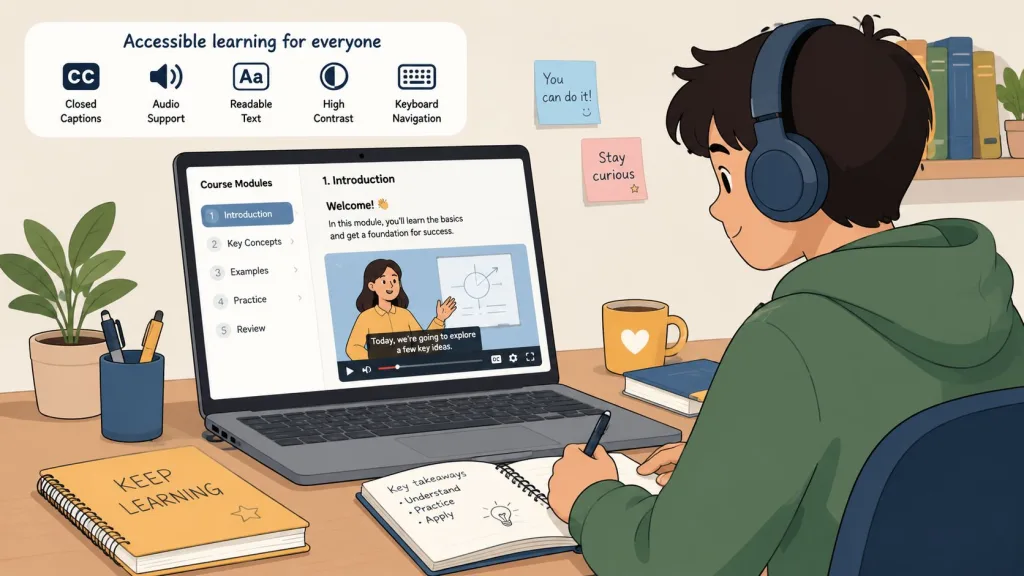
What still needs to be requested
Some supports still have to be asked for directly. A learner may need extended deadlines rather than only more test time, recorded sessions instead of live note takers, keyboard navigation for assistive tech, or alternative response formats like a recorded submission instead of a live proctored video.
That distinction matters most in self-paced learning, where the course moves at the student’s speed only if the design allows it. Without that flexibility, “self-paced” can still feel like a race, just without a teacher standing at the front of the room.
For learners who need a format that fits around work, family, or fatigue, self-paced online courses can reduce barriers before an accommodation request is even needed. The structure itself does part of the access work.
Why this matters beyond college
The same idea applies in online traffic school, driver education, and other training programs. If the course is readable, organized, and flexible, fewer learners hit a wall before they realize they need support.
Accessible design also matters in more formal digital spaces, because access rules are now shaping how online products are built. If you want a broader compliance lens, ensuring EU digital accessibility is a useful place to start.
The practical takeaway is straightforward. Better digital learning can lower the number of accommodations a student needs, but it does not replace them. It makes the right support easier to put in place.
Frequently Asked Questions About Learning Disability Accommodations
A denied request usually means the process needs one more pass, not that the door is closed. Ask for the reason in writing, then use the school or employer appeal steps. If the issue is missing paperwork, update the documentation and send it again, so the request is judged on what the learner needs.
What if my accommodation request is denied?
Ask for the reason in writing, then appeal through the school or employer process. If the denial came from missing documentation, update the records and resubmit rather than treating the first answer as final.
Do accommodations look bad on a college application?
No. Accommodations are about access, not discipline. Colleges should not treat disability support as a negative mark, and the admissions decision is separate from the support process.
When should I disclose a disability at work?
Disclose when you need an accommodation, and use the employer’s ADA process. The timing usually works best before the barrier starts affecting performance, since waiting can make the problem harder to explain.
Can accommodations show up in driving school or traffic school?
Yes. A learner may need flexible pacing, clearer directions, or a format that fits better with reading and attention differences. Those settings still count as education, so access needs do not disappear just because the subject is driving.
What if I wasn’t diagnosed until college or adulthood?
That is common enough to be part of the normal process. Current documentation, a clear description of the barrier, and a timely request for support matter more than when the diagnosis first happened.
If you are comparing access systems across countries or digital products, it can help to read about ensuring EU digital accessibility, because the same access ideas are being applied in more places beyond school.
If you want a flexible way to keep learning moving forward, explore the courses at BDISchool. They are built for learners who need clear structure, self-paced access, and a practical path through topics like driving education and traffic school.