You’re probably in a parking lot, a driveway, or stopped at a red light, and your mirrors were last touched by someone else, or by you, a long time ago. That matters more than most drivers think, because a small change in mirror adjustment can decide whether you catch a car before a lane change or miss it completely.
In Florida, that’s not a small detail. Highway merges, multi-lane turns, and quick passes all depend on what you can see, not what you assume is there. The good news is that mirror setup is a learnable routine, and once you understand the geometry, it stops feeling like guesswork and starts feeling like part of your pre-drive safety system.
Why Mirror Adjustment Matters Before Every Drive
The mistake I see most often is simple, and it happens before the engine even starts. A driver gets in, glances at the mirrors, sees a comfortable view, and assumes that’s enough. Then they merge onto a busy Florida highway, move to the next lane, and suddenly a vehicle appears where they thought there was empty space.
That surprise is exactly why mirror adjustment deserves a few quiet minutes before every drive. It isn’t about personal preference, and it isn’t about making the car look neat from the driver’s seat. It’s a measurable safety setup task, and the geometry changes with the car, the seat position, and the person behind the wheel.
The point is coverage, not symmetry
Many students start by aiming mirrors so they can see the side of their own car. That feels safe, but it often wastes valuable field of view. The better habit is to think in terms of coverage, meaning the mirrors should help you track traffic from behind to beside you without large gaps.
A University of Michigan Transportation Research Institute study showed that mirror coverage can be quantified in degrees, with the Trans Am requiring a total adjustment angle of 15.2° horizontally and 15.7° vertically to achieve the necessary coverage University of Michigan Transportation Research Institute study. That’s a useful reminder that mirror adjustment is technical, not casual.
Practical rule: if the mirror setup still feels “comfortable” but leaves you guessing about adjacent traffic, it probably needs to be redone.
For a driver-friendly foundation on posture and visibility, a strong seating position matters too, and this guide on defensive posture fits that idea well. The seat, steering wheel reach, and mirror angles work together. If one is off, the others usually are too.
Setting Your Interior Rearview Mirror Correctly
Start with your body, not the mirror. Sit in your normal driving position first, the one you use on the road, then reach for the interior rearview mirror and frame the rear window as fully as possible. The goal is simple, see the road behind you clearly while wasting as little mirror surface as possible on the car’s roof, headliner, or dashboard.
If you adjust the mirror before settling your seat, you’re building on the wrong reference point. That’s why this step belongs after the seat is fixed and before the engine is fully part of the routine. A mirror that looked fine yesterday can become wrong the moment someone moves the seat.
What the interior mirror should do
The interior mirror should give you a clean rearward anchor. It does not need to show the whole back seat, and it shouldn’t be used as your only tool for lane changes. Its job is to help you judge traffic behind you, then support the side mirrors rather than duplicate them.
There’s also a safety engineering reason to respect this mirror. A U.S. technical discussion of mirror mounting notes that the mounting must deflect, collapse, or break away without sharp edges when struck with a force of 400 N, which is about 90 pounds of force, in a forward direction within 45° of the vehicle’s forward longitudinal axis interior rearview mirror mounting discussion. That detail matters because interior mirrors are designed with collision safety in mind, not just visibility.
Before you drive off, glance at the mirror once more after any seat change. If you adjusted your seatback, moved the seat forward, or handed the vehicle to someone else earlier, check it again. A mirror that matches yesterday’s driving position may not match today’s.
Adjusting Side Mirrors Using the Blind Spot Overlap Method
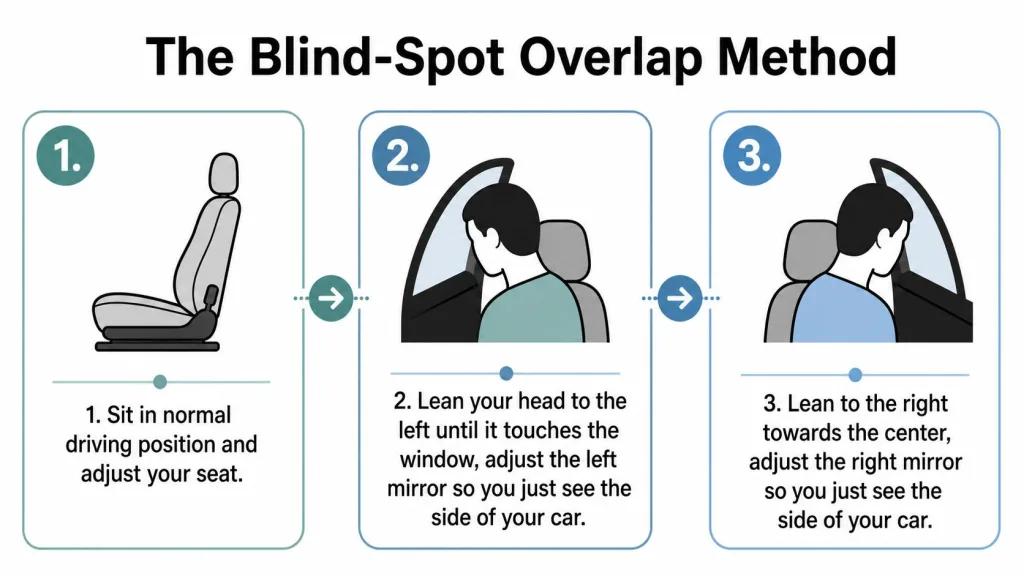
The blind-spot overlap method turns side-mirror setup into a repeatable task. Instead of centering the mirrors on the side of your car, you move them outward so the car body is only barely visible from the normal driving position, and the side-mirror view just overlaps the outer edge of what the interior mirror already shows.
That overlap is the key. If the mirrors are aimed too far inward, they give you redundant rearward coverage and leave a bigger lane-adjacent blind zone. That blind zone is the gap that matters when a car moves from behind you to alongside you.
How to set the left mirror
Sit normally. Then adjust the driver-side mirror outward until you can barely see the side of your car at the inner edge of the glass. If you keep seeing a large slice of your own door, the mirror is probably aimed too far in.
Lean your head left toward the window if that helps you find the edge of the vehicle, then return to normal posture and confirm the mirror still gives you lane coverage. The point is not to stare at the car body. The point is to make sure the adjacent lane enters the mirror view smoothly as traffic approaches from behind.
How to set the right mirror
Use the same logic on the passenger side, but expect the view to feel wider. A common truck-mirror setup rule uses a similar idea, with the driver-side mirror showing the trailer’s rear corner at the inner edge and the passenger-side mirror set farther outward so only a small sliver of the trailer remains visible truck-mirror setup guidance. The principle is the same even when the vehicle isn’t a truck, reduce wasted overlap and expand usable lane view.
If you want a simple visual comparison of this concept in another context, the Sixrace buyer guide mirrors is a useful reference point for how riders think about visibility, though the setup details differ from cars. The broader lesson is the same, mirrors should be adjusted for what’s around you, not for what looks balanced from inside the cabin.
When another vehicle moves from behind to beside you, the transition should feel continuous across mirrors, not like a sudden disappearance.
If that transition feels broken, the angle is wrong. Fine-tune it again before you drive.
A simple lane-change check is useful here too, and this guide on how to check blind spot while driving pairs naturally with the mirror-overlap habit. The mirror setup gives you the coverage, and the shoulder check confirms what the mirrors can’t show.
How Poor Mirror Setup Increases Crash Risk
Poor mirror setup does more than make driving feel awkward. It creates a visibility gap at the exact moment you need a clear picture of nearby traffic, such as before a turn, a merge, a lane change, or a pass. On busy Florida roads, that gap can turn a routine maneuver into a fast-moving hazard.
The Commercial Vehicle Safety Alliance built its Driver’s Challenge mirror-adjustment station around a key finding from the American Transportation Research Institute. In that data, the likelihood of a crash rises by 105% for an improper turn violation, 78% for an improper lane-change violation, and 25% for an improper passing violation CVSA and ATRI mirror-adjustment guidance. Those figures come from commercial vehicles, but the safety lesson applies to every driver. If your mirrors leave a blind spot where another vehicle can disappear, the risk rises the moment you commit to the maneuver.
Why this matters on Florida roads
Florida driving often requires quick judgment. Traffic can move from open to crowded in a short stretch, and a mirror that leaves a blind zone gives you less time to react. A proper setup helps you spot a merging vehicle before the lane change becomes dangerous.
The CVSA guidance emphasizes testing mirror adjustment before driving so the driver can verify that blind spots are minimized and surrounding traffic moves from one mirror field to the next in a predictable way, as noted earlier from the ATRI data. That predictable transition is the point. If a vehicle appears in the side mirror and then disappears before your shoulder check, the angle needs to be corrected.
For a broader look at collision triggers, the internal guide on what causes most car accidents fits here because it reinforces the same point, avoidable visibility errors are often part of larger driving mistakes. Mirror setup will not remove every hazard, but it does remove one of the easiest ones to fix.
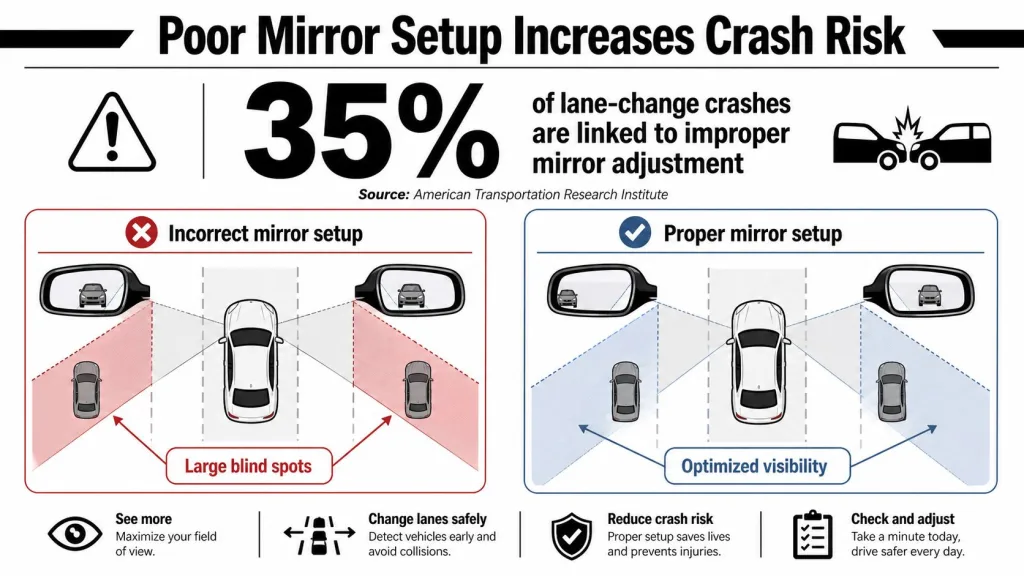
On busy Florida roads, a properly set mirror can catch a merging vehicle seconds before a lane change becomes hazardous. That is why mirror adjustment belongs in the same pre-drive routine as fastening the seat belt and checking the traffic around you. It is a small setup step, but it shapes how much of the road you can see.
Common Mirror Adjustment Mistakes to Avoid
The biggest mirror mistakes are usually the ones that feel harmless. Drivers make them because they seem familiar, and familiar feels safe. In practice, they often do the opposite.
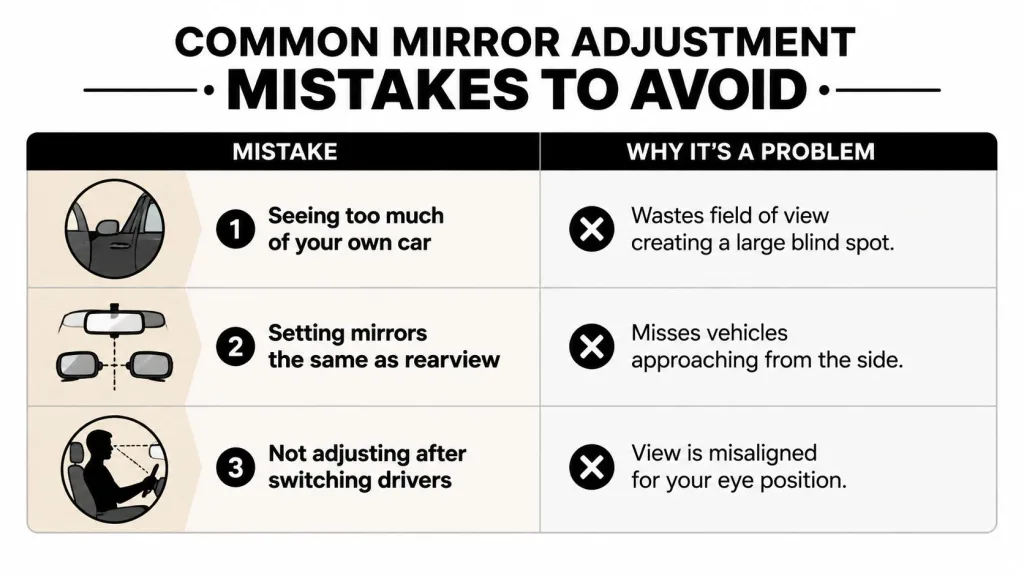
Seeing too much of your own car
If the side mirror shows a large chunk of your door, it’s probably too far inward. That wasted space in the glass is space that should be showing traffic beside you. A better setup keeps only a small sliver of the car visible, just enough for orientation.
Setting side mirrors like the rearview mirror
The interior mirror and the side mirrors do different jobs. The rearview mirror looks straight back, while the side mirrors should extend your view outward to cover adjacent lanes. If you duplicate the same rearward view across all three mirrors, you leave gaps where another car can hide.
Failing to re-adjust after a different driver uses the car
This is easy to overlook. A mirror set for a taller driver, a shorter driver, or someone with a different seat position may not work for you at all. Check the mirrors every time you get in, especially if the vehicle was shared.
Practical rule: if the seat changed, the mirrors probably changed too, even if they still look “close enough.”
There’s one more mistake that can be distracting and imprecise. Don’t try to fine-tune mirrors while the car is moving. That divides attention and usually leads to a sloppy setting. Pull over, set the mirrors correctly, then move on with your drive.
Your Pre-Drive Mirror Checklist and Next Steps
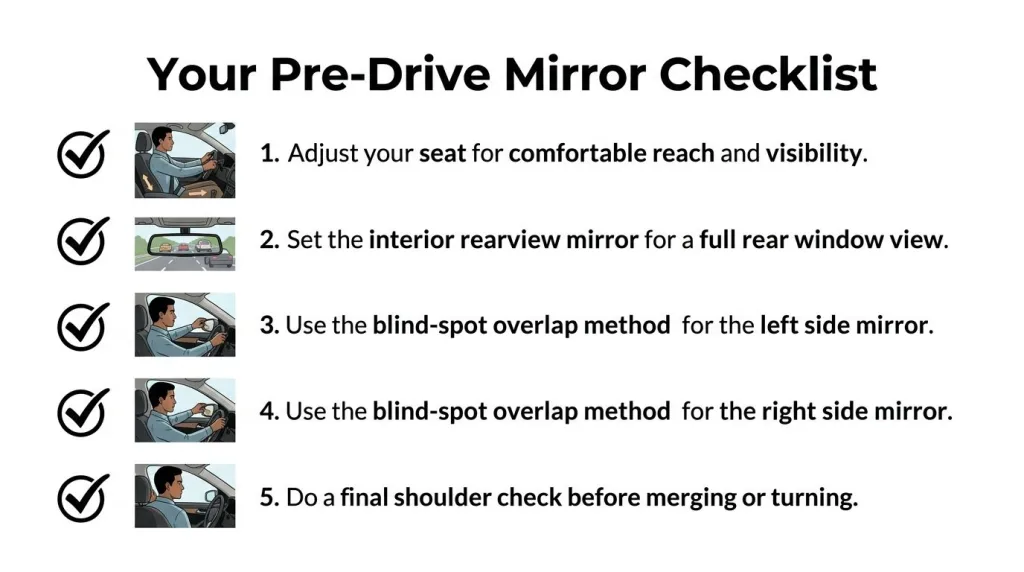
A good pre-drive routine is short, repeatable, and hard to skip. Start with your seat, because everything else depends on that position. Then set the interior mirror, adjust both side mirrors with the blind-spot overlap method, and finish with a quick shoulder check before merging or turning.
A simple checklist you can use every day
- Adjust your seat first. You want comfortable reach to the wheel, pedals, and controls before touching the mirrors.
- Set the interior rearview mirror. Frame the rear window and remove unnecessary dashboard or headliner clutter.
- Set the left mirror. Use the blind-spot overlap method so the vehicle body is only barely visible.
- Set the right mirror. Match the same overlap principle on the passenger side.
- Verify traffic flow. Watch for a car to move from the interior mirror into the side mirror without a gap.
That final visual check matters because it tells you whether the mirrors are working together. If the same vehicle disappears and reappears awkwardly between mirrors, the setup still needs refinement.
For drivers preparing for a road test, this internal driving test checklist is a useful companion because it keeps the basics organized. Mirror setup is one of those basics, and examiners notice it fast.
If you want to build safer habits that stick, BDISchool offers Florida-approved courses for new drivers, drivers handling a moving violation, and anyone who wants a sharper refresh on safe driving routines. Strong mirror habits are a small part of a bigger skill set, and the right course can help you turn those habits into something you use every time you get behind the wheel.