You're probably here because a Florida ticket is sitting on your counter, in your inbox, or in your glove box, and one question keeps looping in your head. How many points is this going to put on my license, and am I getting close to a suspension?
That worry is reasonable. Florida's system looks simple from a distance, but drivers get tripped up by one detail all the time. Points aren't just about what ticket you got. They're also about when that ticket gets counted and whether you act before points attach.
A lot of people make the same expensive mistake. They see a fine, pay it quickly, and only later realize they may have just let points post to their record. Others assume one small speeding ticket can't matter much, then a few ordinary violations pile up inside the wrong time window.
If you understand the timing rules early, you can make much smarter choices.
What Florida Moving Violation Points Really Mean for Your License
A Florida ticket often feels like a one-time problem. You pay the fine, move on, and assume the issue is over. For your license, that is not how the system works.
Points matter because they turn one ticket into part of a time-based pattern. Florida looks at how many points collect inside specific rolling windows, so the question is rarely just, “How many points is this ticket?” It is, “How many points could be sitting on my record at the same time?”
Florida also does not place points on your record the instant an officer writes the citation. Points usually attach after the ticket is resolved in a way that counts as a conviction or admission, including paying many citations. That is why the decision you make after the stop can matter as much as the stop itself.
A simple example shows why drivers get caught off guard.
Say a driver gets a routine moving ticket in March, another in August, and a third the following spring. If each one carries 3 points, those ordinary tickets can stack inside the same suspension window. What looked like three separate errands gone wrong can start to act like one larger license problem.
That is also why it helps to know what counts as a moving violation in Florida before you respond to the citation.
The part many drivers misunderstand
Basic Driver Improvement, often called BDI or traffic school, can prevent points only if you elect it in time and the ticket qualifies. Once you resolve the case in a way that posts points, traffic school usually does not rewind the clock and erase them.
Use the timeline like a fork in the road. Before points post, an eligible BDI election may keep them off your record. After points post, the question usually changes from prevention to damage control.
That distinction saves drivers from an expensive mistake.
Why a “small” ticket can hit harder than expected
Many everyday moving violations carry the same point value, and that can lull drivers into treating them as minor. The danger comes from repetition, not drama. Three ordinary 3-point tickets can create more risk than one driver expects because Florida's system reacts to clustering over time.
Severity still matters. Some offenses carry more points, and higher-point violations fill the suspension bucket faster under Florida's traffic citation schedules and point rules published by the state court system and FLHSMV.
Keep these practical ideas in mind:
- A ticket is the start of the issue. Points usually arrive later, after you choose how to resolve it.
- Dates matter as much as point values. Several average tickets close together can be more dangerous than one serious-looking ticket by itself.
- BDI works best before points attach. If the citation is eligible, waiting too long can cost you the chance to prevent points.
For many Florida drivers, the smartest next step is not paying fast. It is checking eligibility, understanding the timing, and choosing the response that protects the record before points start stacking.
How the Florida Point System Works Behind the Scenes
Florida tracks points through rolling time windows. That detail changes how suspension risk builds.
A driver can have the same total number of past points as someone else and still face a different result because the state looks at when those points posted, not just how many exist overall. The official Florida Driver Handbook explains that points can lead to suspension based on how many are received within set time periods.
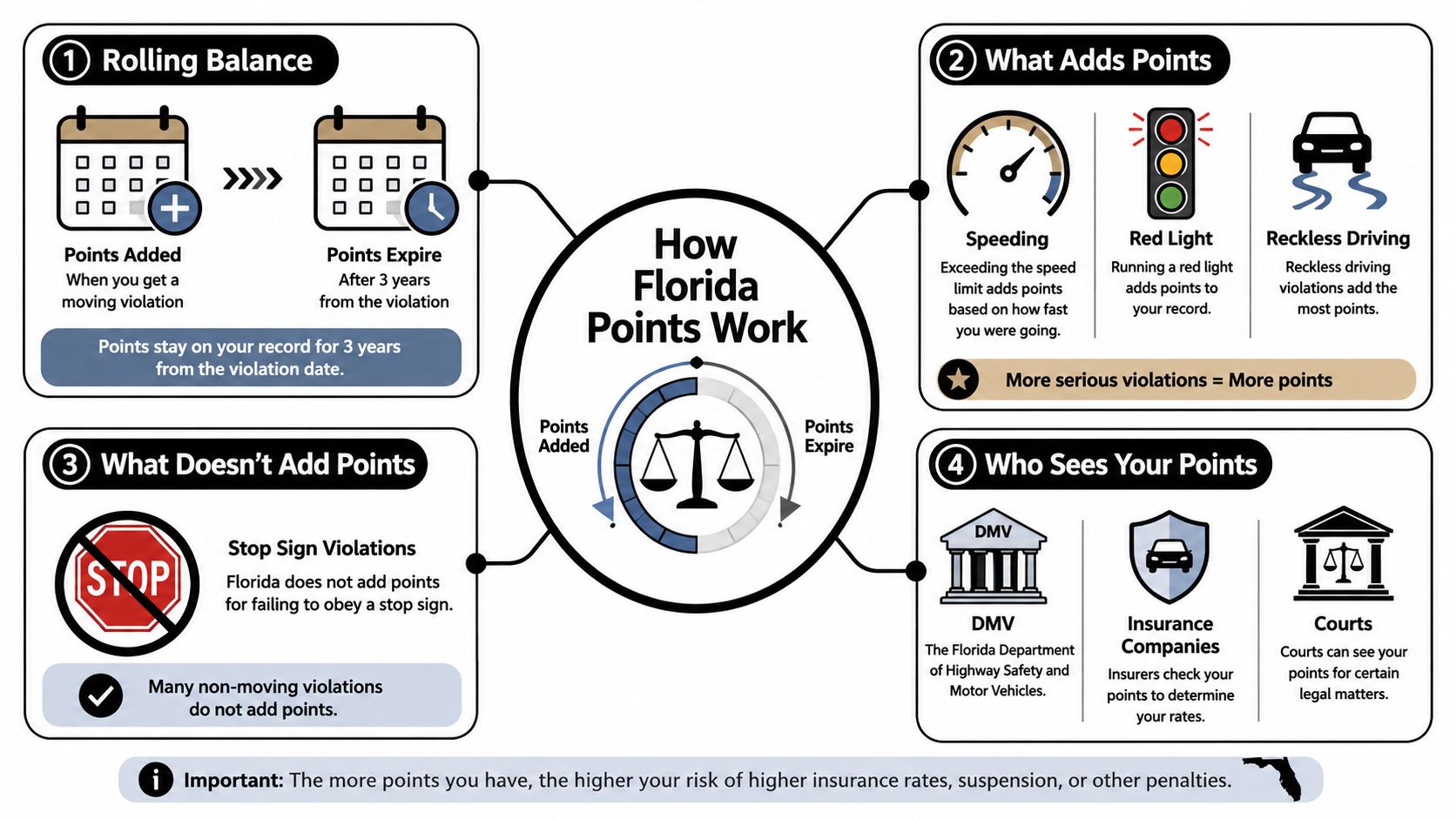
Florida uses a rolling balance
The easiest way to understand the system is to picture three windows sliding forward with time. As new points post, Florida checks whether your recent history inside those windows reaches a suspension trigger. Older points can still stay on your record, but the suspension math focuses on the rolling periods the state uses.
That is why dates matter so much.
A driver who gets three ordinary 3-point tickets close together can move from “just a few tickets” to a suspension problem faster than expected. A driver who gets those same tickets spaced much farther apart may avoid the same immediate result because fewer points fall inside the same review window at once.
For a plain-English explanation of how Florida license points are counted over time, it helps to separate the process into stages:
- You receive a citation
- You choose how to resolve it
- Points post only if the resolution leads to guilt
- Florida counts those posted points inside rolling time windows
- As time passes, older points stop counting toward that suspension calculation
A simple ticket example shows why this matters. If a driver gets a 3-point speeding ticket, then another 3-point moving violation, then a third 3-point ticket within a short enough span, the issue is not that 9 is a scary number by itself. The issue is that all 9 points can sit inside the same active window at the same time.
Paying, a guilty outcome, and BDI election lead to different results
These outcomes are not interchangeable.
If you pay a ticket, that usually functions as admitting the violation for point purposes. If the court adjudicates you guilty, points can also be assessed. An eligible election of Basic Driver Improvement works differently because it can stop points from being added for that ticket in the first place.
That timing is the part many drivers miss. BDI is a prevention tool before points post. It is usually not a cleanup tool after they already appear on the record.
When BDI helps, and when it cannot
Use the fork-in-the-road test.
If the citation is eligible and you elect traffic school in time, you may keep points from being assessed for that violation. If you already paid the citation or were already found guilty, the decision point has usually passed. At that stage, the case is no longer about preventing points from attaching. It is about handling the consequences already set in motion.
That is why a fast payment can be expensive. The smartest move is often to pause, check whether the ticket is eligible for BDI, and make the decision before the points window starts filling up.
Point Values by Offense and Why Severity Changes Everything
Two drivers can leave court saying, “I got a traffic ticket,” and still be in very different positions a few months later. One may have a routine 3-point violation. The other may have a 4-point violation because speed, crash involvement, or the exact charge changed the outcome.
That difference matters because Florida points work like weight added to a shelf with a time clock attached. A common 3-point ticket may seem small by itself. Put several ordinary tickets inside the same active period, and the shelf fills faster than many drivers expect.
Florida Moving Violation Point Values by Offense
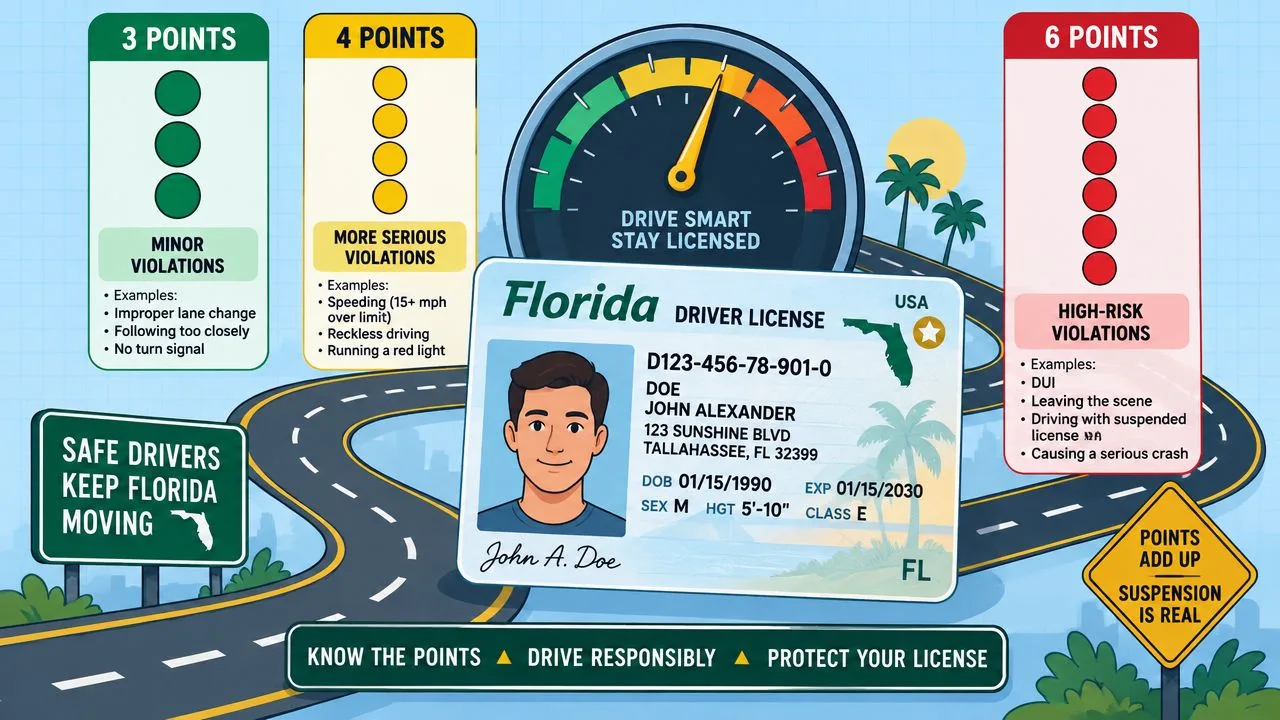
Florida assigns different point values based on the offense and the facts tied to it. Many everyday moving violations fall into the 3-point range. More serious conduct, or conduct tied to a crash, can raise that number.
| Violation Type | Points Assigned | Risk Note |
|---|---|---|
| Speeding | 3 points | Common offense, but not all speeding carries the same risk |
| Careless driving | 3 points | Often treated as routine, but still adds up quickly |
| Failure to stop at a steady red signal | 3 points | A common citation with meaningful record impact |
| Too fast for conditions | 3 points | Context matters even when speed isn't the only issue |
| Reckless driving | 4 points | Higher-risk violation with broader legal consequences |
| Other moving violations | Generally 3 points | Many everyday citations fall here |
| Moving violation causing a crash | 4 points | A crash can raise the point outcome |
| Speeding in excess of 50 MPH | 4 points | Severity changes the downstream risk |
A simple way to read that table is this: 3-point tickets are the “standard bricks,” and 4-point tickets are the heavier ones. If your record already has points sitting in the current rolling window, one heavier ticket can shorten the time between “annoying” and “license problem.”
The same label on a ticket does not always mean the same exposure
“Speeding” is a good example. Drivers often use that word as if it describes one fixed point value in every case. It does not.
A routine speeding citation may be treated one way. A much higher speed allegation may be treated more harshly. A moving violation connected to a crash can also carry more point exposure than similar driving without a collision. The practical question is not just what you called the stop on the phone afterward. The practical question is what exact charge was entered and what facts were attached to it.
That distinction becomes more important once you view points as a rolling time-window problem. Three separate 3-point tickets can create serious risk if they land close together. Replace one of those with a 4-point offense, and the stacking math gets tighter even faster.
Reckless driving deserves a separate look
Reckless driving already sits above many common citations in point value, so it should never be grouped casually with ordinary traffic infractions. It also carries legal exposure beyond the point count. If you want the criminal side explained clearly, this guide on when reckless driving becomes a felony helps show when a traffic case can become much more serious.
Here is the takeaway drivers can use right away. A 3-point red-light ticket, a 3-point careless driving citation, and a 4-point reckless driving charge do not create the same level of risk, even if all three feel like “just tickets” on the day they are issued.
Severity changes the pace of the clock. And once a ticket posts as points, the next question is no longer what the citation was called. The next question is how many other points are already sitting in the same active window.
How Points Stack Up and Trigger License Suspension
A driver picks up a 3-point red-light ticket in March, another 3-point citation in June, a 4-point offense in September, and one more 3-point ticket before the year ends. None of those stops feels like a license crisis by itself. Together, they can become one because Florida looks at points inside rolling windows, not as a lifetime running total.
The stacking math is less forgiving than it looks
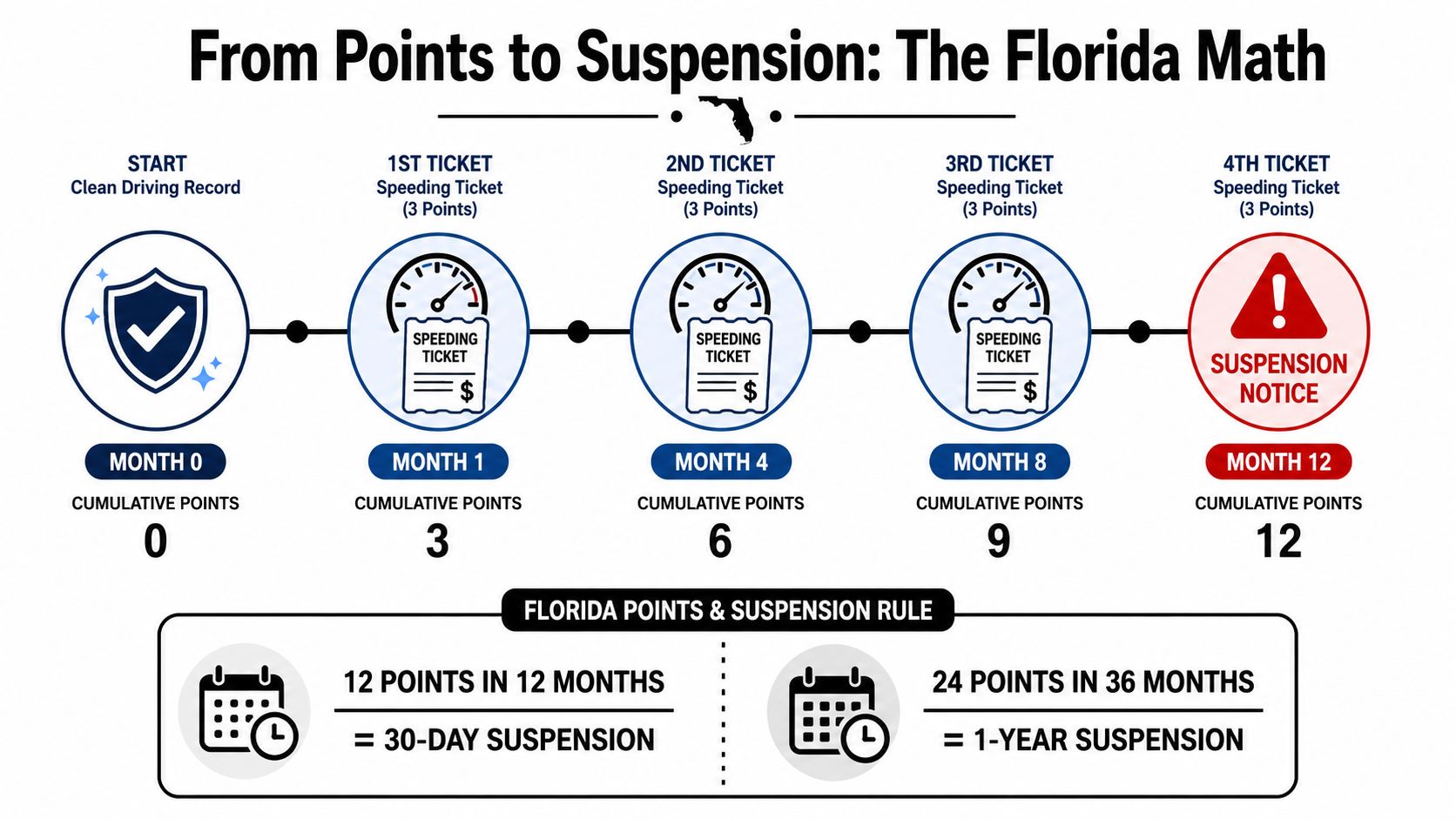
Florida uses fixed suspension thresholds tied to time windows. If enough points land within a short enough span, the license consequence follows. As noted earlier, the key thresholds are 12 points in 12 months, 18 points in 18 months, and 24 points in 36 months.
That rolling-window design catches drivers off guard.
A single 3-point ticket often feels manageable. Four ordinary 3-point tickets posted within the same 12-month window can put a driver at the first suspension level. Swap in a 4-point offense, and the same problem arrives faster. The lesson is simple. Small tickets do not stay small when the dates bunch together.
Timing matters as much as the point value
Points work like items sitting inside moving buckets of time. One bucket covers the last 12 months, another covers 18 months, and another covers 36 months. Each new conviction drops into those buckets based on its date.
That means the same four tickets can create very different outcomes depending on when they happen.
Here is how the timing breaks down:
- Clustered dates: Higher suspension risk because more points stay active in the same counting window.
- Wider spacing: Lower immediate suspension risk because an older ticket may fall outside a shorter window before the next one posts.
- Still part of your record: A ticket that no longer counts toward a suspension window may still matter for insurance, employment review, or how a later case is viewed.
If you want a plain-English walkthrough of the thresholds, this guide on how many points suspend a Florida license explains the timing in a practical way.
This short video also helps visualize how quickly a normal-looking record can turn into a suspension problem.
Why BDI timing can change the outcome
This is also the point where many drivers misunderstand traffic school. If you elect a Basic Driver Improvement course for an eligible ticket before points are assessed, that election can prevent points from being added for that citation. If the ticket is not eligible, if the deadline passes, or if the conviction has already posted in a way that does not allow that election, traffic school does not erase points that are already counting in the active window.
That is why the first ticket often matters more than drivers expect. Waiting until a fourth citation appears means the rolling clock may already be crowded.
A simple example shows why. A driver gets a 3-point speeding ticket and handles it correctly with an eligible BDI election, so no points post from that case. Later in the year, the same driver receives three more 3-point moving violations. That record is very different from a driver who let the first 3 points post. In one version, the year ends at 9 active points. In the other, it reaches 12.
Same roads. Same driver. Different timing decisions.
The smart next step is to check each new ticket for eligibility and act before points begin stacking inside the same active window.
The Real Cost Beyond Points From Insurance Hikes to Court Risk
Points are the part drivers can see on paper. The larger cost often shows up later.
A conviction can change how insurers, employers, and courts view your driving habits. One avoidable moving violation may look minor to you. To everyone reviewing your record, it can look like the start of a pattern.

Why drivers feel the damage outside the DMV
For a busy professional, a suspension can interfere with commuting, client visits, or job duties that require a clean record. For a parent insuring a teen driver, even one preventable conviction can add stress to an already expensive insurance situation.
This is why many drivers eventually search for insurance rate increase after ticket information only after the record impact has already happened.
The cheapest ticket is often the one that never turns into points.
Courts and employers notice patterns
Repeated moving violations can also affect how future cases are viewed. A judge, clerk, prosecutor, fleet supervisor, or employer may see repeated citations as evidence that the driver hasn't corrected the behavior.
That doesn't mean every ticket becomes a legal crisis. It does mean each conviction makes the next one harder to explain away.
A clean record gives you room. A cluttered record takes that room away.
How to Prevent or Reduce Points With Florida Approved Traffic School
If your ticket is still eligible, this is usually the smartest place to focus.
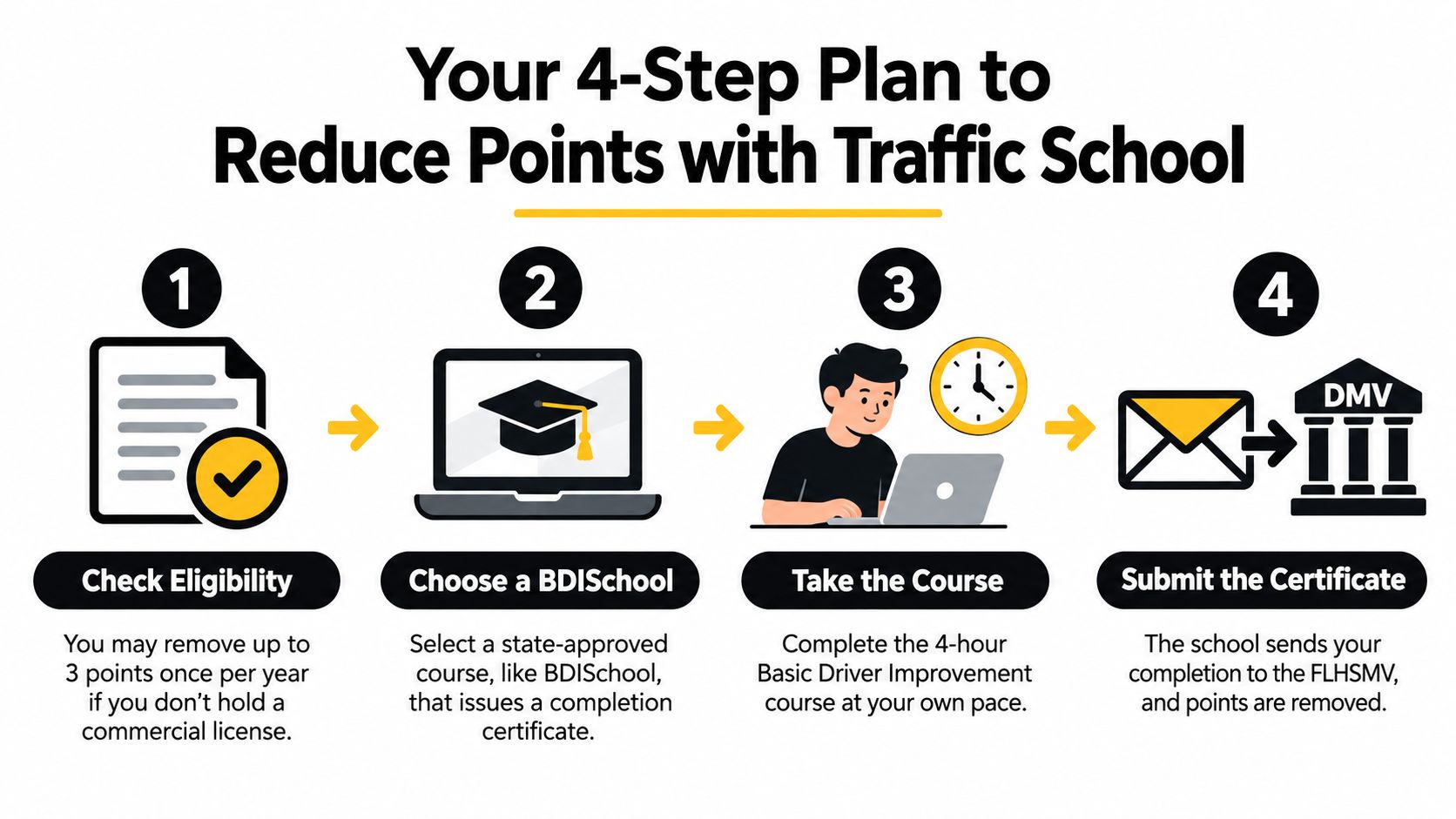
For many non-commercial drivers with an eligible non-criminal moving violation, Florida allows the election of a Basic Driver Improvement course once every 12 months and up to eight times in a lifetime, and successful completion can prevent points from being added for that citation under the state's Basic Driver Improvement rules and approved provider information and the broader driver improvement schools guidance.
The key rule most people miss
Traffic school usually works before points attach, not after.
That's the heart of the issue. If you've already paid the ticket or already had the case resolved with points added, you may be past the prevention stage. That's why the practical question isn't only “Can I take traffic school?” It's “Can I still elect it in time for this citation?”
If you already paid, your options may be very different from the options you had before payment.
A simple action checklist
Use this sequence right away if you've just received a citation:
Check the ticket type
Look at whether it's a non-criminal moving violation. Not every citation qualifies for the same treatment.Review your recent course history
Florida allows the election once every 12 months for eligible drivers, and there's also a lifetime cap under the state rules linked above.Contact the clerk of court
Election procedures matter. The clerk can tell you what the county requires to elect traffic school for your case.Complete an approved course correctly
An approved provider matters because the course has to satisfy Florida's requirements.
What an online course option looks like
Many drivers choose a fully online course because it fits around work, family, and court deadlines. One option is BDISchool, which offers Florida-approved online traffic school courses, including Basic Driver Improvement, through a self-paced format. Available course options can also be reviewed through BDISchool course listings or DriverEducators course listings.
The practical benefits are straightforward. Students can work from their own device, move at their own pace, and complete the requirement without sitting in a classroom. The publisher also states that its courses are available in English, Spanish, and Portuguese, and that completion certificates are issued electronically and reported directly to FLHSMV.
Common questions drivers ask right away
If I already paid the ticket, can traffic school still remove the points
Usually, the better use of traffic school is to prevent points from being added on an eligible citation before that outcome is finalized. Once points have posted, the issue changes from prevention to damage control.
Does traffic school erase every consequence
No. It's better to think of it as a tool that can stop eligible points from landing on the record for the current citation if you elect it properly and on time.
What should I do today
- Read the citation carefully
- Confirm whether you're still within the election window
- Ask the clerk what your county requires
- Choose an approved course before the deadline passes
Drivers lose good options when they wait.
Protect Your Record and Keep Driving With Confidence
A driver gets one 3-point speeding ticket in March, another 3-point ticket in August, and a third after the holidays. None of those tickets feels catastrophic by itself. The problem is not just the total. The problem is that Florida looks at points inside rolling time windows, so several ordinary tickets can bunch together faster than drivers expect.
That is the part many people miss.
Your record works more like a calendar than a scoreboard. Each ticket matters on its own, but the risk shows up when points from separate dates sit close enough together to trigger a suspension review. Three-point tickets are a good example because they are common, and common tickets can still create a serious license problem when they arrive too close together.
Traffic school fits into that timeline in a very specific way. A proper BDI election on an eligible citation can stop points from posting for that ticket. Once points have already posted, or once a ticket was handled in a way that closed off that option, BDI usually shifts from prevention to a separate requirement or may not help with points at all.
So the smart next step depends on where your ticket sits right now.
If the citation is still open, confirm whether you can still elect traffic school before you do anything that finalizes the case. If you already paid the ticket, treat that as a different situation and verify what options remain before assuming the points can still be prevented.
Use this quick check:
- Look at the violation date, not just the ticket amount
- Count how many other points are already sitting within the recent time windows on your record
- Confirm whether this citation is eligible for a BDI election
- Ask the clerk what deadline and election steps apply in your county
- Finish the course on time and keep your completion proof
A calm decision made early often protects your license better than trying to fix a stacked record later.
If you want a simple way to handle an eligible Florida ticket, BDISchool offers Florida-approved online traffic school courses for this purpose, including Basic Driver Improvement for qualifying citations. You can review the course options and get started before an avoidable point problem turns into a suspension risk.