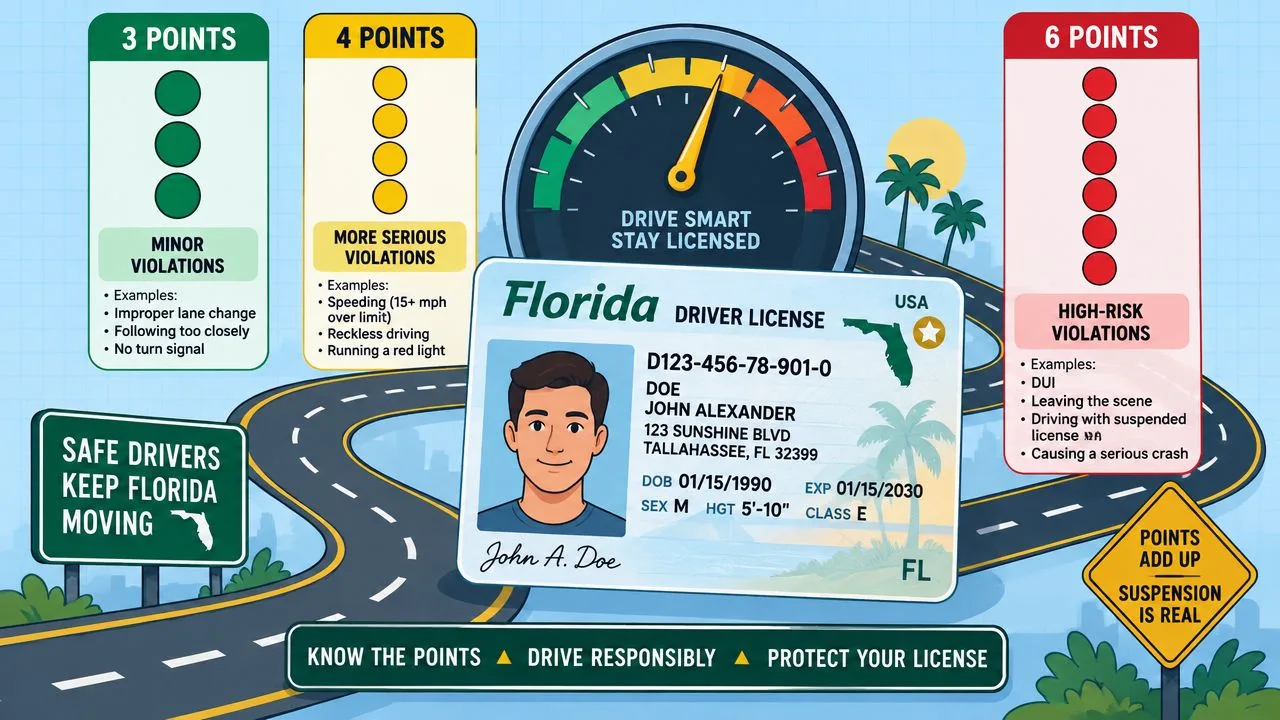
You’re probably here because something already went wrong.
Maybe you got a Florida traffic ticket, your court notice says you need traffic school, or you’re trying to stop a small driving mistake from turning into points, higher insurance, and a bigger headache. That stress is real. The good news is the fix is usually much simpler than people think.
A driver safety course is often the fastest way to get back in control. If your goal is to protect your record, meet a requirement, and finish everything online without rearranging your life, that’s the route I’d recommend.
Why You Might Need a Driver Safety Course
A lot of drivers wait too long because they think traffic school will be confusing, slow, or annoying. In Florida, it’s usually the opposite. If you’re eligible, a driver safety course can be the clean, practical move that helps you deal with the problem before it gets more expensive.
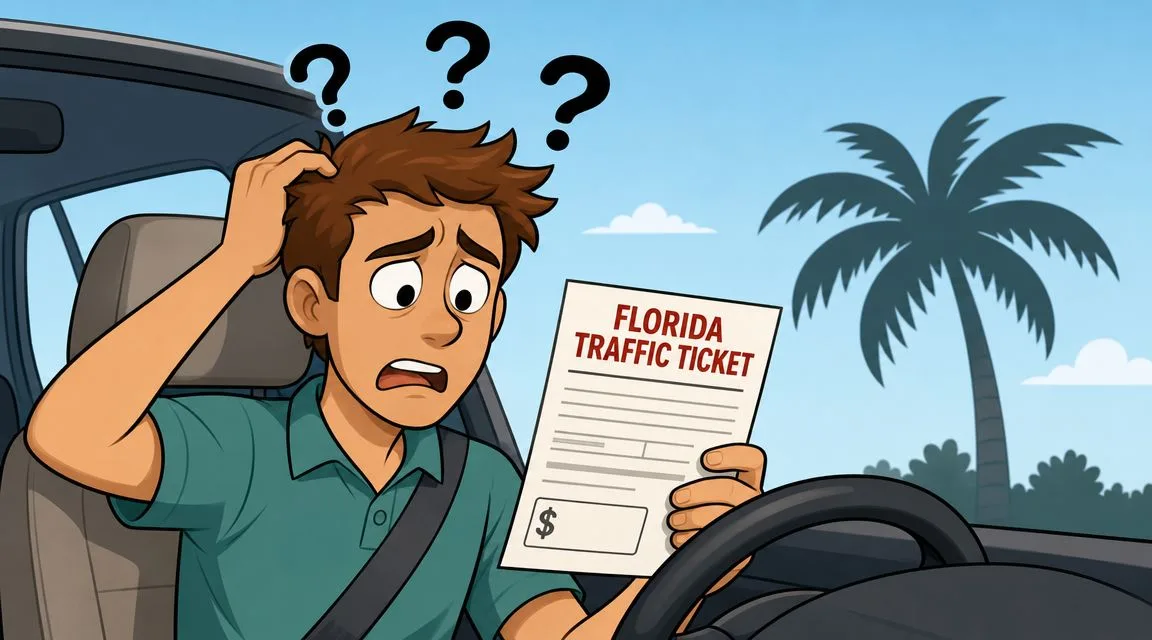
Florida is a huge driving state. It has more than 16 million licensed drivers according to the FLHSMV overview. That matters because the system is built for volume. Courts, insurers, and the state already expect drivers to use approved education to handle tickets, requirements, and record issues.
The most common reasons drivers enroll
People usually need a driver safety course for one of these reasons:
- Ticket response: You got a moving violation and want a practical option to help protect your driving record.
- Court order: A judge told you to complete a course by a deadline.
- Insurance concerns: You want to avoid the ripple effect that can follow points or convictions.
- License protection: You’re trying to stay ahead of accumulating problems before they become harder to fix.
If you’re dealing with a citation right now, start by reviewing the Florida traffic ticket options page so you know what kind of course issue you’re solving.
Registrar advice: Don’t treat traffic school like a punishment. Treat it like paperwork with benefits.
Why acting fast matters
Drivers get in trouble when they hesitate. They put the ticket in a drawer, miss a deadline, pick the wrong course, or assume they can figure it out later.
That’s backwards.
The smart move is to identify the correct course, register, and start immediately. Online completion is easier than trying to fit in a live class, and once you’re moving, the whole situation feels a lot less heavy.
What Is a Florida Driver Safety Course
A Florida driver safety course is a state-approved education program designed to improve judgment, refresh traffic law knowledge, and address a driving-related requirement. Sometimes it’s voluntary. Sometimes it’s required. Either way, the point is the same. Help drivers make better decisions before the next bad stop, collision, or court issue.
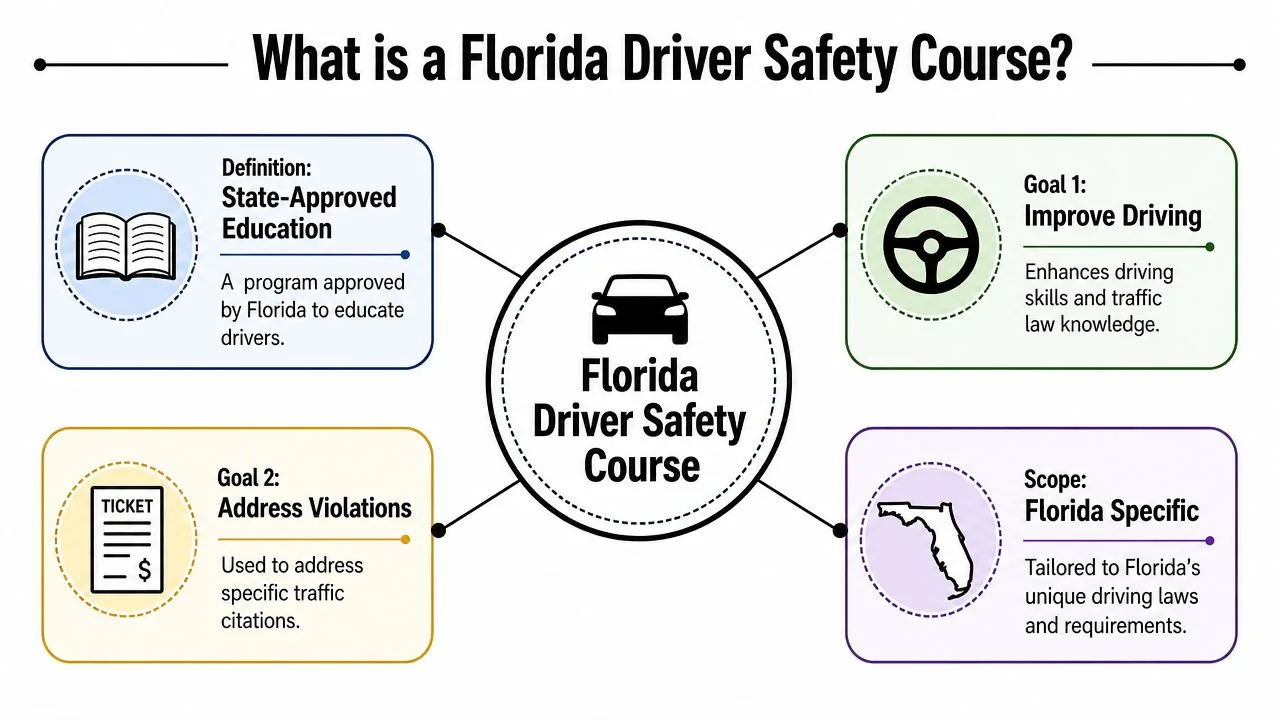
It isn’t just a review of road signs and speed limits. A solid course focuses on what drivers struggle with on real roads. That includes space management, attention, attitude, right-of-way decisions, following distance, and how to avoid preventable conflicts in traffic.
What you actually learn
The best courses teach defensive driving, not just rule memorization.
A key example is hazard anticipation. An effective course should train drivers to look 15 to 20 seconds ahead and scan side mirrors every 3 to 5 seconds, according to DriverEducators defensive driving guidance. That’s what gives you time to brake, steer, or create space before a close call becomes a crash.
Here’s what that looks like in practice:
- Forward scanning: You stop fixating on the bumper in front of you and start reading traffic farther ahead.
- Mirror checks: You stay aware of who’s beside and behind you instead of reacting late.
- Blind-spot habits: You use shoulder checks when a lane change calls for one.
- Behavior correction: You recognize how distraction, impatience, and aggressive choices create risk.
A good driver safety course should change what you do the next time traffic tightens up, not just what you remember on a quiz.
It’s more useful than most drivers expect
Many envision a dull lecture. Modern online courses are usually much easier to get through than that. The better ones use short modules, visuals, practical examples, and straightforward explanations.
If you want a plain-English breakdown of how traffic school works before you register, read what traffic school is in Florida.
That’s a primary value of a driver safety course. It helps you satisfy a requirement, but it also sharpens habits that matter every single day you drive.
The Top Benefits of a Driver Safety Course
You don’t take a driver safety course for entertainment. You take it because it solves a problem.
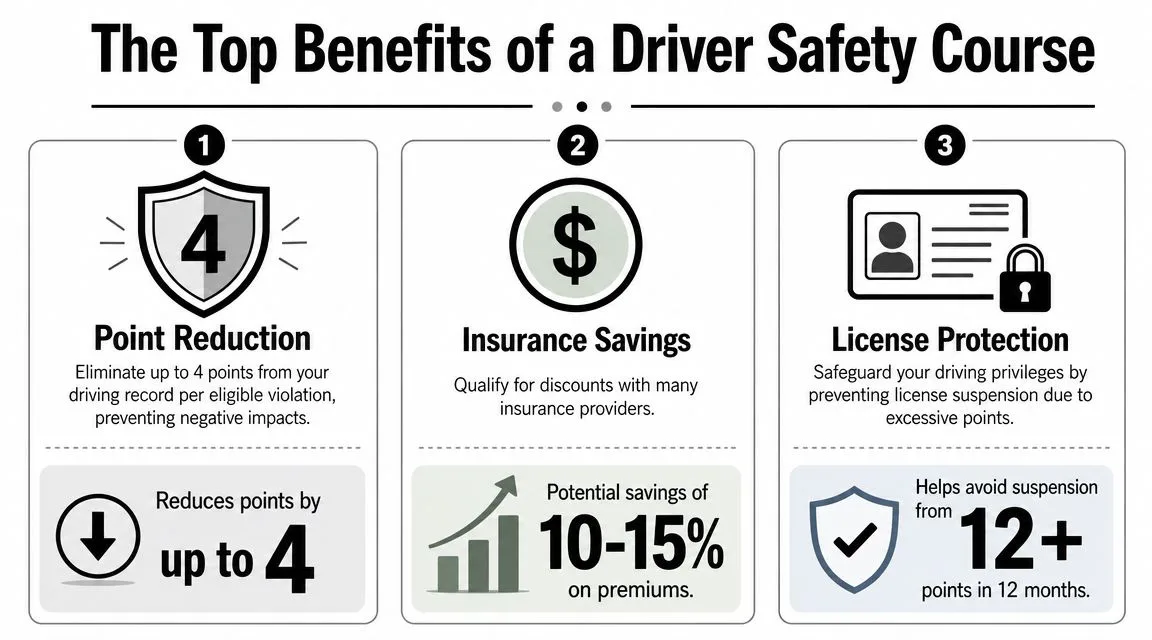
For most Florida drivers, the benefits fall into three buckets. Record protection, compliance, and savings potential.
It can help reduce the damage from a violation
This is the first reason people sign up. State-approved driver safety courses are treated as measurable risk-mitigation tools, and some programs can reduce assessed demerit points by up to 3 to 4 points depending on the jurisdiction, as explained by the Wisconsin DOT traffic safety school overview.
The exact effect depends on your situation and the rules that apply to your case, but the larger point is clear. States don’t treat these courses like busywork. They use them as a structured response to risky driving behavior.
It can satisfy a court requirement cleanly
If a judge ordered traffic school, your main job is simple. Finish the right course on time.
That’s why convenience matters so much. A self-paced online course lets you comply without taking half a day off work, finding childcare, or sitting in a classroom on a weekend. For busy adults, that’s often the difference between getting it done and dragging it out.
Here’s a quick video overview before you decide:
It can support insurance and license goals
A completed course can also help when you’re trying to stay insurable, keep your record manageable, or qualify for an insurer’s safe-driver consideration. I always tell drivers the same thing. A few hours of coursework is far cheaper than letting a record problem grow legs.
Bottom line: If a driver safety course is available to you, ignoring it is usually the expensive decision.
A short time investment now can prevent a much more annoying problem later.
Choosing the Right Florida Course for You
Florida drivers get tripped up by one thing more than anything else. They choose the wrong course.
That wastes time and creates deadline problems. The fix is to match the course to the reason you need it.
The main course types
State-certified defensive driving programs are commonly offered in 8-hour, 6-hour, or 4-hour formats for purposes such as point reduction, court orders, or insurance discounts, according to most defensive driving course overview.
That’s why Florida course selection usually comes down to purpose first, length second.
| Florida Driver Safety Course Comparison | Length | Primary Use Case |
|---|---|---|
| Basic Driver Improvement (BDI) | 4-hour | Standard moving violation situations and general traffic school needs |
| Intermediate Driver Improvement (IDI) | 8-hour | Court-ordered drivers and more serious compliance situations |
| Aggressive Driver Course | 8-hour | Drivers ordered into behavior-focused improvement related to aggressive driving concerns |
| Mature Driver Course | 6-hour | Older drivers refreshing skills and often pursuing insurance-related benefits |
Which one usually fits your situation
If you got a regular traffic ticket and were told to complete a basic course, the 4-hour BDI is usually the one people need.
If your court paperwork specifically says 8-hour, don’t guess and don’t substitute. You need the IDI or other court-required 8-hour option listed for your case. Judges care whether you completed the correct course, not whether you completed some course.
The Aggressive Driver Course serves a different purpose. It focuses more heavily on behavior, attitude, and decision-making patterns that create repeat risk.
The Mature Driver Course is for older adults who want a refresher and may be looking at insurer-recognized safe-driving education. It’s practical, not remedial.
How to choose without overthinking it
Use this quick filter:
- Look at your notice first: Court paperwork or ticket instructions usually tell you whether the course is basic, intermediate, or otherwise specified.
- Match the required length: If the notice says 8-hour, don’t register for a 4-hour class.
- Think about your goal: Ticket handling, court compliance, and insurance-related refreshers are not always the same thing.
- Register only when you’re sure: A few extra minutes reading the requirement saves a lot of cleanup later.
If you want a simple overview of approved online options, review the Florida online traffic school guide.
The right course feels easy. The wrong course creates phone calls, delays, and repeat work.
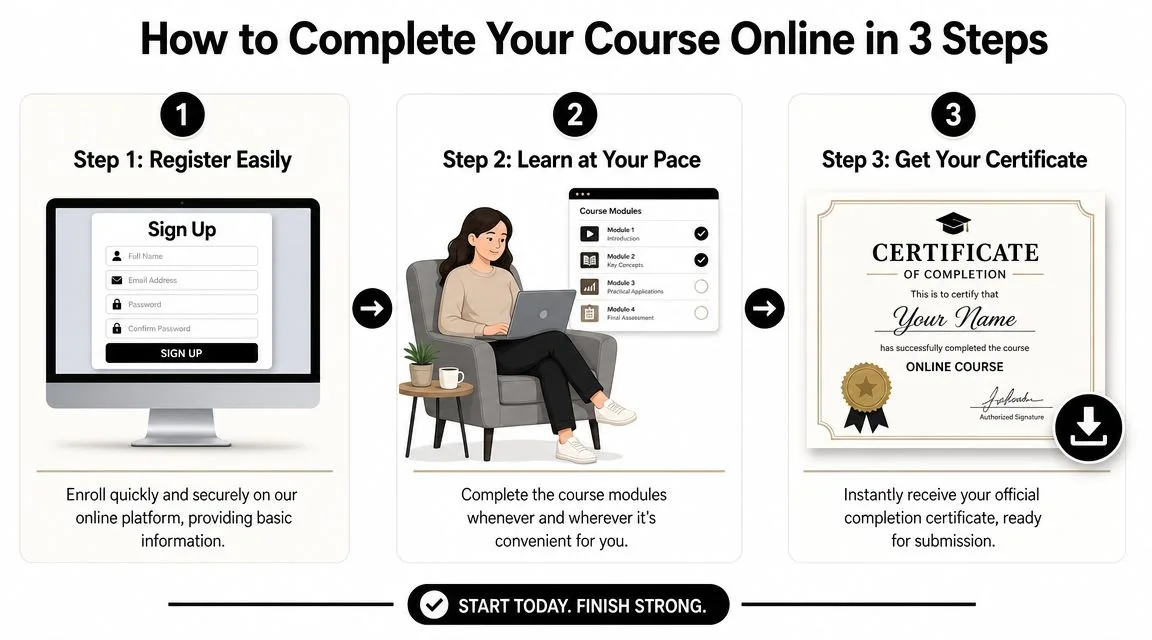
How to Complete Your Course Online in 3 Steps
Most drivers don’t need more motivation. They need less friction.
Online traffic school works when the process is simple enough to start immediately and flexible enough to finish around real life. That’s exactly how it should be.
Step 1 Register and get moving
First, choose the correct course and enroll online.
Don’t overcomplicate this. You should be able to create an account, enter your information, and begin without waiting for a call back or visiting an office. If language access matters, choose a provider that offers the course in the language you’re most comfortable using.
One option is BDISchool, which offers Florida-approved online courses in English, Spanish, and Portuguese with electronic completion processing and course access from common devices.
Step 2 Finish it on your schedule
Online delivery stands out for its flexibility: you can log in, complete a section, stop, and come back later.
That matters if you’re working long hours, sharing a vehicle, handling family responsibilities, or just trying to get this done without burning a Saturday. A good driver safety course should work on your time, not demand that you reorganize your week around it.
A practical setup should let you:
- Use your own device: Laptop, tablet, or phone should all be workable.
- Pause and return: You shouldn’t have to finish everything in one sitting.
- Pick your pace: Some people like to knock out steady progress. Others chip away at it in short sessions.
Simple rule: The fastest course is the one you’ll actually finish.
Step 3 Let the completion process do its job
Once you complete the course, the last thing you want is more paperwork confusion.
That’s why electronic handling matters. You want the certificate process to be straightforward and the reporting path to be clear. If you need proof of completion or want to understand what a Florida online certificate looks like, review the online driving certificate information.
Drivers often delay because they think the admin side will be messy. Usually, it isn’t. The hard part is starting. Once you register and finish the modules, the process becomes much easier to manage.
Florida Driver Safety Course FAQ
Is an online driver safety course accepted statewide in Florida
If the course is Florida-approved and matches your requirement, it’s built for state compliance. The important part isn’t whether it’s online. The important part is whether it’s the correct approved course for your specific situation.
Always match the course type to your notice, citation instructions, or court order.
Can I take the course on my phone
Most modern online courses are designed for flexible access, so mobile compatibility is common. Still, don’t assume every provider handles every device equally well.
If convenience matters, choose a course platform that lets you move between devices without losing progress.
Do these courses still help with real driving, or are they just for tickets
They should do both.
Newer safety education programs are moving beyond point reduction and also teaching drivers how to interact more safely with vulnerable road users such as people walking, biking, rolling, and using electric mobility devices. That’s important because modern traffic problems aren’t just about citations. They’re about awareness in mixed-use road environments.
How quickly should I enroll after getting a notice
Immediately.
The biggest mistake I see is delay. Drivers wait until the deadline feels close, then rush, pick the wrong course, or panic over reporting. If you’ve received a ticket or court instruction, register as soon as you confirm the course type.
Why are online courses easier to finish than old classroom traffic school
Because they fit real life better. You can start when you’re ready, stop when you need to, and return without the hassle of commuting to a classroom.
If you need to handle a Florida traffic issue quickly, the smartest next step is simple. Pick the correct state-approved course and start today at BDISchool.