You got a ticket. You checked the deadline, opened a few tabs, and immediately ran into the same depressing promise from every traffic school site: “fast, easy, convenient.” That’s helpful in the way a beige waiting room is “calming.”
Most drivers aren’t asking for a comedy show. They’re asking for a course that won’t make their brain leave the building halfway through the section on following distance. That’s where defensive driving course comedy gets interesting. At its best, it isn’t fluff. It’s instructional design with better timing.
I’ve spent enough time around courses and enough time around comedians to know the overlap is real. Both jobs depend on pacing, surprise, clarity, and knowing exactly when an audience will drift. In a driving course, that matters because the lesson isn’t abstract. It’s about choices you make in traffic when you’re tired, late, annoyed, or distracted.
Your Ticket to a Less Boring Traffic School
The usual traffic school experience goes like this. You sit down with noble intentions, read three screens about right-of-way, and suddenly find yourself reorganizing your desk, checking your phone, and wondering whether licking a battery would be more stimulating.
That boredom isn’t a small problem. A defensive driving course only works if you stay engaged long enough to absorb it.
One reason comedy-based formats have lasted is simple: drivers keep choosing them. It is suggested this approach has held attention for a long time, not just as a novelty but as a repeatable teaching model. If you’re still sorting out the basics, this overview of what traffic school is and how it works helps clarify where a course fits after a citation.
Why the format caught on
A serious topic doesn’t require a grim delivery.
Road safety has real stakes. The same provider notes a broader road-safety backdrop of roughly 32,719 motor-vehicle deaths annually in the U.S., with about 3,154 deaths from distracted-driving crashes each year in the facts it cites on its site. That’s exactly why a course needs to be memorable.
A joke can open the door. The lesson still has to walk through it.
The best comedy traffic school doesn’t mock safety. It lowers resistance to learning. A dry sentence about distraction might slide right past you. A funny scenario about a driver treating a phone notification like a royal summons tends to stick.
What students usually mean by “fun”
They rarely mean nonstop punchlines.
They mean:
- Less mental fog: The material feels easier to get through.
- Better pacing: The course breaks up repetitive text with scenes, stories, or witty narration.
- More recall: A humorous example helps a rule stay in your head when you need it later.
That’s the promise. Not “traffic school, but with a laugh track.” More like “traffic school that understands human attention.”
Why Funny Actually Means Safer
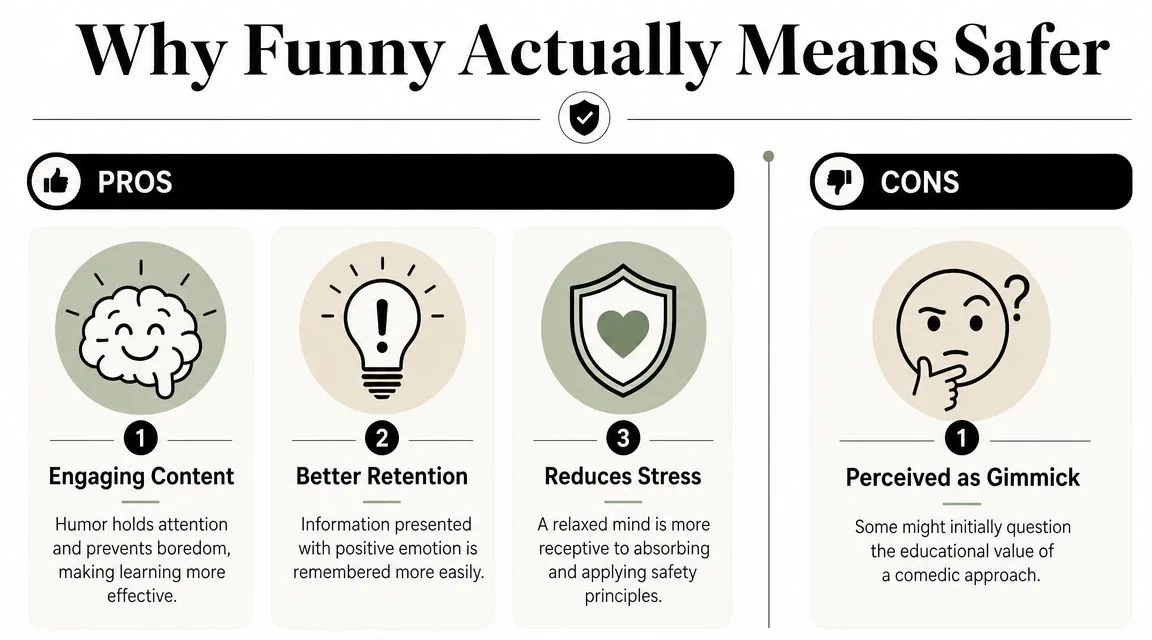
Humor works in education when it serves the lesson. If it distracts from the point, it fails. If it sharpens the point, it becomes one of the most efficient teaching tools you can use.
Attention is the first job
A defensive driving course competes with everything else in your day. Work messages. Kids. Dinner plans. The tiny voice that says, “I can probably finish this later,” right before later becomes next month.
Humor helps because it breaks pattern. Your brain expects another block of instructions and gets a quick surprise instead. That surprise resets attention.
Educational research discussed by one comedy traffic-school provider says humor can increase attention and enjoyment, though its effect on memory and transfer is mixed and depends on execution. That nuance matters. A joke tied directly to the safety concept helps. A random gag is just confetti with Wi-Fi.
Retention depends on relevance
A strong course doesn’t sprinkle jokes on top of the material like stale parmesan. It builds the humor into the explanation.
Consider the difference:
| Approach | What happens |
|---|---|
| Random joke | You remember the joke, not the rule |
| Scenario-based humor | You remember the unsafe habit and the safer response |
| Mocking tone | Students tune out or feel preached at |
| Relatable tone | Students recognize themselves and stay open to correction |
That’s why the funniest moment in a good course is often also the clearest. You laugh because you recognize the behavior. Then you remember the fix.
Practical rule: If the joke can be removed without changing the lesson, it probably wasn’t doing enough instructional work.
Engagement can affect outcomes
Not every basic driver improvement course using comedy course is equally effective. It needs to support a common-sense idea: when students stay engaged, they’re more likely to finish, process the material, and carry some of it onto the road.
If you want extra context on the kinds of behaviors these courses try to correct, this legal perspective on car crash causes is useful because it frames crashes in terms of actual driver decisions rather than abstract theory. For many students, that’s the wake-up call.
A course is also easier to complete when it respects your time. These defensive driving course benefits matter most when the format keeps you alert long enough to use them.
The Anatomy of a Great Comedy Driving Course
A good comedy course is not a stand-up special with a stop sign cameo. It’s still a structured driver-safety class. The difference is in how the material gets delivered.
What the format usually includes
Most strong courses combine a few elements:
- Witty narration: A voice that sounds like a person, not a fax machine.
- Short scenarios: Little stories that show a common mistake before explaining the correct response.
- Visual contrast: Clean layouts, clear examples, and moments of relief between denser topics.
- Humor with a target: The joke points at the unsafe behavior, not at the student.
That last point matters. Shame shuts people down. Recognition wakes them up.
What standardization looks like
Comedy traffic school didn’t stay a niche because drivers wanted novelty. It became established because the format could fit official education requirements.
Here’s what that tells you as a student:
| Sign of quality | Why it matters |
|---|---|
| State approval | The course isn’t winging it |
| Defined length | You know the time commitment upfront |
| Online access | You can fit it around real life |
| Clear completion path | Less friction, less procrastination |
The most effective comedy in a safety course doesn’t steal the spotlight. It points the spotlight at the rule.
What to look for on the page
When you open a course, ask yourself whether the humor portion is doing a job. It should not take over the content, but instead, be discretely present.
A quality program usually feels organized, not chaotic. Lessons move logically. Examples sound familiar. The tone says, “We know this requirement isn’t your dream date, so let’s make it useful.”
If you prefer learning in shorter sessions, self-paced online course options are often the easiest fit for a busy schedule. That flexibility matters because attention is easier to maintain when you can stop before your brain starts filing formal complaints.
Balancing Laughs with Lifesaving Rules
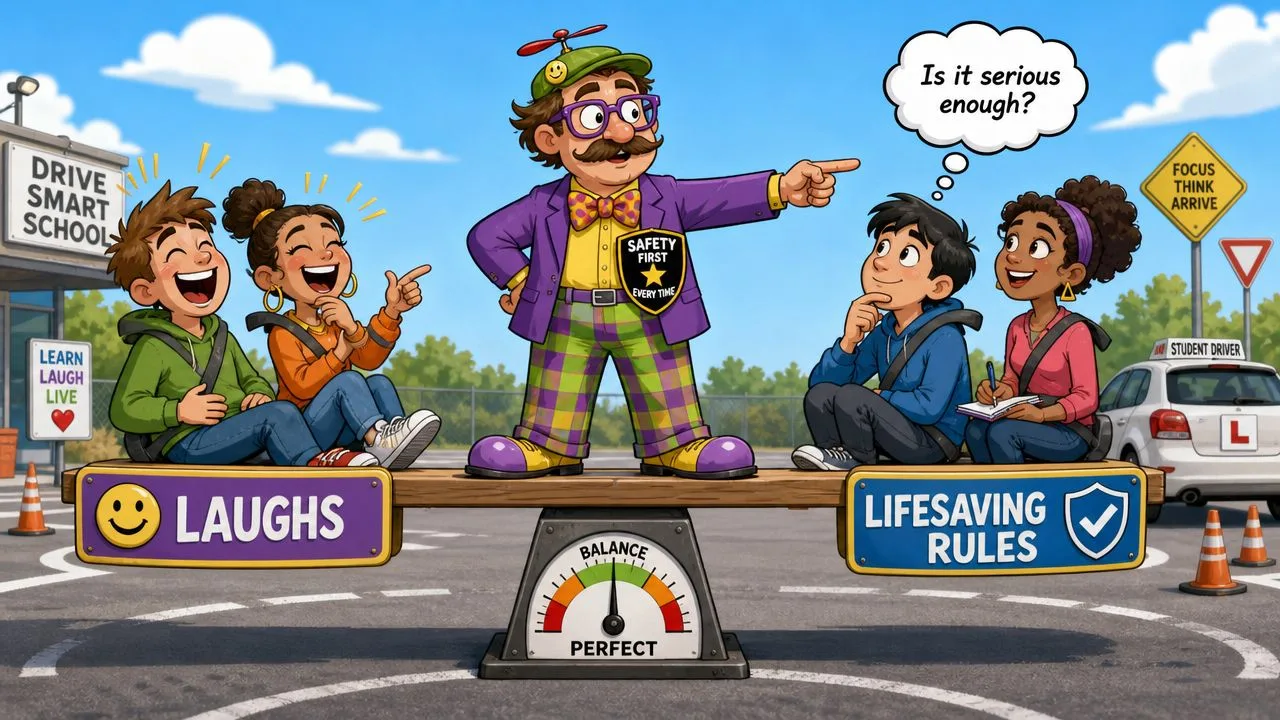
The biggest misunderstanding about comedy traffic school is that “funny” means “lightweight.” It doesn’t. A state-approved course still has to teach the required material and verify that you learned it.
The jokes don’t replace the curriculum
A proper course still covers the serious stuff. Traffic laws. Defensive habits. Hazard recognition. Choices that prevent crashes from happening in the first place.
Comedy changes the delivery, not the obligation.
That’s why a well-designed class feels like a balance beam. Too dry, and students disengage. Too silly, and the safety message gets lost. The sweet spot is a course that uses humor to make the rules easier to notice, understand, and remember.
Assessments keep it real
State-approved courses also use checks for understanding.
Florida DMV approved Driver Safety Program will all require an 80% passing threshold to the final exam. That tells you something important: the “fun” label doesn’t cancel rigor.
Funny is the wrapper. Compliance is still the package.
A course can have charm, timing, and personality, but it still has to prove learning happened. That’s good for the student and good for the court system. If your goal is ticket dismissal, point reduction, or an insurance-related purpose, you want a course that treats completion as more than clicking “next” until the universe forgives you.
A useful test for skepticism
If you’re wondering whether a course is “real enough,” ask three questions:
- Is it approved for your purpose?
- Does it include actual knowledge checks?
- Do the examples reinforce the rules instead of drifting away from them?
If the answer is yes across the board, humor isn’t weakening the class. It’s helping the class do its job.
Finding Your Perfect Florida Comedy Course
Florida drivers usually aren’t shopping for abstract educational theory. They want the right course for the right situation, without wasting time or choosing something that won’t count.
That means the best option is usually the one that matches your specific need, fits your schedule, and keeps the material readable enough that you’ll finish it.
Start with the purpose, not the joke count
Before you pick a comedy-style course, identify why you need it.
Some Florida drivers need a course after a moving violation. Others need a court-ordered program. Some want an insurance discount. A few want a refresher that won’t feel like reading the back of a cereal box for hours.
Use this quick filter:
| Your situation | What to verify first |
|---|---|
| Moving violation | Approval for point or citation-related needs |
| Court order | The exact course type required by the court |
| Insurance discount | Whether your insurer accepts the course |
| General refresher | Flexible format and easy device access |
Then evaluate the experience
Once the approval piece is clear, the quality questions matter.
Look for:
- Clean navigation: If the login and lesson flow are clunky, the course gets longer than it needs to be.
- Reasonable pacing: Good online instruction breaks up content so you don’t hit a wall.
- Plain language: Legal and safety concepts should sound understandable, not theatrical.
- Flexible access: Busy people need to start, stop, and resume without drama.
A strong Florida option should also feel current. Not “website preserved in amber.” You’re trusting the course to translate rules and habits into something useful on actual roads, with actual distractions, and your actual schedule.
What Florida students often value most
It usually comes down to convenience plus credibility.
The format should be fully online, self-paced, and easy to use from whatever device you already have in your hand. A course can be funny, but if it’s confusing to use or unclear about what it satisfies, the humor won’t save it.
For a focused starting point, this guide to the best online traffic school in Florida can help you compare what matters before you enroll. The right pick should make compliance easier, not add another errand to your week.
How to Write a Driving Safety Joke
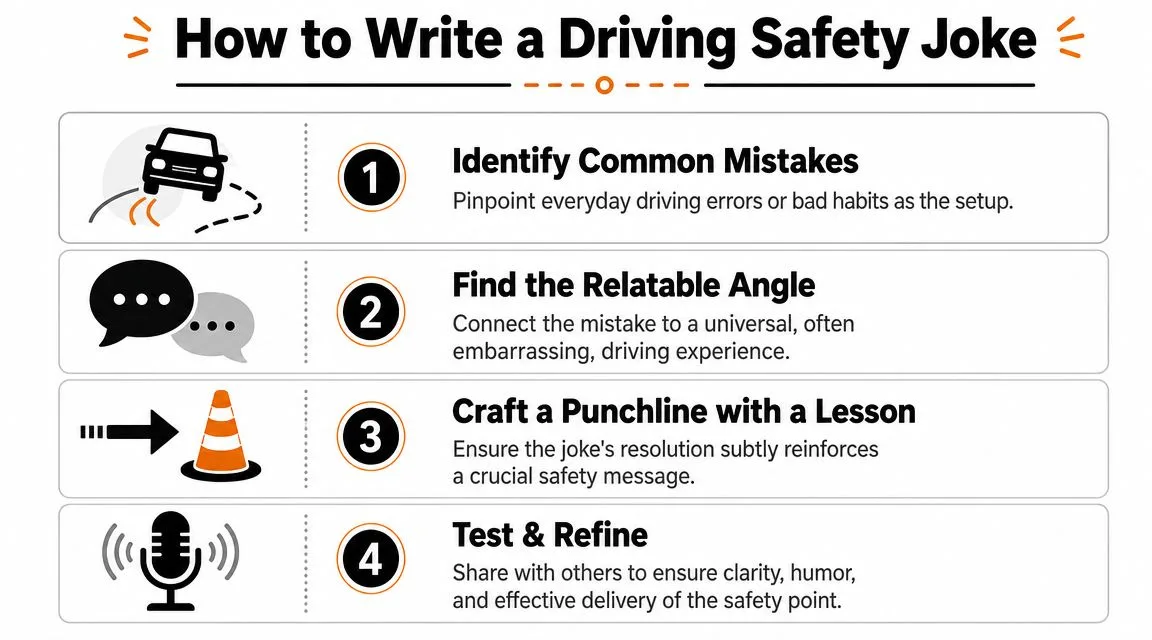
To understand why some comedy courses work, it helps to look under the hood. Safety humor is built, not improvised in a parking lot between coffee and panic.
The three-part framework
A useful driving joke usually has three moving parts.
Setup
Start with a recognizable mistake. Merging too late. Braking too hard. Treating a yellow light like a motivational speech.Punchline
Add surprise, but keep it tied to the behavior. The laugh should come from recognition, exaggeration, or timing.Takeaway
Land on the safe alternative. If the student remembers only the laugh, the joke failed.
Here’s a simple example.
- Weak version: “Other drivers are idiots.”
- Better version: “I used to merge like I was being launched from a catapult. Turns out checking blind spots works better than blind optimism.”
The second one is better because it names a real habit and points toward a safe correction.
What good course writers avoid
Not every joke belongs in driver education.
Avoid humor that:
- Blames a group of drivers: It creates distance instead of self-awareness.
- Glorifies risky behavior: If the reckless part sounds cooler than the lesson, you’ve lost the plot.
- Gets too clever: Students shouldn’t need to decode the bit before learning the rule.
- Distracts from the action: The safety point has to remain the star.
Write the joke so the student thinks, “Yep, I’ve done that,” not “What on earth was that supposed to mean?”
A quick writing exercise
Try this template:
| Step | Prompt |
|---|---|
| Behavior | What common mistake are you targeting? |
| Human truth | Why do people do it? Impatience, distraction, overconfidence? |
| Comic angle | What exaggeration or twist makes it memorable? |
| Safety lesson | What specific rule or habit should replace it? |
A course writer might start with tailgating. The human truth is impatience. The comic angle could compare the behavior to trying to personally supervise the other driver’s bumper. The lesson becomes following distance.
That’s how instructional humor earns its keep. It makes the unsafe habit visible, then gives the student a cleaner mental cue for the next real-world decision.
Evaluating a Course Beyond the Punchlines
Not all comedy-based courses deserve the same grade. Some use humor like seasoning. Others dump it on the plate and hope nobody notices the meal is undercooked.
The key question is simple: does the comedy improve the teaching, or does it just decorate it?
A smarter checklist
The BDI School page notes an important nuance: humor can boost attention, but its effect on memory is mixed and depends on execution.
Use that idea as your filter.
- Check approval first: A funny course that doesn’t satisfy your requirement is just an expensive side quest.
- Look at the lesson design: Does the material flow clearly, or does it feel stitched together?
- Test the humor: Are the jokes tied to driving behavior, or are they random filler?
- Notice the interface: Clean design reduces fatigue. Confusing design creates it.
- Read for tone: The course should sound human and professional, not smug or juvenile.
The best sign of quality
A good course makes you forget you were dreading traffic school.
Not because it hides the seriousness, but because it presents the seriousness in a way your brain can keep hold of. You should come away remembering a few key habits more clearly than you did before.
That’s the standard. Not “Did it make me chuckle once?” Better question: “Did the humor help the rule make sense?”
Frequently Asked Questions About Comedy Traffic School
Is a comedy traffic school course actually legitimate
Yes, if it’s state-approved for your purpose.
The word “comedy” describes the delivery style, not a loophole. A legitimate course still follows required curriculum rules and includes the completion steps the state or court expects.
Will a funny course be easier to pass
Sometimes it feels easier because the material is easier to stay with.
That’s different from being watered down. A better learning experience can reduce mental drift, which helps with quizzes and final assessments.
Does comedy really help me remember safety rules
It can, when the humor is directly connected to the lesson.
A relatable joke about distracted driving, lane changes, or following distance gives your brain a hook. But random humor won’t do much except fill space.
Are online courses better for busy drivers
For many students, yes.
Online formats are easier to fit around work, family schedules, and everything else competing for attention. The big advantage is being able to complete the material in manageable chunks instead of forcing yourself through it at the worst possible time.
What should I check before registering
Start with the basics:
- Approval for your need
- Clear course format
- Simple login and navigation
- Language availability if needed
- Straightforward completion process
Can I take a course if I prefer Spanish or Portuguese
Many online providers offer multilingual options.
If language access matters to you, verify it before enrollment rather than assuming it will appear later in the process. A course is only “easy” if you can learn from it comfortably.
What if I just want the fastest option
Fast matters, but fit matters more.
The best course is one that counts for your situation, works on your device, and keeps you engaged enough to finish without fighting it every step of the way.
If you need a Florida-approved course that’s built for real schedules and real drivers, BDISchool offers online programs designed to help you handle requirements efficiently while learning material that matters on the road. You can explore the available course options, choose the one that matches your situation, and get started in a format that’s clear, flexible, and easier to complete.