You’re over 18, you need a Florida license, and you don’t want to waste weeks figuring out what the DMV expects. Good. The process is more direct for adults than generally assumed, but it still punishes sloppy preparation.
If you’re searching for how to get drivers license in Florida over 18, focus on efficiency, not guesswork. Adults can go straight to a Class E license instead of starting with a learner stage, but only if they handle the required steps in the right order and show up with the right documents, test prep, and road-test vehicle.
Your First Step The Mandatory TLSAE Course
You decide to get your Florida license, carve out a morning for the DMV, and then learn you should have finished TLSAE first. That is the kind of mistake that turns a simple process into a dragged-out one.
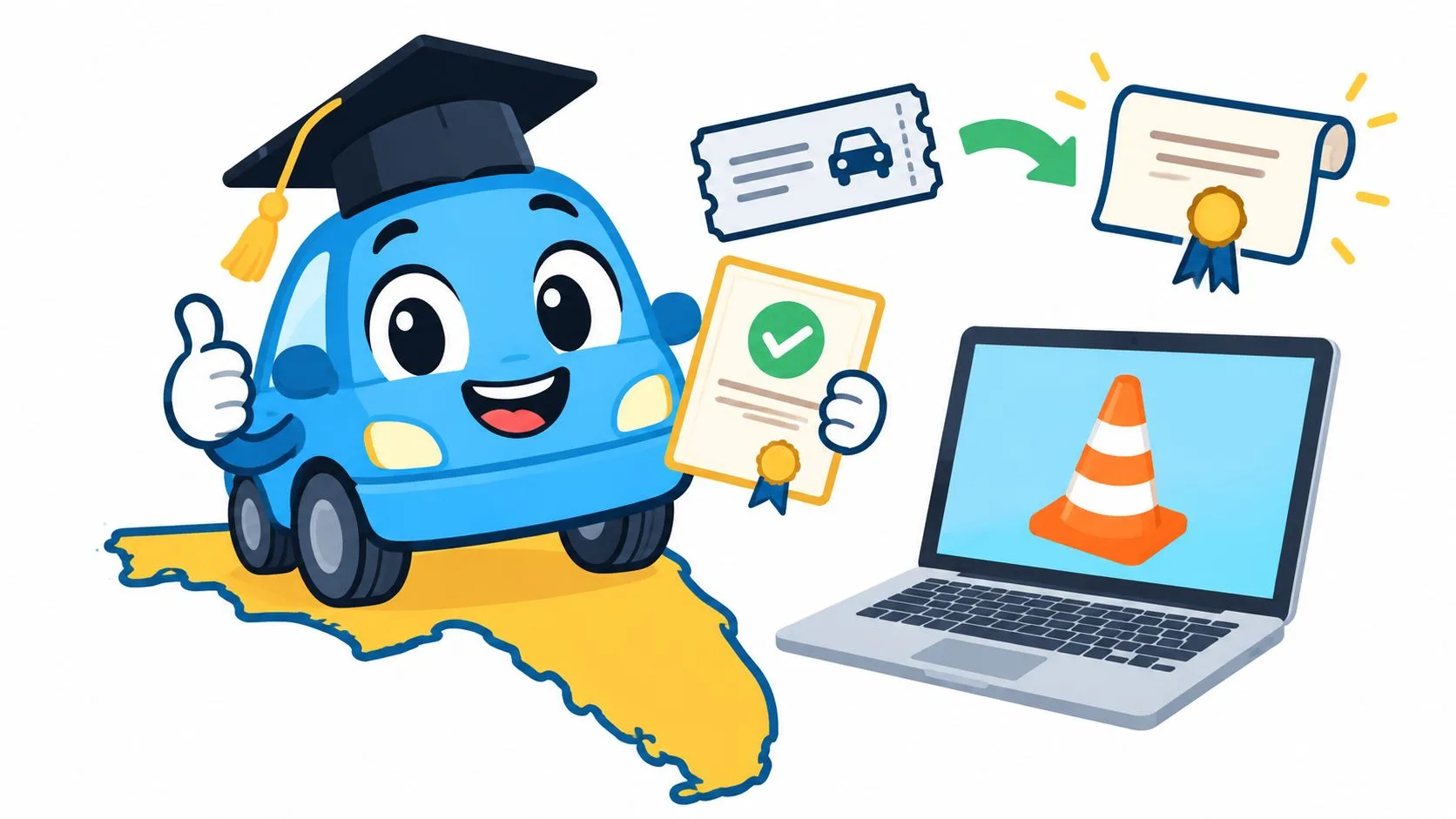
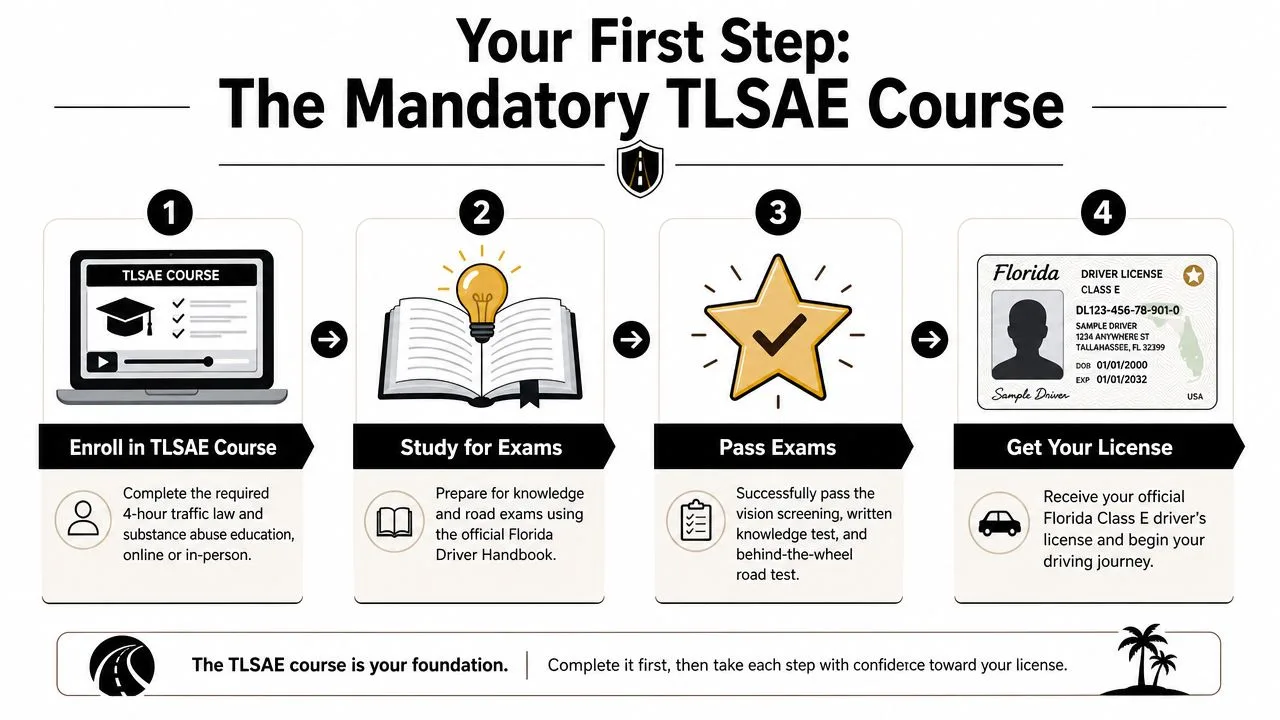
Start with the Traffic Law and Substance Abuse Education course. Florida requires this step before many first-time adult applicants take the Class E Knowledge Exam, and treating it as your starting line is the fastest way to stay on track.
Why TLSAE comes first
Adults often try to jump straight to the test phase. Bad move. The course gives you the rules, safety concepts, and impairment awareness Florida expects you to know before you sit for the knowledge exam.
It also keeps your timeline clean. Finish TLSAE early, and you can focus on studying, documents, and scheduling instead of backtracking after a rejected appointment.
A law that took effect on July 1, 2025, established broader course expectations for many applicants age 18 and older, as reported by ClickOrlando’s coverage of the 2025 Florida licensing change. The practical takeaway is simple. Put TLSAE at the top of your checklist unless your situation clearly falls under an exception.
My recommendation: Complete TLSAE before you schedule any exam or DMV visit. It saves time and cuts out avoidable mistakes.
Online is the smart way to do it
For working adults, online TLSAE is usually the easiest choice. You can complete it on your own schedule, keep your momentum, and avoid wasting half a day on a basic education requirement.
A Florida-approved option is the online TLSAE course at BDISchool. The advantage is simple. You finish a required step efficiently and build a stronger base for the written test at the same time.
Use this approach:
- Take the course early: Do it before you start hunting for appointments.
- Pay attention while you complete it: The material supports what you will see on the knowledge exam.
- Keep your completion records organized: Do not rely on memory or screenshots buried in your phone.
- Study the Florida handbook after TLSAE: The course gives you structure. The handbook sharpens your recall.
Adults have a faster path than teens
This is one of the biggest advantages of applying over 18. Adult applicants are not stuck following the same training timeline used for teen licensing.
As noted earlier, adults can generally pursue the Class E process without the teen-style supervised driving framework. That makes TLSAE even more important. It is the first organized step that gets you pointed in the right direction and helps you pass on the first try.
Handle this course seriously, and the rest of the process gets easier. Ignore it, and you create delays you never needed.
Assembling Your Document Dossier for the DMV
You can study hard, book the appointment, and still walk out empty-handed if your documents are wrong. For adults getting a Florida license, paperwork is often the part that causes the delay, not the exams.
Treat your DMV documents like a pass or fail checkpoint. If your name, address, or status records do not line up, the visit can stop right there.
Florida REAL ID Document Checklist
| Document Category | Acceptable Examples |
|---|---|
| Primary identification | Birth certificate for eligible U.S. citizens, or legal presence documents that match your status |
| Social Security number | Social Security documentation accepted by Florida licensing offices |
| Residential address proof | Two documents showing your Florida residential address |
| Immigration or status documents when applicable | Passport, visa, I-94, or other status-specific records, depending on your category |
That chart gives you the categories. Your job is to match them to your situation before appointment day.
A U.S. citizen, permanent resident, non-immigrant, and out-of-state transfer applicant do not all bring the same packet. That is the mistake that burns time. Adults often grab a generic checklist, assume it applies to them, and find out too late that they missed one status document or brought the wrong proof of address.
What to bring without guessing
Build your folder in this order:
- Primary ID: Bring the document that fits your legal status.
- Social Security proof: Make sure the name matches your ID.
- Two Florida address documents: Use records that clearly show your residential address.
- Status documents if needed: Bring every immigration or category-specific record required for your classification.
Bring originals or accepted official documents when required. Do not show up with random screenshots, expired records, or mail that does not clearly prove residency.
I tell students to prepare documents before they obsess over the driving test. That is the efficient move. It prevents the kind of failed DMV trip that kills momentum and forces you to start over with another appointment.
The smartest way to prep
Use a practical checklist, then compare it against your exact status. Start with this what to bring to the DMV checklist and organize everything in one folder before you book your visit.
Follow this order:
- Identify your applicant category.
- Pull the matching identity and status documents.
- Verify that names are consistent across records.
- Confirm your two proof-of-address documents show your current Florida residence.
- Set the full packet aside so nothing gets lost before your appointment.
Simple beats rushed.
Get this part right, and the rest of the licensing process gets much easier. That is how adults move through the system faster and pass on the first try.
Passing the Vision and Written Knowledge Exams
Adults rarely worry about the vision check. The knowledge exam is the part that causes retakes, wasted appointments, and unnecessary frustration.
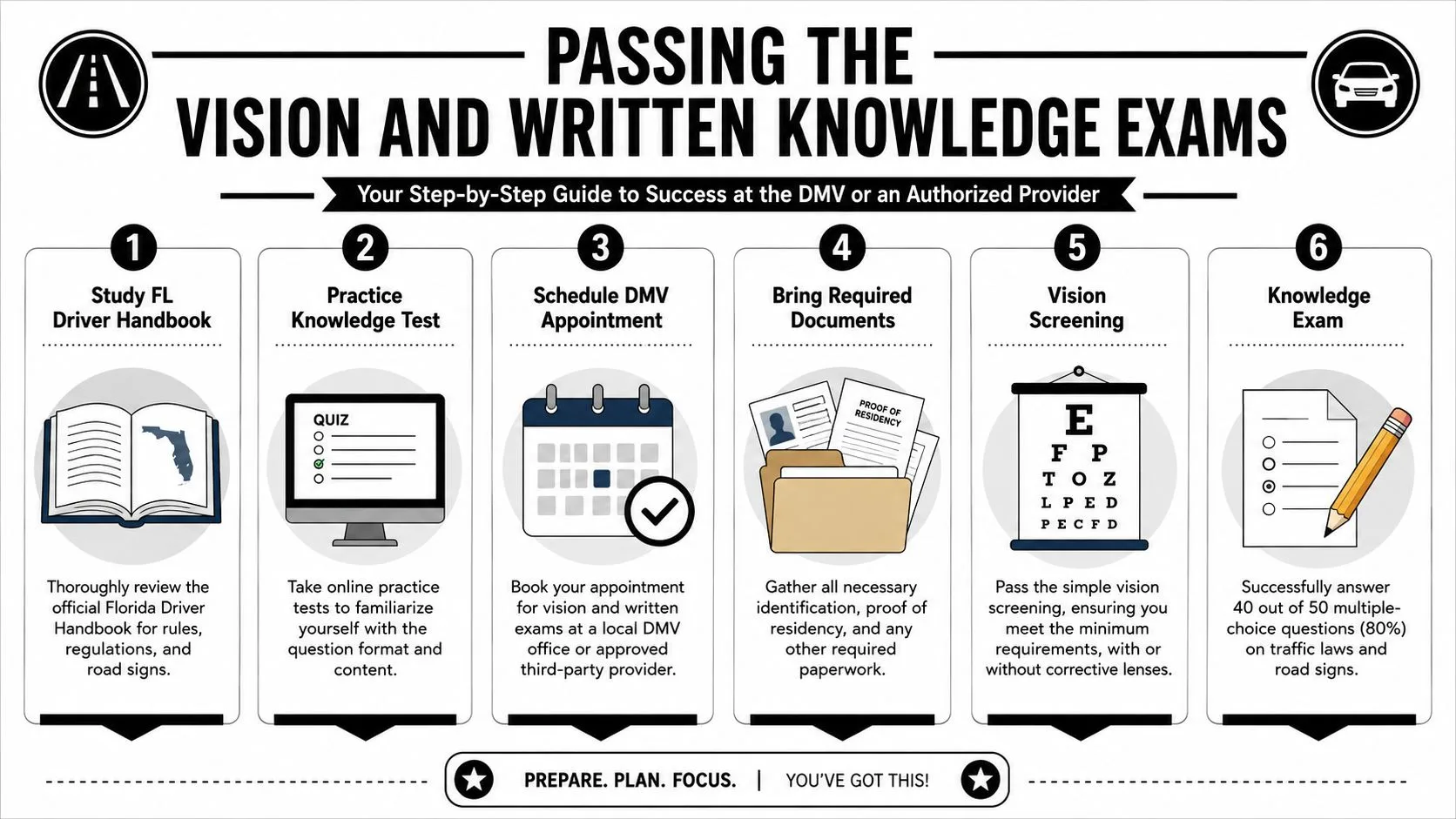
Florida’s Class E Knowledge Exam is a real test of whether you understand road signs, traffic laws, and safe-driving decisions. Treat it that way. The fastest path to a license is passing it on your first attempt, and that starts with serious prep, not guesswork.
What to expect from the vision screening
The vision screening is simple if you show up prepared. If you use glasses or contacts to drive, bring them. If you forget them, you create a problem that should never have existed.
Examiners want to confirm that you can see well enough to drive safely. That is it. Handle this part like an adult and move on.
How to pass the knowledge exam the first time
The exam covers the rules that trip people up in traffic. Right-of-way, signs, lane use, safe following distance, alcohol laws, and basic driving responsibilities all matter.
Here is the study plan I recommend to adult students:
- Read the Florida Driver Handbook with a purpose: Focus on signs, pavement markings, right-of-way, and penalties.
- Use your TLSAE course as your foundation: It gives you the mindset Florida expects before you start memorizing rules.
- Practice questions repeatedly: Repetition exposes weak spots fast.
- Study in short sessions over several days: You retain more and panic less on test day.
If you want a smart way to rehearse before the official exam, use this Florida DMV practice permit test and check whether you know the material or just recognize it.
One blunt truth. Adults fail this exam because they rush it.
My instructor advice
Do not schedule the test just because you are tired of waiting. Schedule it when road signs feel familiar, right-of-way answers come quickly, and basic Florida rules no longer feel fuzzy.
That is why I push students to take the TLSAE course seriously from the start. It is not just a box to check. It sets up the rest of the licensing process and makes the written exam much easier to handle with confidence.
Pass this step cleanly, and you keep your momentum. That matters.
Conquering the Behind-the-Wheel Road Test
You can do everything right up to this point and still lose your appointment in the parking lot. I see it happen with adults who are perfectly capable of passing, but show up in the wrong car, forget paperwork, or practice like they are running errands instead of taking a state test.
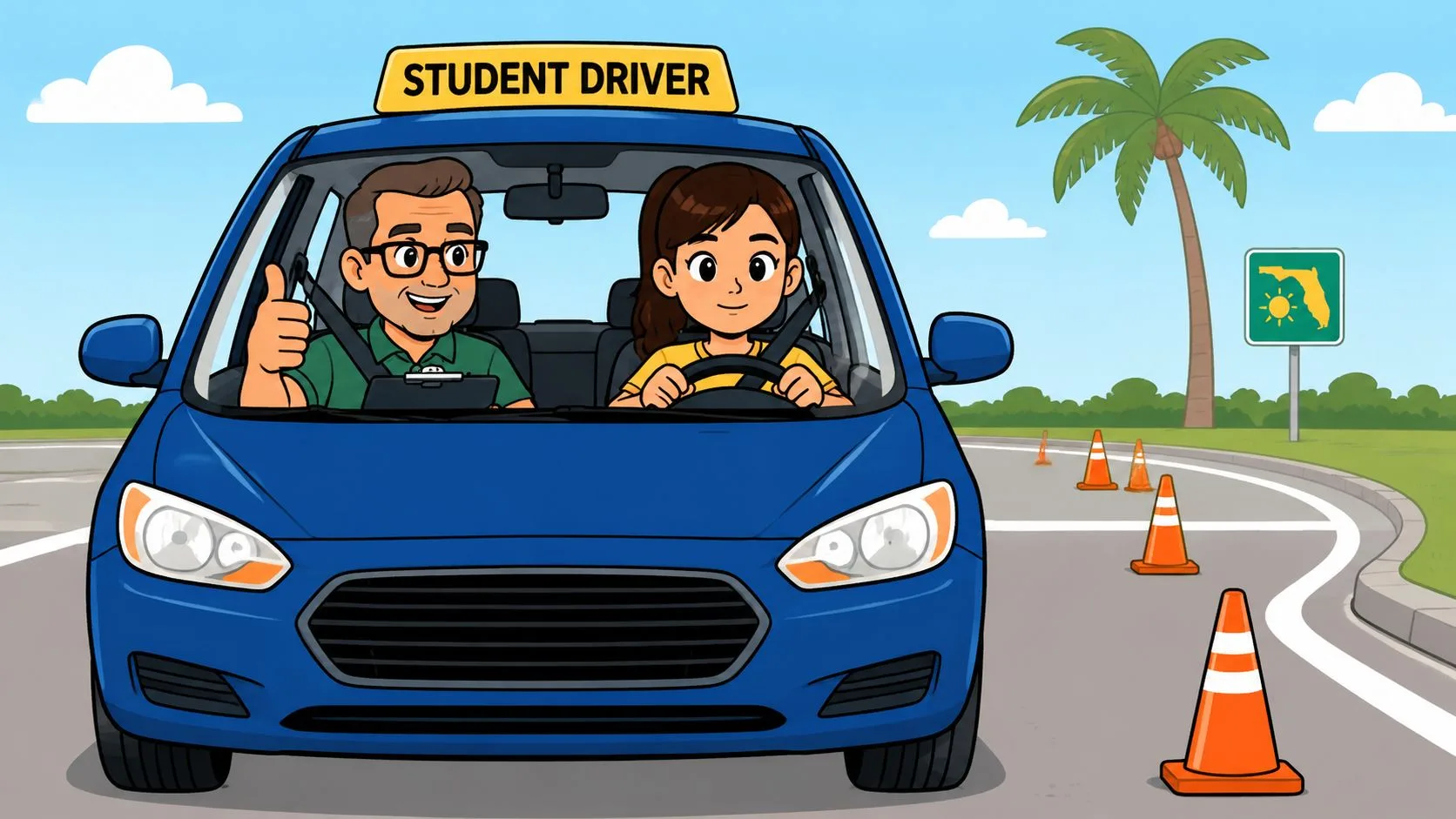
Treat the road test like a performance check. The examiner wants to see one thing. Can you control the vehicle safely, follow instructions calmly, and make legal decisions without coaching?
What examiners are actually checking
Examiners focus on repeatable driving habits, not flashy skill. They watch how you handle routine situations because routine mistakes cause real crashes.
Expect them to pay close attention to:
- Turns and lane position: Stay in the correct lane and finish the turn under control.
- Stops: Stop smoothly and fully where required.
- Backing up and parking: Keep the car steady and check your surroundings.
- Three-point turns: Show control, patience, and awareness.
- Observation: Use mirrors, look in the right places, and check before moving.
The checklist that saves test day
Your car and your documents need to be ready before your driving even gets judged. Bring a vehicle that is legal, safe, and familiar to you.
Check these items before you leave home:
- Current registration: Verify it yourself.
- Proof of insurance: Have it ready to show.
- Working vehicle equipment: Signals, brake lights, horn, tires, and brakes should all be in good condition.
- Required personal documents: Bring what your appointment requires.
- A car you know well: Do not test in a borrowed vehicle you barely drove.
A clean road test starts before the engine does. If your car or paperwork is not ready, your driving skill never gets evaluated.
For a focused refresher, review this behind-the-wheel test guide for Florida drivers and practice the exact habits examiners expect to see.
Practice like a test candidate
Informal driving experience does not automatically translate into test-ready driving. Adults often feel comfortable behind the wheel, then lose points on simple things like incomplete stops, late signal use, wide turns, or forgetting to check properly before backing.
Practice with someone who will correct you immediately. Run short sessions built around test skills, not long casual drives. Work on following verbal directions, stopping exactly where you should, checking mirrors consistently, and keeping your speed controlled in every maneuver.
One more instructor tip. Use the same car for practice and for the test if you can. Familiar controls cut down nerves fast.
This video gives a helpful look at behind-the-wheel testing and what to expect:
Special Cases and Your New Life on the Road
Not every adult applicant starts from the same place. Some are true first-time drivers. Others already drove in another state or another country and just need to sort out Florida paperwork.
That’s where generic guides usually fail. They act like everybody follows one identical path. Florida doesn’t work that way, especially when document status and prior licensing history enter the picture.
If you’re moving to Florida
If you already hold a valid license from another state, your path may be different from a first-time applicant’s. The practical issue is whether Florida treats you as a transfer rather than a new driver.
That’s why I tell transfers to focus on two things first:
- Status and identity paperwork: Your document list still has to line up.
- Office-specific requirements: Confirm what your location wants before showing up.
If you’re not a first-time driver, don’t assume you need every step in the standard adult path. Verify your transfer situation directly before booking unnecessary testing.
If your case is more complicated
Some applicants are dealing with immigration records, prior expired credentials, or unusual name and address issues. In those cases, speed comes from precision.
Use this mindset:
- Match every document to your status
- Resolve name differences before your visit
- Bring more organization, not more random paperwork
A neat folder with the right records beats a backpack full of maybe-documents every time.
What happens after you pass
Once you complete the process successfully, you move from applicant to licensed Florida driver. That sounds obvious, but it’s a bigger shift than one might initially expect.
You’re no longer just learning rules for a test. You’re responsible for keeping a clean record, avoiding citations, and driving like someone who plans to stay licensed. That means following the basics every day, not only when an examiner is watching.
Getting the license is the start of responsible driving, not the finish line.
That’s also why smart drivers keep education in mind after licensing. If you ever need a driver-improvement course for a citation, or you want a refresher later in life, taking care of it quickly protects your time and your record.
Florida Driver’s License Frequently Asked Questions
Do I need a learner’s permit if I’m over 18 in Florida
No. If you are 18 or older and getting your first Florida license, you can usually go straight to a Class E license instead of following the teen permit path.
That saves time. Adults should use that advantage and start with the required TLSAE course, because it clears the first official hurdle and makes the rest of the process easier to organize.
What do I need before I can take the written test
Complete the TLSAE course first. Then get your identification documents in order before you book anything else.
That sequence matters. Adults who try to schedule tests before handling the course and paperwork usually create their own delays.
How hard is the Florida written knowledge exam
It is passable for prepared applicants and unforgiving for casual ones. The test covers traffic laws, road signs, and safe-driving rules from the Florida handbook.
My recommendation is simple. Study the handbook, use practice questions, and treat the exam like a real checkpoint, not a formality. The TLSAE course gives you a strong start, but first-time success usually comes from combining the course with focused review.
What if I fail a test
Fix the reason you failed, then retake it with a better plan.
For adult applicants, the usual causes are predictable:
- weak knowledge-test preparation
- avoidable road-test mistakes under pressure
- missing paperwork or a car that is not test-ready
Do not turn one failed attempt into three. Diagnose the problem, correct it, and come back organized.
Can I use any car for the road test
No. Use a car that is legal, safe, and ready for inspection on test day.
Check the registration, insurance, lights, signals, brakes, and basic condition before your appointment. Borrowing a car at the last minute is a common mistake, and it costs adults time they could have saved with a simple pre-check.
What documents do I need at the DMV
Your document list depends on your legal status and identity records. That is why generic checklists mislead people.
Bring documents that clearly prove who you are, your lawful status, your Social Security eligibility when required, and your Florida residential address. If your name appears differently across documents, fix that before your appointment. A clean document set speeds everything up.
Are there driving-hour requirements for adults
Adults do not follow the same supervised driving-hour rules that apply to teens. Your path is more direct.
That does not mean you should skip practice. It means your time is better spent on the required course, smart study, proper document prep, and enough real driving practice to pass the road test the first time.
What’s the fastest way to get licensed over 18 in Florida
The fastest path is the clean path.
Use this order:
- Finish TLSAE
- Collect the right documents
- Study seriously for the knowledge test
- Practice for the road test in a compliant vehicle
- Show up early and organized
That is the adult strategy that cuts delays and improves your odds of passing on the first try.
If you want the process to feel simpler, start with the required course and handle each step in order. BDISchool offers Florida-approved online driving courses that can help you complete required education, prepare smarter, and move through the licensing process with less stress.