In the United States, drivers permit requirements usually start with a minimum age of 15 or 15½, plus a vision screening, a written knowledge test, identity and residency documents, and parental consent if you're under 18. In Florida, that path begins at 15, and teens under 18 must also bring signed parental consent, pass vision and hearing tests, pass the Class E Knowledge Exam, and show proof of identity, Social Security number, residential address, and Driver Education Traffic Safety course completion.
If you're reading this, there's a good chance you're doing what most new drivers and parents do. You have a folder open on the kitchen table, a DMV appointment on the calendar, and one big question: what exactly do I need so I don't get turned away at the counter?
That confusion is normal. Drivers permit requirements sound simple until you compare states, age rules, school requirements, supervision rules, and test steps. The details matter, especially in Florida, where one missing form or one misunderstood testing rule can delay the whole process.
The good news is that the process is easier when you break it into pieces. Once you understand the common permit rules across the country, Florida's version becomes much easier to manage, and you can move straight from research into the right course and the right next step.
What Every Drivers Permit Requirement Has in Common
A lot of permit problems happen before the test even starts. A teen or first-time adult driver walks up to the counter with one document missing, the wrong person signed the form, or nobody checked whether the state requires a class first.
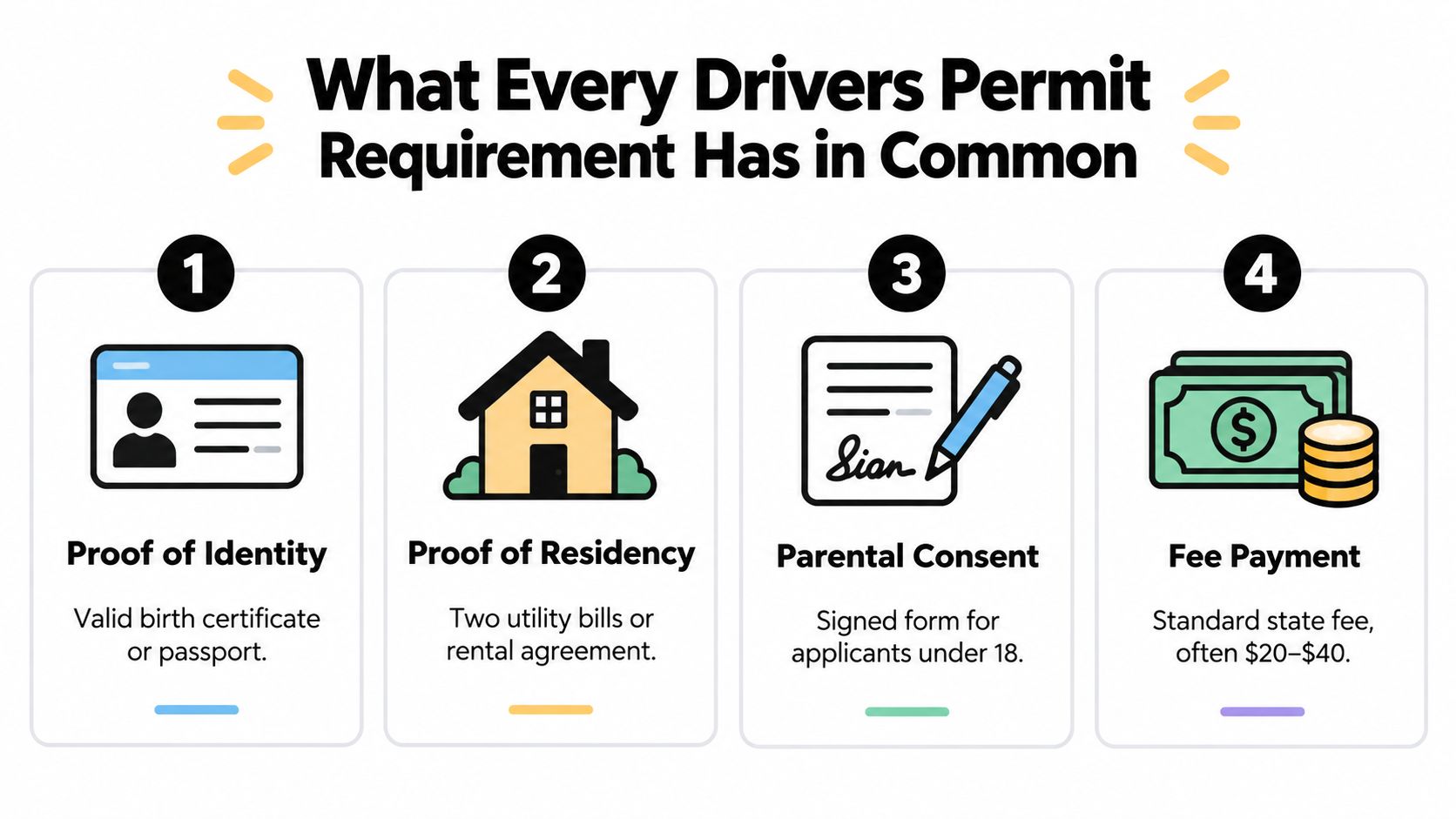
Most drivers permit requirements in the U.S. follow the same basic pattern. States change the fine print, but the structure stays familiar.
Eligibility comes first
The first gate is age and legal eligibility. Across major states, permit entry often starts at 15 or 15 years and 6 months, with examples including Florida at 15, Arizona at 15 years and 6 months, Virginia at 15 years and 6 months, Tennessee at 15, and California at 15½ for an instruction permit process that also requires driver education for applicants under 18 (multi-province and state permit overview, Arizona permit rules).
Some families get tripped up here because they assume age is the only requirement. It usually isn't. Residency, identity verification, and in some places school or course status can matter too.
Documents prove who you are
The second pillar is paperwork. States commonly ask for proof of identity, proof of residence, and proof tied to your legal record, such as a Social Security number.
If you're helping a teen prepare, build a document folder early. That same habit matters in other jurisdictions too. If you're comparing motorcycle licensing requirements in Canada, this guide to documents for the M1 permit Ontario is a useful example of how documentation rules can be more specific than people expect.
Practical rule: If a state asks for identity and residency documents, bring exactly what the state lists, not what seems close enough.
Testing and supervision are built in
The third pillar is testing. Permit systems commonly separate knowledge from vehicle-control skills. Maryland, California, and Nevada all show how the permit step acts as a sequence control before later road testing, with the permit process forcing identity checks, knowledge assessment, and permit issuance before the skills exam (Maryland learner permit guidance).
The fourth pillar is consent and supervision. For minors, parents usually have to sign. Once the permit is issued, the learner must also drive with a legally qualified adult in the proper seat position. New York requires a supervising driver age 21 or older with a valid license for the vehicle, and similar supervision rules in other states show why one wrong setup can make a practice drive unlawful (supervision rule overview).
State-by-State Permit Requirements at a Glance
A family comparing permit rules often runs into the same problem. Two states can use the same word, "permit," while meaning slightly different steps, ages, and practice rules.
A clean way to compare states is to look at three checkpoints first: starting age, how long the permit must be held before the next license step, and whether the state spells out supervised practice hours. That gives you the big picture before you sort through Florida's details.
Permit Ages, Holding Periods, and Supervised Hours by State
| State | Min Age | Holding Period | Supervised Hours |
|---|---|---|---|
| Florida | 15 | Before a teen moves to the next license stage, Florida uses a required learner period under its graduated licensing system | 50 hours, including 10 at night |
| California | 15½ | Under 18 applicants must hold the permit before taking the drive test | State teen licensing rules include supervised practice before the next step |
| Arizona | 15 years and 6 months | 6 months | State teen rules include supervised driving requirements before progression |
| Virginia | 15 years and 6 months | 90 days for applicants ages 18 to 20 who have never been licensed | Driver education requirements apply for affected applicants |
| Tennessee | 15 | 180 days | Practice requirements apply before advancement under state teen licensing rules |
| Georgia | 15 | Permit stage applies before the next license level | 40 hours, including 6 at night, plus driver education and behind-the-wheel or parent-taught training requirements |
| Maryland | 15 years and 9 months | Permit must be completed before a provisional license | Supervised practice is part of the state process before advancement |
| Nevada | Teen applicants begin with a learner permit before later licensing steps | Permit stage applies before skills testing and later licensing | Supervised driving rules apply during the learner stage |
The table is a map, not the whole trip. It helps you spot which states start earlier, which ones make learners wait longer, and which ones build in more practice before a road test.
Florida and California show why small differences matter. Florida starts at age 15. California starts at 15½, and teen applicants face added education and practice steps before they can move on. For a parent, that half-year difference can affect school schedules, insurance timing, and when supervised driving begins.
Arizona, Virginia, and Tennessee also separate the permit stage in different ways. Arizona uses a six-month permit period. Virginia has a shorter holding rule for a specific adult beginner group, applicants ages 18 to 20 who have never been licensed. Tennessee uses a 180-day permit period. Those rules are easy to mix up if a family recently moved or is comparing one sibling's path to another relative's path in a different state.
Georgia gives a good example of how one row in a table can hide a lot of structure. A teen may start with an instructional permit at 15, but later license steps can also require classroom education, behind-the-wheel training or parent-taught instruction, and logged supervised hours, including night driving. Maryland and Nevada follow the same general pattern many states use. The permit is a checkpoint first, then the next license stage comes after the learner meets the state's practice and testing conditions.
If Florida is the state you care about, start with this guide on what age you can get a permit in Florida. It gives you the age rule in plain language before you sort through documents, testing, and supervision.
Florida Permit Documents and Parental Consent
A common Florida permit problem starts before the test. A teen studies for days, a parent clears the morning for the DMV visit, and then the application stalls because one document is missing or the consent form was signed the wrong way.
Florida's permit paperwork works like a checkpoint at the gate. If one required item is missing, the rest of the process usually stops until it is fixed. For families comparing states, that is one place Florida can feel stricter in practice than it first appears on a national chart. The age rule may be simple, but the document rule is where many first-time applicants lose time.
For a learner's license in Florida, teens generally need proof of identity, proof of Social Security number, proof of residential address, proof that the required traffic law and substance abuse course was completed, and parental consent if the applicant is under 18. If you want a plain-language checklist before the appointment, this guide on what you need to get your permit lays out the items step by step.
Build a permit folder before appointment day
Treat your permit documents like school forms for the first day of class. Put everything in one folder and check it twice before you leave home.
Bring:
- Identity proof: Use a primary identity document accepted by Florida.
- Social Security proof: The name should match your other records.
- Residential address proof: Use current documents that show where the applicant lives.
- Parental consent: Required for applicants under 18.
- Course completion proof: Teen applicants need proof of the state-required traffic law and substance abuse course, often called TLSAE or DETS.
The details matter. A document can be valid on its own and still create a problem if the name, address, or status does not line up with the rest of the application.
Parental consent causes more delays than families expect
This step confuses parents because the rule sounds simple until signature details come into play. Florida requires a parent or guardian to sign for an applicant under 18, and the signature must be completed in the way the state accepts for permit issuance, as explained by the FLHSMV teen licensing requirements page.
A good rule is to confirm the consent format before the appointment, not at the counter. Parents often assume they can sign later, fix it at home, or send a teen in with partial paperwork. That is how a short DMV errand turns into a second trip.
One more point helps Florida families act right away. If the teen still needs the required pre-permit course, BDISchool offers FLHSMV-approved options that satisfy that step before the document check begins. That connection matters because permit eligibility is not only about age. It is also about arriving with the right course record and the right paperwork on the same day.
Passing the Knowledge Vision and Hearing Tests in Florida
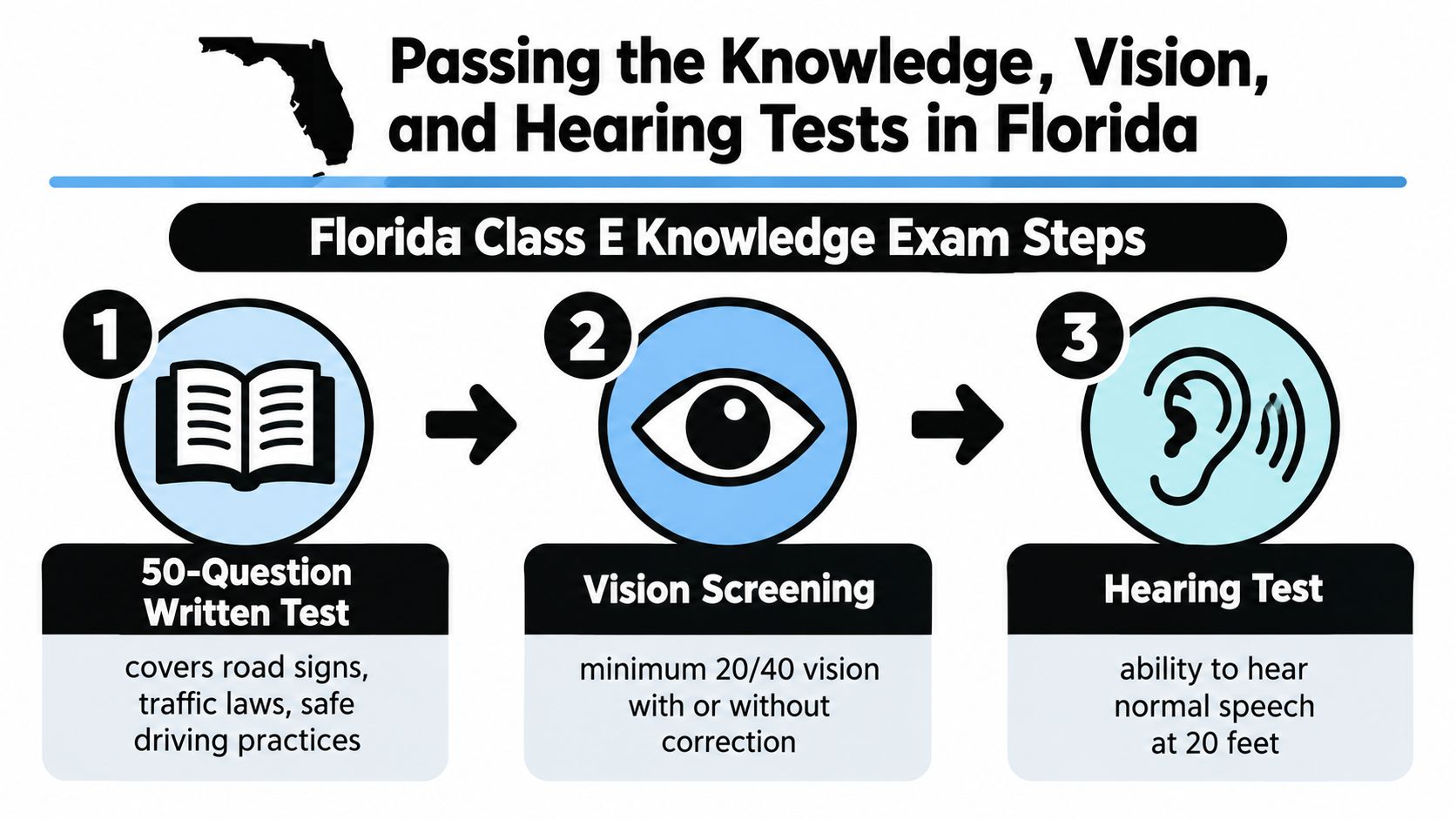
A lot of Florida families reach this stage thinking the permit hinges on one written exam. Then test day arrives, and they learn the process works more like a three-gate checkpoint. The learner's license is issued only after the teen clears the knowledge exam, vision screening, and hearing screening, as noted earlier.
The knowledge test measures readiness for supervised driving
The Class E Knowledge Exam checks whether a new driver understands the rules that keep early practice safe. That includes traffic laws, road signs, and basic driving situations a teen will face before ever driving alone.
Students often get stuck in the same place. They recognize a sign in real life, but miss the question because the test asks for the rule behind it, not just the picture. Reading the handbook carefully, then practicing with question wording, usually helps more than memorizing sign shapes by themselves.
A good next step is to use a Florida driver license practice test so the wording feels familiar before the exam.
Vision and hearing screenings are part of permit eligibility
These checks are easy to overlook because families tend to focus on studying. Florida does not treat them as side steps. They are part of the permit decision.
The simplest way to prepare is practical. If the teen uses glasses or contacts, bring them. If hearing has already been a concern at school, at home, or during past medical visits, address that before the appointment instead of sorting it out at the counter.
That small bit of planning saves frustration.
A national comparison helps here too. Many states test permit knowledge, but the details around screening and appointment flow vary. Florida families usually do better when they prepare for the full checklist, not just the exam score.
A short explainer can help if you want to see the testing process in a more visual format.
Online testing creates one extra paperwork trap
Families who choose the online Class E Knowledge Exam can run into a separate problem. Passing the test does not automatically finish the permit step for a minor.
Florida also requires the parent or guardian to complete the online test proctoring form correctly if the exam was taken through an approved third-party provider. If that form is missing, incomplete, or signed the wrong way, the teen may have to fix paperwork before the permit can be issued.
That catches families off guard because the test result feels like the hard part. In practice, the score and the paperwork have to line up together, much like matching documents earlier in the permit process.
Who Can Supervise a Permit Driver
A common permit mistake happens in the driveway. A teen is ready to practice, a licensed adult is available, and everyone assumes that is enough. In many states, it is not.
Supervision rules work like a safety checklist. Before the car moves, families need to confirm that the adult in the passenger seat meets the state's rule, not just the family's comfort level.
Three things to check before any practice drive
Start with these questions:
- Is the supervising driver old enough under that state's rule? Many states set a minimum age for the adult who supervises a permit holder. In New York, for example, the supervising driver must be 21 or older and properly licensed for the vehicle (supervision rule overview).
- Does that adult have the right license, and is it valid? A suspended, expired, or wrong-class license can make the practice drive improper.
- Is the adult in the front passenger seat? Supervision usually means immediate access to the learner, the road, and the situation around the vehicle.
That last point trips people up more often than you might expect. A licensed adult in the back seat is not the same as a supervisor in the seat beside the driver.
The national pattern is fairly consistent even though states word it differently. Permit drivers are expected to practice with an adult who is legally qualified, close enough to monitor the drive, and old enough to meet the state's minimum. The exact age rule can shift from state to state, which is why parents should check the permit state, not rely on what a cousin did elsewhere.
Florida families should be especially careful here. Florida's permit stage is part of a larger graduated licensing path, so supervised driving is not just a casual practice period. It is the training phase where habits are built under adult oversight. If you want a plain-English map of how that process fits together, BDISchool's guide to graduated driver licensing lays out the stages clearly.
A few real-world examples help. An older sibling may be calm and responsible but still fail the age rule. A grandparent may be happy to help but may need to confirm their own license is current. An out-of-state relative may be fully licensed, yet the family still has to make sure that person's age, license class, and seat position satisfy the rule that applies to the permit holder.
Before handing over the keys, ask three questions out loud: Is the supervising adult old enough, properly licensed for this vehicle, and sitting in the front passenger seat?
Common Mistakes That Block Florida Permit Holders
A common Florida permit-day scene goes like this: the teen studied, the parent took time off work, everyone shows up to the office, and the application still stalls over one missing paper or one misunderstood rule. The problem usually is not driving ability. It is a paperwork or process error that could have been caught the night before.
Florida's permit path works a lot like a checklist at an airport. If one item is missing, the line stops there. Families who compare Florida with other states often get tripped up for the same reason. Many states ask for similar proof and parent involvement, but the exact form, signature, or course rule can differ.
The avoidable mistakes
| Common Mistake | What goes wrong | Fix |
|---|---|---|
| Bringing a partial document set | A learner may have one strong ID but still be missing proof tied to identity, Social Security, or address. | Lay every document on a table the day before the appointment and match each one to the Florida checklist covered earlier. |
| Showing up without valid parental consent | For applicants under 18, a parent or guardian signature issue can stop the application even if every other item is ready. | Confirm who must sign, whether notarization is needed in your situation, and whether the form is completed before test day. |
| Mishandling Form 71144 for online testing | Families sometimes assume passing an online knowledge exam is the final step, then learn the proctoring form was not completed correctly. | Treat the exam and the form as a pair. If a minor tests online through a third party, review the form instructions carefully before the test begins. |
| Choosing a traffic class that does not count | After a citation, some drivers register for a class that sounds right but is not the state-approved course tied to that purpose. | Check the provider and course type before paying. If the need is Basic Driver Improvement, use the state's approved provider list: approved BDI provider guidance. |
| Assuming ticket-election options are unlimited | A driver can run into trouble by electing the same course too often and finding out the option is no longer available for that ticket. | Keep a simple record of prior course elections and confirm eligibility before choosing that route again. |
One mistake deserves extra attention. Families often mix up permit prep with post-ticket courses.
Those are different lanes. Studying for a Florida permit helps a new driver qualify to start driving. Basic Driver Improvement is a separate state-defined course used in specific traffic-ticket situations after someone is already in the licensing system. If a family hears "take a course" and assumes any course will do, they can lose time and money.
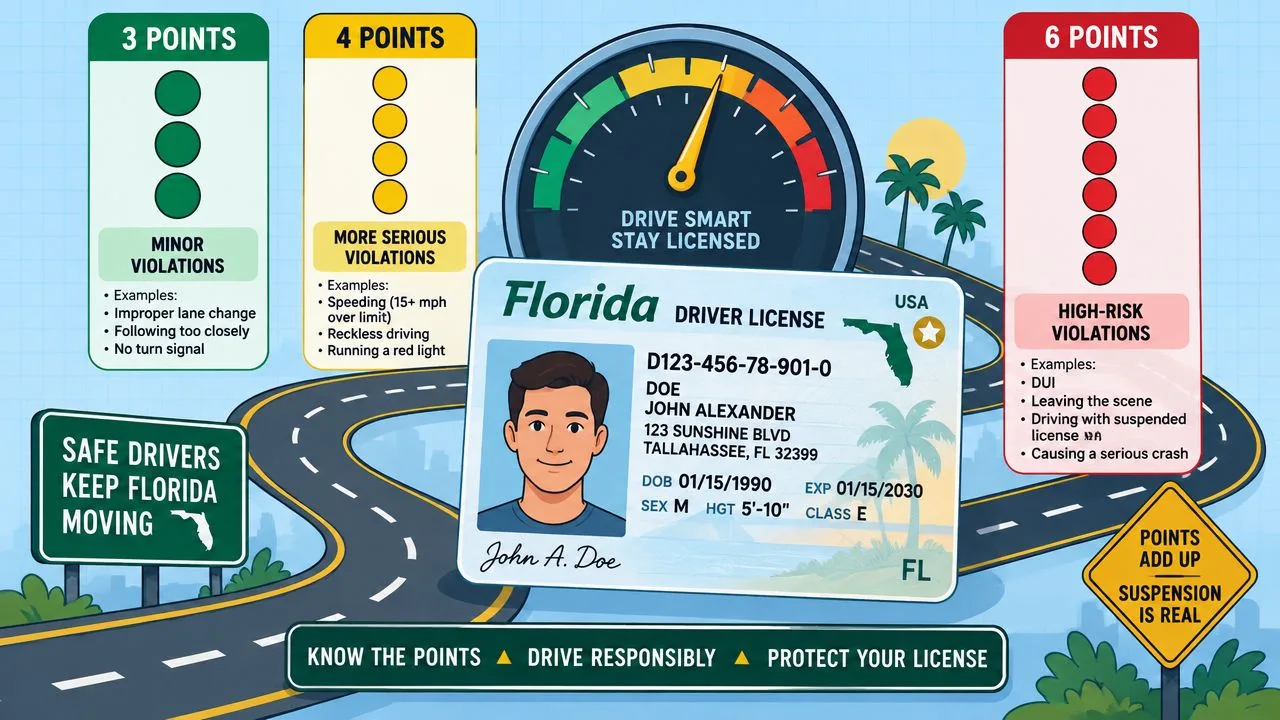
The same pattern shows up with point consequences. New drivers sometimes treat an early citation like a small bump that will disappear on its own. Florida does not handle points casually, and repeated mistakes can lead to suspensions over time. That is why permit-stage habits matter so much. The way a learner handles rules, supervision, and attention now often carries straight into the first year of licensed driving.
For Florida families, the practical lesson is simple. Do not prepare only for the test. Prepare for the process. A careful document check, the right parent signature, and a clear understanding of which course fits which situation prevent many of the delays that block permit holders before they ever get meaningful practice on the road.
Turning Permit Progress into Real Benefits
A permit often feels like the finish line for a family. In practice, it is more like getting the keys to the classroom car. What happens next shapes how confidently a new driver studies, practices, and responds if a traffic problem shows up later.
That matters even more in an article like this one, because permit rules are not identical across the country. A teen comparing Florida with Texas, California, or New York can see the broad pattern, then still run into Florida-specific course terms that sound similar but serve different purposes. The goal is simple. Match the course to the stage you are in.
Florida Course Benefits at a Glance
| Course Type | Best For | Florida Benefit | Completion Window |
|---|---|---|---|
| First-time driver education or permit-prep study | New teen drivers and first-time learners | Builds the knowledge needed for permit testing and early safe-driving habits | Before permit issuance or before exam prep |
| Basic Driver Improvement | Drivers with a moving violation who are eligible to elect the course | May satisfy a ticket-related need under Florida's driver improvement system, subject to state limits on how often that option can be used | Depends on the ticket timeline and eligibility rules |
| Traffic school for court compliance | Drivers ordered by a court or managing a traffic issue | Helps meet the requirement listed in the notice or court instruction | Depends on the court notice or case instructions |
Why the right course matters later
Permit study and post-ticket education are different tools. A permit-prep course helps a beginner learn signs, rules, and safe decisions. Basic Driver Improvement is for a different moment, after a citation or another traffic-related requirement enters the picture.
That distinction is where families often get tripped up.
A parent may hear "take a course" and assume any Florida driving course will satisfy the need. But course names work like labels on medicine bottles. Two products can sit on the same shelf and still solve two different problems. Picking the wrong one can cost time, delay compliance, and force the driver to start over with the correct class.
For Florida drivers who are already dealing with a ticket-related issue, BDISchool offers FLHSMV-approved online traffic school options, including Basic Driver Improvement. The course catalog is available at https://bdischool.com/courses/.
The benefit is not that a course fixes every problem on a driving record. The benefit is that the right course matches the requirement attached to that problem.
A practical way to choose
Start with one question. Are you still trying to qualify for or use your permit, or are you responding to a citation or court notice?
If you are in the permit stage, stay focused on beginner education, knowledge review, and supervised practice. If you have already received a ticket, check the notice carefully and confirm which course type it names, if any. If a court or clerk gives specific instructions, follow those instructions word for word.
That step-by-step approach turns permit progress into something useful. It helps a new driver build habits early, and it helps parents avoid signing up for a course that sounds familiar but does not fit the legal purpose.
Quick Answers to Top Permit Questions
A lot of permit questions come up at the counter, not because the rules are impossible, but because one small missing detail can stop the whole trip. These quick answers give you the direct answer first, then the next step so you know what to do today.
How long does an adult have to hold a Florida permit before testing for a license
No verified adult permit holding period is confirmed here. Verify the current FLHSMV rule before you book a road test.
Your next step is simple. Call a Florida licensing office or check the current FLHSMV driver license service guidance and write down the answer with the date you confirmed it. That gives you something concrete to rely on if a parent, instructor, or scheduler gives conflicting advice.
Does an out-of-state permit transfer when moving to Florida
Usually, no. Florida generally requires a person who moves in with a learner permit to confirm Florida eligibility and follow Florida's permit process rather than treating the old permit like a full transfer.
The smart next step is to make a moving file before you visit the office. Put your current permit, proof of Florida address, identity document, and Social Security document in one folder, then ask FLHSMV one direct question: "Can I drive in Florida on my current learner permit while I apply, or do I need a Florida permit first?" That one question prevents a lot of guesswork.
What happens if a permit is lost before the license test
You need a replacement before the driving test. A road test appointment without the permit in hand can stall the appointment even if your practice is complete.
Add "request duplicate permit" to your checklist before test week. If you already have a ticket-related issue separate from the permit problem, BDISchool offers Florida-focused course options, including Basic Driver Improvement, for the citation side. That course does not replace the duplicate permit request.
Can permit holders drive out of state
Maybe, but only if the other state recognizes your permit and you follow that state's learner rules. A Florida permit works a bit like a school ID. It proves status at home, but another state decides how much it accepts and under what conditions.
Before any trip, check three things with the state you are visiting: minimum supervisor age, where the supervisor must sit, and whether night driving is limited for permit holders. Save a screenshot or print the rule page for the glove box so the supervising adult can show what rule you checked.
What's the difference between a suspended and revoked permit
A suspended permit is paused. A revoked permit is ended and usually requires a new restoration process before driving privileges can return.
Your next step is to read the notice line by line and identify the action word the state used. Look for "suspension," "revocation," "clearance," or "reinstatement." Those words tell you whether you are waiting out a period, paying a fee, completing a condition, or starting over with the state.
Do glasses or contacts affect the driving exam
Yes, if you need them to meet the vision standard. If you normally drive with corrective lenses, wear them to the screening and to every permit or license appointment.
Treat them like part of your paperwork. Put glasses or contacts on the same night-before checklist as your permit, appointment confirmation, and any required parent or guardian forms. That small habit prevents one of the easiest appointment-day mistakes to avoid.