You’re probably here because the paperwork is confusing, the deadline feels too close, and searching for a DUI class near me has turned into a mess of mixed answers.
That’s normal.
The process is often made more difficult than necessary. Individuals frequently search by distance first, select the initial class they encounter, and subsequently discover the course doesn’t match what the court, DMV, or state agency requires. That error incurs costs in time, money, and occasionally additional paperwork.
The easier path is simple. First, confirm exactly what authority is requiring. Second, choose a course format that fits your schedule without creating more disruption. Third, make sure completion gets reported correctly.
If your situation also points to a deeper alcohol or substance-use issue, it’s smart to look beyond the class requirement and get actual support. A useful starting point is this guide to find addiction treatment in Massachusetts, especially if you’re trying to solve the underlying problem and not just satisfy a deadline.
For Florida drivers dealing with license and compliance issues, it also helps to understand the reinstatement side early. This overview on reinstating a suspended license in Florida can save you from finishing a class and then realizing you missed another required step.
Your Quick Path to Resolving a DUI Requirement
The fastest way through this is to stop treating it like a shopping problem.
It’s a compliance problem. That means the right class is the one that satisfies the correct authority with the least friction for your schedule.
Start with the authority, not the classroom
Your court order, DMV notice, probation paperwork, or state referral controls what you need. The phrase DUI class near me sounds like a location search, but in practice it’s usually a legal-status search.
A nearby provider is only useful if that provider is approved for your exact requirement.
Practical rule: Convenience matters after legal acceptance is confirmed, not before.
Use the path of least resistance
For most busy adults, least resistance means removing travel, fixed classroom times, and avoidable admin work.
That’s why the right course setup usually has these features:
- State recognition: The provider is accepted for your jurisdiction and purpose.
- Clear enrollment flow: You can tell what information they need before you begin.
- Flexible access: You can work around your job, family, and transportation limits.
- Clean reporting process: Your completion record gets where it needs to go without guesswork.
Don’t overcomplicate this
People often assume they need to call multiple offices, compare random providers, and decode legal terms on their own. Usually, they just need to match the requirement to the approved format and get started.
If you do that first, the whole process gets smaller. It becomes one task at a time instead of a pile of stress.
First Verify Your Exact DUI Class Requirements
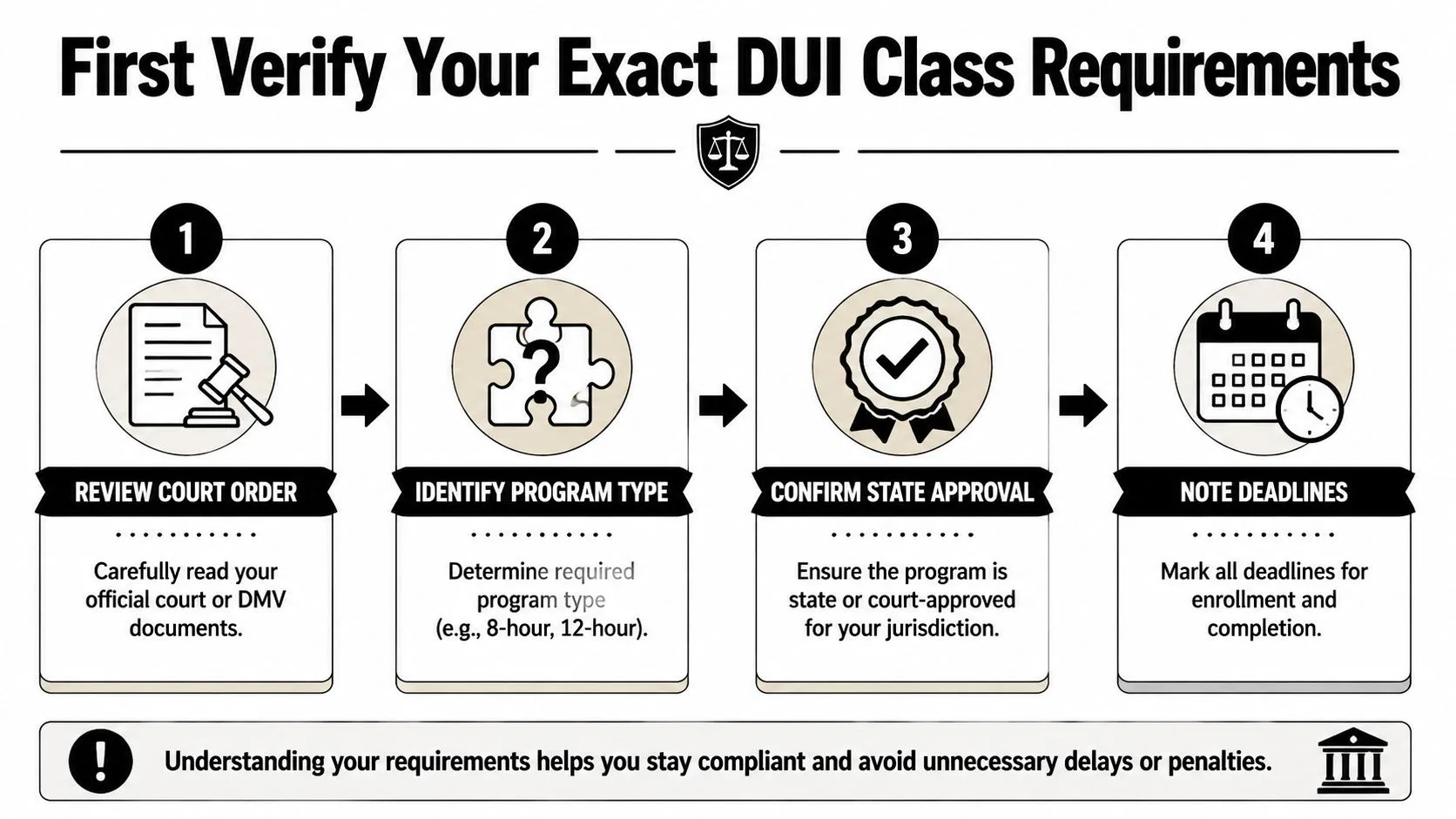
The biggest mistake is enrolling before you know what you’ve been ordered to complete.
In many states, DUI education sits inside a court-directed system, not a menu of classes you can choose from at will. A Virginia DUI law summary explains that a conviction requires completing the Virginia Alcohol Safety Action Program, and that the class cannot be completed before court because it’s tied to the court order, probation, or a suspended sentence through Virginia’s DUI class requirements.
Read the paperwork like a checklist
Don’t skim. Pull out the exact items that control enrollment.
Look for:
- Who ordered the requirement
- Whether it’s DUI school, driver improvement, evaluation, treatment, or another program
- Any deadline for enrollment or completion
- Any wording about approved providers, in-person attendance, or reporting
If the paperwork is vague, call the court clerk, probation office, or state agency that issued it. Don’t guess.
Match the program type correctly
A lot of drivers confuse a general traffic course with a DUI-related requirement. Those are not automatically interchangeable.
Florida drivers also need to understand related impaired-driving concepts before enrolling. This summary of what impaired driving means in Florida helps clarify the difference between broad safety education and a court-specific alcohol-related obligation.
Here’s the practical breakdown:
| What you see on paperwork | What it usually means |
|---|---|
| Court-ordered language | You need the exact program the court recognizes |
| DMV or license action notice | You may need a course tied to reinstatement or compliance |
| Evaluation requirement | Don’t book a class first if the evaluation decides the track |
| State-approved wording | The provider must be recognized by the relevant authority |
If the order names a track, provider type, or agency, follow that language exactly.
Why this matters more than location
People search DUI class near me because they want a quick fix. That instinct is understandable, but location is secondary.
The right question is this: Will this provider satisfy the authority that ordered my requirement?
If the answer isn’t clear, move on. A class that’s easy to find but wrong for your case is worse than no class at all.
Online vs In-Person DUI Classes The Smart Choice
For most working adults, online is the smarter choice.
Not because online is trendy. Because it removes the parts of the process that waste the most time: commuting, rigid schedules, parking, missed work, and trying to fit your life around someone else’s classroom calendar.
What in-person really costs you
An in-person course isn’t just the class.
It’s the drive there, the drive back, the schedule conflict, the child care arrangement, the late arrival risk, and the possibility that a single missed session turns into another delay. If you work irregular hours or commute long distances, that burden stacks up fast.
That doesn’t mean in-person is always wrong. It means you should only accept that burden when your jurisdiction requires it.
Online only works when it’s officially accepted
Convenience by itself isn’t enough. A provider has to line up with the legal workflow.
That’s the core point raised in this overview of approved DUI evaluations and course alignment: flexible scheduling helps, but regulatory alignment matters more, and the safest option is a provider recognized by the relevant authority that can handle the full path from evaluation through completion documentation.
That’s why I tell people to judge providers using this short table:
| Decision factor | In-person class | Online class |
|---|---|---|
| Schedule control | Limited to posted sessions | Usually easier to fit around work and family |
| Travel burden | High | Low |
| Missed session risk | Higher | Lower when self-paced access is available |
| Compliance value | Good if properly approved | Good if properly approved |
| Admin simplicity | Varies by provider | Often simpler when reporting is integrated |
The practical recommendation
If your state or court allows an online option, take it.
A Florida-approved online course usually gives you the least disruptive route to compliance. You can complete the work from home, from your phone, or during the small openings in your day instead of burning half a day on logistics.
One Florida option is BDISchool’s online driving courses, which are offered in English, Spanish, and Portuguese and are built for drivers who need a state-approved format without the friction of classroom attendance.
The right online class saves effort only if it also satisfies the correct state or court requirement.
When in-person may still be required
Some jurisdictions still insist on in-person attendance for certain parts of the process.
That’s why “online is easier” is not the same as “online is always allowed.” If your paperwork names a licensed local provider, a specific curriculum, or an attendance format, follow that requirement.
But if your Florida requirement allows an approved online course, there’s no reason to make this harder on yourself than it already is.
Your Enrollment Checklist For Fast Registration
Fast registration comes down to one thing. Have the right information in front of you before you start.
Most enrollment problems aren’t technical. They happen because people begin with half the paperwork missing, pick the wrong program, or enter details that don’t match the court or DMV record.
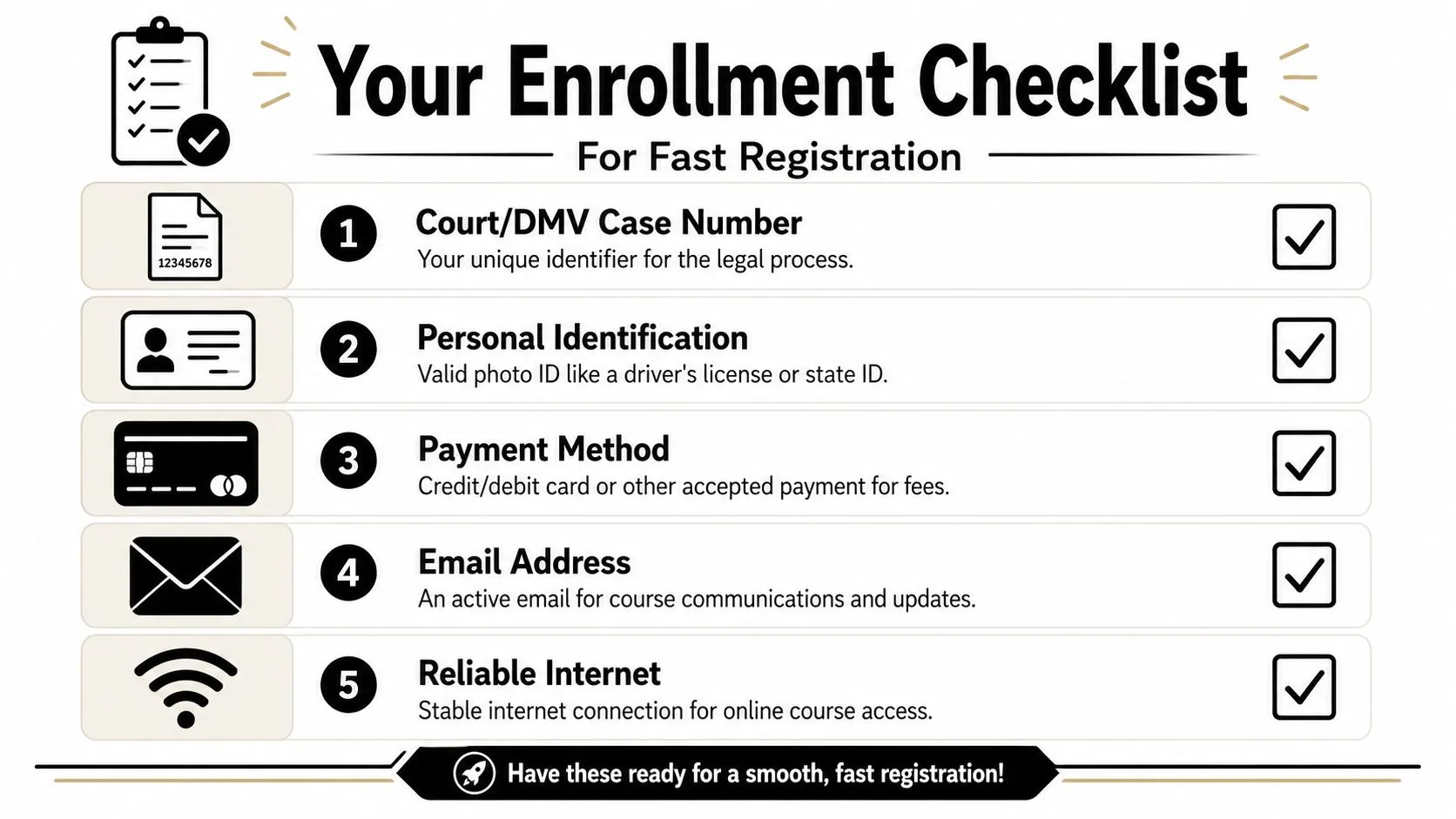
Gather these items first
Keep this simple. Before you register, collect:
- Court or DMV reference number: This is the fastest way to match your record correctly.
- Valid photo ID: Use the same name and identifying details that appear on your official paperwork.
- Active email address: You’ll need it for login access, notices, and completion records.
- Payment method: Have it ready so you can finish enrollment in one pass.
- Reliable internet access: Don’t start on a weak connection if you want a smooth setup.
Check whether an evaluation comes first
Many people go wrong at this point.
In Illinois, the state says a pre-class alcohol and drug evaluation is used to determine risk to public safety, and that required services can range from 10 hours of DUI risk education to 75 hours of substance-misuse treatment under Illinois DUI evaluation requirements. The lesson is straightforward: if your jurisdiction uses an evaluation to assign the track, don’t sign up for a generic class first.
Use this order
If you want the smoothest enrollment, follow this sequence:
- Confirm the authority that issued the requirement.
- Verify whether an evaluation is required before class placement.
- Choose the approved program type.
- Register with matching personal and case details.
- Save every confirmation email and receipt.
Bring order to the process first. Speed comes after that.
This approach avoids rework. It also protects you from the most annoying outcome, finishing a course and learning it wasn’t the course you were supposed to take.
After You Finish What Happens Next
Finishing the class is a milestone. It isn’t the finish line.
What matters next is whether your completion gets recognized by the authority that required it. That’s where provider quality starts to matter a lot more than glossy marketing.
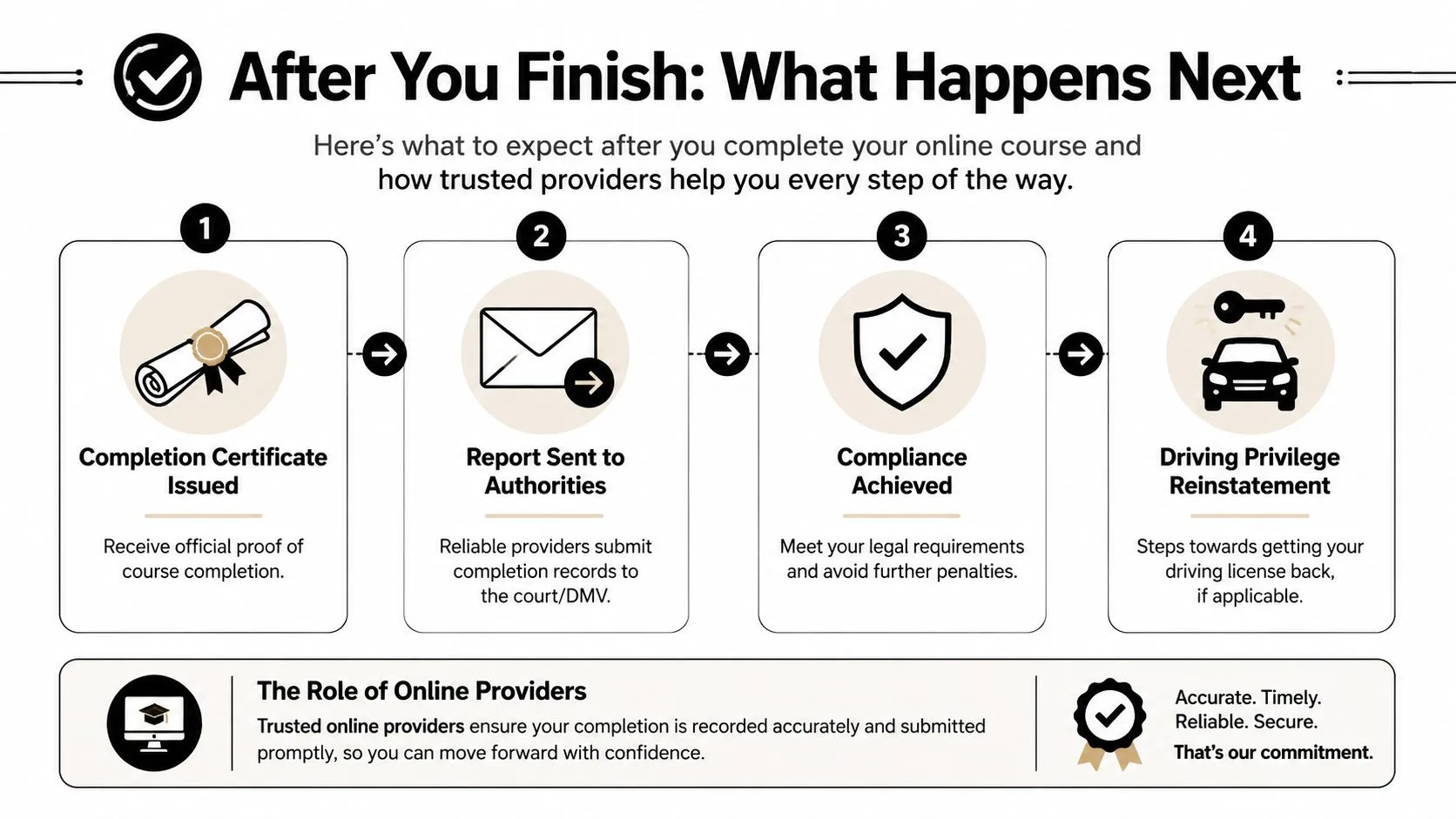
Completion is only useful if it reaches the right place
State enforcement around impaired driving is strict for a reason. A Virginia-focused report notes there were 318 alcohol-related fatalities in Virginia in 2024 and also points out that Tennessee does not license online DUI schools, which underlines how important jurisdiction-specific approval is when choosing a provider through Virginia impaired-driving statistics and state rules.
That has one practical consequence for you. Don’t assume a certificate is enough by itself.
You need to know:
- Who receives the completion record
- Whether reporting is automatic or manual
- What proof you should keep for yourself
- Whether you need the certificate for court, DMV, probation, or insurance
Keep your own copy anyway
Even when a provider reports completion electronically, save your certificate and confirmation emails.
If you’re also thinking beyond immediate compliance, you may want to review DUI record expungement options. That won’t replace your current requirement, but it can help you understand the longer-term legal cleanup process in jurisdictions where relief may be available.
Watch the reinstatement side closely
Some drivers finish the course and then stall because they forget about testing, reinstatement paperwork, or separate agency steps.
If your case involves alcohol-related licensing issues, review Florida’s alcohol and drug test DMV requirements so you don’t assume course completion alone resolves everything.
A smooth finish means two things happened: you completed the right course, and the right authority received proof.
That’s the standard to judge by.
Frequently Asked Questions About Florida DUI Classes
What if there isn’t an in-person class near me
Then stop focusing on distance and start focusing on acceptance.
This is one of the biggest reasons people search DUI class near me in the first place. In many places, provider availability is fragmented by county or region. Ventura County’s official program even sends people to different contacts for records, transfers, or payment balances through county DUI program logistics. That’s exactly why centralized online options are often easier when Florida allows them.
How do I know which class I actually need
Read the exact wording on the court or DMV notice.
If the requirement mentions evaluation, treatment, reinstatement, probation, or a specific approved program type, follow that language. Don’t translate it into “any driving course.” That shortcut creates delays.
Are all DUI classes cheap
No.
Some people assume this will cost about the same as a basic traffic course. That’s not how impaired-driving programs work in every jurisdiction. For example, Massachusetts lists a first-offender fee of $1,535.84 effective July 1, 2025 and also separates first-offender programs from more intensive second-offender formats on Massachusetts impaired driving program fees and types.
That’s why you should ask three questions before enrolling:
- Is this the legally correct program for my case
- What exactly is included in the fee
- How is completion documented and reported
Can I take the class online if I’m in Florida
If your Florida requirement allows an approved online format, that’s usually the lowest-friction option.
But always verify the approval status and the purpose of the course. Online only helps if the state, court, or agency accepts it for your exact requirement.
What if I moved or need records sent somewhere else
Don’t assume enrollment and records are handled by the same office.
Cross-county issues, transfers, and record requests can create delays when systems are fragmented. That’s another reason a single-provider online process is often easier to manage than piecing things together across separate locations.
What’s the simplest path forward
Use this decision rule.
If Florida allows an approved online course for your requirement, choose the option that reduces travel, simplifies reporting, and lets you work on your own schedule. If your paperwork requires a different format, follow it exactly and don’t improvise.
If you need a Florida-approved course and want the lowest-friction path, start with BDISchool. You can review the available courses, confirm the right fit for your requirement, and register without turning this into a bigger problem than it already is.