You’re probably in one of two places right now. You’re excited because driving means freedom, or you’re nervous because the Florida permit process feels like a pile of rules, forms, and tests.
Both feelings are normal.
A lot of first-time drivers picture the fun part first. Picking up a friend. Driving to school. Running your own errands without asking for a ride. Then reality shows up. Which course do you need? What documents count? Do you take the test online or at the DMV? What if you forget something and have to come back?
That’s where people get stuck. Not because the process is impossible, but because most guides only list requirements. They don’t help you prepare for each step in a calm, practical way.
This guide does. It walks you through how to get a permit in Florida in the order that makes the most sense, with extra attention to the parts that usually trip people up. Consider it a driving lesson before you ever touch the wheel. You don’t need more pressure. You need a clear route.
Your Road to Driving Freedom Starts Here
A common Florida permit story starts in the kitchen, not at the DHSMV. A teen is ready to drive. A parent asks about the course, the documents, or the test. Suddenly a simple goal feels like five different tasks with no clear starting point.
That pressure is real.
For first-time drivers, the hardest part is often the setup. The permit process can feel like packing for a trip when no one has told you what belongs in the bag. If you guess, you overpack, forget something important, or waste time backtracking. If you follow the right order, the whole process feels lighter.
The good news is that Florida’s learner’s permit path is manageable when you treat it like a checklist with a purpose, not a pile of random rules. Start by confirming the permit you need. Then gather the documents that match it. After that, complete the required course, study for the knowledge test, and arrive at your appointment with everything organized.
That order lowers stress for both teens and parents. It also gives you a better chance of passing the first time, because each step supports the next one.
BDISchool helps make that preparation clearer. A state-approved course should do more than check a box. It should explain what comes next, what to bring, and how to avoid the mistakes that cause delays. That kind of preparation turns the process into something you can handle calmly.
Here is the sequence that keeps the permit process straightforward:
- Confirm eligibility so you know you are on the right permit path.
- Gather documents before appointment day, not the night before.
- Complete the required course so there are no preventable surprises.
- Study for the knowledge test with a plan that builds confidence.
- Arrive prepared with your paperwork and next steps clear in your mind.
A permit is your first key, but preparation is what cuts it correctly.
Confirming Your Eligibility for a Florida Permit
A common mistake is collecting papers before confirming that you qualify for a Florida learner’s permit. It feels productive in the moment, but it can send you chasing documents you may not need yet.
For most first-time teen drivers, the learner’s permit is the correct starting point. It is your practice stage. You are getting legal permission to learn before you qualify for a full license.
Start with the basics
Florida’s eligibility rules are not complicated, but they do work like the first checkpoint at the entrance to a course. If you clear this checkpoint, the rest of the process gets much easier to plan.
Ask yourself these questions:
- Are you at least 15 years old? Florida generally allows drivers to apply for a learner’s permit starting at 15.
- Do you live in Florida? You will need to show that connection later with accepted records.
- Are you a first-time driver in Florida? If you have not been licensed before, the learner’s permit is usually the right path.
- If you are under 18, can a parent or guardian be involved? Florida typically requires parental consent for younger applicants.
If those answers line up, you are probably in the right lane.
Why checking eligibility first lowers stress
Students often get nervous because they treat the permit process like one giant hurdle. It works better as a series of smaller steps. Eligibility comes first because it answers the question that matters most right now. Are you allowed to begin?
That one answer clears up a lot. It tells you whether to spend time on course completion, studying, and appointment planning, or whether you need to sort out age, residency, or parent involvement first.
This is also where good preparation helps you pass the first time. BDISchool’s state-approved courses are designed to make the process clearer, not just satisfy a requirement. When students understand what Florida expects before they book an appointment, they show up calmer and make fewer mistakes.
A quick self-check
Use this table like a pre-drive mirror check. You are making sure everything is in place before you start.
| Eligibility Question | What to Confirm |
|---|---|
| Age | You meet Florida’s minimum age for a learner’s permit |
| Residency | You live in Florida and can later prove that with accepted records |
| Permit path | You are applying for a learner’s permit, not a different license type |
| Parent or guardian support | If required, a parent or guardian can take part in the application |
| Readiness | You are prepared to complete the required course and test steps |
If one of those boxes is still unclear, pause and fix that first.
That is not falling behind. It is the smart version of preparation. A few minutes spent confirming the right path now can save you a stressful appointment later.
Two points that confuse families
One common question is whether eligibility and document gathering are the same thing. They are connected, but they are not the same. Eligibility is about whether you meet the rules. Documents are how you prove it.
Another question comes from families moving between states. Be careful not to mix state rules. Florida has its own permit steps, and using a Florida-specific checklist helps avoid mix-ups. BDISchool’s guide on what to bring to the Florida DMV for your permit appointment is useful once you have confirmed you are eligible.
The instructor’s advice
I tell nervous students to focus on one green light at a time. The first green light is simple. You are old enough, you live in Florida, and you have the right support if you are under 18.
Once that is clear, the process stops feeling mysterious. It starts feeling manageable.
Gathering Your Essential Documents
Organizing your documents correctly is the single best way to avoid delays at the DHSMV.
A lot of permit appointments go sideways for a simple reason. The student knows the rules, but the paperwork is incomplete, out of order, or harder to prove than expected. The good news is that this step gets much easier once you treat it like packing for a road trip. You do not throw random items into the car and hope you remembered everything. You use a checklist, confirm the must-haves, and put them where you can reach them.
Why document prep matters so much
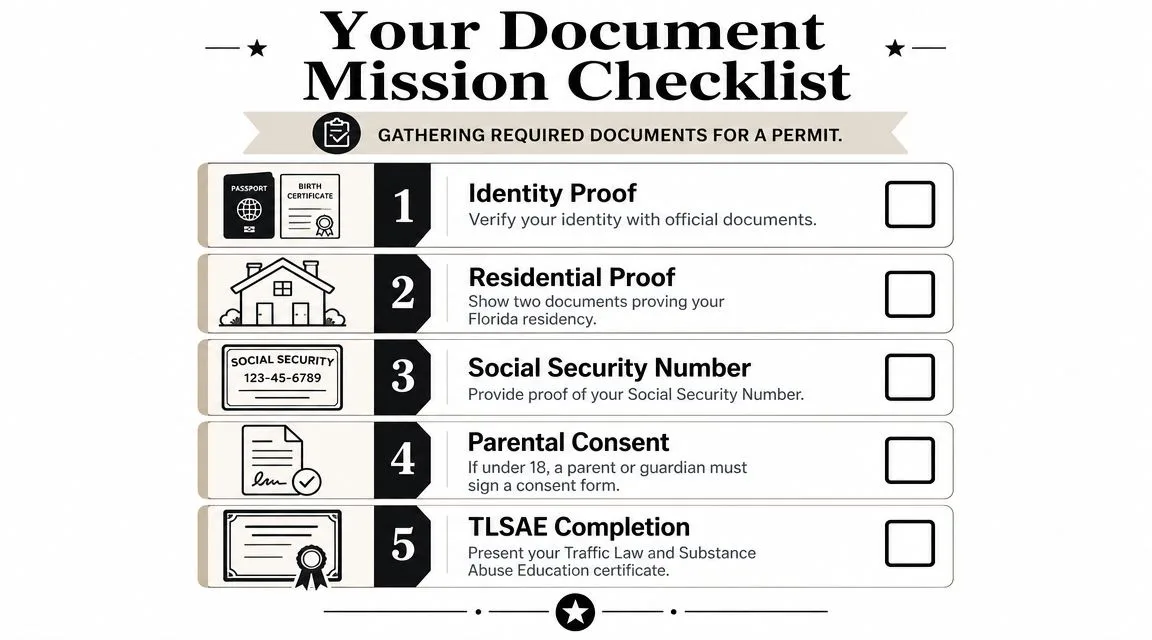
At the DHSMV, your documents do one job. They prove that the information on your application is real.
That usually means showing:
- who you are
- where you live
- your Social Security number
- parent or guardian consent, if your age requires it
- proof that you completed the required course
If even one piece is missing, your appointment can turn into a practice run instead of a finished step. That is why I tell students to build their document packet a few days early, not the night before.
Your checklist table
Use this as your working list.
| Document Category | Examples of Accepted Documents |
|---|---|
| Identity Proof | Birth certificate, passport, or other official identity record |
| Residential Proof | Mail, school or household records, or other documents showing Florida residence |
| Social Security Number | Social Security card or another accepted record showing your number |
| Parental Consent | Signed consent from a parent or guardian if required for your age |
| TLSAE Completion | Proof that you completed the required traffic law and substance abuse education course |
The exact documents can vary by situation, so do a final check against a Florida-specific list before you leave home. This guide on what to bring to the Florida DMV for your permit appointment helps families review the packet without guessing.
How to organize your packet
Order matters more than students expect.
Put your identity document on top. Keep residency papers together in one small stack. Place your Social Security proof behind those. If a parent or guardian needs to sign or appear, keep that paperwork easy to reach too. Then keep your course completion proof in its own sleeve or folder pocket.
That setup saves time at the counter and lowers stress because you are not digging through a backpack while the clerk waits.
If you completed a state-approved course through BDISchool, keep your confirmation details handy along with the rest of your paperwork. Students who prepare this packet while they finish their course usually feel much calmer on appointment day because they are handling the learning step and the paperwork step at the same time.
What confuses families most
A few points trip people up again and again.
- Copies versus official documents. Some items may need to be original or certified, not a casual photocopy.
- Residency proof. Families often know their address but are unsure which papers the state accepts as proof.
- Course records. Students sometimes finish the course but forget to keep the completion information easy to access.
- Last-minute prep. Rushing makes simple mistakes much more likely.
If your family recently moved or you are comparing rules across states, be careful not to mix them together. Florida has its own document standards.
A clean, organized folder changes the whole feel of this step. Instead of hoping everything works out, you show up knowing you brought what the state asked for.
The Smart Way to Complete Your TLSAE Course
The TLSAE course is one of the first major boxes to check.
If you’re getting a Florida permit for the first time, this course is part of the process. You may also hear people call it the DATA course. Same idea. It covers traffic law, substance abuse awareness, and the basics new drivers need before moving forward.
Why this step is easier online
For most students, the smartest approach is simple. Take the course online, finish it at a steady pace, and avoid adding more stress to your DMV day.
That matters because early wins build momentum. Once this requirement is done, the whole permit journey feels more real and more manageable.
Here’s what to look for in a course provider:
- State approval so the course is recognized for Florida requirements
- Self-paced access so you can work around school, sports, or family schedules
- Clear explanations instead of dry legal language
- Simple completion process so you’re not chasing paperwork afterward
One Florida option is the Traffic Law and Substance Abuse Education course, which is designed for online completion.
How to get more out of the course
A lot of students treat TLSAE like a box to check. That’s a mistake.
Use it as your first round of permit test preparation.
When you pay attention during the course, you’re not just satisfying a requirement. You’re building familiarity with Florida driving rules, risky behaviors, and the mindset behind safe decision-making. That makes the written test feel less like a cold start.
The course works best when you study it like a future driver, not like someone clicking through screens.
A calmer way to finish it
If you tend to get test anxiety, break the course into smaller sessions. Take notes on signs, right-of-way rules, and anything that feels unfamiliar. Write down the parts you’d want explained by a driving instructor in plain English.
That turns the course into a study guide you created for yourself.
It also helps parents. Instead of asking, “Did you finish it?” they can ask, “What did you learn about Florida road rules today?” That keeps the focus on preparation, not pressure.
Common mistakes to avoid
Some students make this harder than it needs to be.
- Rushing through with no note-taking leaves you with less to review later.
- Waiting too long to start creates a bottleneck when you’re ready for the permit.
- Assuming the course and the test are unrelated misses a valuable study advantage.
- Treating it like a formality wastes one of the easiest preparation tools in the process.
Get this done early, take it seriously, and the next step becomes much less intimidating.
Preparing to Ace the Florida Knowledge Test
This is the part that gets into students’ heads.
They say, “What if I blank out?” or “What if the questions are trickier than I expect?” Usually, the main issue isn’t ability. It’s that they haven’t been shown how to study for a driving test efficiently.
What the test feels like
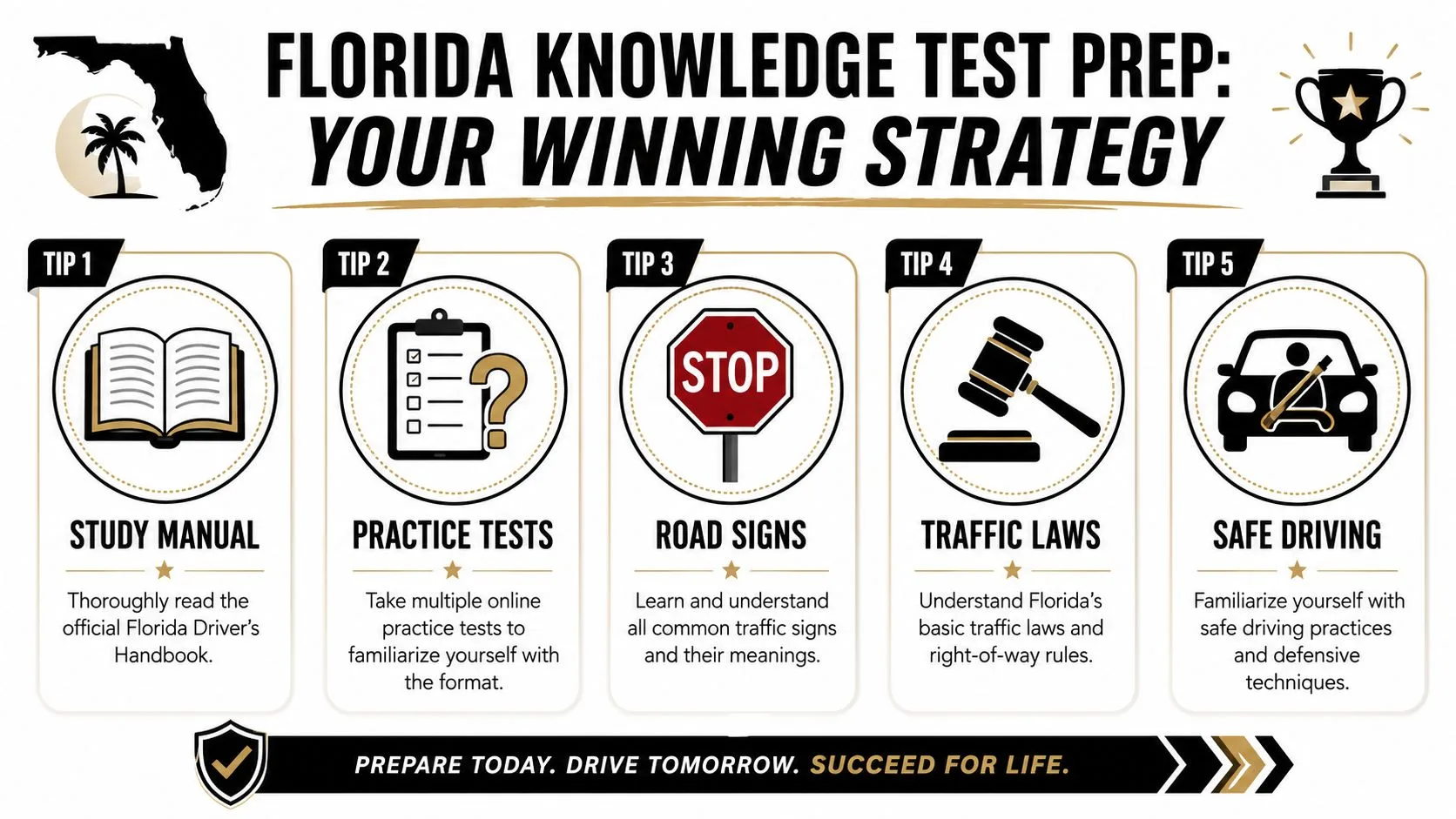
The Florida permit knowledge test is commonly understood as a written-style exam covering road rules and road signs. Students usually don’t struggle because every question is hard. They struggle because they study too broadly, too passively, or too late.
The cure is structure.
A focused study routine works better than reading randomly. If you want extra help building a study system, Vivora’s guide on test preparation has useful ideas on pacing, review habits, and staying calm under pressure.
Your study plan
Break your prep into a few buckets instead of one giant study session.
- Road signs first because they’re visual and easier to memorize in short bursts.
- Rules of the road next so you understand who goes first, when to stop, and how to react.
- Practice questions after that so you can spot weak areas.
- Final review at the end for the rules you keep missing.
If you want targeted practice, use a Florida-specific resource like this Florida DMV permit practice test.
Here’s a quick visual refresher before you study further:
Smart ways to remember more
Don’t just reread. Interact with the material.
Try these:
- Say sign meanings out loud when you review them.
- Group similar signs together such as warning signs, regulatory signs, and guide signs.
- Turn missed questions into flashcards instead of just moving on.
- Explain a rule to someone else. If you can teach it with ease, you probably understand it.
Study for recognition and judgment. The test isn’t only asking what a sign looks like. It’s asking whether you know what to do.
What to do the day before
Keep it light.
Read your notes. Do a short review. Avoid panic-cramming late into the night. Students who do best usually walk in with steady confidence, not mental exhaustion.
And if you’re nervous, that’s okay. Nervous doesn’t mean unprepared. It usually means you care.
Navigating Your DHSMV Appointment
Appointment day feels big, but it gets easier when you know the rhythm of it.
It’s similar to arriving for a road lesson. You don’t need to be fearless. You just need to know what’s coming next.
Before you leave home
Do one final document check.
Put everything in order. Bring the documents you organized earlier, and make sure they’re the versions you need. If you’re trying to avoid long waits, this guide on the best day and time to go to DMV can help you plan more strategically.
A simple night-before checklist helps:
- Documents packed
- Course completion confirmed
- Parent or guardian ready if needed
- Appointment details saved
- Good sleep and a decent breakfast
What the visit usually feels like
Most students picture chaos. In reality, the experience is usually a sequence of straightforward steps.
You arrive, check in, wait for your turn, and then move through the tasks tied to your permit application. That may include document review, a vision screening, testing steps, and your photo.
The hardest part for many students isn’t the testing. It’s the uncertainty of not knowing what will happen in what order.
A calm walkthrough
Here’s the mental script I’d give a student:
You walk in with your folder. When called, you hand over your documents. The clerk reviews them. If everything is in order, you move forward instead of trying to solve a paperwork problem on the spot.
Then you complete the remaining required steps for your permit path. If you’ve prepared well, the appointment feels less like an obstacle and more like a confirmation of work you already did.
Walk in organized, and the appointment becomes a process. Walk in guessing, and it becomes a stress test.
Day-of behavior that helps
Small habits make a difference.
- Answer questions clearly instead of rushing.
- Read screens carefully during any testing step.
- Don’t panic if something takes time. Waiting isn’t failure.
- Keep your attention on your task instead of comparing yourself to everyone else in the room.
Students who stay steady often perform better because they leave less room for avoidable mistakes.
Life with a Learner’s Permit and Your Next Steps
Getting your permit feels like the finish line for about one day.
Then real learning begins.
A learner’s permit gives you the chance to practice under supervision and build habits that stay with you long after the road test. That’s why this stage matters so much. You’re not just earning driving privileges. You’re shaping your driving judgment.
The rules you’ll live with
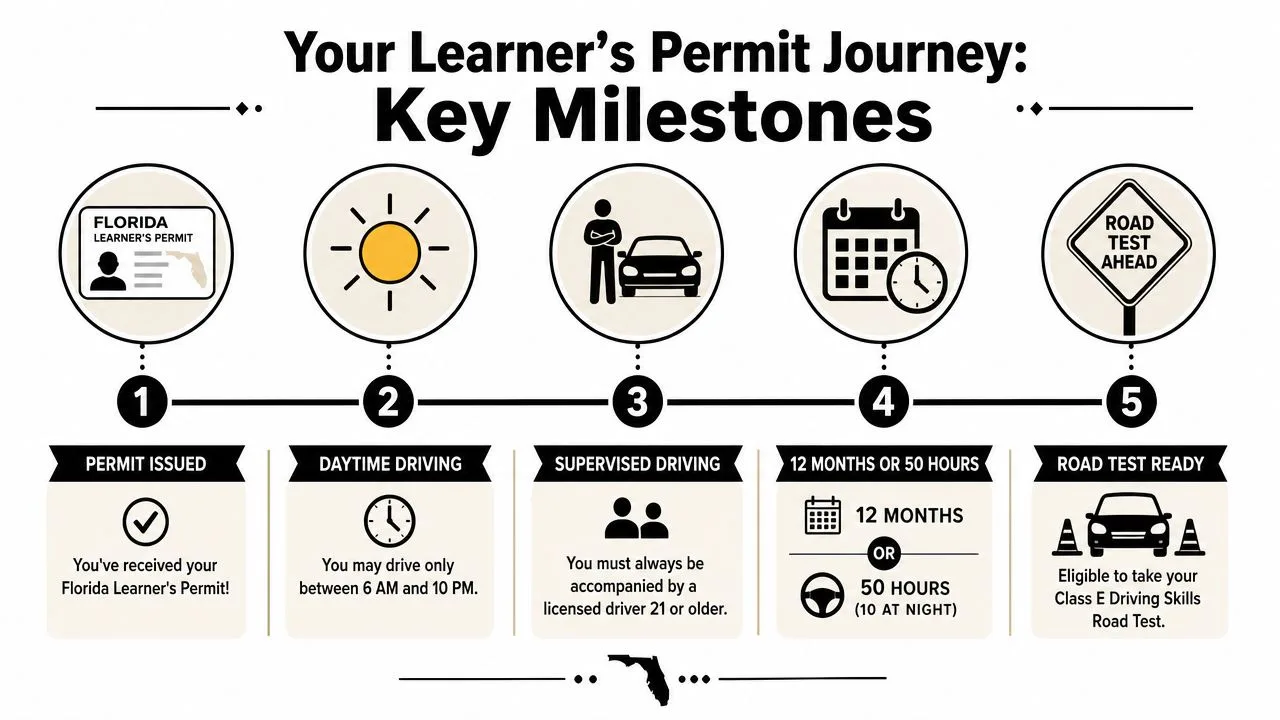
A learner’s permit comes with restrictions. In general, you must drive with a licensed adult in the front seat, and your driving hours are limited according to the permit stage described in the milestone graphic above.
Those rules aren’t there to annoy you. They create a safer practice window while you’re learning how to scan traffic, judge speed, and handle real road situations.
Why practice quality matters
Some families think permit practice is only about putting in time.
It’s not. Good practice has structure.
Try building your sessions like this:
- Start in low-stress areas such as quiet neighborhoods or empty parking lots where appropriate.
- Move to traffic gradually once steering, braking, and turns feel natural.
- Practice at different times of day so you experience changing road conditions.
- Review mistakes calmly afterward instead of turning every drive into a lecture.
That approach helps new drivers improve without freezing up.
The milestone mindset
The broader permit world offers a useful reminder about why permits matter. Building permits are a strong leading indicator because permit timing often comes shortly before actual work begins. The National Association of Home Builders notes that nearly half of single-family homes start in the same month the permit is issued, and more than 90% begin within two months. For multifamily housing, about one-third start in the same month and roughly 80% begin within two months, according to NAHB’s starts and permits overview.
Your learner’s permit works the same way in spirit. It isn’t the destination. It’s the signal that active driving development starts now.
What comes after the permit
You’ll spend this phase building supervised experience, learning from mistakes while the stakes are lower, and preparing for the next licensing step.
That’s where many students benefit from formal instruction. A structured driver education program can help translate random practice into deliberate skill-building, especially if a new driver feels anxious, inconsistent, or unsure how to improve.
The goal isn’t just to move on from the permit. It’s to become the kind of driver who’s safe, observant, and ready for independence.
Florida Learner’s Permit FAQ
Can I get a permit as soon as I want to drive?
You can apply once you meet Florida’s permit requirements. For many teens, the hardest part is not the rule itself. It is realizing that wanting to drive and being eligible to start are two different things. Check your age, confirm the required steps, and treat the process like lining up for a road test. You want every piece in place before your turn comes.
Do I need to finish the TLSAE course before my permit process moves smoothly?
Yes. Completing the TLSAE course early makes the rest of the process much easier. It gives you a clear starting point, cuts down on last-minute stress, and helps you understand why Florida has these rules in the first place.
Students who handle this step early usually feel more in control. That is one reason many families choose BDISchool. A state-approved online course lets you work at your own pace and check off one major permit requirement without rushing.
Is the written test the hardest part?
For many first-time drivers, yes. The good news is that it usually feels hard for a simple reason. Students try to memorize everything at once.
A better approach is to study in smaller pieces. Learn signs first. Then rules of the road. Then practice with questions that simulate the actual test. It works like building driving skill in a parking lot before heading onto a busy street. A calm, repeatable routine beats cramming almost every time.
Can I take the knowledge test online or at a DHSMV location?
That depends on your situation and the testing option available to you. What matters more is being ready for the format you choose.
If you test online, make sure you understand the setup and rules ahead of time. If you test at a DHSMV office, give yourself extra time and bring everything you need. In either case, strong preparation matters more than the room where you answer the questions.
What usually causes permit delays?
Incomplete paperwork is one of the most common reasons. A missing document can turn one trip into two, which is frustrating when you were ready to finish that day.
The fix is simple. Use a checklist and review every document before your appointment. Broader permitting systems work the same way. Missing items often send an application back for another review, as noted earlier. Your permit process is much easier when your paperwork is complete the first time.
What if I feel too nervous to start?
That feeling is normal. Nervous does not always mean unprepared. It often means the process still feels unfamiliar.
A good plan lowers anxiety. Break the permit process into small jobs: course first, study plan next, documents after that, appointment last. Each completed step gives you proof that you are making progress. Many new drivers relax once they stop treating the permit as one giant obstacle and start treating it as a series of manageable turns.
After I get my permit, am I basically done?
Your permit is your practice license. It means the learning now shifts from reading about driving to doing it with supervision.
That stage matters a lot. You are building habits, judgment, and confidence one drive at a time. The goal is not only to qualify for the next license step. It is to become the kind of driver who stays calm, scans ahead, and makes safe decisions without panic.
What’s the most important takeaway?
Prepare in order and keep it simple. Confirm you qualify, complete the course, study with a plan, gather your documents carefully, and arrive organized. Students who do that usually feel less stressed and give themselves a better shot at passing the first time.
If you want a simpler path through the Florida permit process, BDISchool is a practical place to start. You can choose a state-approved online course, study at your own pace, and take one major source of permit stress off your plate before appointment day.