You probably landed here right after one of three things happened. You got a ticket in Raleigh, your lawyer or the court told you to take a class, or you’re trying to cut your insurance bill without wasting money on the wrong course.
Here’s the straight answer. A defensive driving class Raleigh NC can absolutely help, but only if you pick the right class for the right reason and finish the paperwork after you pass. Most drivers mess up one of those two parts. They sign up for a course that doesn’t match their need, or they complete the class and never submit the certificate where it counts.
I’ve watched that mistake for years. The class itself is the easy part. The decision, the timing, and the follow-through are what matter in Wake County.
Should You Take a Defensive Driving Class in Raleigh?
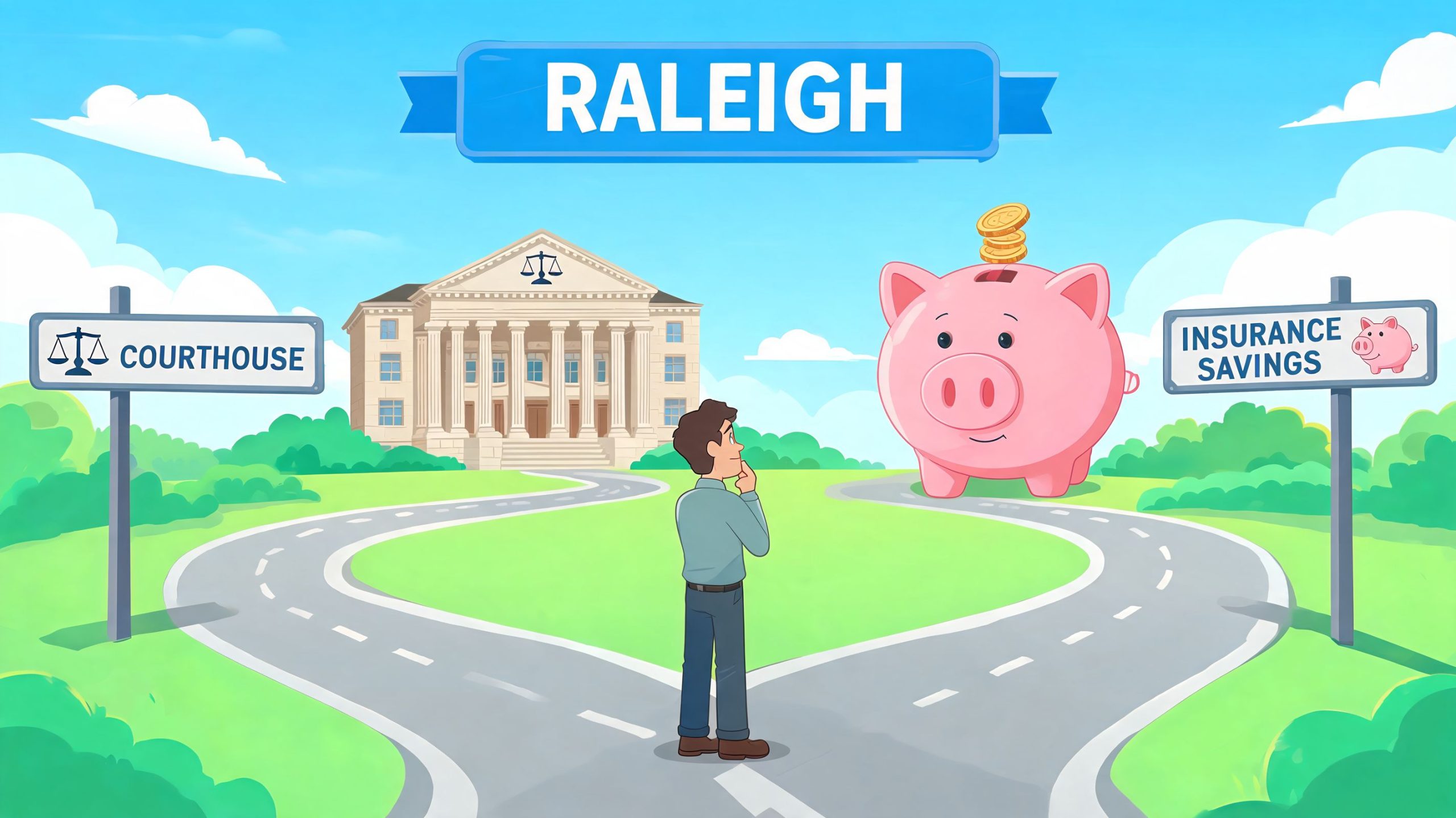
You get a ticket in Raleigh, check your mail a day later, and suddenly you are sorting through court dates, insurance questions, and bad advice from three different people. Here is the right way to look at it. Take a defensive driving class only if it solves a specific problem on your Wake County case or your insurance policy.
When it makes sense for a ticket
For Raleigh drivers, the class usually makes sense in two situations. You need it for a court-related reason, or you qualify to reduce DMV points under North Carolina rules.
North Carolina does have specific eligibility rules. To qualify for point reduction, you must have at least seven points on your record, you cannot have completed a similar course within the past five years, and completing the course removes three points. If you use a 4-hour course and then get another violation within three years, the next eligible course requirement is 8 hours, according to North Carolina defensive driving eligibility rules.
That is why I tell drivers in Wake County to stop guessing. Before you register, pull your driving record, read every line on your citation or court notice, and make sure the class matches the reason you are taking it. Raleigh drivers lose time and money when they sign up first and ask questions later.
Use this filter:
- Court or attorney told you to take a class: Confirm the exact course they will accept.
- You want DMV point reduction: Check that you meet the state eligibility rules before you pay.
- You want lower premiums: Treat insurance savings as a separate issue from court or DMV benefits.
Practical rule: A course that helps with insurance is not automatically the course you need for court or DMV purposes.
When it makes sense for insurance
Plenty of Raleigh drivers take a class with no ticket involved. That can be a smart move if your carrier will honor the certificate and the discount is large enough to justify the cost.
Call your insurer before you enroll. Ask one direct question: “If I complete this exact course, will you apply a discount to my current policy, and how long will it last?” That answer matters more than any sales page.
For a general overview, defensive driving course benefits covers the common reasons people sign up. The local reality is simpler. In Raleigh, the class is worth it only when you can tie it to a clear result. Better court positioning. Fewer DMV points. Verified insurance savings.
My recommendation
If you got cited in Raleigh, start with your paperwork and your record. If you are trying to save on insurance, start with your carrier and get the discount terms in writing or by email.
Do not start with ads, promo codes, or the fastest checkout page. That is how Wake County drivers end up with a certificate that does not help where they need it most.
Finding a State-Approved Course in Wake County
You got a ticket in Raleigh, searched for a defensive driving class, and now every provider claims to be accepted. That is where drivers in Wake County make expensive mistakes. They sign up first, then learn the class does not match what the court, the DMV, or their insurer needed.
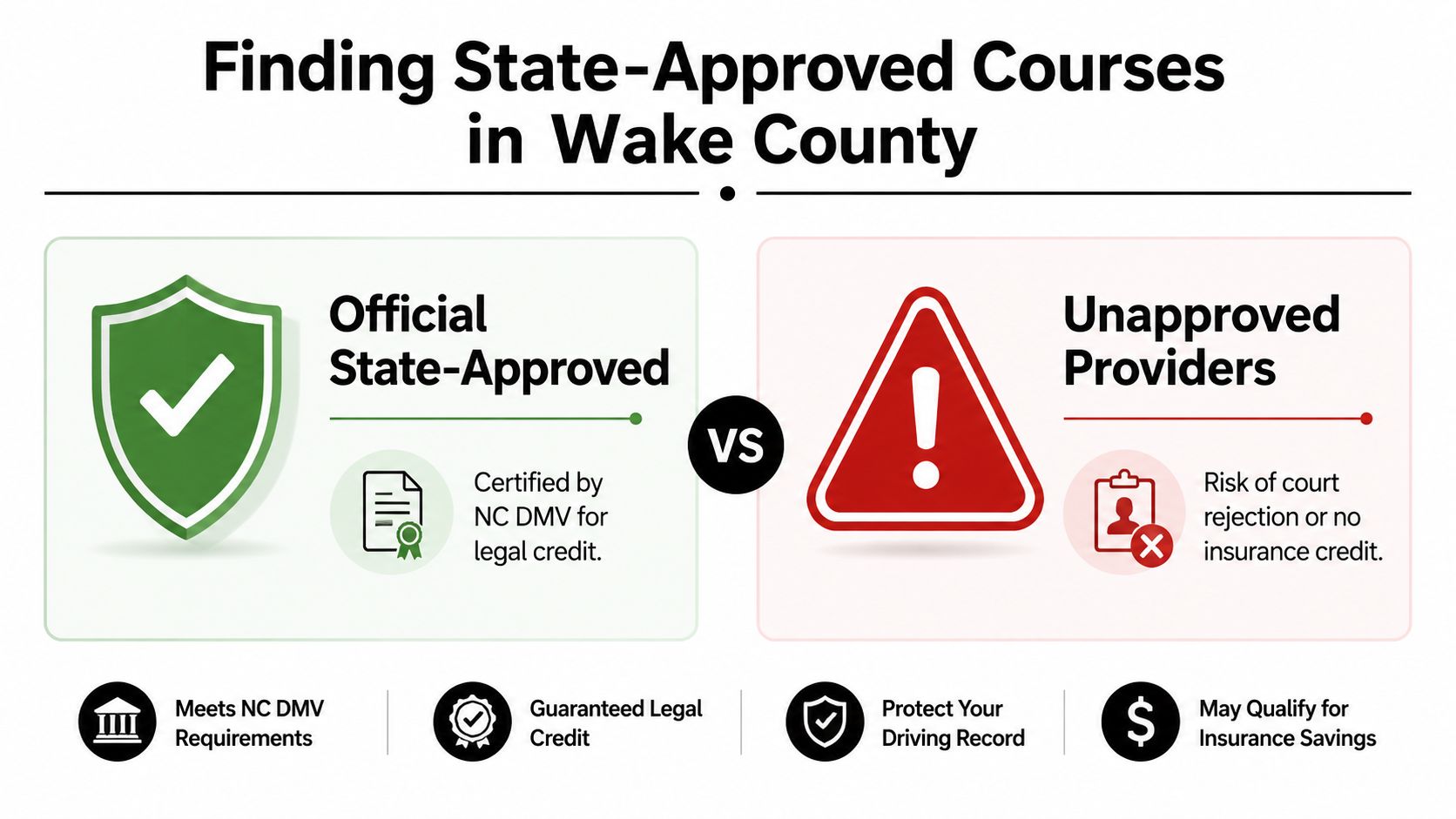
The right course is the one that fits your exact goal. In Wake County, that means checking acceptance before you pay, not after. If your case touches court, DMV points, or insurance pricing, treat those as separate boxes to verify.
What to verify before you register
Ask these questions in this order:
| What to confirm | Why it matters in Raleigh | What to ask |
|---|---|---|
| Court acceptance | Wake County case handling is specific. A legitimate class can still be useless for your citation. | “Will this certificate work for my Wake County traffic matter?” |
| DMV relevance | A class does not automatically change your driving record or point status. | “Is this the correct course for my DMV situation?” |
| Insurance acceptance | Carriers set their own discount rules and may limit which course formats they honor. | “Will you apply a discount for this exact course and certificate?” |
If a provider cannot answer those questions clearly, do not give them your money.
How to judge a course provider fast
Start with transparency. A serious provider tells you what the course is for, how the class is delivered, how long it takes, and what completion proof you receive. If the website is heavy on sales language and light on approval details, move on.
For online options, review approved online traffic school options and compare them against your actual need, not just price or speed.
Local Raleigh drivers should also pay attention to practical details that generic articles skip. Does the provider understand Wake County deadlines? Do they explain how fast your certificate is issued? Do they tell you whether you need to send the certificate yourself or keep it for insurance records? Those details matter more than a coupon code.
Online versus in-person in Wake County
Choose the format that gives you the best chance of finishing correctly and on time.
Online classes work well for drivers with work, childcare, or irregular schedules. They also make sense if you are organized and can complete the course without waiting until the last day.
In-person classes are better for drivers who want structure and direct answers. They are often the safer choice if you are anxious about a recent ticket and do not want to guess whether you are meeting the right requirement.
My recommendation is simple. If your goal is tied to a Raleigh ticket, choose clarity over convenience. If your goal is only an insurance discount, you have more room to pick the format that fits your schedule.
Your Enrollment and Course Completion Checklist
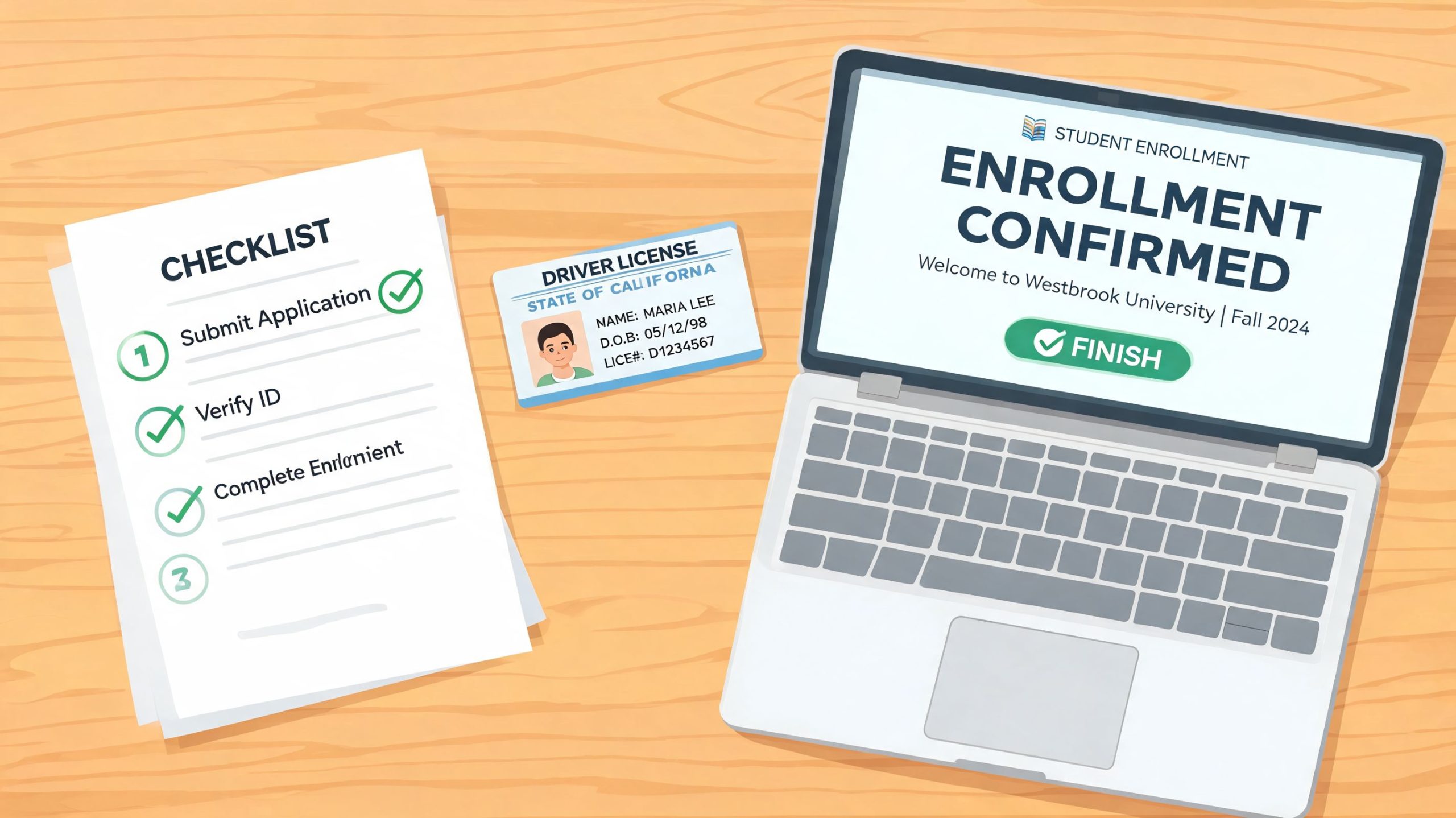
You get the ticket, put off the class for a week, then another week, and suddenly your Wake County deadline is close and you are guessing your way through registration. That is how drivers create avoidable problems.
Treat enrollment like paperwork, not a shopping trip. Get your details right the first time, finish the course early, and keep proof of everything.
What to gather before you enroll
Set these items in front of you before you start the signup form:
- Your license and full legal name. The course record needs to match your ID and, if applicable, your court paperwork.
- Your ticket or case documents. Keep the citation number, court date, and any Wake County paperwork visible while you register.
- A payment method that works. Do not start, stop, and come back later if you are already close to a deadline.
- Your completion target date. Give yourself enough time to finish the class and get the certificate issued.
That last point is where Raleigh drivers get burned. Finishing on the deadline is often too late if the certificate still has to be processed, downloaded, mailed, or submitted.
What to expect while you are taking the course
A standard defensive driving class usually covers traffic laws, hazard recognition, speed control, following distance, distracted driving, and decision-making behind the wheel. The useful courses also force you to slow down and pay attention instead of clicking through slides half-awake.
Some providers require quizzes during the course and a final exam before they issue a certificate. Do not assume the passing score is the same everywhere. Read the course instructions before you begin, not after you fail the final screen and realize you have to repeat part of the program.
If you are taking the class online, review the provider’s rules for identity checks, time requirements, and certificate release. This online driving certificate guidance will help you understand what proof you should receive and what to save for your records.
Use this checklist and you will avoid the usual mistakes
- Register early enough to leave room for delays. A rushed course is where errors happen.
- Enter your name exactly as it appears on your license. Do not use nicknames, shortened names, or old address information if the form asks for current details.
- Keep your case information nearby. If the class is tied to a citation, you need to match the certificate to the right record later.
- Complete every section. Incomplete modules, missed quizzes, and timed-out sessions can delay certification.
- Pass the required tests. Read the questions carefully. Drivers fail these more often than they admit because they rush.
- Save your completion confirmation immediately. Screenshot it, download it, print it, and email it to yourself.
- Confirm how the certificate is issued. Downloadable, emailed, mailed, or sent by the provider. Get the answer before you log off.
- Store the certificate where you can find it fast. If Wake County, the DMV, or your insurer asks for it, you do not want to dig through old emails.
One more point for families with younger drivers. Teen skill-building programs are different from standard defensive driving classes for tickets or insurance. The BRAKES program at the NC State Highway Patrol Training Center gives young drivers hands-on practice in panic braking, crash avoidance, and vehicle control, and WRAL’s featured BRAKES report on YouTube says participants were 64% less likely to crash in their first three years of driving (WRAL-featured BRAKES report on YouTube).
For a Raleigh ticket or insurance discount, stick with the approved course you chose and finish it correctly the first time. That is the part that saves money and headaches.
Submitting Your Certificate for Maximum Benefit
You finish the course on Sunday night, toss the certificate in your email, and assume the hard part is over. Then Wake County has no record of it, or your insurance renewal shows the same premium. I see that mistake every week.
A defensive driving class only pays off after the right office gets the certificate and posts it to the right file. In Raleigh, that means being precise. Names, citation numbers, policy numbers, and deadlines need to match.
For court or DMV purposes
If your class connects to a Wake County ticket, DMV point issue, or a request from your attorney, verify the filing process before your court date. Do not assume the school sends the certificate for you. Some providers file it. Some only email it to you. Some mail a paper copy and stop there.
Use this process:
- Confirm who files it. Ask the provider whether they send the certificate directly to the court, your lawyer, or the DMV, or whether you must send it yourself.
- Match the certificate to the case. Use the exact name on the citation, plus the citation number or court reference listed on your paperwork.
- Keep proof. Save the email, upload receipt, fax confirmation, or mailing receipt.
- Call to confirm it posted. In Wake County, clerical delays happen. A two-minute follow-up call can save you a wasted trip or a missed benefit.
If you want a quick refresher on the driving habits these courses are supposed to reinforce, review these defensive driving techniques after you submit the paperwork.
For insurance savings
Insurance discounts work the same way. No submission, no discount.
According to North Carolina defensive driving insurance discount details, most North Carolina drivers can expect a 10% to 20% premium reduction for 3 years after completing a course. The same source says major carriers commonly accept approved programs and notes potential savings of over $150 annually on an average policy, but only after you send in the certificate and the carrier applies the discount.
Here is the checklist I recommend:
| Step | What to do | Why it matters |
|---|---|---|
| 1 | Call your agent or carrier | Confirm the course qualifies under your policy |
| 2 | Send the certificate right away | The discount does not start until they process it |
| 3 | Ask for the effective date | Some companies apply it mid-term, others at renewal |
| 4 | Review your declarations page | That is where you confirm the credit was added |
My advice: Stay on the call until the agent tells you what they need, where to send it, and when the discount should appear.
A quick walkthrough can help if you’re unsure what paperwork flow usually looks like:
The mistake I see most often
Drivers treat completion as the finish line. It is not.
The finish line is confirmation. Confirm the court received it. Confirm your insurer applied it. Then keep a copy of the certificate with your case paperwork and policy documents, because Raleigh drivers often need it again when questions come up later.
Making Your New Driving Skills Stick
The certificate matters once. The habits matter every day after that.
The strongest defensive driving courses focus on four core skills: anticipatory scanning, spatial management, velocity control, and right-of-way decision-making, as outlined by most defensive driving methodology.
The four habits that actually prevent repeat tickets
Anticipatory scanning means looking far enough ahead to catch trouble before you’re forced into a bad reaction. In Raleigh traffic, that means noticing brake lights building up well ahead of you instead of reacting to the bumper directly in front of your hood.
Spatial management means protecting your cushion of space. If someone cuts in, rebuild the gap calmly. Don’t turn one aggressive driver into your emergency.
Velocity control is smoother than commonly believed. It’s not just about not speeding. It’s about avoiding abrupt surges, late braking, and unnecessary acceleration that put you in bad positions.
Right-of-way decision-making is where a lot of avoidable crashes start. If you’re not sure who should go, don’t force the issue to prove a point.
A practical Raleigh routine
Use this on your next week of driving:
- Before moving: Set your phone out of reach or silence it.
- At every major intersection: Ask yourself, “Who can do something dumb here?”
- On beltline traffic: Watch several vehicles ahead, not just one.
- When frustrated: Back off the gas before you touch the horn.
Good defensive driving is boring on purpose. Smooth inputs, early decisions, and fewer surprises.
How to keep the course from fading out
Review one skill each day for a week. Monday, focus on scanning. Tuesday, following distance. Wednesday, speed changes. Thursday, yielding decisions.
That simple rotation works because it keeps the material active instead of turning the class into a one-day memory dump. If you want a deeper refresher on real-world application, defensive driving techniques can help you turn course concepts into habits.
Raleigh Defensive Driving FAQ
Do I need a class if I only want an insurance discount?
Yes, if your insurer requires a recognized course for the discount. No, if your insurer doesn’t offer one or won’t accept the provider you choose.
Call first. Ask about the exact course, the certificate format, and how to submit it. That saves a lot of wasted effort.
What if the court gave me a deadline?
Treat the deadline as fixed unless the court tells you otherwise. Register immediately, confirm the course length, and ask how fast the certificate is issued after completion.
If you’re already close to the deadline, don’t rely on assumptions. Contact the court or your attorney and confirm what they’ll accept and when they need proof.
Can I take any online course and use it for Wake County?
No. Some online courses are fine for insurance purposes but not necessarily for the result you want in court or with the DMV.
That’s why verification comes first. Match the course to the reason you’re taking it.
How do I know if my certificate was actually used?
Don’t guess. Confirm with the receiving party.
For court-related matters, verify that the certificate was received and connected to your file if that option is available. For insurance, check with your agent and review your updated policy documents or declarations page.
Is in-person better than online?
Not automatically. In-person is often better for drivers who want structure and immediate answers. Online is often better for drivers with tight schedules who will finish the work.
The best format is the one that is both accepted for your purpose and realistic for your life.
Can I take a class before I ever get a ticket?
Yes, for insurance purposes that can make sense. Plenty of drivers do it proactively. The mistake is waiting until after a renewal notice arrives and then scrambling.
If you’re trying to save money, ask your insurer what they accept before you enroll.
What if I already took a class recently?
That can matter a lot for point-related use. If your goal involves point reduction, prior course completion can affect eligibility. Check your record and confirm the timing before paying for another class.
What’s the biggest mistake Raleigh drivers make?
Many drivers believe completing the course itself is the final step. It is not. The true conclusion occurs when your certificate is officially accepted by the court, DMV, or insurance company requiring the documentation.
That’s the part to stay obsessive about.
If you want a flexible, straightforward way to handle traffic school and defensive driving education online, BDISchool is worth a look. Their courses are built for drivers who need clear instruction, simple completion steps, and reliable certificate handling without unnecessary hassle.