Preparing for a Florida defensive driving course test, whether to dismiss a ticket, lower your insurance rates, or simply become a safer driver, can feel daunting. The key to success isn’t just memorizing rules; it’s about understanding the real-world scenarios behind them and how to apply proactive driving strategies. This comprehensive guide breaks down the most critical topics you will encounter on your exam.
We have compiled a thorough collection of defensive driving test questions and answers that mirror what you’ll find in certified Florida traffic school courses, like those offered by BDISchool. This roundup is structured to give you more than just correct answers. You will gain a deeper understanding through detailed explanations, common pitfalls to avoid, and actionable tips rooted specifically in Florida’s unique traffic laws and road conditions.
This resource is designed to be your ultimate study companion. We will cover eight essential areas of defensive driving, providing you with the knowledge and confidence needed to ace your test. From mastering the 3-second following distance rule on a congested I-95 to correctly navigating a busy four-way stop in downtown Miami, the insights here will prepare you for the exam. More importantly, they will equip you to be a more confident, aware, and proactive driver on Florida’s bustling roads. Let’s dive into the essential concepts that will help you pass your test and enhance your driving skills for years to come.
1. Safe Following Distance – The 3-Second Rule
One of the most common topics on any defensive driving test is the concept of maintaining a safe following distance. In Florida, the gold standard for this is the 3-Second Rule. This rule is a simple, yet highly effective method to ensure you have enough space between your vehicle and the one ahead of you to react to sudden hazards and stop safely. It is a cornerstone of the curriculum at BDISchool because it directly prevents one of the most frequent types of collisions: rear-end crashes.
Understanding and applying this rule is critical. It moves beyond simply guessing the distance in feet and provides a dynamic measurement that automatically adjusts for your current speed.
How to Apply the 3-Second Rule
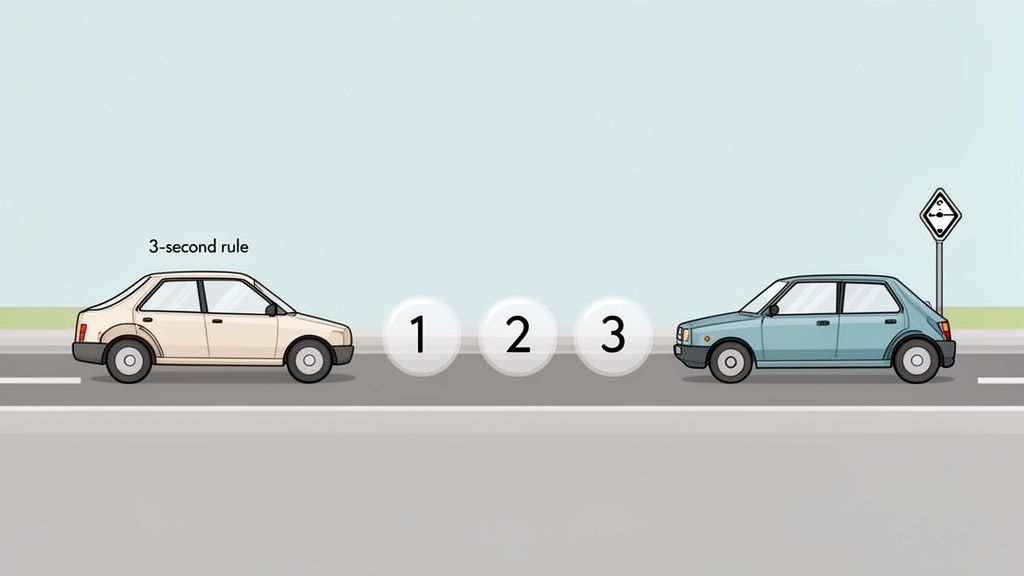
Implementing this technique is straightforward. First, watch the vehicle in front of you pass a fixed object on the side of the road, like a sign, a bridge overpass, or a distinct tree. As soon as the rear of that vehicle passes the object, begin counting: “one-one-thousand, two-one-thousand, three-one-thousand.”
If the front of your car reaches that same fixed object before you finish counting to three, you are following too closely. You should ease off the accelerator and allow more space to open up. This simple count represents the minimum time needed for an average driver to perceive a hazard, react, and apply the brakes effectively under ideal conditions.
Adjusting for Florida’s Driving Conditions
The 3-second rule is a baseline, not an absolute. Defensive driving test questions and answers often include scenarios where you must increase this distance.
- Adverse Weather: During a typical Florida afternoon downpour or when roads are wet, double the time to at least six seconds. Reduced traction significantly increases your vehicle’s stopping distance.
- Heavy Traffic: In stop-and-go traffic on I-4 or I-95, increasing your following distance helps prevent chain-reaction collisions and provides a smoother driving experience.
- Night Driving: Limited visibility at night means you need more time to identify and react to potential road hazards.
- Large Vehicles: When following trucks or buses that can obstruct your view of the road ahead, leave extra space.
Mastering this concept is essential for both passing your test and becoming a safer driver. While some refer to it differently, the core principle remains the same. You can find a deeper analysis of similar concepts by exploring the differences between the two-second rule and the three-second standard taught in Florida courses.
2. Right-of-Way and Turning Responsibilities (Four-Way Stops and Intersections)
A significant portion of any defensive driving test will focus on right-of-way rules at intersections. These regulations, governed by Florida Statutes Chapter 316, provide a clear, predictable order for traffic flow, preventing confusion and collisions. At BDISchool, we emphasize that mastering these rules is non-negotiable for driver safety, as intersections are hotspots for serious accidents, particularly in busy cities like Miami and Orlando.
Understanding the hierarchy of who proceeds first is a fundamental skill. It’s not about being aggressive; it’s about being predictable and safe. These rules dictate everything from how to handle a four-way stop to executing a left turn against oncoming traffic, and they are frequently covered in defensive driving test questions and answers.
How to Apply Right-of-Way Rules
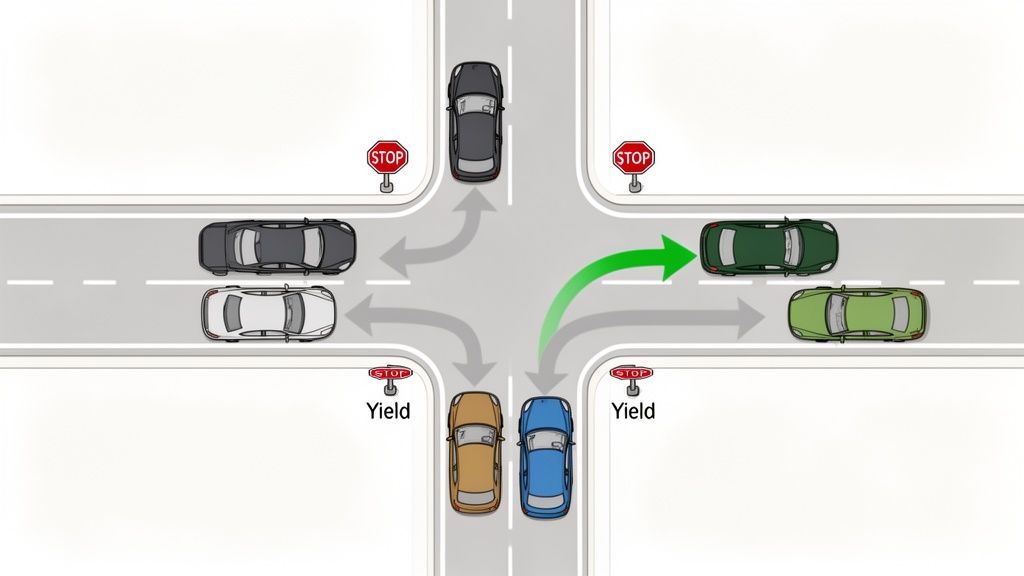
The core principle is simple: the first vehicle to arrive at a stop sign is the first to proceed. When two or more vehicles arrive simultaneously, the vehicle on the right has the right-of-way. This rule prevents dangerous standoffs and ensures a smooth flow of traffic.
For turns, the rules are just as clear. A vehicle turning left must always yield to oncoming traffic that is proceeding straight or turning right. This is because left turns cross over a lane of traffic, creating a high-risk situation. For instance, a Jacksonville driver attempting to “beat” oncoming traffic when making a left turn is a classic example of a preventable collision caused by failing to yield.
Navigating Common Florida Intersection Scenarios
Florida’s diverse and often congested roadways present unique challenges. Defensive driving test questions will likely quiz you on these specific situations.
- Four-Way Stops: At a Coral Gables four-way stop, if cars arrive at the same time, the driver going straight or turning right has priority over a driver turning left. If both are going straight, the car on the right goes first. Understanding who has the right-of-way is critical at intersections, especially at four-way stops, where misjudgment often leads to collisions. For a detailed look at state-specific right-of-way rules for four-way stops, it’s beneficial to consult legal resources.
- Protected vs. Unprotected Turns: A green arrow signifies a “protected” turn, meaning you have the right-of-way. A solid green light indicates an “unprotected” turn, requiring you to yield to all oncoming traffic and pedestrians before proceeding.
- Pedestrians: Always yield to pedestrians in a crosswalk, whether it is marked or unmarked. Before and during any turn, scan the crosswalks to ensure they are clear. An Orlando driver striking a pedestrian because they failed to look is a tragic, yet common, preventable incident.
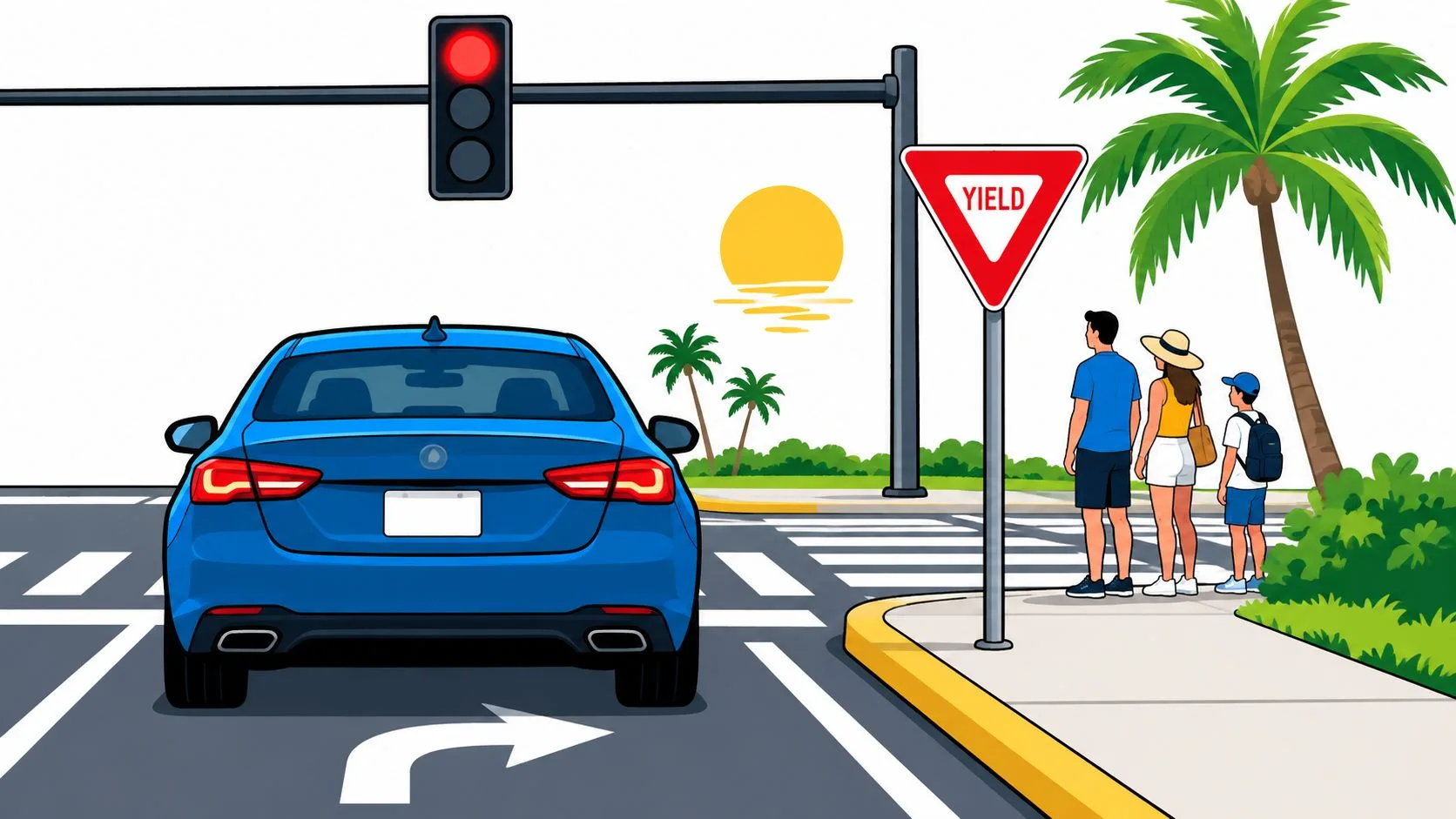
- Right on Red: You may turn right on a red light after coming to a complete stop, unless a sign prohibits it. You must yield to all traffic and pedestrians with a green light before you proceed.
Knowing these rules is essential for passing your test and, more importantly, for safe driving. BDISchool offers a comprehensive breakdown of these scenarios, helping you to understand the nuanced right-of-way rules at intersections.
3. Identifying and Avoiding Aggressive Drivers
A significant portion of defensive driving test questions and answers focuses on handling one of the most unpredictable road hazards: aggressive drivers. Aggressive driving is defined as operating a vehicle in a way that endangers or is likely to endanger people or property. It encompasses behaviors like excessive speeding, tailgating, cutting off other drivers, and improper gesturing. Learning to recognize and safely respond to these actions is a core competency taught at BDISchool, particularly in our specialized Aggressive Driver Course.
This skill is not just about avoiding confrontation; it is a critical safety strategy to prevent high-risk situations from escalating into collisions or road rage incidents. Your primary goal as a defensive driver is to create distance and disengage from these individuals to protect yourself and your passengers.
How to Identify and Respond to Aggressive Drivers
Recognizing the warning signs is the first step. Look for vehicles making erratic lane changes, speeding far beyond the flow of traffic, or following others dangerously closely. For example, a driver in Tampa tailgating at 75 mph on I-4 is a clear sign of aggression. Your defensive response should be immediate and calm. Slow down slightly, move to the right lane when it is safe, and allow them to pass.
The key is to de-escalate, not challenge. A driver in Miami who was cut off at an intersection correctly chose not to engage when the other driver gestured angrily, preventing a minor conflict from becoming a dangerous road rage event. Never respond to aggression with more aggression.
Defensive Strategies for Aggressive Encounters
Defensive driving tests often present scenarios requiring you to choose the safest response. The correct answer almost always involves de-escalation and creating space.
- Do Not Engage: Avoid making eye contact or returning aggressive gestures. This can be interpreted as a challenge and may worsen the situation.
- Let Them Pass: Your priority is safety, not teaching someone a lesson. If a driver is tailgating you, even in the fast lane, move over and let them by. Arriving two minutes later is far better than being involved in a preventable crash.
- Maintain Your Space: Keep your doors locked and windows at least partially up when stopped in traffic. This creates a physical barrier between you and a potentially volatile driver.
- Report If Necessary: If a driver is behaving in a way that presents a clear danger to public safety, pull over when it is safe and report their license plate, vehicle description, and location to law enforcement.
These strategies are a central part of the BDISchool Aggressive Driver Course, where court-ordered drivers learn to manage triggers and de-escalate tense situations on the road.
4. Impaired Driving Recognition and Response
A critical component of any defensive driving curriculum involves identifying and reacting to impaired drivers. Florida law is particularly strict on this issue, and test questions often focus on a driver’s ability to recognize erratic behavior and respond safely. Understanding the signs of impairment from alcohol, drugs, or even extreme fatigue is a life-saving skill that BDISchool emphasizes in its course modules.
Recognizing an impaired driver allows you to take proactive steps to protect yourself and others on the road. It’s not about confrontation; it’s about creating distance, staying safe, and alerting the proper authorities to prevent a potential tragedy.
How to Identify an Impaired Driver
An impaired driver often displays a distinct pattern of dangerous and unpredictable actions. Defensive driving test questions and answers will expect you to know these common indicators. Look for vehicles that are weaving within their lane, drifting into other lanes, or straddling the center line.
Other major red flags include driving at speeds significantly slower or faster than the flow of traffic, making abrupt or illegal turns without signaling, and stopping for no apparent reason in a traffic lane. For example, a driver on I-75 near Tampa at 2 AM who is swerving and braking erratically is exhibiting classic signs of impairment that a defensive driver must recognize immediately.
Responding Safely and Effectively
Your priority when encountering a suspected impaired driver is your own safety. Do not attempt to pass them, get their attention, or engage with them in any way. Instead, focus on creating as much space as possible between your vehicle and theirs.
- Increase Following Distance: If you are behind them, slow down and increase your following distance dramatically, to at least eight to ten seconds. This gives you ample time to react if they stop suddenly.
- Do Not Pass: Passing an impaired driver is risky, as they could swerve into your lane without warning. It is safer to stay back and let them move further ahead.
- Pull Over to Report: When it is safe to do so, pull over and call 911 or the Florida Highway Patrol (*FHP). Provide the dispatcher with the vehicle’s location, direction of travel, a brief description (make, model, color), and the license plate number if you can read it safely.
- Describe the Behavior: Clearly explain the specific actions you observed, such as “weaving across three lanes” or “nearly hitting the median.” This information is vital for law enforcement.
Mastering these response strategies is crucial for road safety in Florida, where FLHSMV data shows that early reporting of impaired drivers is a key factor in preventing accidents.
5. Distracted Driving – Avoiding Cell Phones and In-Vehicle Distractions
Distracted driving has become one of the most significant dangers on modern roads, and questions about it are a major component of any defensive driving test. In Florida, with laws like the ban on texting while driving (Florida Statute 316.305), understanding this topic is non-negotiable. Distracted driving is any activity that diverts attention from the primary task of driving. BDISchool dedicates significant course material to this subject because it is a leading and entirely preventable cause of accidents and fatalities statewide.
Understanding the real-world impact is critical. It’s not just about taking your eyes off the road for a second; it’s about the cognitive, visual, and manual impairments that result. These distractions dramatically reduce a driver’s ability to perceive and react to hazards in time.
The Three Types of Distractions
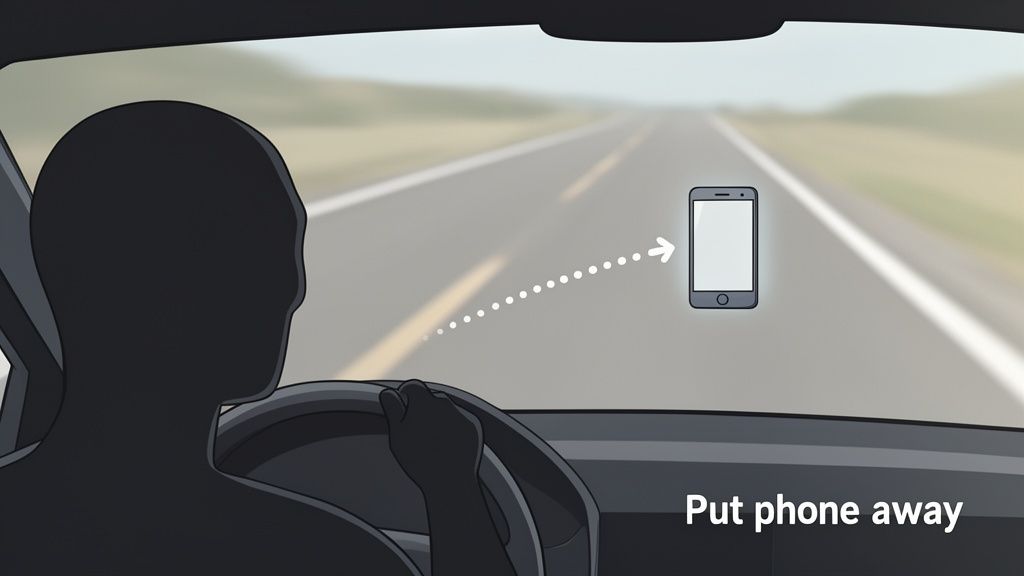
Defensive driving courses categorize distractions into three main types. Often, a single action like texting involves all three, making it exceptionally dangerous.
- Visual: Taking your eyes off the road. Examples include looking at a GPS, a passenger, or a cell phone screen.
- Manual: Taking your hands off the wheel. This includes eating, adjusting the radio, or holding a phone.
- Cognitive: Taking your mind off of driving. This is the most deceptive type and can happen even with hands-free devices, as your mental focus is on a conversation rather than the road.
A driver in Miami checking a text message at 55 mph can travel the length of a football field completely blind. This illustrates how a seemingly minor distraction can have catastrophic consequences.
How to Practice Undistracted Driving in Florida
The key to avoiding these dangers lies in preparation and discipline. Defensive driving test questions and answers will focus on your knowledge of proactive strategies.
- Prepare Before You Drive: Set your GPS destination, choose your music playlist, and finish any food or drinks before you put the car in drive.
- Silence Your Phone: Put your phone on silent or use a “Do Not Disturb While Driving” mode. Place it out of sight and reach to remove the temptation entirely.
- Pull Over Safely: If a call, text, or other issue is urgent, find a safe place to pull over and park before addressing it. It is never safe to handle these situations while in motion.
- Limit Passenger Distractions: While conversations are normal, avoid deep or stressful discussions that pull your focus from the road. Ask passengers to assist with navigation or other tasks.
- Understand Hands-Free is Not Risk-Free: While legally permissible, hands-free phone calls still create a significant cognitive distraction. Keep these calls brief and avoid them whenever possible.
Mastering the habit of focused driving is as important as any other skill taught in a BDI School course. By recognizing and eliminating distractions before they arise, you protect yourself, your passengers, and everyone else on Florida’s roads.
6. Weather Conditions and Reduced Visibility Adjustments
A significant portion of defensive driving test questions and answers focuses on adapting to adverse weather, a daily reality for Florida drivers. From sudden afternoon thunderstorms to seasonal fog, understanding how to adjust your driving is non-negotiable for safety. This topic is a core component of the BDISchool curriculum because Florida’s unpredictable climate is a major contributing factor in thousands of preventable accidents each year.
Successfully navigating these conditions means recognizing that your vehicle’s capabilities are severely limited. Wet roads reduce tire grip, fog slashes visibility, and darkness conceals hazards. A defensive driver proactively changes their behavior before a situation becomes critical, rather than reacting to a loss of control.
How to Adjust for Poor Conditions
The first step is accepting that posted speed limits are for ideal, dry conditions. When visibility drops or roads become slick, your primary responsibility is to reduce speed and increase following distance significantly. For example, a driver on I-4 near Orlando during a heavy downpour should safely reduce their speed from 65 mph to around 45 mph and extend their following distance from three to at least eight seconds.
Similarly, a driver encountering thick fog on the Sunshine Skyway Bridge must immediately turn on their low-beam headlights (high beams reflect off fog and worsen visibility), slow down by at least 15-20 mph, and listen for other traffic. These proactive adjustments are what separate a safe driver from one who becomes a statistic.
Critical Adjustments for Florida’s Climate
Defensive driving test questions will often present scenarios requiring specific actions. Committing these adjustments to memory is essential for both the test and real-world safety.
- Reduce Speed Immediately: For rain, slow down by 10-20 mph. For heavy fog or severe downpours, a reduction of 20-35 mph may be necessary.
- Increase Following Distance: The 3-second rule is a minimum. Double it to six seconds for wet roads and increase it to eight seconds or more in heavy rain or fog.
- Improve Visibility: Turn on your headlights as soon as visibility is compromised, not just at dawn or dusk. This makes you more visible to others.
- Avoid Cruise Control: This feature can cause your wheels to spin if you hydroplane, leading to a complete loss of vehicle control on wet surfaces.
- Handle Standing Water: After driving through a deep puddle, gently tap your brakes to help dry the rotors and ensure they function properly.
- Know When to Stop: If visibility becomes so poor that you cannot see the edge of the road or other vehicles, pull off the road completely, turn off your driving lights, and turn on your emergency flashers.
Mastering these skills is crucial. BDISchool offers a comprehensive guide for driving in adverse conditions that details these techniques further, helping you prepare for any weather Florida throws your way.
7. Understanding Blind Spots and Mirror Adjustment
A significant portion of defensive driving test questions and answers will focus on managing the areas around your vehicle that you cannot see in your mirrors. These “blind spots” are danger zones responsible for countless lane-change and merging collisions on Florida’s busy highways. At BDISchool, we emphasize that mastering mirror adjustment and head checks is not just a test-passing technique, it’s a fundamental survival skill for every driver.
Properly managing these areas involves more than a quick glance. It requires a proactive system of setting up your mirrors to minimize blind spots and consistently using physical head turns to verify that the path is clear before making any lateral movement.
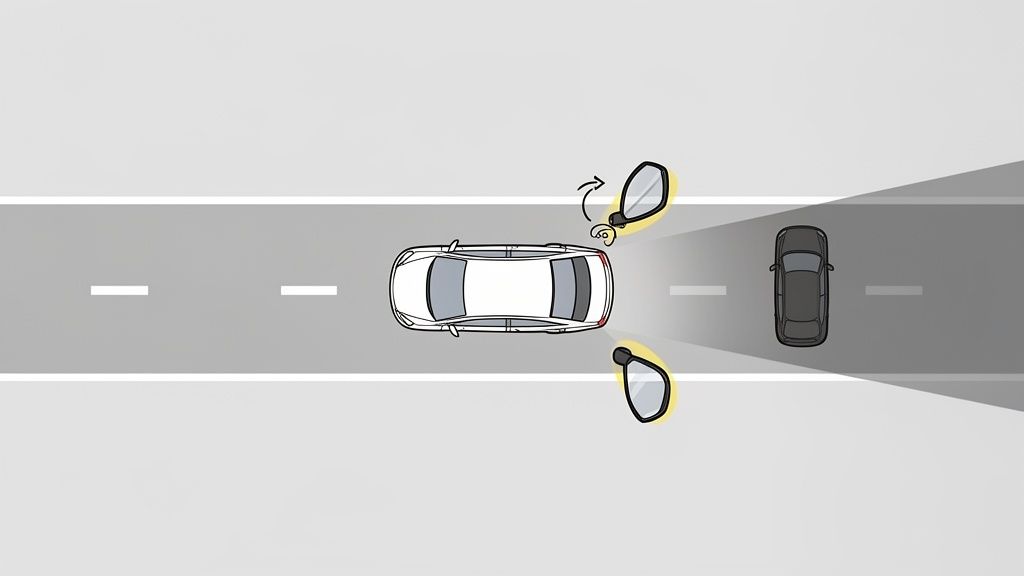
How to Properly Adjust Mirrors and Check Blind Spots
The goal is to create a panoramic view around your vehicle with minimal overlap between your mirrors. The Society of Automotive Engineers (SAE) method is the standard taught in modern defensive driving courses. To set your mirrors this way, lean your head until it almost touches the driver’s side window and adjust the left mirror so you can just barely see the side of your car. Then, lean to the center of the car and do the same for the right mirror.
This setting drastically reduces the size of your blind spots. However, it does not eliminate them. The critical final step before any lane change, merge, or turn is the shoulder check: a quick, physical turn of your head to look into the area your mirrors don’t cover. For instance, on I-75 near Tampa, a driver changing lanes without this quick head turn could easily strike a vehicle hidden from view.
When to Be Extra Cautious of Blind Spots
While checking your blind spot is always necessary before moving sideways, certain situations demand heightened awareness.
- Highway Merging: When entering a busy road like the Florida Turnpike, check your blind spot twice: once as you approach the merge point and again just before you fully enter the lane.
- Driving Beside Large Vehicles: Trucks, buses, and RVs have massive blind spots. A defensive driver avoids lingering in these “no-zones” and passes them decisively.
- Night Driving: Reduced visibility at night can make it harder to spot vehicles in your blind spots. To further boost your nighttime safety and reduce dangerous headlight glare for safer night driving, consider learning more about how features like Auto Dimming Mirrors can help.
- Multi-lane Turns: In complex intersections, vehicles can easily slip into your blind spot as you navigate the turn.
Understanding this topic is essential. For more techniques, BDISchool offers a comprehensive guide on how to properly check blind spots while driving.
8. Proper Braking Techniques and Anti-Lock Brake Systems (ABS) Operation
Understanding how to brake correctly, especially in an emergency, is a fundamental skill that defensive driving tests frequently cover. The key to effective braking lies in knowing whether your vehicle is equipped with an Anti-Lock Brake System (ABS). This technology, now standard on most modern cars, fundamentally changes the proper technique for stopping quickly and safely, making it a critical topic in BDISchool’s curriculum.
Proper braking is about more than just slowing down; it’s about maintaining control of your vehicle when you need it most. Applying the wrong technique during a panic stop can lead to skidding, loss of steering control, and a collision that could have otherwise been avoided.
How to Apply Proper Braking Techniques
The correct method depends entirely on your vehicle’s braking system. For cars with ABS, the process is designed to be straightforward and effective, even for an inexperienced driver. The system prevents the wheels from locking up, which is what causes a vehicle to skid.
If your vehicle has ABS, the emergency braking procedure is to stomp, stay, and steer. Stomp firmly on the brake pedal, stay on the pedal with consistent, hard pressure, and steer around the hazard. You may feel the brake pedal pulsate or vibrate under your foot; this is the ABS working as intended and is not a sign of brake failure. Conversely, if you are driving an older vehicle without ABS, you must pump the brakes gently if you feel the wheels start to lock up to prevent skidding.
Braking Scenarios in Florida
Defensive driving test questions and answers often present real-world scenarios to test your knowledge. For instance, a Tampa driver on a rain-slicked I-275 who needs to stop suddenly will rely on their ABS. By applying steady, hard pressure, they maintain steering control and stop safely. In contrast, a driver in a non-ABS vehicle who slams on the brakes in the same situation might experience wheel lockup, lose steering, and skid.
- Vehicles with ABS: Apply firm, continuous pressure to the brake pedal. Do not pump the brakes, as this will interfere with the system’s operation. Trust the pulsating feeling and focus on steering.
- Vehicles without ABS: If you feel the wheels lock and begin to skid, release brake pressure slightly and then reapply with a gentle pumping motion until you come to a stop.
- Hydroplaning: It’s crucial to remember that ABS does not prevent hydroplaning. The best defense against hydroplaning in a Florida downpour is to slow down and avoid sudden maneuvers.
Mastering your vehicle’s braking system is non-negotiable for safe driving. BDISchool data highlights that drivers who understand and practice proper ABS operation are significantly better equipped to handle unexpected emergencies on the road.
8-Point Defensive Driving Q&A Comparison
| Topic | Implementation Complexity 🔄 | Resource Requirements ⚡ | Expected Outcomes ⭐ | Ideal Use Cases 📊 | Key Advantage / Quick Tip 💡 |
|---|---|---|---|---|---|
| Safe Following Distance – The 3-Second Rule | Low — easy to learn, requires constant attention | Minimal — practice and situational awareness | ⭐ High — greatly reduces rear-end collisions and increases reaction time | Highways, everyday driving, adjust for rain/fog/night | 💡 Use a fixed landmark and count “1-one thousand…3” — add seconds for adverse conditions |
| Right-of-Way & Turning Responsibilities (Four-Way Stops/Intersections) | Medium — rules vary by scenario and require judgment | Low — knowledge, observation, clear signaling | ⭐ High — prevents T-bone and pedestrian collisions | Urban intersections, four-way stops, protected/unprotected turns | 💡 When unsure, yield to the vehicle on your right; make eye contact when possible |
| Identifying & Avoiding Aggressive Drivers | Medium — recognize behaviors and apply de-escalation | Moderate — training, awareness, ability to relocate or document | ⭐ High — reduces risk of road-rage incidents and confrontations | High-traffic urban areas, highways, when confronted by tailgaters/cutters | 💡 Avoid eye contact, let them pass, document details if needed |
| Impaired Driving Recognition & Response | Medium — subtle signs require trained observation | Moderate — observation, phone/reporting ability, documentation | ⭐ High — can prevent DUI-related crashes and save lives | Night driving, weekends/holidays, long empty roads | 💡 Increase distance, never confront; report location, vehicle description, plate to 911 |
| Distracted Driving — Cell Phones & In-Vehicle Distractions | Low — behavioral change and simple tech settings | Low — phone DND, set GPS before driving, habit training | ⭐ High — markedly improves reaction time and lowers crash risk | All drivers; especially novice/young drivers and urban settings | 💡 Enable “Do Not Disturb While Driving” and set navigation before departure |
| Weather Conditions & Reduced Visibility Adjustments | Medium — requires judgement and variable adjustments | Moderate — vehicle maintenance (wipers/tires), time to slow down | ⭐ High — significantly lowers weather-related crashes (hydroplaning, low visibility) | Rain, fog, heavy wind, night driving, coastal bridges | 💡 Reduce speed 10–35 mph by condition, increase following to 6–8+ seconds, avoid cruise control |
| Understanding Blind Spots & Mirror Adjustment | Low — learn SAE mirror method + habitual head checks | Low — time to adjust mirrors and practice shoulder checks | ⭐ High — prevents sideswipe/merging collisions | Lane changes, merging, multi-lane highways, parking | 💡 Use SAE mirror setup and always perform a quick shoulder check before lane changes |
| Proper Braking Techniques & ABS Operation | Medium — differentiate ABS vs non-ABS and practice emergency braking | Moderate — hands-on practice, familiarity with vehicle systems | ⭐ High — improves stopping control and steering during emergencies | Emergency stops, wet/slippery roads, downhill grades | 💡 For ABS: apply steady firm pressure and steer; for non-ABS: pump brakes gently to avoid lockup |
From Practice Questions to Road-Ready Confidence
Navigating through this comprehensive list of defensive driving test questions and answers is more than just a study session; it’s a foundational step toward transforming your on-road habits. We’ve broken down critical concepts, from mastering the 3-second following distance to understanding the nuances of right-of-way at four-way stops. Each question you reviewed is a building block for a stronger, more proactive driving mindset.
The true goal isn’t merely to memorize answers for an exam. It’s about internalizing the principles behind them so they become second nature. When you encounter an aggressive driver, you won’t just recall the textbook response; you’ll instinctively create space and de-escalate. When rain slicks the pavement, you’ll automatically double your following distance and reduce your speed without a second thought. This is the transition from theoretical knowledge to practical, life-saving skill.
Key Takeaways: Proactive Driving in Practice
Mastering the content covered in these defensive driving test questions and answers empowers you to shift from a reactive driver to a proactive one. Let’s recap the core pillars of this transformation:
- Space Management is Survival: The 3-second rule isn’t just a guideline; it’s your primary defense against rear-end collisions. Consistently maintaining this cushion gives you the time and space needed to react to sudden stops or unexpected hazards.
- Predictability Prevents Collisions: Properly yielding right-of-way, signaling your intentions early, and positioning your vehicle correctly removes ambiguity for other drivers. Predictable drivers are safe drivers.
- Awareness is Your Best Tool: This extends beyond just checking mirrors. It means actively scanning for potential threats, recognizing the signs of impaired or aggressive drivers, and being brutally honest about your own distractions, like cell phones.
- Adaptability is Non-Negotiable: Florida’s weather can turn in an instant. Knowing how to adjust your speed for rain, manage hydroplaning, and use your brakes effectively (especially with ABS) is a critical skill, not an optional one.
Crucial Insight: The difference between a close call and a serious accident often comes down to a split-second decision. The knowledge gained from studying these test questions directly prepares you to make the right choice when it matters most.
Your Actionable Next Steps to Driving Mastery
Knowledge is powerful, but certified knowledge is what satisfies court requirements and lowers insurance premiums. Your journey doesn’t end with this article. To truly cement these concepts and earn your official completion certificate, the next logical step is to engage with a structured, state-approved program.
Think of this guide as your pre-flight checklist. You’ve reviewed the systems and understand the theory. Now, it’s time to step into the simulator. An official course like the one offered by BDISchool takes these static questions and brings them to life with interactive modules, real-world video scenarios, and progress-tracking quizzes that ensure you don’t just know the material, but you understand it deeply. This structured learning process is designed to build lasting habits, turning test answers into instinctual safe driving practices that protect you, your passengers, and everyone else on the road.
Ready to turn your knowledge into an official certificate? BDISchool offers a 100% online, state-approved BDI course that builds directly on the defensive driving test questions and answers you’ve just reviewed, making it easy to satisfy court requirements and improve your skills. Enroll in our Florida traffic school today and take the definitive step toward becoming a safer, more confident driver.