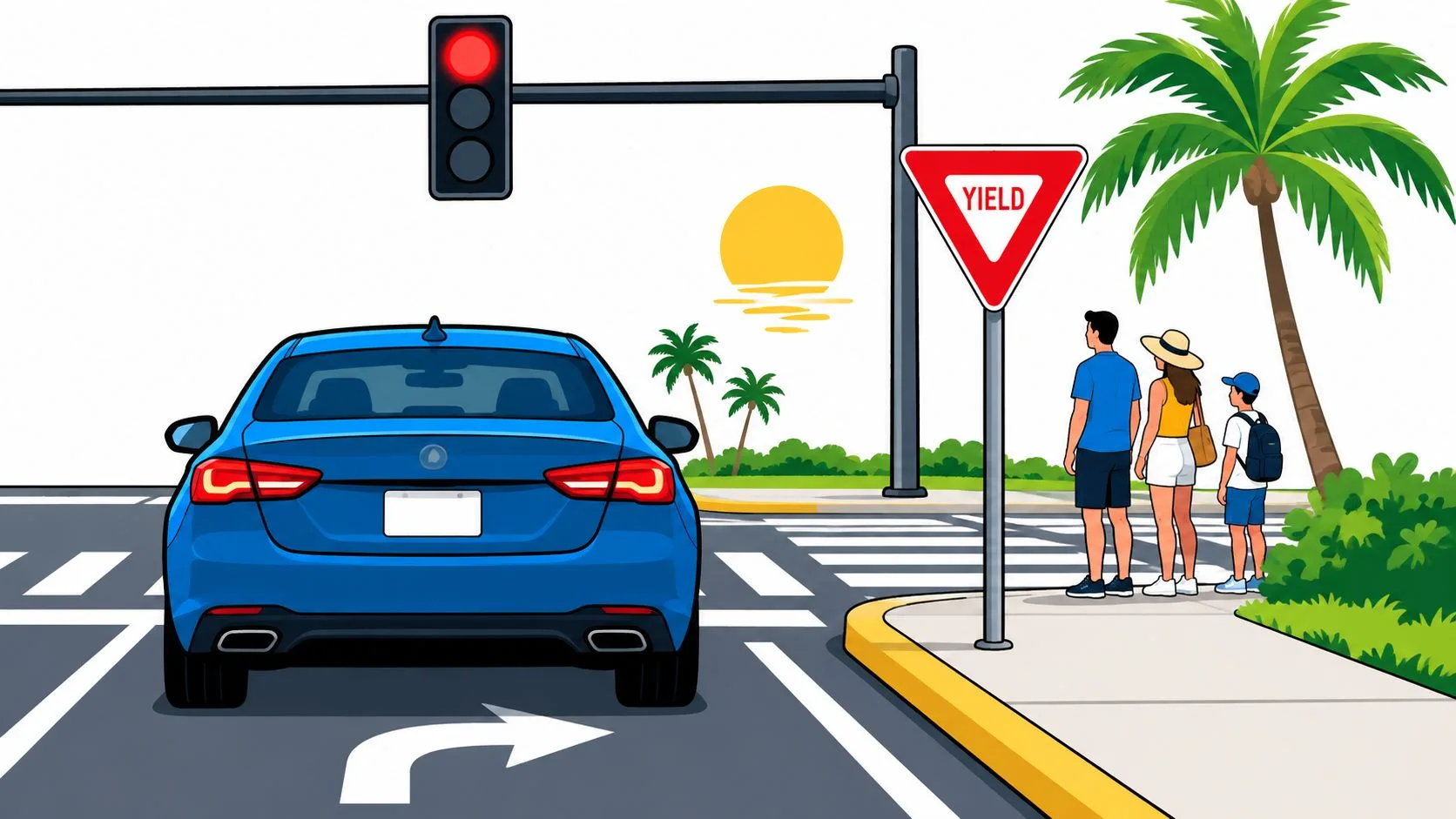
Hopping on a scooter is a fantastic way to zip around the Sunshine State, but the rules of the road aren’t always crystal clear. It can feel a little confusing at first, but it really boils down to one simple thing: what kind of scooter are you riding?
Your Quick Guide to Florida Scooter Rules
Florida law looks at scooters in two very different ways. An electric scooter is treated almost exactly like a bicycle. On the other hand, a more powerful, gas-fueled scooter is basically seen as a motorcycle.
Getting this distinction right is the key to everything. It determines the minimum age you have to be, whether you need a helmet, and even where you’re legally allowed to ride. If you get it wrong, you could be looking at fines and a major headache.
This guide will break it all down for you, starting with the basics. For a really deep dive into the specifics, this resource on electric scooter laws in Florida is a great read.
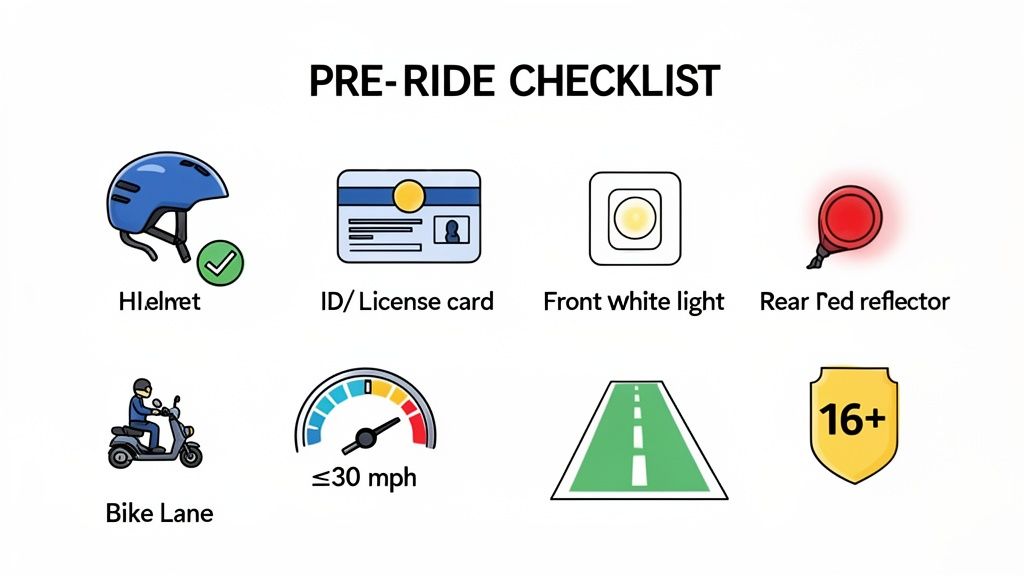
Florida Scooter Regulations at a Glance
To make it easy, here’s a quick cheat sheet covering the core rules for the two main types of scooters you’ll see on Florida roads. This table gives you a fast way to check the requirements for your ride.
| Regulation | Electric Scooter (E-Scooter) | Motorized Scooter (Gas-Powered) |
|---|---|---|
| Minimum Age | 16 years old | 16 years old |
| Driver’s License | Not required | Required (with motorcycle endorsement) |
| Vehicle Title | Not required | Required |
| Registration/Plate | Not required | Required |
| Helmet Rule | Required for riders under 16 | Required for riders under 21 (unless specific insurance is held) |
| Where to Ride | Bike lanes and streets (like bicycles) | On public roads (like motorcycles) |
As you can see, the differences are pretty stark. An e-scooter gives you a lot of freedom with minimal red tape, while a gas-powered scooter comes with the same legal duties as a full-fledged motorcycle.
Why This Matters for Every Rider
Knowing these rules isn’t just about avoiding a ticket—it’s about staying safe and being predictable to everyone else on the road. When you ride your scooter where you’re supposed to, you become a seamless part of the traffic flow, which dramatically cuts down the risk of an accident with a car, pedestrian, or another rider.
Plus, when you’re informed, you can ride with confidence. You’ll know without a doubt whether you belong in the bike lane or the main roadway and what safety gear is required by law. This kind of knowledge is a huge part of defensive driving, a skill that’s just as vital on two wheels as it is on four. Many of these safety principles are universal, and you can get a good overview in our guide to general https://bdischool.com/florida-state-driving-laws/.
The Twists and Turns That Shaped Florida’s Scooter Laws
To really get a handle on Florida’s scooter laws today, you have to look at how we got here. It wasn’t a straight path. It was a bumpy ride full of legal gray areas, courtroom arguments, and eventually, a big legislative push to catch up with technology.
The “Wild West” Era of Gas-Powered Scooters
Before you could rent an e-scooter with your phone, the streets saw the rise of gas-powered motorized scooters. For years, nobody—not riders, not even law enforcement—knew exactly what to do with them. This confusion left everyone in a tough spot.
The whole issue blew up in 2003. Then-Attorney General Charlie Crist issued a legal opinion that shook things up, declaring that anyone riding a motorized scooter on public roads needed a valid driver’s license.
His reasoning? Even though these scooters didn’t fit the classic “motor vehicle” definition in one part of the law (Chapter 316), they were still considered “vehicles” under another (Chapter 320). That meant they belonged on the road, not the sidewalk, and the person driving one had to be licensed. Court cases like State v. Riley backed this up, and just like that, the casual, unlicensed scooter ride was a thing of the past. You can dig into the specifics of that legal opinion to see just how much it framed the debate for years to come.
A New Player Enters the Game: The E-Scooter
Flash forward a decade or so, and everything changed. Dockless electric scooters from companies like Bird and Lime started popping up in cities across the country. But when they arrived in Florida, they hit the same old legal wall.
Cities like Fort Lauderdale and Miami were stuck. How were they supposed to handle this new wave of “micromobility”? The result was a messy, confusing patchwork of local rules. Fort Lauderdale, for example, flat-out banned the scooters at first, which really shined a spotlight on the clash between new tech and old laws. It was obvious the state needed to step in and create a clear, consistent set of rules.
The heart of the issue was simple: Florida law had no category for these modern e-scooters. They weren’t mopeds, and they certainly weren’t the noisy, gas-powered scooters from the early 2000s. Lawmakers had to go back to the drawing board.
This frustration is what finally sparked a major legislative change, one that would redefine getting around in Florida’s cities.
The Game-Changer: Florida’s 2019 Scooter Law
The big moment came in 2019 when the state passed House Bill 453. This law was a landmark piece of legislation that finally, officially, defined and legalized electric scooters in Florida. It brought the clarity that riders, rental companies, and local governments had been waiting for.
The law tackled three critical things:
- It Created a Clear Definition: For the first time, the law defined an “electric scooter” as a vehicle that doesn’t have a seat and can’t go faster than 30 mph.
- It Granted Riders Rights: E-scooter riders were given all the same rights—and responsibilities—as bicyclists.
- It Gave Power to Local Governments: Critically, it allowed individual cities and counties to set their own rules for scooter operations, like establishing local speed limits or deciding whether to allow riding on sidewalks.
This 2019 law ended the legal chaos. It created a solid foundation for Florida scooter laws by recognizing e-scooters as their own unique form of transportation. This history is exactly why the rules can feel so different from one city to the next—the state sets the baseline, but your local city hall gets the final say.
Scooter vs. Moped: Unpacking the Legal Definitions in Florida
In Florida, what you call your two-wheeled ride might not be what the law calls it, and that distinction is everything. Getting it wrong can lead to fines, citations, or worse. While we often use “scooter” and “moped” interchangeably, Florida Statutes see them as entirely different vehicles, each with its own set of rules.
Think of it like the difference between a golden retriever and a coyote. They might look similar from a distance, but one needs a leash and a license, while the other plays by a whole different set of rules. Understanding the legal DNA of your vehicle—its engine type, speed, and design—is the first step to staying on the right side of Florida scooter laws.
The Modern Electric Scooter
The game completely changed on June 18, 2019, when Governor Ron DeSantis signed House Bill 453 into law. This was a huge deal. Championed by Rep. Jackie Toledo and Sen. Jeff Brandes, this legislation finally legalized electric scooters statewide, clearing up years of legal fog and paving the way for shared scooter companies like Lime and Bird to operate.
So, what exactly is an electric scooter in the eyes of the law? According to Florida Statute §316.003, it’s a device with:
- Two or three wheels
- Handlebars and a floorboard to stand on
- An electric motor
- A top speed no greater than 30 mph
- No seat
That last point is a big one. This specific definition places e-scooters in a special category, treating them much like bicycles. This means you don’t need a driver’s license, registration, or a license plate. You do, however, have to be at least 16 years old to ride one.
This timeline shows how the law has scrambled to keep up with technology.
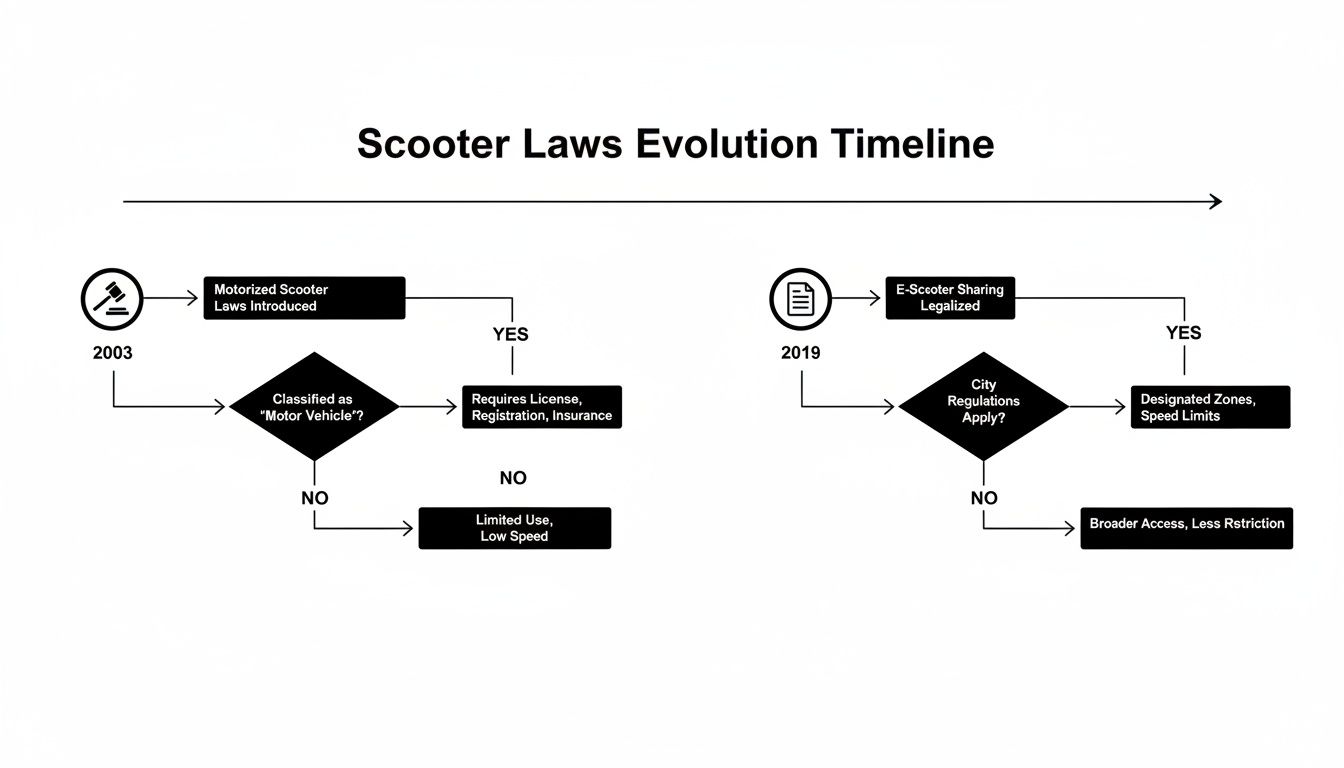
The 2019 law was a direct response to the explosion of micromobility, creating a modern legal framework for vehicles that simply didn’t exist when the old statutes were written.
The World of Mopeds and Motorized Scooters
Now, let’s switch gears. If your scooter has a gas engine or a seat, Florida law almost certainly sees it as a moped or a motorized scooter. This is a completely different legal category.
A moped is typically defined by its small engine (no more than 50cc) and a top speed of 30 mph on level ground. Push past that 50cc limit, and you’re legally riding a motorcycle, which requires a full motorcycle endorsement on your license. For mopeds, the rules get much stricter than for their electric, stand-up cousins:
- Driver’s License Required: You need at least a standard Class E driver’s license.
- Registration is Mandatory: Your ride must be registered with the state and display a license plate.
- Title is Not Required: Good news here—mopeds under 50cc don’t require a certificate of title.
It’s helpful to also understand what constitutes a Low Speed Vehicle (LSV), as this broader category helps put these smaller vehicle rules into perspective.
To make these distinctions crystal clear, here’s a simple table breaking down the key differences under Florida law.
Vehicle Classification Under Florida Law
| Feature | Electric Scooter | Motorized Scooter/Moped | Mobility Device |
|---|---|---|---|
| Power Source | Electric motor | Gas engine (up to 50cc) or electric | Electric motor |
| Top Speed | Max 30 mph | Max 30 mph | Not speed-rated for traffic |
| Seat? | No | Yes | Yes |
| Driver’s License | Not required | Class E license required | Not required |
| Registration | Not required | Required | Not required |
| Age Requirement | 16+ | 16+ | No age limit specified |
| Primary Use | Transportation | Transportation | Aiding persons with disabilities |
This table should help you quickly identify which category your vehicle falls into and what regulations you need to follow.
The biggest red flags are the presence of a seat or a gas-powered motor. If your scooter has either of these, you have to assume it falls under the tougher rules for mopeds or motorcycles, not e-scooters. This is a critical detail covered thoroughly in the official Florida driver’s manual. For a deeper dive, check out our guide covering the Florida drivers manual.
Navigating Where You Can Legally Ride
Deciding between the bike lane, the street, or the sidewalk is easily the most confusing part of riding a scooter in Florida. The answer isn’t a simple one, because it’s a mash-up of state law and local city rules. Getting this right is about more than just avoiding a ticket—it’s about keeping yourself and everyone around you safe.
The starting point is a simple, foundational principle in state law: electric scooters are treated just like bicycles. Once you get that, the rest starts to make more sense. This means you generally have the same rights and responsibilities as any cyclist out on the road.
The Street and Bike Lane: Your Primary Zones
The best way to think about your e-scooter is as a modern-day bicycle. You wouldn’t see a cyclist trying to merge onto I-95, and the same logic applies here. You should stick to roads where you can safely keep up with the flow of traffic, especially those with lower speed limits.
Under Florida law, you’re entitled to ride on any street that a bicyclist can. Bike lanes are your best friend—they give you a dedicated space, putting a buffer between you and much faster, heavier cars. If a bike lane is available, that’s where you should be. It makes your next move predictable for drivers, which is a huge factor in preventing collisions.
But what if there’s no bike lane? In that case, you can ride on the street, keeping as far to the right as is practical and safe. “Practical” is the key word here. It doesn’t mean you have to hug a curb littered with storm drains, debris, or broken pavement. Your safety comes first, and you have the right to take the lane if you need to be visible or avoid a hazard.
The goal is to operate like any other vehicle, obeying all the same traffic lights and signs. Understanding how to handle intersections is a big part of this, and you can get a good refresher by reviewing our guide on right-of-way rules at intersections.
The Sidewalk Situation: A Major Point of Confusion
This is where so many riders get tripped up. While the state treats scooters like bikes on the road, it takes a different approach for sidewalks. As a general rule, riding your scooter on the sidewalk is prohibited.
This rule is all about protecting pedestrians, who are the most vulnerable people in any public space. A scooter zipping along at 15 mph can cause serious harm to someone on foot.
Now, this ban isn’t absolute, but the exceptions are few and far between. They are entirely up to local governments.
A city or county has the authority to pass an ordinance that specifically permits scooter riding on its sidewalks. Unless you see a sign that explicitly allows it, you have to assume it’s illegal. Pleading ignorance of a local ordinance won’t get you out of a ticket.
If you remember one thing, make it this: the default answer for sidewalk riding in Florida is no.
How Local Rules Create a Patchwork of Regulations
Because the state gives cities and counties the final say on where scooters can operate, the rules can literally change from one street corner to the next. This is probably the most frustrating aspect of staying compliant with Florida scooter laws.
Let’s look at a few real-world examples:
- Miami: The city has had ongoing issues with sidewalk riding, which has led to tough enforcement and specific “no-ride zones” in busy areas like Bayside. In these geofenced areas, rental scooters might even slow to a crawl or shut down completely.
- Orlando: In the downtown core, scooters are expected to be in bike lanes or on the street. The city has also established “dismount zones” where you have to get off and walk your scooter on the sidewalk.
- Tampa: With its growing network of bike lanes, Tampa actively encourages scooter use but remains firm on its ban against sidewalk riding in the dense downtown area to protect pedestrians.
These examples highlight why a one-size-fits-all approach just doesn’t work. It’s your responsibility to know the rules before you ride. A quick search on a city’s official website for “scooter ordinance” or “micromobility” is all it takes to avoid a fine and ride with confidence.
Essential Safety Gear and Rider Rules
Knowing where you can legally ride your scooter is half the battle. The other half? Understanding the on-the-road rules and what safety gear you need to have. Following these Florida scooter laws isn’t just about dodging a ticket—it’s about keeping yourself and everyone around you safe. The state has some very clear, non-negotiable standards here.
Think of it this way: these rules are the basic language of the road. When you follow them, your actions are predictable and safe for drivers, pedestrians, and other riders. Ignoring them just creates confusion and dials up the risk of a serious accident.
Age Limits and Helmet Laws
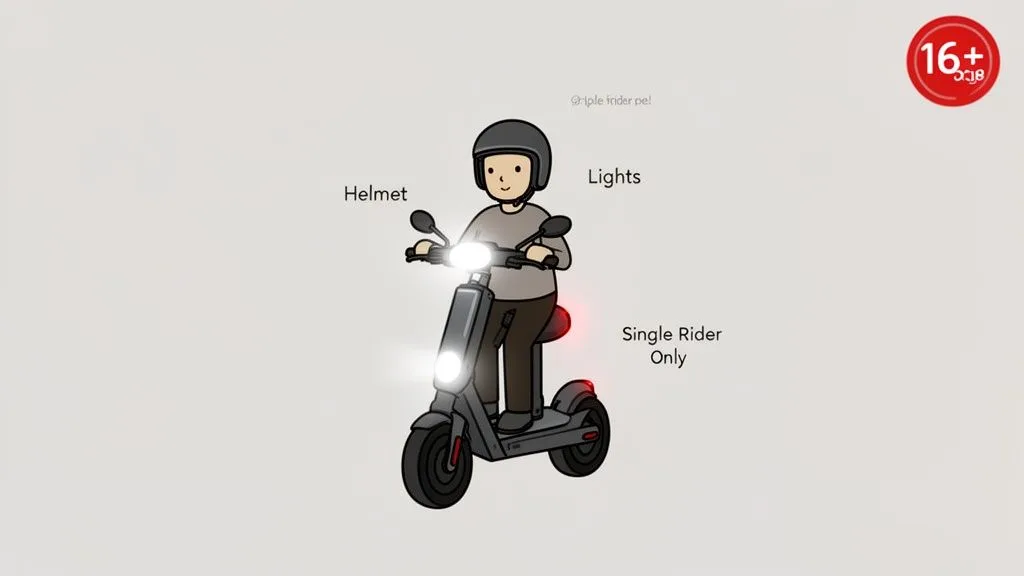
Florida law is crystal clear about who can legally operate an e-scooter. You absolutely must be at least 16 years old to ride one on public streets or in bike lanes. There’s no wiggle room on this, and parental permission doesn’t change a thing.
The helmet rules can sometimes trip people up because they change depending on your age and what you’re riding. For electric scooter riders, it’s straightforward: if you are under 16, you are legally required to wear a helmet.
Now, while riders 16 and older aren’t legally mandated to wear a helmet on an e-scooter, this is one of those times where the law is just the bare minimum. Head injuries are, by far, the most common and devastating outcome in scooter accidents. Riding without a helmet is a huge gamble, and every safety expert out there will tell you to wear one on every single ride, no matter your age or how short the trip is.
Mandatory Lights for Night Riding
When the sun goes down, visibility is everything. Florida law mandates that any scooter operated between sunset and sunrise must have specific lights. This isn’t just a friendly suggestion; it’s a legal requirement to make sure you can see what’s ahead and, just as importantly, that others can see you.
Your scooter must be equipped with:
- A front-facing white light that’s visible from at least 500 feet away.
- A rear-facing red reflector and a red light, both visible from 600 feet away.
These lighting requirements are almost identical to the rules for bicycles, and they are critical for avoiding a collision after dark. If you want a deeper dive into why vehicle lighting is so important, you can learn more about high beam and low beam headlights in our detailed guide.
Remember, at night, drivers are instinctively looking for car-sized objects, not small, quick-moving scooters. Your lights are the single best tool you have to announce your presence and stop a driver from pulling out in front of you simply because they never saw you coming.
Critical Prohibitions and Rider Conduct
Beyond the gear you wear, Florida scooter laws lay down some hard-and-fast rules for how you operate the scooter itself. Breaking these can easily land you a traffic ticket and, worse, put you in a very dangerous spot on the road.
First, scooters are built for one. It is illegal to carry a passenger—that includes holding a small child. The scooter’s deck, brakes, and balance are all engineered for a single rider. Adding a second person throws everything off and makes it dangerously unstable.
Second, DUI laws apply to scooter riders, period. You can absolutely be arrested and charged with Driving Under the Influence while on an e-scooter. The consequences are just as severe as getting a DUI in a car, including massive fines and having your driver’s license suspended. Always ride sober.
How Local City Rules Shape Your Ride
Florida’s state laws give us the basic rulebook for riding a scooter, but that’s really just the starting point. The rules that will actually impact your day-to-day ride—things like where you can park, your speed limit in a crowded downtown, or which streets are totally off-limits—are almost always decided at the city or county level. This creates a real patchwork of regulations that can feel worlds apart as you cross from one city line to the next.
Think of it this way: state law is like the driver’s manual for your car. It gives you the fundamentals. But the local ordinances are the specific road signs in a neighborhood—the school zones, the one-way streets, the “no parking” areas. To ride smart and avoid a ticket, you have to know both. Honestly, ignoring the local rules is one of the quickest ways to find yourself with a citation.
The Miami-Dade E-Scooter Experiment
For a perfect case study in just how much local control matters, look no further than the rollercoaster history of Miami-Dade County’s e-scooter program. The initial pilot program launched with a whopping seven different rental companies. It didn’t take long for things to go sideways.
Officials ended up yanking the permits for five of those companies because riders were ignoring the rules left and right. People were constantly speeding on sidewalks, doubling up with passengers, and blowing right past perfectly good bike lanes. The whole situation became a textbook example of the enforcement headache cities were handed after the 2019 state law made scooters legal but didn’t force cities to have strict oversight. This chaos is why you now see much tighter regulations in Miami and other cities. Fort Lauderdale and Miami Beach have also waffled on their scooter rules, sometimes banning them outright only to bring them back later with much stricter controls. You can discover more insights about these local scooter law challenges to see how different communities have tried to wrangle the scooter boom.
Geofencing and No-Ride Zones
To get a handle on the scooter explosion, many Florida cities have turned to a clever bit of tech: geofencing. This has become an essential tool for enforcing local rules without needing a police officer on every corner. It works by creating invisible, virtual boundaries that can automatically change how a rental scooter operates.
Here’s what that looks like in the real world:
- No-Ride Zones: In super-congested spots like a historic district or a beachfront boardwalk, a city can designate a “no-ride zone.” The second your scooter crosses into that area, the motor will slow to a crawl and then shut off completely. You’ll have no choice but to get off and walk it out of the zone.
- Speed-Restricted Zones: In areas with lots of pedestrians where scooters are still allowed, a city can create a “slow zone.” As you ride in, your scooter’s top speed will be automatically capped, often dropping to as low as 7-10 mph, to keep everyone safe.
- No-Parking Zones: To stop sidewalks from turning into a scooter graveyard, cities create geofenced no-parking zones. If you try to end your rental session inside one of these areas, the app simply won’t let you, and you might even get hit with an extra fee for leaving it there.
The bottom line is this: the rules of your ride can literally change from one block to the next, and you might not even see a sign. The rental scooter itself often knows the local rules better than the rider does, and it will enforce them automatically.
Ultimately, staying on the right side of Florida scooter laws is all about situational awareness. Before you hop on a scooter in a new town, take two minutes to check the city’s website or look for local rules inside the rental app. That tiny bit of prep can easily save you the hassle of a fine and make sure your ride is safe and legal.
Common Questions About Florida Scooter Laws
Even after you get the hang of the main rules, real-world situations can pop up that leave you scratching your head. Let’s run through some of the most common questions riders have. Getting these details straight is the final piece of the puzzle for riding confidently and staying on the right side of Florida scooter laws.
Do I Need a Driver’s License for an Electric Scooter in Florida?
Good news: for a standard electric scooter that fits the legal definition in Florida, you do not need a driver’s license, registration, or insurance. That’s one of the biggest perks of choosing an e-scooter.
But here’s where you have to be careful. If your scooter has a seat or a gas engine, it’s almost certainly not an “electric scooter” in the eyes of the law. It’s likely a moped or even a motorcycle, and for those, you absolutely do need a license and will have to register the vehicle with the state.
Can I Get a DUI on a Scooter in Florida?
Yes. Absolutely. This catches a lot of people by surprise, but Florida’s DUI laws are written very broadly. They apply to anyone operating a “vehicle,” and that legal definition includes everything from your car to an electric scooter, a bicycle, or even a skateboard.
Don’t make the mistake of thinking it’s a lesser offense. The penalties are just as serious as a DUI in a car, including hefty fines, a suspended driver’s license, and potential jail time. Impaired riding is a serious crime, so if you’ve been drinking, stay off the scooter.
Think of it this way: if you’re in control of a moving vehicle on a public road, DUI laws apply. It doesn’t matter what kind of vehicle it is—it’s the act of operating it under the influence that counts.
What Happens If I Get a Ticket on My Scooter?
Getting a traffic ticket on your scooter is treated the same as any moving violation you’d get while driving a car. An officer can write you up for all the usual stuff—running a stop sign, not yielding to a pedestrian, or weaving between lanes unsafely.
That citation goes right onto your official driving record. The silver lining is that for many common violations, you’ll probably have the option to take a Basic Driver Improvement (BDI) course. Completing a BDI course is a smart move; it can prevent points from being added to your license, which helps you dodge a painful spike in your car insurance premiums.
Are There Special Speed Limits for Electric Scooters?
While state law caps an e-scooter’s top speed at 30 mph, that doesn’t mean you have a green light to max it out everywhere. You must still obey all posted speed limits, just like any car on the road.
More importantly, local rules are often much stricter. Cities with scooter-sharing programs frequently use geofencing technology to enforce “slow zones” in busy areas like downtowns or beach boardwalks. Ride into one of these zones, and your scooter will automatically slow down to a crawl, often around 10-15 mph. The bottom line is to always ride at a speed that’s safe and sensible for your surroundings.
If you’ve received a traffic ticket while riding your scooter, don’t let points tarnish your driving record. BDISchool offers Florida state-approved online courses like the Basic Driver Improvement program to help you meet court requirements and keep your insurance rates down. Enroll today at https://bdischool.com and protect your license.