That flash of blue and red in your rearview mirror is a feeling no one enjoys. But getting your first speeding ticket in Florida isn’t the end of the world. It’s a common rite of passage for drivers, and there’s a clear path to handling it.
The key is to act quickly and understand your options. Making the right move now can save you from points on your license and a nasty surprise when your insurance bill arrives.
First Things First: Understanding the Citation
That ticket the officer just handed you can look pretty intimidating, full of codes, checkboxes, and legal language. Don’t let it overwhelm you. At its core, it’s just a notice that requires you to make a decision within 30 days. Let’s break down what you need to look for right away.
What to Check on Your Citation Immediately
Before you do anything else, grab a pen and give that ticket a thorough read. Make sure all your personal details—name, address, driver’s license number—are spot on.
Next, look at the violation specifics. Check the location, date, time, and especially the speed you were allegedly driving versus the posted limit. A simple mistake here could be grounds for a challenge later on.
Pay close attention to these critical details:
- The fine amount: This is what you’ll owe if you decide to just pay it and be done.
- The statute number: This is the specific Florida law you’re accused of breaking.
- The deadline: This is the big one. In Florida, you have 30 days to respond. Mark it on your calendar, set a reminder—whatever it takes. Missing this deadline creates a much bigger problem.
Think your ticket is bad? The world’s first speeding ticket was issued way back in 1896. The driver was caught going a blistering 8 mph in a 2 mph zone! While speeds have changed, the process of dealing with a ticket has been around for a long time.
Your Three Main Choices
Okay, you’ve read the ticket. Now you have a decision to make. In Florida, you have three fundamental ways to handle this, and each one has very different consequences for your driving record and your wallet.
Here are your options, boiled down:
- Pay the Ticket (Plead Guilty): This is the fastest route, but it’s an admission of guilt. You’ll get points on your license, which is exactly what you want to avoid.
- Fight the Ticket (Plead Not Guilty): This means you’re heading to court to argue your case before a judge. If you win, great! If you lose, you face the fine and points.
- Elect Traffic School (No Contest): For most first-timers, this is the golden ticket. You agree to take a driver improvement course, and in exchange, the state withholds adjudication, meaning no points go on your record.
Making a smart decision starts with knowing what happens when you get a traffic ticket and how each choice impacts you down the road. Let’s walk through it so you can turn this frustrating moment into a simple, manageable task.
Deciding Your Next Move: Your Three Options
So, you’ve got that first speeding ticket in your hand. The clock is ticking—you have 30 days to make a choice that will impact your driving record and your wallet for years. It can feel overwhelming, but it really boils down to three distinct paths.
Let’s walk through what each option really means for you, so you can make the smartest decision.
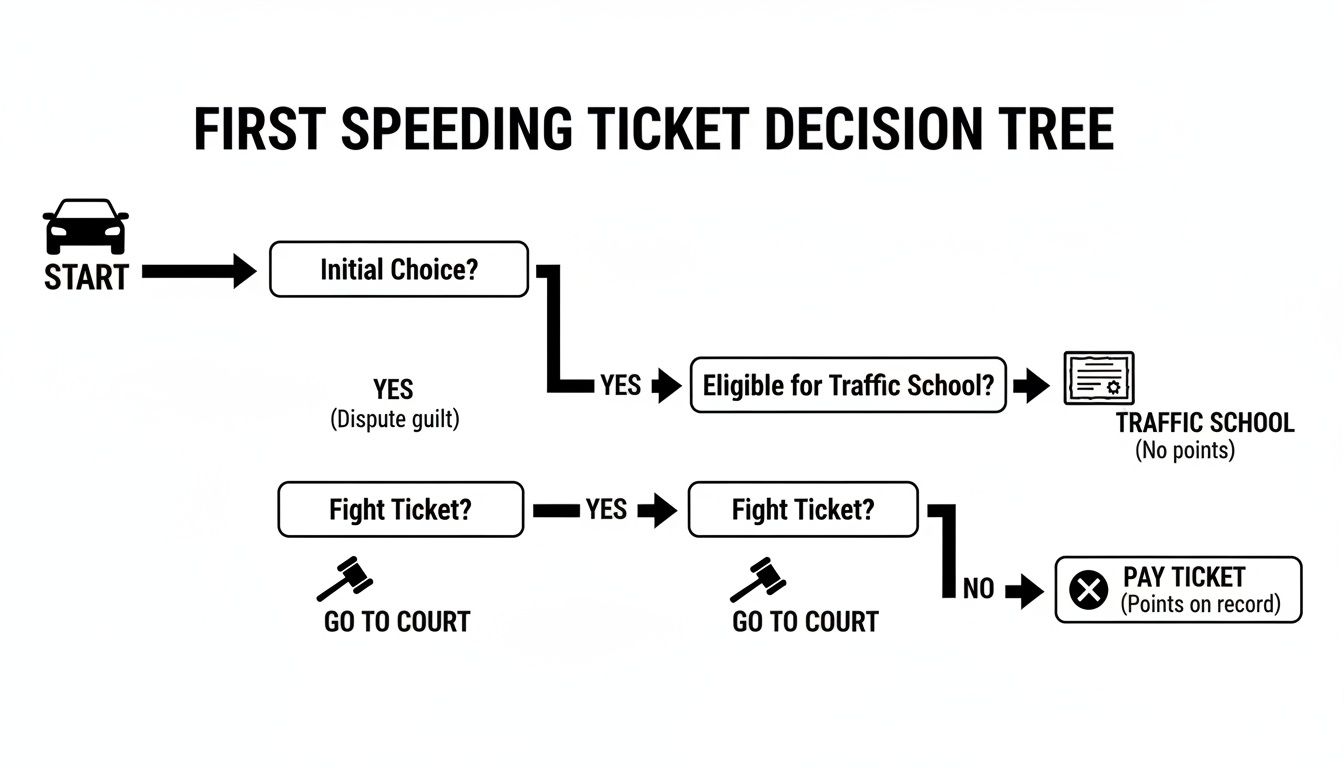
As you can see, what seems like the easiest path—just paying the ticket—often has the most painful long-term consequences.
Option 1: Pay The Fine And Plead Guilty
Paying the fine feels like the quickest way to put this whole thing behind you. A few clicks online or a check in the mail, and it’s done. Right?
Not quite. What you’re actually doing is pleading guilty to the violation. This is an official conviction, and the Florida DHSMV will automatically add points to your license—usually 3 or 4 points for a common speeding offense.
Those points are exactly what insurance companies look for when it’s time to renew your policy. Just one ticket can trigger a premium hike of 20% or more, an increase you’ll be stuck paying for the next three to five years. It’s a very expensive “convenience.”
Option 2: Fight The Ticket In Court
Your second choice is to plead “not guilty” and take your case to court. This makes sense if you genuinely believe the ticket was issued in error. Maybe the speed limit sign was hidden by a tree, or you have dashcam footage that tells a different story.
To win, you’ll need to build a solid argument for the judge. This could involve questioning the officer’s equipment calibration or presenting clear evidence in your favor. It’s a bit of a gamble, though. If you lose, you’re on the hook for the original fine, plus court costs, and you still get the points.
Option 3: Elect Traffic School (The Best Bet For Most)
For the vast majority of people facing their first ticket, this is the golden ticket. By pleading “nolo contendere” (no contest) and agreeing to take a Basic Driver Improvement (BDI) course, you get the best of both worlds.
Here’s the magic: once you complete a state-approved BDI course, Florida withholds adjudication. In plain English, this means you are not officially convicted. The result? Zero points go on your driving record for that ticket.
No points means your insurance company can’t legally raise your rates because of this specific incident. It’s a clean slate.
There are a few simple rules for eligibility:
- You can’t have taken traffic school in the last 12 months.
- You haven’t used this option more than 5 times in your entire life.
- This option isn’t available if you have a Commercial Driver’s License (CDL).
You just need to inform the Clerk of Court (in the county where you got the ticket) that you’re choosing the traffic school option and pay the ticket fine. Then, you simply complete the 4-hour course. Our guide on Florida traffic ticket options breaks down the official steps. It’s a small investment of time to save a lot of money and headaches.
Florida Speeding Ticket Options At A Glance
To make it even clearer, here’s a simple breakdown of how these three choices stack up against each other.
| Action | Points on Record | Impact on Insurance | Best For |
|---|---|---|---|
| Pay the Ticket | Yes (3-4 points) | High probability of a rate increase (20%+) for 3-5 years. | Almost no one, unless you’re ineligible for other options. |
| Fight in Court | Yes, if you lose. No, if you win. | High probability of a rate increase if you lose. | Cases with strong evidence of error (e.g., faulty equipment, incorrect sign). |
| Elect Traffic School | No points are added. | No rate increase for this ticket. | Most first-time offenders who want to protect their driving record and avoid insurance hikes. |
Looking at the table, it’s easy to see why taking a BDI course is the recommended path for a simple mistake. It’s the one option that gives you complete control over the long-term financial outcome.
Making Traffic School Work For You
So you’ve decided that keeping points off your record and dodging an insurance hike is the way to go. Smart move. For a first speeding ticket, electing traffic school is almost always the best financial and long-term decision. The process itself is surprisingly simple and designed so you can get it done without turning your life upside down.
Let’s walk through what you need to do, from telling the court you’re taking the course to getting that all-important completion certificate filed.
Your first official step is notifying the Clerk of Court in the county where you got the ticket. This is time-sensitive—you have to do it within 30 days of the citation date. When you do, you’ll plead “nolo contendere” (no contest) and pay the ticket fine. This payment acts as your formal election to take traffic school. Thankfully, most county clerks have an online portal, making this a quick and painless process.
Finding the Right Online Course
Once you’ve paid the fine and told the court you’re taking the course, it’s time to find a state-approved Basic Driver Improvement (BDI) course. Forget any images of sitting in a stuffy classroom for a whole Saturday. Modern traffic schools are entirely online, giving you the freedom to chip away at the material whenever it fits your schedule.
When you’re comparing schools, here’s what really matters:
- Florida DHSMV Approval: This is the most important one. If the school isn’t officially approved by the state, the court won’t accept your certificate. No exceptions.
- Self-Paced Learning: The best courses let you log in and out as you please. You can do 20 minutes on your lunch break or an hour after dinner—whatever works for you.
- Mobile-Friendly Design: Can you complete it on your phone or tablet? This is a huge plus, letting you make progress from anywhere.
- Automatic Reporting to the State: A good school will automatically send your completion certificate to the Florida DHSMV for you. This is a huge relief and one less thing for you to worry about.
“For most drivers, the small investment of time in a BDI course pays for itself many times over by preventing a multi-year insurance premium increase. It’s a simple calculation with a clear winner.”
Choosing a trusted and approved online traffic school is the key to making this whole process smooth and stress-free.
What to Expect From the Course Itself
Let’s be clear: a 4-hour BDI course isn’t meant to be a brutal exam. It’s a practical refresher on defensive driving techniques and Florida traffic laws. You’ll go over topics that can actually help you on the road, like navigating tricky right-of-way situations, avoiding distractions, and why maintaining a safe following distance is so critical.
Think about this: the very first speeding ticket was handed out back in 1899 for going just 12 mph! Today, with around 2.5 million moving violations issued in Florida every year, the stakes are much higher. A single ticket can slap 3-4 points on your license and cause your insurance premiums to jump by 20-30%. Learning simple things like the 3-second rule in a BDI course can genuinely help you avoid another ticket down the road. You can actually read about the world’s first speeding ticket on Carbuzz.com.
Finishing Up and Getting It Filed
Once you’ve worked through the course material and passed the final quiz, you’re on the home stretch. Your traffic school will process your completion certificate and, in most cases, send it electronically straight to the DHSMV.
And just like that, you’re done. You’ve met your legal obligation, successfully kept points off your driving record, and legally blocked your insurance company from jacking up your rates over this ticket.
The Real Cost of a Ticket on Your Record and Insurance
That fine printed on your ticket? Think of it as just the down payment. The real sting of a first speeding ticket isn’t the initial penalty, but the financial hangover that can last for years. What happens behind the scenes with your driving record and insurance company is where the true cost lies.
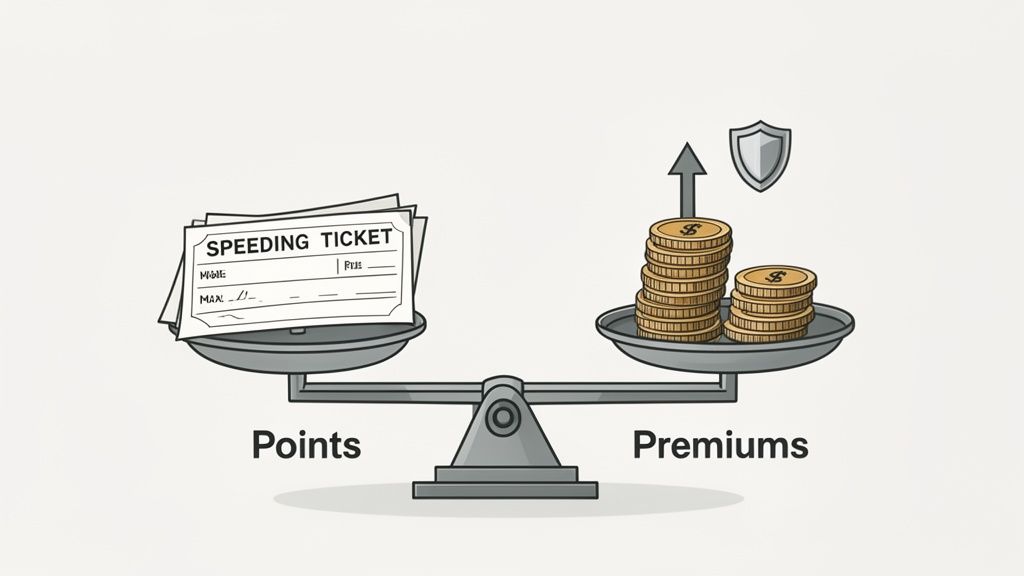
This is precisely why just paying the fine is often the worst thing you can do. When you pay, you’re admitting guilt. That “guilty” plea goes straight to the Florida DHSMV, which then adds points to your license.
To an insurance company, those points are like waving a giant red flag. When it’s time to renew your policy, their system flags that conviction as a new risk. The result? Your premiums will almost certainly go up, and you’ll be stuck paying that higher rate for the next three to five years.
Understanding the Florida Points System
Florida uses a point system to keep track of moving violations and flag drivers who might be a higher risk on the road. Each violation has a point value, and if you rack up too many points too quickly, you’re looking at an automatic license suspension.
Here’s how it breaks down:
- 12 points within 12 months = 30-day suspension
- 18 points within 18 months = 3-month suspension
- 24 points within 36 months = 1-year suspension
A standard ticket for going up to 15 mph over the limit will land you 3 points. If you were caught going 16 mph or more over, that jumps to 4 points. It’s surprisingly easy to see how a couple of bad days could put your license in serious jeopardy.
And this isn’t just a Florida problem. Across the U.S., about 45 million speeding tickets get handed out every year, and many come with a hefty price tag beyond the fine. For a first-time violation, drivers can see their insurance premiums spike by an average of 21%.
How a BDI Course Wipes the Slate Clean
This is where electing to take a Basic Driver Improvement (BDI) course becomes your secret weapon. When you choose this option and complete a state-approved course, the court agrees to a “withholding of adjudication.”
That’s a fancy legal phrase, but it’s incredibly important. It means you are not officially convicted of the violation.
Here’s the key takeaway: With no conviction on your record, no points are added to your license. And because no points are added, Florida law forbids your insurance company from jacking up your rates or dropping your policy because of that one ticket.
While a speeding ticket is serious, other infractions can have an even more devastating financial impact. Understanding things like how a DWI can affect your insurance rates really puts into perspective how crucial it is to keep your record clean. Opting for a BDI course is the simplest way to take that ticket out of the equation, saving you a small fortune in insurance hikes over the next few years.
When It Makes Sense to Contest Your Ticket in Court
While opting for traffic school is usually the path of least resistance for a first-time speeding ticket, it’s not your only move. If you genuinely believe you weren’t in the wrong, pleading “not guilty” and taking your case to court is a valid option. It’s more work, for sure, but winning means you walk away with no fine, no points, and no BDI course on your to-do list.
So, when should you seriously consider fighting it?
The process begins the moment you get back to your car. Take a hard look at the citation—and I mean really scrutinize it. Beyond your name and the speed you were allegedly going, check every detail. Is the date right? The location? The statute number? A simple mistake, like the officer writing down the wrong direction of travel, can sometimes be enough to get the entire thing thrown out.
Building Your Defense Strategy
If the ticket itself is free of errors, you need to pivot to the circumstances of the stop. A solid defense isn’t just about saying, “I wasn’t speeding.” It’s about planting a seed of reasonable doubt in the judge’s mind. And to do that, you need evidence.
Start thinking like a detective. What can you gather to back up your version of events?
- Dashcam Footage: This is your best friend in court. If you have video showing you were driving at the posted speed limit, or that the sign was impossible to see, it’s powerful stuff.
- Photos of the Scene: Was the speed limit sign covered by a tree branch? Was it faded, bent, or covered in graffiti? Drive back to the spot (safely!) and take clear pictures from a driver’s perspective.
- Witnesses: Did you have a passenger in the car? Their testimony can help corroborate your story and add credibility.
Your goal here isn’t to make excuses. It’s to build a logical, fact-based case that shows there’s a real possibility the officer made a mistake.
Remember, the burden of proof is on them, not you. The state has to prove you were speeding “beyond a reasonable doubt.” Your job is to poke holes in their argument and introduce that doubt.
Presenting Your Case in Court
Walking into a courtroom can feel nerve-wracking, but being prepared is the best cure for anxiety. Always be respectful, addressing the judge as “Your Honor.” When it’s your turn, lay out your evidence clearly and stick to the facts. Don’t editorialize; just explain what your photos show or what the video proves.
A huge part of the process is listening to the officer’s testimony. Pay close attention. Does their story in court match what’s written on the ticket? If they say they “paced” you but admit they had trouble keeping a steady distance, that’s a weakness you can politely question.
If the thought of cross-examining an officer makes your palms sweat, or if you’re facing a more serious charge, hiring a traffic attorney might be a wise investment. They know the local court’s quirks and are skilled at asking the right questions about radar calibration, officer training, and procedural steps.
Contesting a ticket is always a gamble. If you lose, you’re on the hook for the fine, court costs, and the points. But if you have strong, compelling evidence, it’s a risk that could pay off big. To dive deeper into the pros and cons, our guide can help you figure out if you should contest your traffic ticket in Florida.
Common Questions After Your First Florida Speeding Ticket
That sinking feeling when you see the flashing lights in your rearview mirror for the first time… it’s a mix of confusion, frustration, and a lot of questions. What do I do now? How bad is this?
Don’t worry, you’re not alone. Let’s walk through the most common questions people have after getting their first speeding ticket in Florida and get you some clear, straightforward answers.
Can I Just Ignore My First Speeding Ticket?
Let me be blunt: absolutely not. Ignoring a traffic ticket is the single worst thing you can do.
In Florida, the clock starts ticking the moment that citation is in your hand. You have 30 days to respond. If you miss that deadline, the state automatically suspends your driver’s license. No ifs, ands, or buts.
Getting your license back isn’t just a simple fix, either. You’ll be on the hook for the original fine, plus late fees and a separate reinstatement fee. It spirals quickly from a minor annoyance into a major expense. On top of that, a conviction gets slapped on your record, bringing points and an insurance hike. You must take action—pay it, fight it, or elect traffic school.
How Do I Know If I’m Eligible for Traffic School?
For most first-time offenders, this is the go-to option, and thankfully, the rules are pretty clear. You can almost certainly take a Basic Driver Improvement (BDI) course if:
- You haven’t taken traffic school for another ticket in the past 12 months.
- You haven’t used the traffic school option five times over your entire driving history.
There are a couple of exceptions. This option is off the table if you have a Commercial Driver’s License (CDL), even if you were driving your personal car. It also generally doesn’t apply if you were ticketed for causing an accident. If you’re unsure, just call the clerk of court in the county where you got the ticket—they can tell you for sure.
The real magic of traffic school is what’s called a “withholding of adjudication.” It’s a legal term that means you’re never officially convicted. As a result, no points go on your license, and your insurance company can’t legally raise your rates for this ticket.
Will My Insurance Company Find Out If I Do Traffic School?
Nope. And this is the biggest reason people choose the BDI course route.
When you complete the course and the court gets your completion certificate, the ticket is essentially sealed. Because you aren’t “convicted” and no points are added to your license, the state has nothing to report to your insurance provider.
This is a huge financial win. Florida law specifically prevents insurance carriers from raising your premiums or dropping your policy for a ticket that was handled with a BDI course. It’s the one guaranteed way to keep this little mistake completely off their radar.
What If I Was Driving More Than 30 MPH Over the Limit?
This is where things get serious. Speeding 30 mph or more over the limit isn’t just a regular ticket in Florida; it’s a mandatory court appearance. You lose the ability to just pay the fine or sign up for traffic school online.
You’ll have to stand before a judge, who has the power to hit you with much higher fines, order a more advanced driver improvement course, or even suspend your license right then and there. With penalties this severe, walking into that courtroom alone is a big risk. I strongly advise talking to a traffic attorney to figure out your best defense.
Dealing with your first speeding ticket doesn’t have to be overwhelming once you know the ropes. For the vast majority of drivers, a state-approved BDI course is the smartest and cheapest way out. At BDISchool, our 100% online courses are built to be quick and painless, helping you meet court deadlines and keep your driving record clean. Enroll in a Florida-approved BDI course today at BDISchool.com and put this ticket behind you for good.