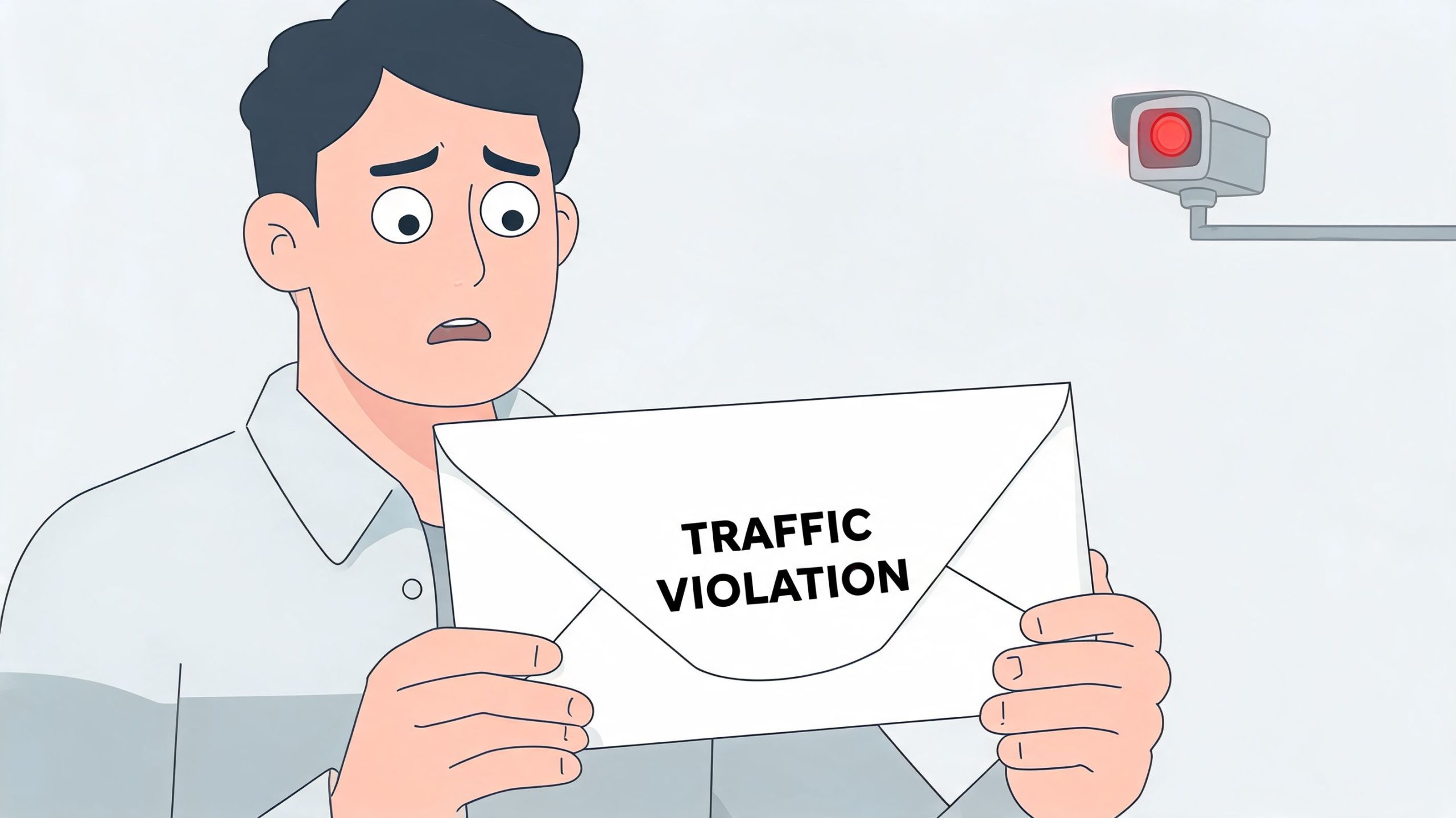
You open your mail, see a red light camera notice, and your stomach drops. Most drivers have the same first thought. “Did I really do this, and how bad is this going to get?”
Take a breath. A camera ticket feels personal, but the process is mechanical. If you handle it early, read it carefully, and choose the right path, you can keep a stressful mistake from turning into a bigger problem.
Florida drivers deal with these notices every day. At the same time, the system isn’t as simple or as bulletproof as cities want you to believe. That matters, because if you understand how traffic light cameras florida enforcement works, you stop feeling trapped and start making good decisions.
Understanding Florida Traffic Light Camera Tickets
A typical driver story goes like this. You were turning, traffic was tight, the light changed fast, and weeks later a notice shows up with photos of your car. You don’t remember the moment clearly. You do remember the stress.
That reaction is normal. Camera tickets are designed to feel final because they arrive with images, dates, and deadlines. But a mailed notice is not the end of the story. It’s the start of a process, and you have choices.
The bigger trend is worth knowing because it tells you something important. Florida still uses red light cameras, but they aren’t expanding in a straight line. Red light camera tickets in Florida dropped 25% from their 2016 peak to 2025. The statewide count went from 347,633 tickets in 2016 to 248,996 by 2025, according to Florida ticket trend reporting that cites state data.
What that means for you
The state is still issuing a large number of these citations. But the decline tells me something as an instructor. Red light camera enforcement isn’t untouchable, and it isn’t the only priority in Florida traffic enforcement anymore.
That matters because worried drivers often assume a camera notice is unbeatable. It’s not.
Here’s the practical mindset I want you to adopt:
- Don’t panic: A camera notice doesn’t mean your license is automatically in danger.
- Don’t ignore it: Waiting is how a manageable problem becomes a more serious one.
- Don’t guess: Read every line of the notice before you decide to pay, contest, or seek traffic school.
Practical rule: Treat the notice like a deadline document, not a moral judgment.
The first question to ask
Ask one thing before anything else. “What stage is this at?” If it’s an initial mailed notice, your options are broader. If it has already escalated, the consequences can be tougher.
That distinction controls everything else. Your record, your points exposure, your insurance risk, and whether fighting it still makes sense all depend on the stage of the ticket.
How Red Light Cameras Operate in Florida
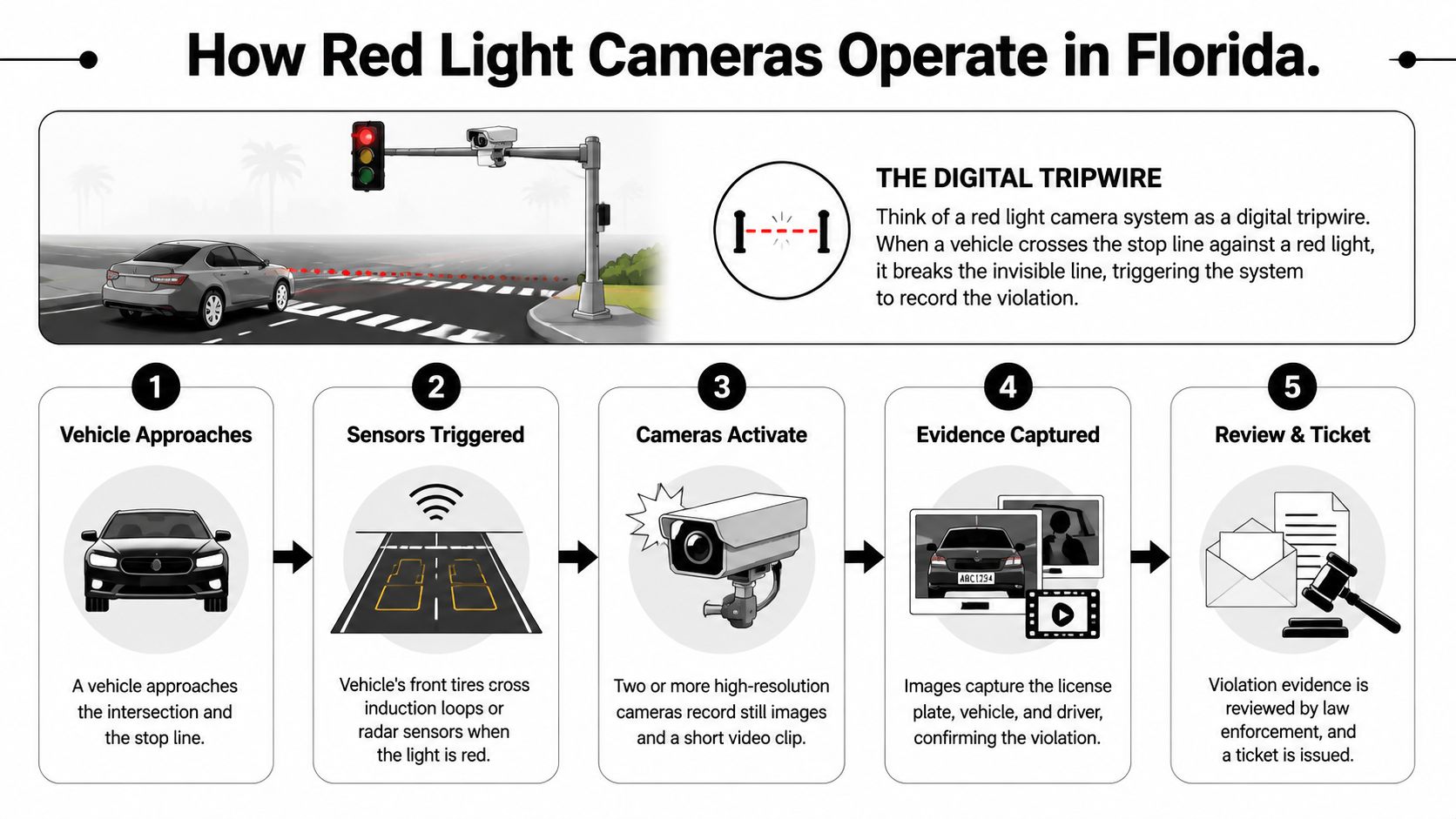
Most drivers think a red light camera works like a person watching a live video feed and pressing a button. That’s not how it works. Think of it more like a digital tripwire tied to a traffic signal.
The system watches for a specific event. A vehicle enters after the light is already in steady red. If the equipment detects that event, cameras record the evidence for later review.
The basic sequence
Here’s the simple version of what happens at a camera-equipped intersection:
Your car approaches the stop line.
The system is tied to the signal phase and the vehicle detection setup at the intersection.The light turns red.
This is the critical moment. The legal issue is not that you were near the intersection. It’s whether the vehicle entered after steady red began.The detection system is triggered.
That can involve road sensors or other approved equipment connected to the camera system.The cameras capture images and video.
The evidence package usually includes the vehicle, license plate, and movement through the intersection.A violation is reviewed and processed.
A notice is mailed to the registered owner.
The timing rule that drivers need to know
Florida’s technical standards matter more than is often appreciated. A key requirement for the state’s Traffic Infraction Detector equipment is that the system triggers a violation only if the vehicle enters after the steady red begins, with a minimum 0.7-second delay from red onset to account for the “dilemma zone”, according to the FDOT Traffic Infraction Detector equipment specifications.
That delay is a big deal. It exists because traffic engineers know drivers can get trapped in a split-second decision area where stopping or proceeding can both feel unsafe.
If your case is close, timing and calibration are not technical trivia. They’re central to whether the citation is valid.
Why the law and the hardware both matter
Florida authorizes red light camera enforcement under state law, but that doesn’t mean every setup is beyond challenge. These systems are supposed to be state-regulated, technically compliant, and properly timed.
That’s why I tell drivers not to assume every camera capture equals a clean violation. The law authorizes the program. The equipment still has to do its job correctly.
If your entry was after red and clearly captured, paying or resolving it quickly may be the sensible move. If the situation was tight, confusing, or unusual, the details matter more than the city’s envelope suggests.
Penalties Fines Points and Insurance Impacts
Most confusion comes from one mistake. Drivers treat every camera ticket as if it carries the same penalty from day one. It doesn’t.
In Florida, the risk changes if you ignore the first notice and let it escalate. That’s where people get into trouble. Not because the first paper was catastrophic, but because they didn’t respond.
Florida Red Light Ticket Stages Explained
| Feature | Notice of Violation (Initial Stage) | Uniform Traffic Citation (Second Stage) |
|---|---|---|
| How it starts | Mailed after camera review | Issued after the initial matter isn’t resolved |
| Nature of case | Civil camera enforcement notice | More formal traffic citation stage |
| Points risk | Usually treated differently from a moving citation at the start | This is the stage where points become the major concern |
| Insurance concern | Lower immediate record impact | Greater risk of long-term record and insurance consequences |
| Best response | Review, verify details, decide quickly | Take it seriously and act fast |
What drivers worry about most
Drivers usually care about three things. Cost, points, and insurance.
That’s the right order emotionally, but not strategically. The smarter order is this: protect your record first, then control the financial damage. A one-time payment stings. A damaged driving record can follow you much longer.
If you need a quick refresher on how Florida’s system works, this driver license points guide lays out the point consequences in plain language.
The mistake that creates bigger problems
Ignoring the notice is the worst move. I’ve seen calm, fixable situations turn into expensive, time-consuming ones because the driver assumed the ticket was junk mail or thought they’d “deal with it later.”
Don’t do that.
Use this checklist instead:
- Check the deadline first: Your response window controls your options.
- Confirm the vehicle details: Make sure the plate, car, and event details match.
- Look at the images carefully: Don’t rely on memory alone.
- Decide on a path: Pay, contest, or use an eligible compliance option before the case hardens.
Pay attention to the stage, not just the amount due. The stage tells you how serious the exposure is.
Insurance reality
Drivers often ask whether a camera ticket will raise insurance right away. The honest answer is that the biggest insurance concern usually comes when the matter escalates and affects your driving record more directly.
That’s why delay is expensive even when the original notice doesn’t look devastating. The safest approach is fast action, not wishful thinking.
How to Dispute a Florida Red Light Camera Ticket
If you believe the ticket is wrong, unclear, or legally weak, dispute it. Don’t argue emotionally. Build a clean, organized challenge.
That means focusing on evidence, identification, timing, procedure, and whether the agency can support the allegation. A lot of drivers lose because they complain instead of proving.
Start with the strongest question
The strongest opening question is often simple. Were you even the driver?
A Broward County judge ruled Florida’s automated enforcement law unconstitutional because it presumes the registered vehicle owner committed the violation without proving who was driving. The ruling states that under the Mark Wandall Traffic Safety Act, the burden should be on agencies to prove guilt, not assume it from registration, as discussed in this report on the Broward constitutional ruling.
That doesn’t mean every ticket vanishes tomorrow. It does mean the owner-assumption issue is no longer something drivers should ignore.
Practical dispute angles
A smart challenge usually centers on one or more of these points:
- Identity problem: You were the registered owner, but not the driver.
- Vehicle issue: The plate, car, or registration link is wrong.
- Timing concern: The event was too close to the light change, or you need records on calibration and signal timing.
- Procedural defect: The notice or review process may have compliance issues.
- Evidence weakness: The images or video don’t clearly prove the legal violation.
If you’re trying to understand how courts think about digital records generally, this digital evidence admissibility guide is useful background. It’s not about red light cameras specifically, but it helps explain why authenticity, reliability, and chain of proof matter when evidence is electronic.
What to do before the hearing
Don’t walk in unprepared. Pull the file together first.
Read the notice line by line.
Check names, dates, location, plate, and instructions.Review every image and video frame available.
Don’t assume the city’s summary tells the full story.Write your timeline.
Short, factual, and clean. No speeches.Gather supporting documents.
If someone else was driving, get documents that support that claim.Request the hearing properly.
Follow the method on the notice. Missing the process can kill a decent defense.
For a practical walkthrough of the contest process, this Florida traffic ticket defense guide is a useful companion.
Here’s a helpful explainer before you decide how aggressive to be with your challenge:
My direct advice
Dispute a ticket when you have a real issue to raise. Don’t contest it just because you’re angry. Judges and hearing officers respond better to a disciplined argument than to frustration.
Bring facts, not outrage. A short, credible explanation beats a long emotional one.
How Traffic School Can Protect Your Driving Record
Traffic school is often the cleanest exit ramp for a driver who wants to limit damage and move on. If you’re eligible, this route can protect your record better than a casual decision to just pay and forget about it.
That’s the part many drivers miss. They focus on ending the annoyance. You should focus on ending the case without making your driving history worse.

When traffic school makes sense
Traffic school is usually the smart choice in situations like these:
- You don’t have a strong defense: The evidence is clear enough that a fight is unlikely to be worth the time.
- You want to avoid record damage: Your main goal is protecting your license and minimizing downstream consequences.
- You need a predictable solution: You’d rather complete a course than spend time in hearings or court.
For eligible drivers, a Florida-approved course can serve as a practical compliance tool. If you need a state-approved online option, review the available approved traffic school online courses.
BDI and IDI in plain English
The two course names that matter most are Basic Driver Improvement (BDI) and Intermediate Driver Improvement (IDI).
BDI is the standard option many drivers use after a moving violation when they want to protect their record. IDI is more common when a court orders a more involved course or when the situation requires a deeper corrective step.
The main benefit isn’t academic. It’s strategic. You’re using a lawful education option to reduce the long-term consequences of a traffic mistake.
Why I recommend this route often
As an instructor, I care less about punishment and more about driver behavior. A good traffic course doesn’t just help with compliance. It also forces you to slow down and look at the habits that caused the citation in the first place.
That matters with intersections. Red light camera cases often come from impatience, late braking, rolling turns, distraction, or trying to beat the yellow. Those are fixable habits.
Instructor’s view: The best outcome isn’t winning an argument with a camera. It’s avoiding the next risky intersection decision.
Keep it procedural
If you choose traffic school, do it the right way. Confirm eligibility, follow the instructions tied to your case, complete the right course, and keep proof of completion.
Drivers get themselves in trouble when they assume “taking a class” automatically fixes everything. It only works when you follow the required process.
Where Are Florida’s Red Light Cameras?
Florida doesn’t have one uniform camera experience statewide. Some areas rely on them more heavily, some use them selectively, and some have pulled back or stirred public controversy around them.
That means your local experience with traffic light cameras florida enforcement can vary a lot by county and city. Urban areas and larger intersections tend to be the places drivers encounter them most often.
The places drivers talk about most
Drivers commonly associate red light cameras with larger and busier parts of the state, including areas around Orlando, Tampa, and South Florida. That tracks with how these programs tend to cluster around dense traffic corridors and major intersections.
If you drive in the Tampa area, this local Tampa red light camera overview gives practical location-specific context.
The safety debate is real
Cities often defend camera programs as safety tools. Sometimes the earlier data supported that claim. But the picture is mixed.
While some early studies showed safety improvements, more recent statewide figures indicate increases in collisions at some equipped intersections. Statewide, crashes at camera intersections rose 3% last year, and in Orlando they were up 12%, according to the Florida red light camera crash summary discussed by Miami Springs.
That doesn’t prove every camera is bad. It does prove the safety argument isn’t automatic.
What drivers should take from that
Don’t assume a camera intersection is necessarily safer just because a camera is present. Also don’t assume every camera program is purely about preventing dangerous behavior.
Use a defensive approach at known camera intersections:
- Stop early, not late: Don’t drive into the yellow hoping to save a few seconds.
- Leave more following space: Tailgating near camera intersections invites panic braking.
- Complete turns carefully: Rolling right turns are a common source of trouble.
- Stay off the clock mentally: Rushing creates bad red-light decisions.
The smart driver response is simple. Drive the intersection correctly whether the camera helps safety or not.
Legal Controversies and The Future of Camera Tickets
A lot of public messaging treats red light camera programs as if they exist for one reason only. Safety. That’s too neat, and I don’t buy it.
Camera enforcement sits at the intersection of safety policy, municipal finance, vendor contracts, and constitutional arguments. If you only hear the safety pitch, you’re hearing half the story.
Revenue changes the conversation
A 2024 investigation found that some Florida cities derive over 15% of their total budget from red-light camera fines, which creates an obvious conflict between public safety claims and revenue generation, especially when some studies show crashes can increase after installation, according to WLRN’s investigation into Florida red light camera revenue.
That should concern every driver. Once a city depends heavily on citation money, the public has every right to ask hard questions about placement, oversight, and motivation.
Safety and fairness are not the same thing
Even if a city says a camera program improves compliance, that doesn’t answer every fairness question. Drivers still deserve accurate equipment, lawful procedures, transparent review, and a real chance to contest the allegation.
That’s especially true when owner identity and digital evidence remain active legal pressure points. A system can be legal in general and still produce weak individual cases.
My opinion on where this is going
The future of camera tickets in Florida will probably be shaped less by technology and more by scrutiny. Courts, journalists, and drivers are all pushing on the same pressure points:
- Who was driving
- How the evidence is reviewed
- Whether intersections become safer
- How much money local governments collect
- Whether the public still trusts the system
A camera program that can’t defend its fairness won’t keep public confidence, even if it keeps mailing notices.
What drivers should do right now
Don’t wait for the whole legal situation to settle. Handle your own case based on today’s reality.
That means:
- Read the notice carefully
- Decide quickly whether to pay, contest, or use traffic school
- Raise identity and evidence issues when they’re legitimate
- Keep every deadline
- Drive camera intersections more conservatively from now on
That last point matters most. Whether these systems shrink, survive, or get reworked, the safest move is still boring, disciplined intersection driving. Full stop before right on red when required. More following distance. No late lunges through yellow. No distracted rolling turns.
Frequently Asked Questions About Florida Red Light Cameras
Do Florida red light camera tickets put points on my license right away
Not at the initial notice stage in the same way drivers usually fear. The bigger risk comes when you ignore the notice and let the matter escalate into a more serious citation stage.
Should you ignore a red light camera ticket in Florida
No. That’s the worst move. Even if you think the ticket is wrong, respond on time and choose a path.
Can you fight a camera ticket if you weren’t driving
Yes, that can be a serious issue. Owner identity is one of the most important legal pressure points in Florida camera cases.
Are red light cameras always accurate
No system should be treated as automatically flawless. Timing, calibration, image quality, and procedure all matter.
Is traffic school better than fighting the ticket
Sometimes yes. If the evidence is strong and you’re eligible for a traffic school option, it can be the cleanest way to protect your record and move forward.
Do red light cameras always improve safety
No. Florida data has been mixed, with some locations showing troubling crash trends even at camera-equipped intersections.
If you want the simplest way to protect your record after a Florida traffic ticket, BDISchool offers Florida-approved online courses that are self-paced, practical, and easy to complete from any device. If you need a Basic Driver Improvement course, an Intermediate Driver Improvement course, or another approved option, start early, follow your case instructions carefully, and use the course to keep one mistake from becoming a long-term problem.