Considering a defensive driving course for seniors near you, the concrete answer is simple: there are about 35 million licensed drivers age 70 and older in the United States, and many seniors can qualify for an insurance discount by taking a state-approved mature driver course. In some states, that discount is 5%, which makes an approved course one of the easiest ways to save money while refreshing the skills that matter most on today’s roads.
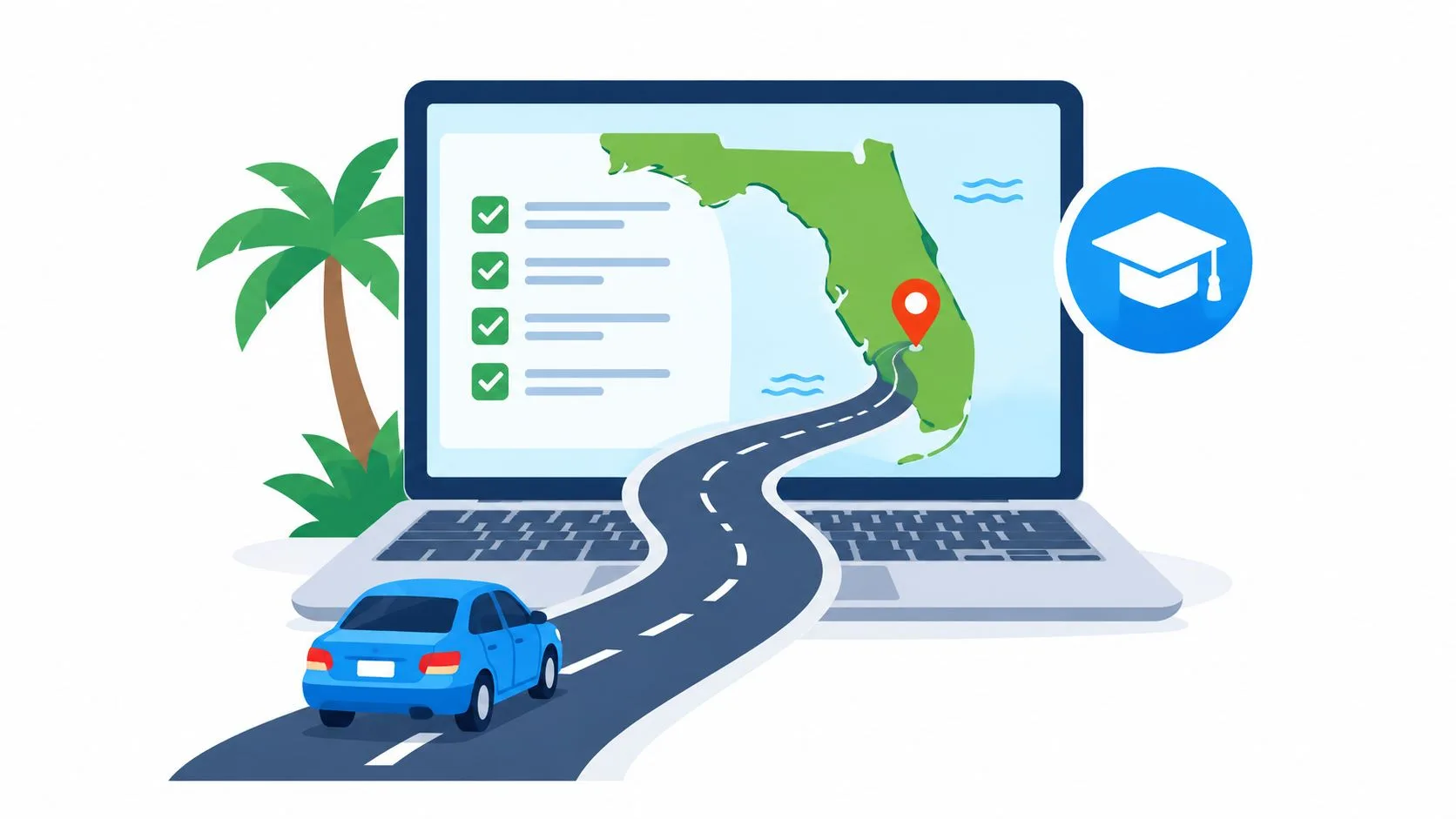
A common approach is to look for a classroom nearby. That makes sense. But for many seniors and families, a state-approved online course is the smarter move because it can satisfy the same insurance-discount requirement without the hassle of driving across town, sitting in a fixed-time class, or rearranging your week.
Maybe your renewal notice just arrived and the premium stung. Maybe a left turn felt more stressful than it used to. Maybe you’re helping a parent stay independent without ignoring real safety concerns. Those are all good reasons to act now.
A mature driver course isn’t remedial. It’s practical. It focuses on the exact issues older drivers face, and it gives you a clear path from enrollment to certificate to discount.
Unlock Savings and Confidence on the Road
A lot of seniors search for a nearby class when what they really want is relief. Relief from rising insurance costs. Relief from uncertainty in busy traffic. Relief from the feeling that driving has become less forgiving than it used to be.
A mature driver course addresses both the money side and the safety side. That’s why I recommend treating it as a smart maintenance step, not a last resort.

Why this matters right now
The driver population is older and growing. The Insurance Institute for Highway Safety reports there were approximately 35 million licensed drivers age 70 and older in 2023, and the U.S. population age 70 and older is projected to rise to 53 million by 2030. IIHS also notes that these courses address common errors for this age group, including inadequate surveillance at intersections, by emphasizing hazard scanning and risk awareness in its older driver research.
That matters because the point of a senior course isn’t memorizing road signs you already know. It’s learning how to compensate for changes in vision, flexibility, reaction time, and attention without giving up your independence sooner than necessary.
Practical rule: If driving still feels mostly comfortable but certain situations feel harder than they used to, a mature driver course is the right next step.
Nearby isn’t always better
A physical classroom can work. But it also creates friction. You have to get there, sit there, and match someone else’s schedule.
An online state-approved course usually fits real life better:
- No travel hassle if driving at night, in traffic, or in bad weather has become less appealing
- Self-paced learning so you can stop, take breaks, and return later
- Less stress for family members who are helping coordinate everything
- Same practical goal of completing an approved course and pursuing the insurance discount your state and insurer may offer
If part of your motivation is lowering overall vehicle costs, it also helps to review your policy and find cheap car insurance through an independent agency that can compare options.
The smart move is simple. Don’t just look for a course near you. Look for the easiest approved path that helps you finish it and use it.
Lower Your Insurance and Sharpen Your Skills
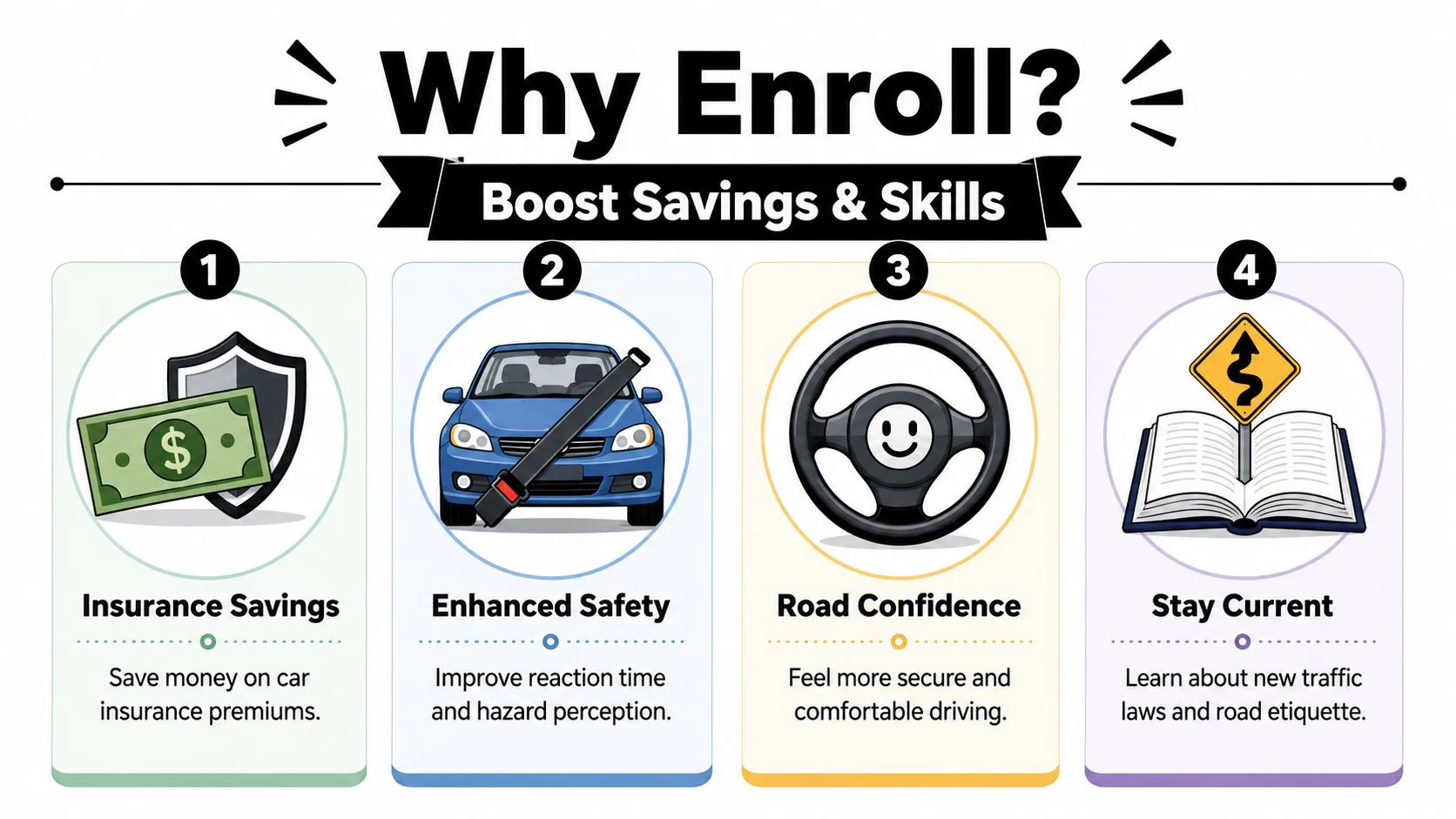
The two strongest reasons to take a mature driver course are obvious. You may save on insurance. You may drive better afterward.
Those aren’t separate benefits. They reinforce each other. Insurers reward approved senior courses because the course content focuses on the exact decisions that reduce risk.
The insurance discount is real
In many states, drivers over a certain age who complete an approved mature driver course are eligible for a mandatory discount. Pennsylvania states that drivers 55 and older may receive a 5% vehicle-insurance discount after completing the Basic Mature Driver Improvement course, and Connecticut says drivers 60 and older who complete a DMV-approved four-hour mature driver course can receive a 5% premium discount for up to two years, as shown on Pennsylvania’s mature driver course information page.
That is exactly why approval matters so much. If the course isn’t recognized by the state or insurer, you’ve spent time without getting the financial payoff you wanted.
If you’re comparing approved options, the mature driver discount course page is the kind of place to check whether the course is built for the insurance-discount purpose rather than general traffic school needs.
What the course actually improves
Some people get the wrong idea. A senior defensive driving course isn’t trying to turn an experienced driver into a beginner again.
It sharpens the skills that tend to slip gradually over time:
- Intersection judgment when multiple vehicles, signals, and pedestrians compete for attention
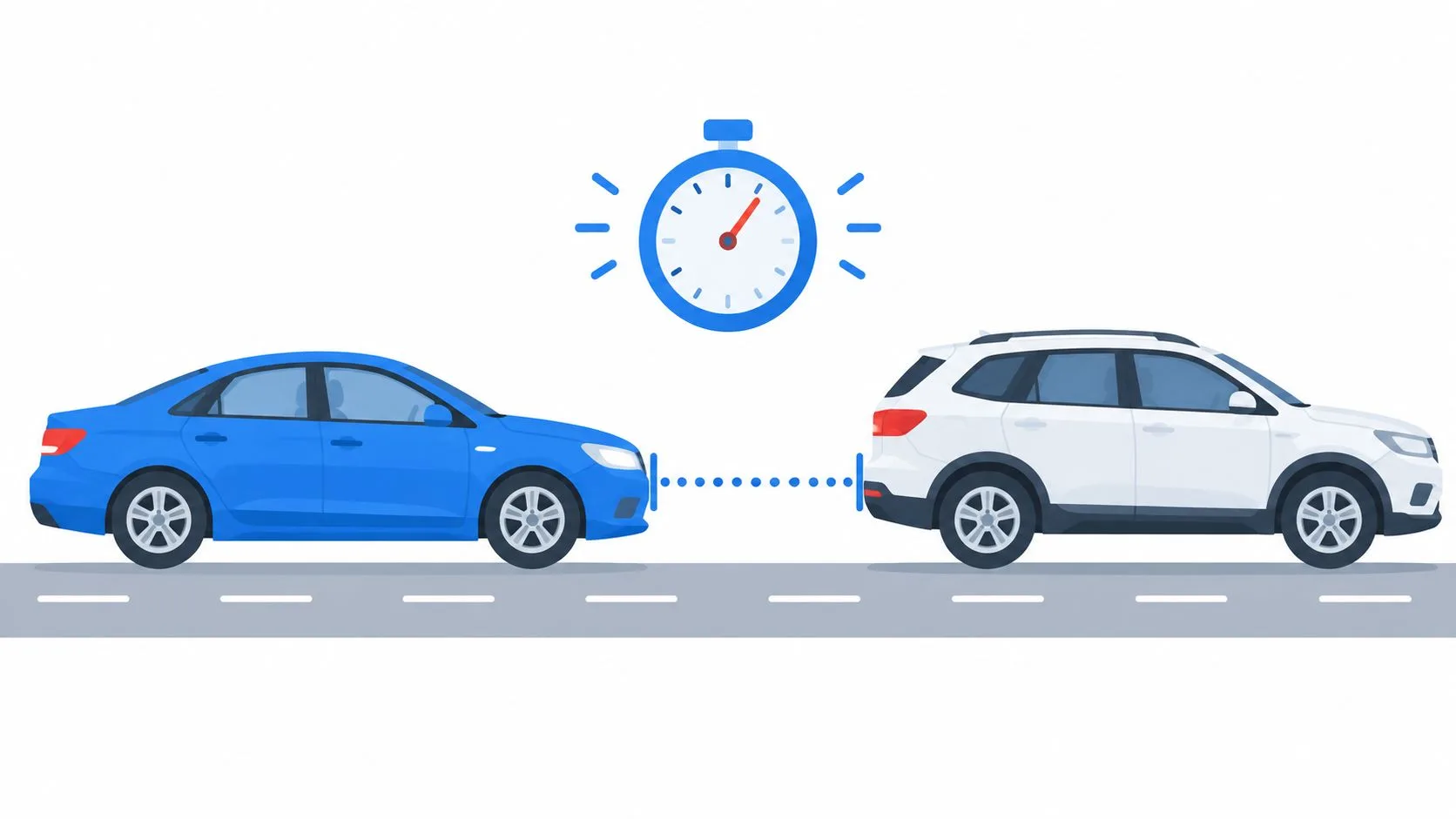
- Hazard scanning so “looked but didn’t see” mistakes happen less often
- Right-of-way decisions in left turns, merges, and uncontrolled intersections
- Risk awareness when traffic density, unfamiliar roads, or distraction increase the chance of an error
IIHS reports that the most common error in crashes involving seniors is failure to yield the right-of-way, and it also cites inadequate surveillance as the most frequent error among crash-involved drivers age 70 and older. That is why mature driver courses focus so heavily on scanning, timing, and decision-making in complex traffic situations.
A good mature driver course respects experience. It doesn’t talk down to older drivers. It updates habits that no longer fit modern roads.
Why this feels empowering, not punitive
Most seniors don’t want a lecture. They want to keep driving safely, comfortably, and on their own terms.
That’s what makes the right course valuable. You leave with a clearer understanding of how to handle today’s roads, and you have documentation that may lower your premium. That combination is hard to beat.
How to Choose Your State-Approved Senior Driving Course
The phrase defensive driving course for seniors near me points you in the right direction, but it doesn’t tell you how to choose well. That’s where people waste time.
The first filter isn’t distance. It’s approval.
Start with the one thing that can’t be optional
If the course isn’t state-approved for the purpose you need, move on. Don’t negotiate with that. Don’t assume “defensive driving” and “mature driver” mean the same thing.
Florida is a good example of why this matters. Verified guidance provided for this topic states that Florida traffic schools report a 99.99% success rate for state-approved programs because they follow strict FLHSMV curriculum guidelines, and that 45% of seniors miss out on premium reductions because they chose courses without the required Mature Driver designation. That’s why I tell people to verify the provider’s state recognition first, such as checking Florida approval details through the Florida Highway Safety and Motor Vehicles course information.
In-person versus online
A classroom still has a place. Some seniors prefer face-to-face instruction, especially if they dislike screens or want the routine of attending in person.
But online usually wins for practical reasons.
| Format | Where it helps | Where it falls short |
|---|---|---|
| Classroom course | Good for people who prefer a scheduled group setting | Requires travel, fixed timing, and more effort |
| Online course | Better for flexible pacing, home access, and convenience | Requires basic comfort using a computer, tablet, or phone |
AAA notes that senior driver programs may be available in classroom, online, or both, and California DMV materials show mature driver courses for drivers 55 and older focus on laws plus age-related factors such as medication, fatigue, alcohol, and sensory limitations. The bigger issue often isn’t location. It’s choosing the format that fits the driver’s actual needs.
My advice: If the senior can comfortably use a tablet, smartphone, or computer, choose online and make the process easier from the start.
A short checklist before you register
Use this screen-before-you-buy approach:
- Confirm state approval for your state and your specific reason for taking the course.
- Confirm the course type is a mature driver or senior discount course, not a generic violation class.
- Check certificate handling so you know whether reporting is electronic, downloadable, mailed, or some combination.
- Check pacing and language support if the driver needs breaks or prefers Spanish or Portuguese.
- Call your insurer first and ask whether the exact course will qualify for the discount.
Most mistakes happen because people assume all driving courses are interchangeable. They aren’t.
What to Expect from Your Online Mature Driver Program
Many seniors hesitate at the word “online.” They assume it will be technical, confusing, or full of timers and traps.
A well-designed online mature driver course should feel the opposite. It should feel calm, clear, and easy to complete in small chunks.
What the experience usually looks like
You register online. You create a login. You start when you’re ready.
Then you work through the material at your own pace. You can log out, make lunch, answer the phone, take a nap, and come back later without losing your place.
That flexibility is one of the biggest advantages of online learning. You’re not trying to absorb everything in one sitting while keeping up with a room full of strangers.
What the course should include
Verified guidance for this topic states that effective online senior courses use a 6-hour minimum curriculum with self-paced, multi-language support and modules on managing distractions. That same guidance says this approach leads to 97% self-reported improvement in driving behaviors.
The point isn’t the number alone. The point is the method. Senior-focused courses work better when they are built around the realities of older driving, not pasted together from a general traffic-school template.
Look for these features:
- Self-paced access so the course fits your energy level and schedule
- Plain-language lessons instead of dense legal text
- Real traffic scenarios that cover intersections, following distance, distractions, and right-of-way
- Multiple device access so you can use a desktop, laptop, tablet, or phone
- Simple progress tracking so you always know what you’ve finished
For people who want this kind of flexibility, self-paced online courses are the standard to look for.
What it shouldn’t feel like
It shouldn’t feel like school. It shouldn’t feel like a punishment. And it definitely shouldn’t feel like a technical obstacle course.
The best online mature driver programs are refreshers, not ordeals.
If you’re helping a parent, sit with them for the first login if needed. They often relax once they see that the process is straightforward. After that, they usually do just fine on their own.
From Certificate to Savings How to Get Your Discount
Finishing the course is only half the job. The other half is making sure the discount gets applied.
Seniors lose easy savings. Not because they failed the course, but because they never completed the insurance follow-through.
Do these steps right away
As soon as you complete the course, keep a copy of your certificate. If the provider reports completion electronically, that’s helpful, but don’t assume your insurer will automatically update your premium without hearing from you.
Use this checklist:
- Save the certificate as a PDF or printed copy.
- Confirm state reporting if your state requires or allows electronic submission.
- Call your insurance company or agent and say you completed a state-recognized mature driver course and want to apply any available discount.
- Ask exactly what proof they need, whether the discount starts immediately, and when it expires.
- Set a reminder if your insurer requires renewal after a certain period.
If you need proof of completion in a simple digital format, a provider that offers an online driving certificate makes this step much easier.
Ask your insurer the right questions
The mature driver discount rules vary by state and insurer, and that it is important to understand your insurer’s process for applying the discount and how long it stays active.
Don’t just ask, “Do I get a discount?”
Ask these:
- Is this course approved for my policy?
- How do I send proof of completion?
- When will the discount appear?
- How long does it last?
- Will I need a refresher course later?
A simple script you can use
Say this:
I completed a state-recognized mature driver course and would like to apply any available senior driver discount to my policy. What document do you need from me, and when will the updated premium take effect?
Short. Clear. Effective.
Your Senior Driving Course Questions Answered
Does every senior driver just need a course
No. Sometimes a course is the right answer. Sometimes it isn’t.
Many families search for a class when the better next step is an adaptive driving evaluation or a physician-referred assessment. California DMV materials make this distinction useful because they connect mature-driver concerns to issues like medication, vision, hearing, fatigue, and mobility in its approved mature driver program guidance.
If the driver is generally safe but a little rusty, choose a course. If the driver is getting lost, missing signals, confusing pedals, or showing major physical limitations, get a professional evaluation.
How do I know whether online is realistic
Ask one practical question. Can the driver use a phone, tablet, or computer well enough to open a browser, log in, and read on screen?
If yes, online is usually realistic. If not, a family member can often help with setup, or an in-person option may be a better fit.
Will any defensive driving class qualify for the discount
No. That’s one of the biggest mistakes people make.
The course must match the state’s rules and the insurer’s requirements. A generic traffic class may not count as a mature driver course for discount purposes.
Is this mainly about saving money or staying safe
Both. It should be both.
If you only focus on the discount, you may choose the wrong course. If you ignore the discount, you may leave easy savings on the table. The smartest choice is an approved course that refreshes real-world driving judgment and gives you the paperwork needed to pursue the insurance benefit.
What if my parent doesn’t want to take a course
Then don’t frame it as “You need help.” Frame it as “Let’s protect your independence and see if we can lower your premium too.”
That usually lands better. Most older drivers respond well when the course is presented as a practical update, not a threat to their freedom.
What’s the best next step
Pick the course type first. Then verify approval. Then register.
If the goal is convenience and discount eligibility, an online mature driver course is usually the most efficient path. If the bigger concern is physical or cognitive ability, pause and seek an evaluation before signing up for any class.
If you’re ready to stop searching and start finishing, BDISchool offers state-approved online driving courses that fit the exact needs many seniors care about most: convenience, simple certificate handling, and a clear path toward insurance-discount eligibility where applicable. Choose the approved option that matches your state and purpose, complete it at your own pace, and turn this from a vague “near me” search into a result that saves you time and money.