You have 30 days from the citation date to elect a Florida-approved driver improvement course through the clerk of court, and 60 to 90 days from that same citation date to finish the course and get proof to the clerk, with the court setting the exact completion date.
Those two numbers decide whether a ticket costs you points.
Nobody loses the point-avoidance option because the course was too hard. Drivers lose it because they registered for a class, felt finished, and never filed anything with the county. The citation stayed open, the deadline passed, and the infraction got treated as an admission.
The rule that trips people up: a finished course is not a closed citation. Only the clerk closes it, and only when proof of completion lands in the file.
Florida traffic school rules work as a chain of deadlines. Break one link and the rest don't matter.
Florida Traffic School Rules at a Glance
The citation date starts two separate clocks: 30 days to elect traffic school and pay the required fines and fees, then the court's deadline to finish the course and file proof. The election is your formal request to the clerk of the county that issued the ticket to take an approved driver improvement course instead of accepting points for a qualifying noncriminal moving violation.
FLHSMV's traffic citation guidance sets the election and payment deadline at 30 days from the citation date. Miss either requirement and you may lose the course option, face additional penalties, or risk license suspension.
What Election Really Means
The clerk must record your election. Buying or starting a course does not close the citation, and the court needs proof of completion by its deadline.
After election, you generally have 60 to 90 days from the citation date to complete the course and provide proof. The court sets the deadline for your case. Miss it, and the infraction can be treated as an admission of guilt, with points assessed.
| Rule | Requirement | If Missed |
|---|---|---|
| Election deadline | Elect through the clerk of court within 30 days of the citation date | You may lose the election option |
| Fines and fees | Pay the required fines and fees within the 30-day window | Possible license suspension and additional penalties |
| Completion window | Finish the course and file proof by the court deadline, normally 60 to 90 days from the citation date | The infraction can be treated as an admission, and points may be assessed |
| Election frequency | Once per 12-month period | You cannot elect traffic school |
| Lifetime limit | No more than eight elections in a lifetime | You cannot elect traffic school |
Three limits also apply. Commercial driver-license holders are generally excluded, even when cited while driving their own car. Traffic school election is limited to once per 12-month period and no more than eight times in a lifetime. The eight-election limit took effect July 1, 2024, as explained on FLHSMV's citation page.
Completing the process correctly means adjudication is withheld and points are not assessed for that citation. FLHSMV's traffic citation guidance also describes an 18% reduction in the citation fee.
Check the date on your citation and count 30 days forward. Elect through the clerk, pay the required amount, complete the course, and make sure proof reaches the court before its deadline.
Points, Suspensions and What Traffic School Prevents
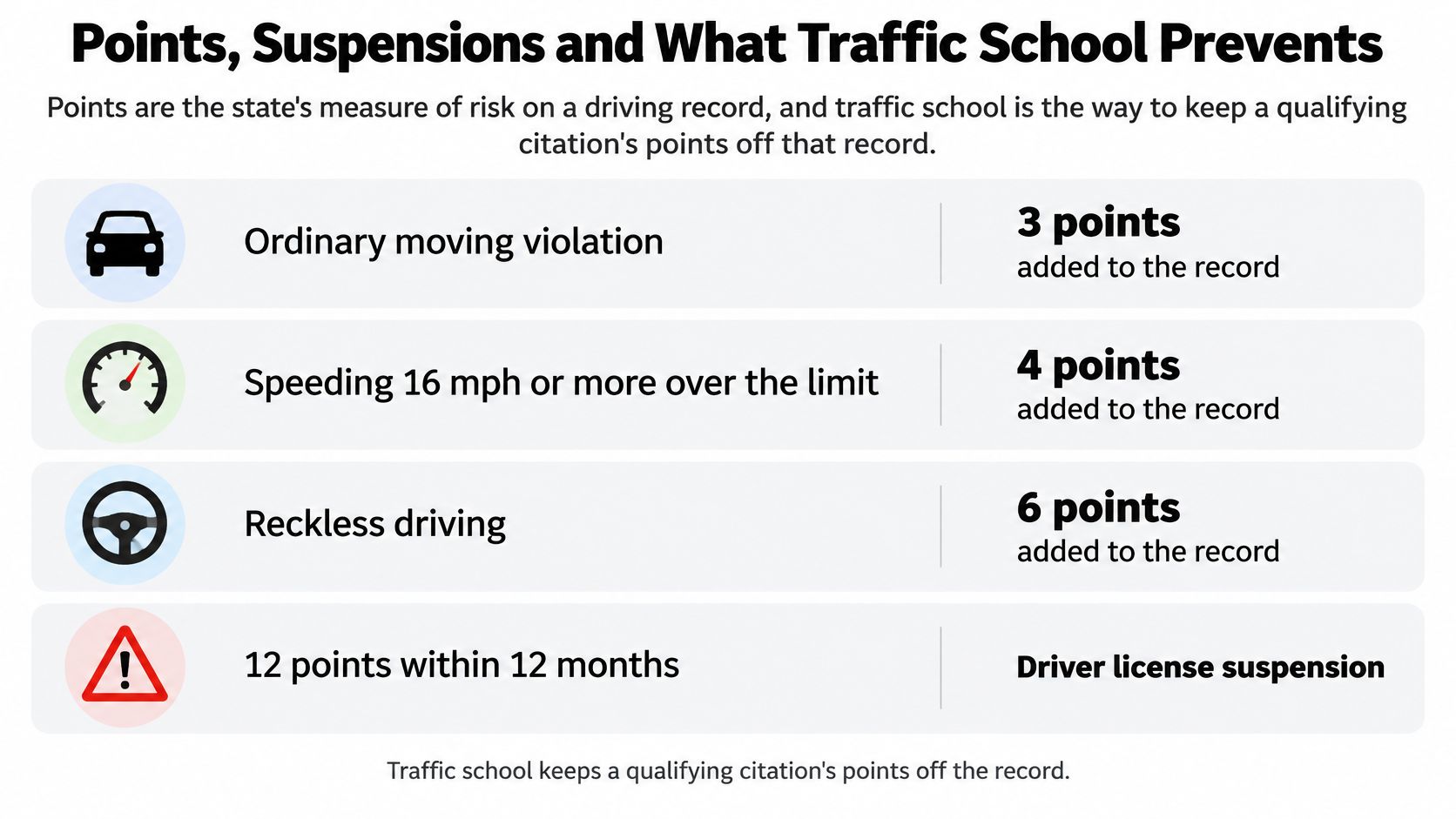
Points stay on your driving record and can lead to a license suspension. A qualifying traffic-school election can prevent points from being assessed for that citation, but only if you meet the course and court requirements.
| Violation | Points assessed |
|---|---|
| Ordinary speeding | 3 points |
| Careless driving | 3 points |
| Failing to yield | 3 points |
| Disobeying a traffic-control device | 3 points |
| Failing to yield to a pedestrian | 3 points |
| Reckless driving | 4 points |
| Certain school-bus violations | 4 points |
| Leaving a crash without providing required information | 6 points |
Where Points Turn Into a Suspension
Florida suspends a license when a driver accumulates enough points within a set period. The practical risk is straightforward: repeated violations can add up, even when none seems serious on its own.
Four ordinary 3-point violations would total 12 points. Two 6-point violations would reach the same total. Check your driving record and understand the point consequences of each citation. Our guide to Florida points and traffic violations explains how points relate to common violations.
What the Election Does and Doesn't Erase
A traffic-school election can keep points from being assessed for the citation when you qualify and complete the course and court requirements. It does not erase the citation or remove the record of the election.
If your ticket involves following too closely, read rear-end collision fault rules explained for context on how fault arguments relate to that type of crash. Don't assume the citation is resolved when you pay for a course or begin studying. The court still needs proof of completion.
Who Qualifies and Who Is Excluded
Eligibility depends on the citation, your license and election history. A standard-license driver with a recent, noncriminal moving violation may qualify, but paying for a course does not establish eligibility or close the citation.
The Three-Part Test
Check that the citation is for a noncriminal moving violation and that you meet the election requirements. A routine speeding citation may qualify; an offense requiring a court appearance may not. Confirm your specific case with the clerk before enrolling.
| Situation | Eligible to Elect | Reason |
|---|---|---|
| Standard license, noncriminal moving violation within 30 days | Generally yes | May qualify for the point-avoidance election |
| Commercial driver-license holder | Generally no | CDL holders are generally excluded, even when not driving a commercial vehicle |
| Election already used in the past 12 months | No | Limited to one election per 12-month period |
| Ninth lifetime election | No | Limited to eight elections in a lifetime |
| Criminal traffic offense | No | The election applies to noncriminal moving violations only |
| Citation older than 30 days | No | The 30-day election window has closed |
Drivers Who Worry Most
Drivers commonly let a ticket sit while work and other obligations take over, then discover the 30-day election window has closed. Check the citation date promptly and confirm the deadline with the clerk. Starting or paying for a course does not by itself notify the court that you elected traffic school.
An out-of-county citation still goes through the clerk in the county that issued it. Contact that clerk to confirm your requirements before enrolling.
Commercial driver-license holders should review Florida traffic school rules for CDL holders before paying for a course. BDISchool offers Florida's Basic Driver Improvement Course, also called Florida Four-Hour Traffic School, for drivers who have recently received a moving violation. The course helps drivers avoid points, but CDL holders should confirm their eligibility with the clerk first.
Verify eligibility and the clerk's requirements before you enroll. Keep the completion paperwork, because the citation is not closed until the court receives proof of course completion.
How to Elect Traffic School Step by Step
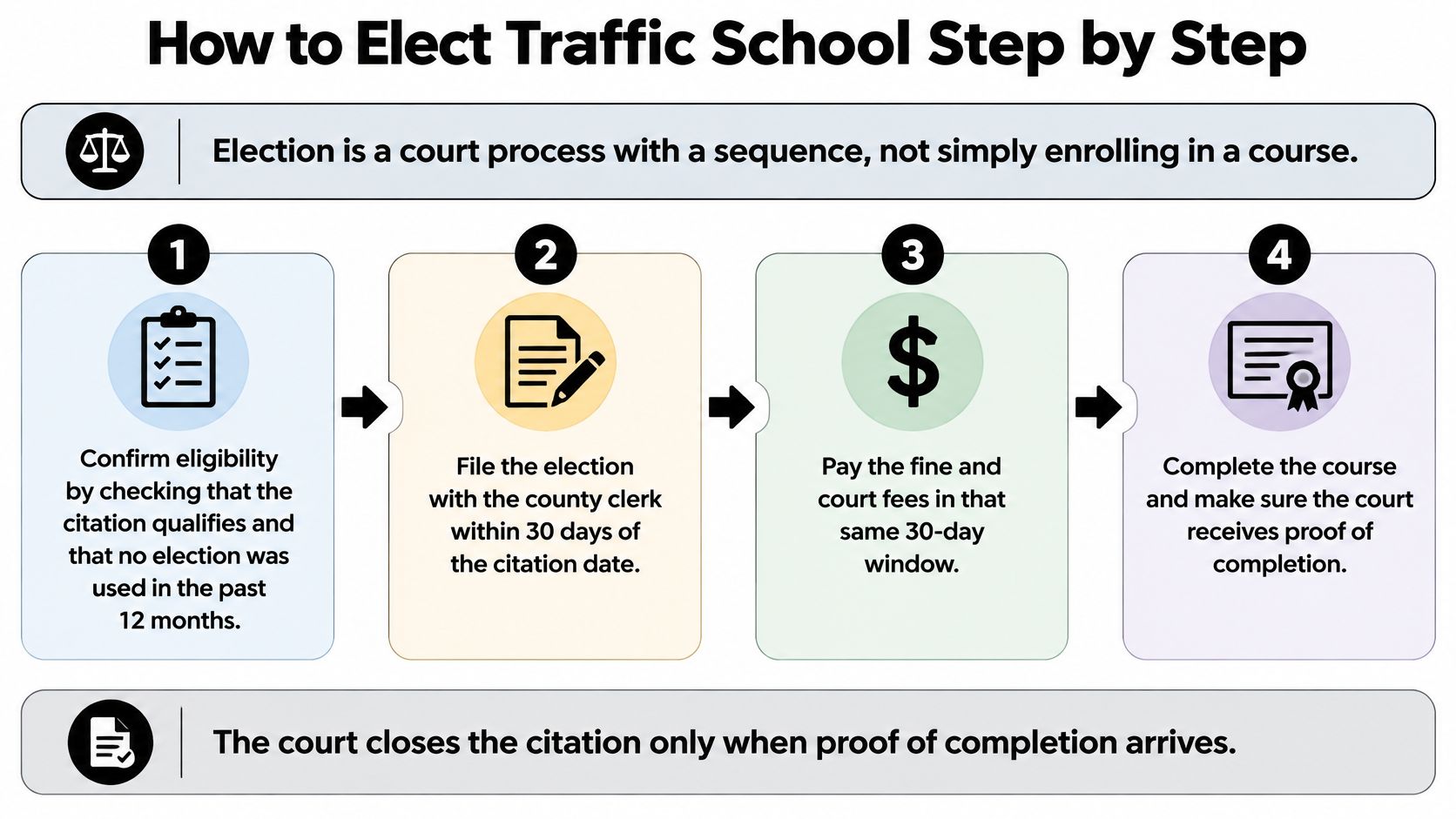
Election is a court process with a sequence, not a course purchase. Florida's driver improvement school guidance treats BDI as a time-critical legal election: elect through the clerk within 30 days, pay the required fine and fees, and complete the approved course by the court's deadline.
The Six Steps in Order
Confirm eligibility. Check that the citation is a noncriminal moving violation and that you hold a standard, non-commercial license. This takes one phone call or one look at the county clerk's portal, and it prevents the worst outcome: paying for a course that can't be credited to your case.
Notify the clerk of court and elect a Florida-approved Basic Driver Improvement course within 30 days of the citation date. This is the step that creates the option. Registering with a school does not constitute an election, no matter what the confirmation email implies. Missing this deadline forfeits point avoidance for that citation, permanently.
Pay the required fine and fees in the same window. A filed election with an unpaid balance doesn't hold. Failure to pay can lead to a license suspension on top of the citation you were trying to manage, so treat payment as part of the election rather than a separate chore.
Register for the approved course. The registration form asks for your name, driver license number and email address, and that information is what generates your completion certificate at the end of the course. Get it right the first time. A typo in a license number creates a certificate the court can't match to your case.
Complete the course, including the final exam and identity validation. Our course is state-approved and meets all requirements set by the Florida DMV, so the certificate you earn is the document the clerk is waiting for. Budget real time for this step rather than squeezing it into the last evening of the completion window.
Submit proof of completion to the clerk before the court deadline, then confirm receipt. Cases can go wrong. A certificate sitting in your inbox is not proof in the court file.
Warning: completing the course does not close the case. Only the clerk closes it, and only after proof arrives.
Why Step 6 Decides the Case
Failing to complete the course or submit proof can trigger suspension or other enforcement, and a driver who pays but never finishes gets treated as having admitted the infraction. The clerk then reports the failure and points are added.
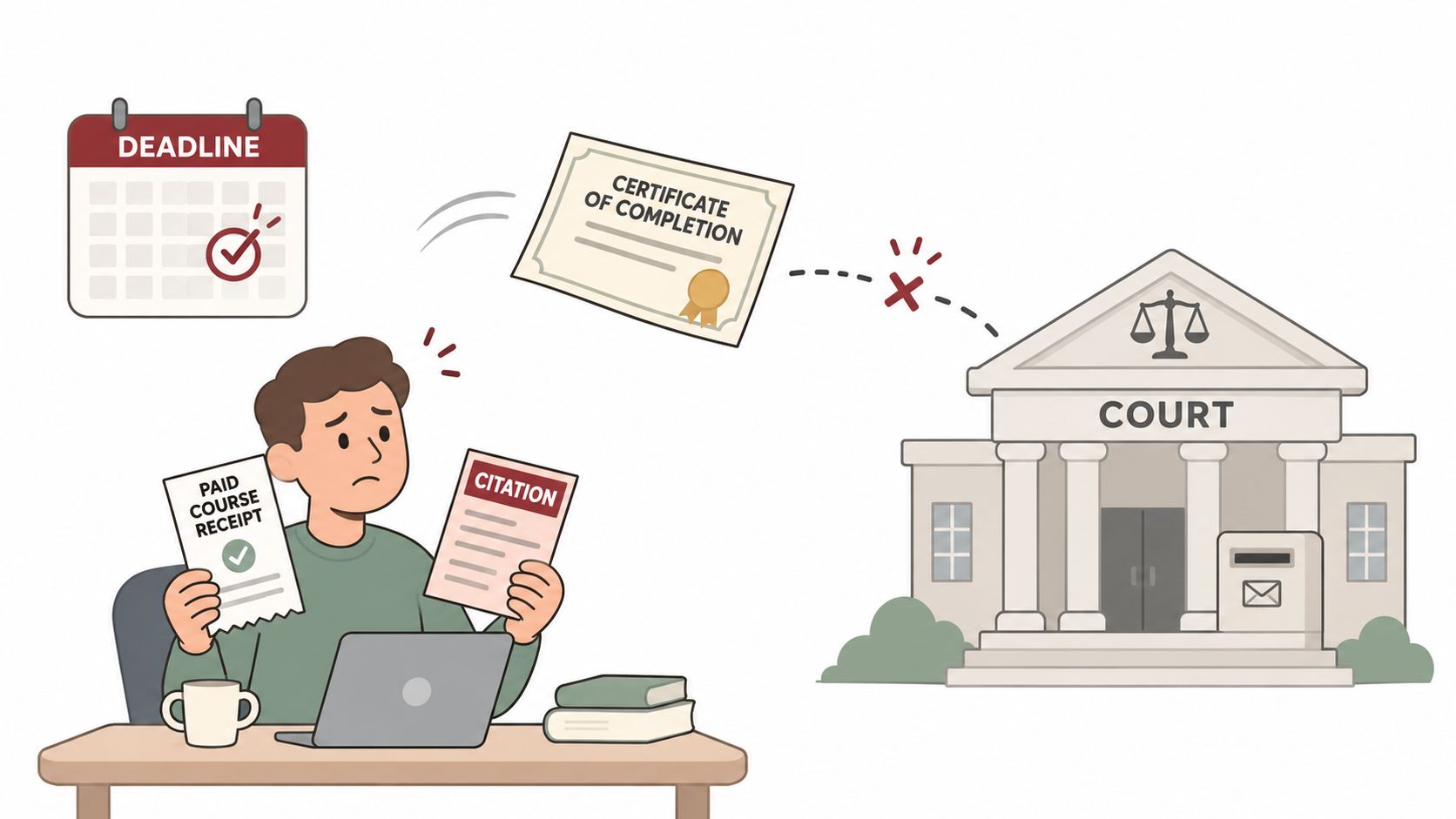
Keep three documents together until the case is closed: the payment receipt, the certificate of completion, and the clerk's confirmation that the certificate was received. Verify eligibility with the clerk before enrolling, and never assume a provider's "complete" status means the court knows anything.
If you're also dealing with a hearing date or a court order, our guide to Florida traffic court rules covers how those intersect with the election.
Paperwork Problems That Cost Drivers Points
Paying and finishing a course does not close a citation. Only proof received by the court does, and the gap between those two facts is where drivers lose points they thought they'd saved.
A driver who doesn't finish inside the court's completion window can be treated as having admitted the infraction. Points get assessed. Nothing about a half-finished course, or a finished course with an unfiled certificate, changes that.
Where the Chain Breaks
| Problem | Likely Cause | Fix |
|---|---|---|
| Course finished but points still show | Proof not yet received by the clerk or court | Ask the clerk to confirm receipt of completion proof in writing |
| Provider shows complete, court shows pending | Provider and court records not synced | Send the certificate and payment receipt to the clerk and request an update |
| Election window passed | Election not made within 30 days of the citation | Option is lost; check the status of points with the clerk |
| Paid but course not finished in time | Completion window missed | Finish as early as possible and contact the clerk before the deadline |
| Final exam not passed | Assessment requirement not met | Retake the assessment as allowed by course guidelines |
The Requirements That Cause Delays
Two requirements inside the course itself cause most of the last-minute failures:
- The final exam and any other in-course assessments. Students must pass the final exam and any other in-course assessment requirements set by course guidelines. A failed attempt near the deadline is a scheduling problem you can't argue your way out of.
- Identity validation. Students must pass identity validation requirements during the course, which can include biometrics, security questions or other required methods. Do this on a device with a working camera, in a quiet room, not in a parking lot on your lunch break.
When the provider portal and the court record disagree, call the clerk. The provider can resend a certificate; only the clerk can update the case.
Our traffic school completion check walks through how to verify what the court has on file.
Do this before you relax: ask the clerk for written confirmation that your completion proof has been received. Screenshot the confirmation and keep it with your receipt.
Florida Traffic School Course Questions
Can You Take the Course Online
Yes. Florida's Basic Driver Improvement Course, also called Florida Four-Hour Traffic School, is available online. Register and start on the BDISchool website, then work through the course at your own pace.
Which Course Counts
Choose a state-approved course that meets Florida DMV requirements. BDI School is an HSMV-approved Basic Driver Improvement School, and its course is approved for all Florida courts and counties.
Before you can use the course, complete the registration form with your name, driver license number and email address. This information is used to generate your completion certificate. You must also pass the final exam, any other required course assessments and identity validation.
Where Do You Start
After the clerk has your election and payment, register for the BDISchool Florida courses and begin the course. Start early enough to complete all course requirements before your deadline.
Does a Completed Status Close the Citation
No. The court needs proof of completion before its deadline. A completed status in the provider's system does not confirm that the clerk has received the certificate. If the records disagree, send the certificate and payment receipt to the clerk and request written confirmation.
Enroll in a Florida Traffic School Course Now
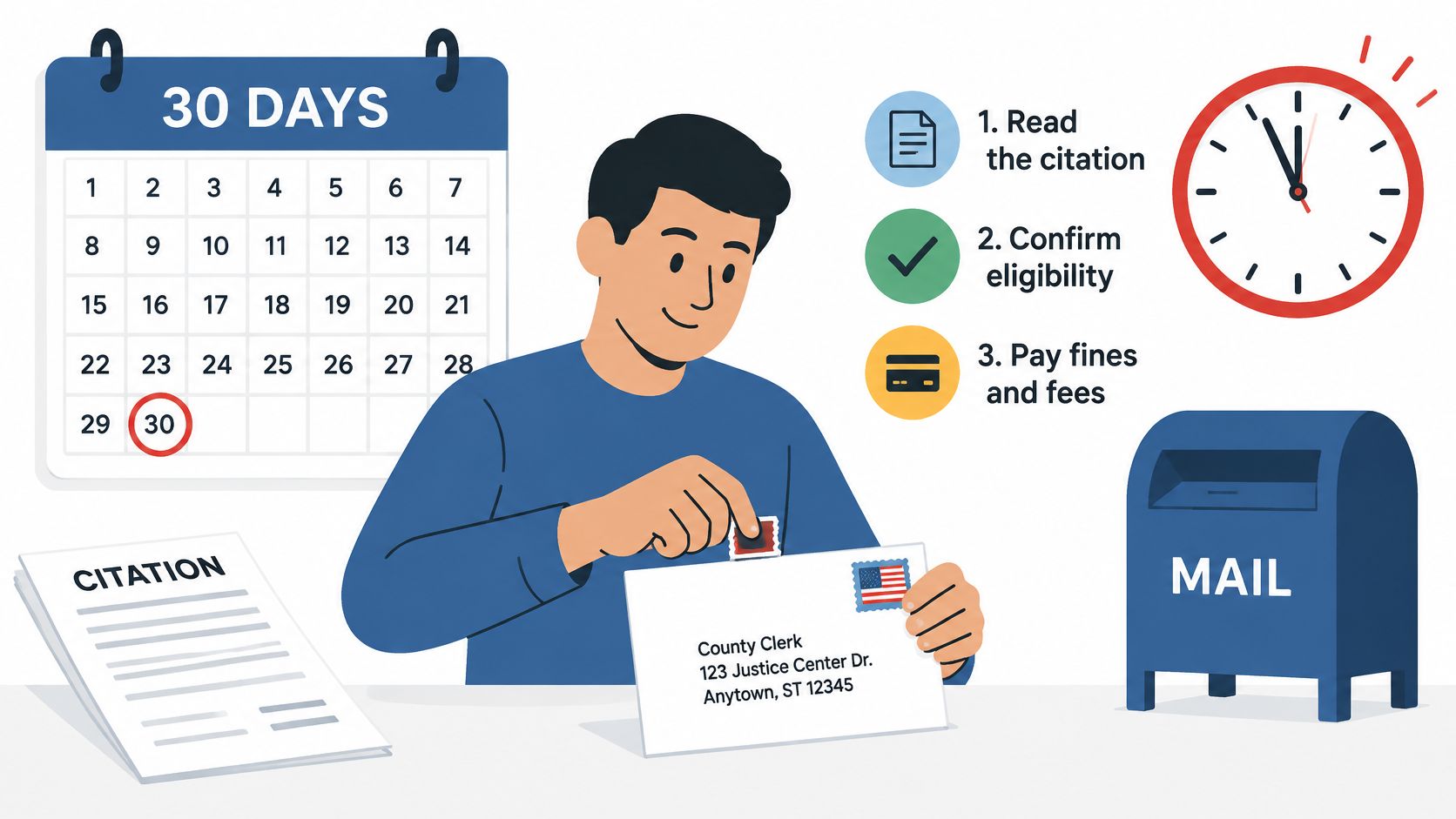
Start with the date on the citation, not with the course catalog. The election has to reach the county clerk inside 30 days, with the fine and fees paid in that same window, or there's nothing left to enroll for.
The Order to Do It In
- Read the citation date and count 30 days forward.
- Confirm the ticket is a noncriminal moving violation and that your standard, non-commercial license is eligible, including the one-election-per-12-months limit and the lifetime cap.
- Elect the FLHSMV-approved Basic Driver Improvement course with the clerk and pay the required fine and fees.
- Register and start the four-hour course at BDISchool from a phone, tablet or laptop.
- Finish the final exam and identity validation, send the certificate to the clerk before the court deadline, and ask for written confirmation of receipt.
The payoff is concrete. A completed election can withhold adjudication, keep points off that citation, and reduce the citation fee. Completing the course also means no insurance rate increase from that moving violation, and you can register and start on the website the same day you elect.
One cushion worth knowing about: a full refund is made to a student who requests cancellation of the enrollment contract within thirty calendar days from the date of purchase, including weekends and holidays, and who has not completed the course or obtained a certificate of completion. That's not a reason to delay. It's a reason not to stall.
Register, keep the certificate, and file proof with the clerk before the deadline. The course takes four hours. The filing is what saves your record.
BDISchool offers Florida's state-approved four-hour Basic Driver Improvement course, built for drivers working through exactly this election and the paperwork that follows it. Register, complete the final exam and identity validation, and you'll have the certificate the clerk needs to close your citation. Start today at BDISchool so the filing happens well before the court's deadline, not on it.