You got a citation last week. It’s still in your console, maybe under a coffee receipt, and the deadline on it is doing quiet damage to your plans.
You’ve heard a defensive driving certificate can make the whole thing disappear. Some of that is true. Some of it is repeated by people who’ve never filed a completion notice with a clerk of court.
Here’s the version I give drivers who call frustrated: the certificate is not a magic document. It’s a deadline-driven legal record, and whether it helps you depends on which of four jobs you’re asking it to do.
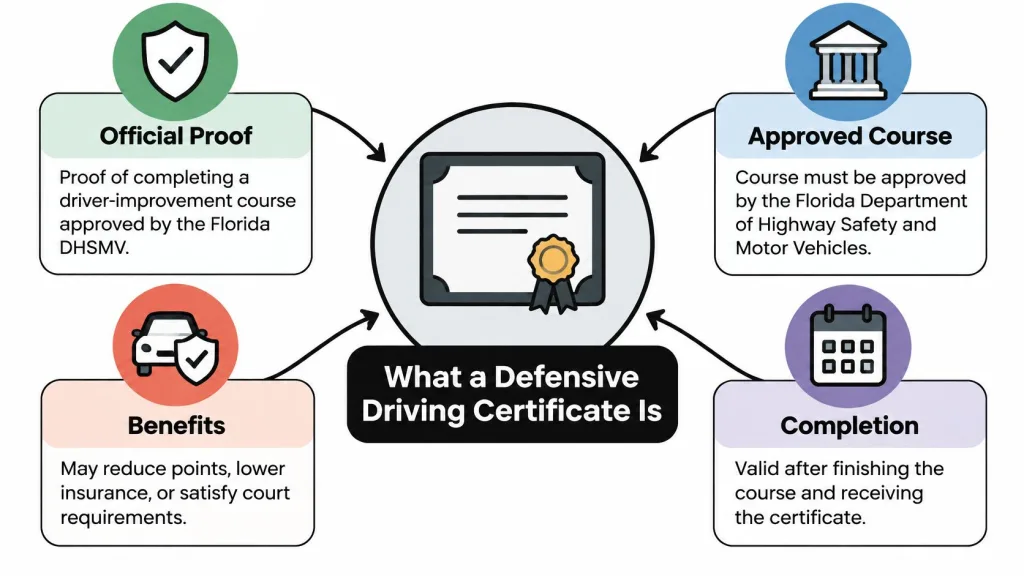
What a Defensive Driving Certificate Is
A defensive driving certificate is official proof that you completed a driver-improvement course approved by the Florida Department of Highway Safety and Motor Vehicles (FLHSMV). Treat it like a receipt for safety training, one that a court clerk, the state and your insurer can each verify on their own.
You don’t get it for showing up. The certificate is generated from the name, driver license number and email address you enter at registration, and it’s issued only after you finish every lesson and pass the final exam. Typo in the license number means a record that doesn’t match you, and that takes days to untangle.
The same document does four different jobs in Florida:
- Keeping points off your license after an eligible moving violation.
- Satisfying a court order when a judge requires a course.
- Supporting an insurance discount you took voluntarily.
- Documenting a refresher you completed for your own reasons.
Each job runs on its own rules, its own deadline and its own definition of success. A certificate that saves your license may be worthless for a discount. A certificate that earns a discount may do nothing for a ticket.
The certificate isn’t a prize for finishing a course. It’s the legal and financial door it opens, and the door only opens if you file it in time.
That paperwork tradition is old. The first known driver-education programs appeared between 1910 and 1920, formal courses took hold in the 1930s, and by 1949 a common model ran 30 hours of classroom teaching plus 6 hours behind the wheel, according to NHTSA’s review of driver education. Enrollment in the United States peaked in 1976, when about 3,200,000 students in 17,000 public schools took driver-education courses.
If you drive for a living, the techniques behind the certificate matter as much as the paper, and this fleet safety guide for small carriers covers what commercial drivers should practice.
Which of the four jobs brought you here? Name it now, because it decides which course you enroll in and where the paper has to land.
When Florida Drivers Need a Defensive Driving Certificate
Find your situation in the table, then read the rows that follow. The course length and the outcome are what make each certificate useful.
| Your situation | Course | Hours | What the certificate does |
|---|---|---|---|
| Moving violation with points at stake | Basic Driver Improvement (BDI) | 4 | Adjudication withheld and no points added |
| Court-ordered driver improvement | Intermediate Driver Improvement (IDI) | 8 | Satisfies the court requirement |
| Aggressive driving or road rage referral | Aggressive Driver Course | 8 | Documents completion of the behavior-focused program |
| Driver aged 55+ refreshing skills | Mature Driver Course | 6 | Supports the mature-driver insurance discount |
| Voluntary refresher for an insurance discount | Approved defensive driving course | 4-6 | Submitted to the insurer for a possible discount |
If you’re reading this, you’re likely in the first row. A ticket arrived, the points are real, and the 4-hour Basic Driver Improvement course is the standard route out.
The ticket row, explained
The mechanism is simple once you see it. The FLHSMV driver improvement course FAQ sets out both the payoff and the limits. Elect the course for an eligible moving violation, complete it, and adjudication is withheld, which means points are not added to your license record.
The limits are narrow. A second infraction within 18 months, a third within 36 months, or speeding more than 15 mph over the limit each disqualifies the election. If you’re already carrying one of those, stop shopping for a school. Call the clerk and ask what options remain, because paying for a course you can’t elect is money you won’t get back.
Who gets turned away
Drivers assume the course is always available. It isn’t.
Eligibility is checked against your record at the moment of election, not at the moment of the violation. A ticket you forgot about from last year can disqualify the one you’re holding now. Pull your driving record before you register, not after.
If a judge ordered you into a course, you’re in a different lane. Court-ordered drivers are usually placed in the 8-hour Intermediate Driver Improvement course, and the deadline belongs to the court, not to you. Road rage or habitual aggressive driving referrals take the 8-hour Aggressive Driver Course. Drivers 55 and older who want to keep an insurance discount take the 6-hour Mature Driver Course.
Practical rule: the course you take must match the paperwork you were given. A four-hour BDI certificate does not satisfy an eight-hour court order.
The filing step that decides everything
Drivers lose the benefit they paid for at this point. Completing the course does not replace filing proof. You still have to submit proof of completion to the clerk of court in the county where the citation was issued, and that’s a separate action from finishing your lessons.
The chain is unforgiving. Timely election plus verified completion keeps the citation from producing points. Miss the election, miss the filing, or file in the wrong county, and the ordinary conviction and point consequences come back into play.
Nobody calls to remind you. The clerk’s office processes what arrives. Set the filing date in your calendar the day you enroll, and treat it as a second deadline with the same weight as the first.
How to Earn a Defensive Driving Certificate in Florida
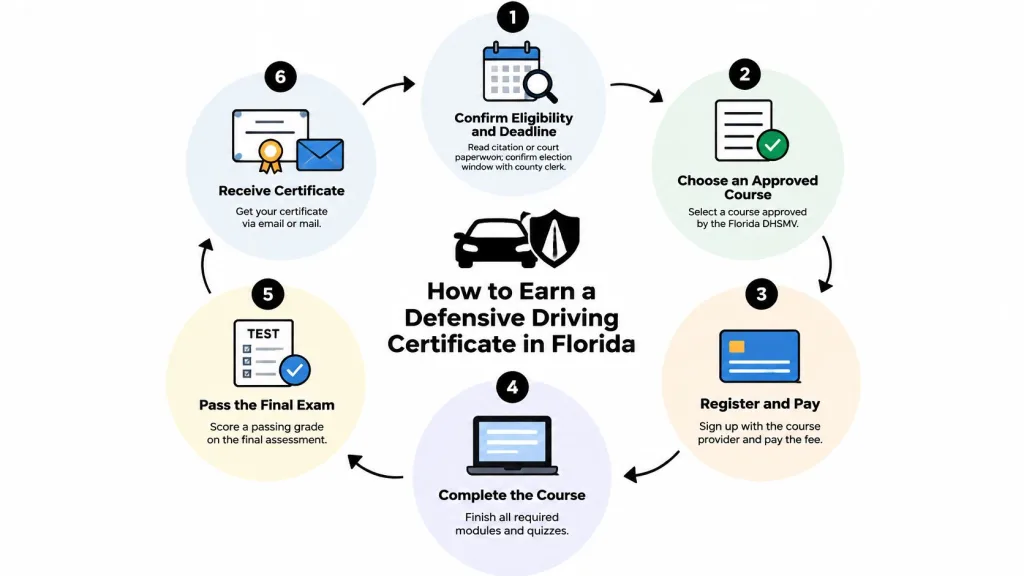
The path from citation to filed certificate has six steps. Each one carries a document, a deadline or a common slip, so work through them in order.
- Confirm eligibility and your deadline. Read the citation or the court paperwork carefully. For a ticket, confirm the election window with the county clerk before you pay a school anything. The classic slip is enrolling during deadline week, which leaves no room for the reporting lag that follows your final exam.
- Register with a Florida-approved school. Registration asks for your name, driver license number and email address, and those details generate the completion certificate at the end of the course. Enter them exactly as they appear on your license.
- Complete the 4-hour Basic Driver Improvement course online. The course is four hours long and you can read how the course hours work in one sitting or across several short sessions, on any device.
- Finish every lesson, pass the final exam and clear identity validation. Expect security questions, biometrics or another verification method during the course. These checks exist so the state will accept the record that follows.
- Receive your electronic certificate of completion. Confirm the name and license number before you send it anywhere.
- Deliver it where it counts. File proof with the clerk of court when the course was elected for a citation. Send it to your insurer when you took the course for a discount.
Step one is where most of the damage happens. Ten minutes on the phone with the clerk settles eligibility, and it costs nothing.
How Your Course Completion Gets Reported
Passing the final exam is not the finish line. The record has to travel from your school to the state, and that travel takes time.
Here’s the sequence, in order:
- The school reports your completion electronically to FLHSMV. Florida-approved providers submit the record directly, so there’s no paper certificate to mail, and FLHSMV doesn’t accept paper certificates for licensing purposes.
- The state system updates after a window of 24 to 72 hours, per FLHSMV’s driver improvement school guidance.
- You verify the record using the state’s Traffic School Completion Check, which is searchable by driver license number, certificate number or citation number.
- You file proof with the clerk of court in the county where the citation was issued, when the course was elected for a citation.
Run a verification routine instead of waiting and hoping. Check your record after 72 hours. If nothing shows, re-run the search using the citation number rather than your license number, then contact your school with the certificate number in hand. The step-by-step Florida traffic school completion check walks through each search field so you know which one to use.
One warning about second thoughts. No refund is issued once your course completion has been reported to FLHSMV, so decide you’re finishing before you start. Your student record isn’t disposable either. Florida requires schools to keep course and completion information for at least seven years.
Your information stays with the people who need it. It isn’t sold or shared with outside third parties except to fulfill a request, such as reporting completion to an insurance carrier.
Turning Your Certificate Into an Insurance Discount
Will your premium go down? In Florida the answer is a conditional yes, and the conditions are where most articles stop reading.
Under Florida Statutes 627.06501, insurers may offer a premium reduction of up to 10% for an approved driver-improvement course, and the reduction generally lasts three years. The insurer may also require you to stay crash- and moving-violation-free for that stretch. The statute permits the discount. It does not order any company to hand it to you.
The exclusion almost nobody mentions
The same statute excludes courses taken instead of appearing in court for a traffic infraction. Read that twice if you’re counting on a premium cut.
A BDI course you elected for a ticket is a court-related course. It’s built to protect your record, and it usually isn’t the certificate that earns a discount. The voluntary course you take for the discount is a different purchase with a different purpose. Confusing the two is the most common reason a driver finishes a course and then sees no change on a renewal notice.
| How the certificate is used | Points protection | Insurance discount | Main condition |
|---|---|---|---|
| Elected after an eligible moving violation | Yes, adjudication withheld | Generally not for this course | File proof with the clerk of court on time |
| Voluntary course for a discount | Not applicable | Up to 10% for about three years | Insurer decides, often requires a clean record |
| Court-ordered course | Satisfies the court | Generally not for this course | Finish by the court’s deadline |
Four questions for your insurer before you enroll
Call your agent and ask these in this order. Write down the answers and the name of the person who gave them.
- Does this specific course qualify? Give the course name, the provider and the hours. Approval is course-specific, not provider-specific.
- When does the discount start? Ask whether it applies to your next renewal or the one after, because timing affects whether the course is worth buying this month.
- How do you want the certificate submitted? Some insurers accept an uploaded copy, others want it emailed to a specific address. Submit it the way they asked.
- Does the discount apply to all coverage components? A reduction on one part of the policy is not a reduction on the whole premium. Get the components named.
If you want the mechanics of the discount in more detail, this explanation of how a defensive driving course can lower insurance walks through the certificate side of the transaction.
Why the discount may still not appear
Completing a course does not guarantee a lower premium. Insurers price policies using many factors, and a legally permitted discount is not the same as a discount offered.
Comparison shopping across jurisdictions helps you see how differently these programs are built. This breakdown of MTO-approved defensive driving courses shows a province-level approval model, which is a useful contrast to Florida’s provider-reporting system.
A reasonable expectation is this: a modest reduction, for about three years, contingent on a clean record and a company that chose to offer the program. Budget as if the discount might not come through, and treat it as a bonus when it does.
What Your Certificate Proves and What It Doesn’t
You’ve probably read that defensive driving courses make people safer drivers. The evidence is thinner than the marketing suggests, and you should know that before you expect a transformed driver in the mirror.
A review summarized by the National Highway Traffic Safety Administration pooled 16 studies and found that driver-education graduates had 1.9% fewer crashes per driver, with a confidence interval stretching from a 3.8% decrease to no difference at all, according to NHTSA’s review of driver education evaluations.
What sixteen studies actually found
The results got weaker as the study designs got stronger.
Measured per kilometer driven, graduates had a 4% lower crash rate, but statistical significance wasn’t reported for that comparison. In experimental studies, where people were assigned to driver education rather than choosing it, participants showed no difference in crashes per driver, and crashes per kilometer were 11% higher among graduates, again without reported significance.
That pattern matters. The apparent benefit shrinks when researchers control for the fact that careful people tend to sign up for safety courses on their own.
The finding that should make you cautious
One result deserves attention from anyone using a certificate to move a process along faster. New drivers who used a driver-education certificate to shorten a learner-license period had 26% more crashes during their first year of unsupervised driving than those who didn’t present a certificate, per the same NHTSA review.
Shortcuts around supervised practice don’t buy safety. They buy time, and sometimes they buy risk with it.
A certificate verifies course completion and satisfies legal, court, licensing or insurance requirements. It is not a guaranteed measure of improved driving performance.
That’s the honest boundary. If you need to know how long a certificate stays usable for a given purpose, this guide to certificate validity periods covers the timing questions.
What is undeniably real in Florida
None of that erases the concrete benefits. Adjudication withheld is real. Points that never land on your record are real. A court requirement satisfied before a deadline is real. A possible insurer discount is real, within the limits already described.
The distinction is between paperwork outcomes and driving outcomes. The certificate delivers the first reliably. The second depends on what you do with the material.
So take the course properly. Safe following distances, scanning far enough ahead to see a problem forming, managing distraction, and refusing to engage with an aggressive driver are the four habits that move your risk. Racing through the modules to reach the exam gets you a PDF and nothing else.
Register and Start Your Course Today
Three sentences decide this. If you have an eligible Florida ticket, elect the 4-hour Basic Driver Improvement course and file proof with the clerk on time. And if a court ordered a course, take the one named on your paperwork before its deadline. Also if you’re chasing an insurance discount, call your insurer first, then enroll.
BDISchool is a Florida HSMV Approved Basic Driver Improvement School, and the Basic Driver Improvement course is approved by the State of Florida for all courts and counties. You can register and start on the BDISchool course page today, work through the modules at your own pace, and receive an electronic certificate that gets reported to the state.
Confirm one thing before you pay: that the course matches the citation or court paperwork in your hand. A four-hour course and an eight-hour order are not interchangeable, and no school can fix that after the fact.
Check the deadline on your citation tonight. Register. Finish the first module before the day ends, because the deadline doesn’t move and the reporting window after your exam is real time you can’t get back.
BDISchool offers Florida’s Basic Driver Improvement course, a four-hour program built for drivers who elected a course after an eligible moving violation, with the certificate issued electronically and reported to the state. If your situation is a ticket, a court order or a discount you want to pursue, the course lineup covers each one. Visit BDISchool to check the options and start your course before your deadline closes in.