96% of surveyed U.S. drivers admitted to at least one aggressive-driving or road-rage behavior during the previous year, according to AAA Foundation findings reported by AAA Northeast. That doesn’t mean nearly every driver is violent. It means ordinary drivers need a better way to recognize dangerous choices before a traffic dispute becomes personal.
The useful distinction in aggressive driving vs road rage is both action and intent. Look at what the driver does with the vehicle, then ask whether they’re trying to get somewhere or trying to punish someone.
Why Aggressive Driving and Road Rage Get Confused
Drivers, headlines, and surveys often use these terms interchangeably. Yet aggressive driving describes unsafe driving choices; road rage adds anger directed at a particular person or vehicle.
Nearly 80% of U.S. drivers expressed significant anger, aggression, or road rage behind the wheel at least once during the preceding 30 days, according to the AAA Foundation findings summarized by AAA Exchange. That broad grouping captures a widespread problem, but it doesn’t make every behavior equally severe.
Someone who rushes through traffic may endanger strangers without targeting any of them. Someone who follows a driver to punish a perceived insult has turned a traffic encounter into a personal confrontation.
Why the distinction changes your response
Recognizing the difference helps you decide whether to create ordinary driving space or actively disengage from someone targeting you. It also matters when evaluating legal consequences and choosing training that addresses the actual habit.
- Unsafe driving habits: Work on speed selection, following distance, signaling, and yielding.
- Personal retaliation: Address the urge to punish, confront, chase, or intimidate another road user.
- Course selection: Match the training to your citation, driving record, and any court requirement.
Start with accountability: You don’t have to feel furious to drive aggressively, and you don’t have to hit someone for a confrontation to become dangerous.
Don’t judge your own driving by whether you consider yourself calm. Judge it by the space you leave, the maneuvers you choose, and whether another driver’s actions change your destination or behavior.
Aggressive Driving vs Road Rage at a Glance
| Criterion | Aggressive driving | Road rage |
|---|---|---|
| Core definition | A combination of moving traffic violations that endanger people or property | Anger-driven conduct aimed at a specific person or vehicle |
| Typical behaviors | Speeding, tailgating, weaving, rapid lane changes, ignoring signals | Threats, blocking, pursuit, confrontation, intentional bumping |
| Intent | Impatience, carelessness, or habit; often no direct confrontation | Intent to intimidate, retaliate, or harm |
| Florida legal framing | Aggressive careless driving under Florida Statutes §316.1923 when two or more listed violations occur simultaneously or in succession | Handled through offenses matching the conduct, such as assault or reckless driving |
| Danger point | Every unsafe maneuver can create a crash hazard | Targeted intimidation, confrontation, violence, or using a vehicle as a weapon |
The comparison below summarizes the behavioral and legal differences.
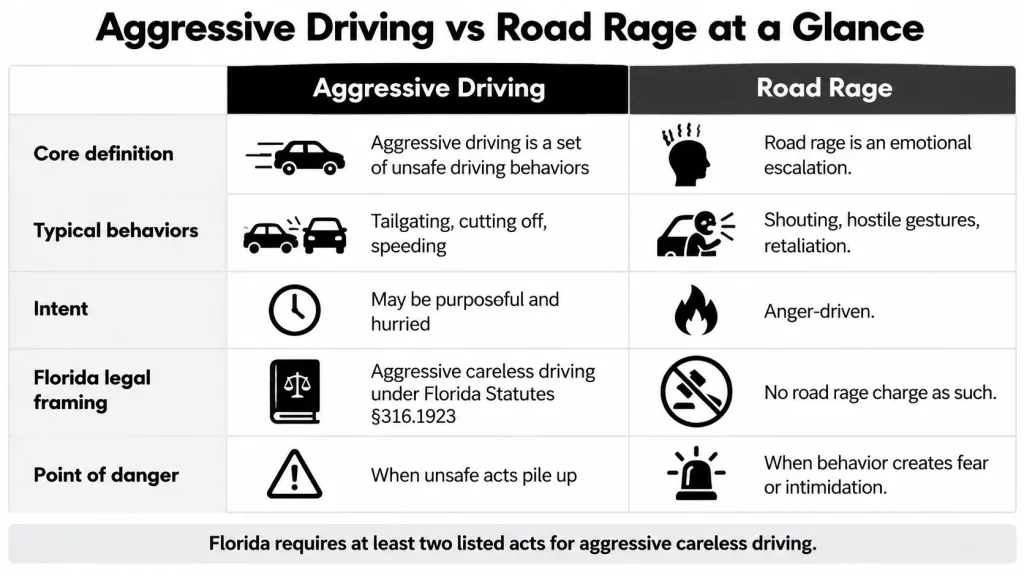
The definition and behavior rows describe what an observer can see. The intent row explains why the driver is doing it, which is often the clearest distinction between dangerous maneuvering and personal retaliation.
Aggressive driving is about how the car moves; road rage is about who the driver is targeting.
Don’t read the danger row as permission to wait until violations accumulate. A single unsafe maneuver can cause a collision, even when it doesn’t satisfy a particular statutory definition.
The same maneuver can mean different things
Say a driver suddenly changes lanes because they’re distracted and miss a vehicle in their blind spot. That’s an unsafe maneuver, but it isn’t automatically evidence of aggression or road rage.
Now suppose the driver deliberately swerves in front of someone who just honked, then keeps blocking that vehicle. The movement looks similar at first, but the continuing conduct reveals a retaliatory purpose.
The AAA Foundation’s nationally representative survey of 2,705 licensed drivers supports distinguishing observable aggressive-driving behaviors from more confrontational conduct. For practical driver education, classify the maneuver and the intent separately rather than assigning every mistake an emotional label.
Don’t use the outcome as your test
A collision doesn’t prove road rage, and the absence of a collision doesn’t prove safety. A hurried driver can cause a devastating crash without targeting anyone; a threatening driver can frighten someone without making contact.
You also can’t reliably read a stranger’s mind. Use repeated, targeted actions as warning signs, and choose distance rather than trying to prove what the other driver intended.
Check your own behavior for these patterns:
- Tailgating: You’re using proximity to pressure someone to move.
- Speed competition: You accelerate because another driver is passing, not because conditions justify it.
- Signal omissions: You change lanes abruptly because getting ahead matters more than communicating.
- Lane blocking: You deny someone space because you believe they don’t deserve to merge.
Your explanation doesn’t erase the maneuver. Being late, annoyed, or convinced you’re right doesn’t make unsafe driving acceptable.
Where Aggressive Driving Ends and Road Rage Begins
Yes, road rage can happen without leaving the car or touching anyone. Deliberate pursuit, punitive braking, and vehicle positioning intended to intimidate can turn a traffic disagreement into a targeted threat.
The Hartford’s explanation of road rage describes NHTSA’s aggressive-driving definition as a combination of moving traffic offenses that endanger people or property. Road rage describes the more emotionally charged escalation associated with a perceived insult or conflict.
Classifying common behaviors by action and intent
| Behavior | Likely category | Intent signal to watch |
|---|---|---|
| Tailgating another car | Aggressive driving | Closing the gap after a lane dispute or slowdown |
| Speeding to pass a vehicle | Aggressive driving | Speed competition with a specific driver |
| Unsafe lane change or weaving | Aggressive driving | Cutting off a driver who just passed or honked |
| Honking in anger | Aggressive driving, escalating toward road rage | Horn used to express hostility rather than warn of danger |
| Braking in front of a driver to punish them | Road rage | Deliberate retaliation for a perceived slight |
| Pursuing or blocking another driver | Road rage | Sustained effort to follow, stop, or intimidate |
| Intentionally bumping or ramming a vehicle | Road rage | Intent to harm or force a confrontation |
| Getting out to confront another driver | Road rage | Threats, shouting, or physical intent |
These are practical classifications, not courtroom findings. A horn can warn someone of danger; the same horn used repeatedly while following that person communicates something different.
Blocking a merge follows the same logic. Refusing to cooperate creates a driving hazard, but repeatedly repositioning your car to trap a particular driver signals targeted intimidation.
Ask what the driver is trying to accomplish
The clearest question is: Would this maneuver still happen if that particular driver weren’t there? If the answer is no because the goal is punishment, you’re no longer dealing with ordinary impatience.
A mistake alone doesn’t establish aggressive driving. But repeated unsafe choices suggest an aggressive pattern, while deliberate intimidation or retaliation indicates road-rage behavior.
This boundary matters because physical confrontation isn’t the starting point. Our guide to the signs of road rage helps drivers recognize the earlier warnings instead of waiting for someone to open a door or make a threat.
Practical rule: The moment your maneuver becomes a response to someone’s supposed disrespect, stop the interaction rather than trying to finish it.
For example, don’t accelerate to prevent a driver who cut you off from moving ahead. Let the vehicle separate from yours, restore a safe gap, and return your attention to traffic.
You don’t need to decide whether the other person deserves blame. You need to decide whether your next action reduces danger or adds to it.
How Common Each Behavior Is Among U.S. Drivers
Approximately 80% of surveyed U.S. drivers reported anger, aggression, or road-rage behavior during the preceding 30 days, according to the AAA Foundation study summarized in 2016. Its reported behavior estimates show a substantial gap between frequent hostility and less common confrontation.
How common each aggressive behavior is among U.S. drivers
| Behavior | Share of drivers | Estimated drivers |
|---|---|---|
| Purposeful tailgating | 51% | About 104 million |
| Yelling at another driver | 47% | About 95 million |
| Honking to express anger | 45% | About 91 million |
| Getting out of the vehicle to confront another driver | 4% | About 7.6 million |
| Intentionally bumping or ramming another vehicle | 3% | About 5.7 million |
The table summarizes the behavior figures and population estimates in that AAA release. These are self-reported survey findings, not police counts or predictions about a particular Florida driver.
Common doesn’t mean harmless
Purposeful tailgating deserves attention precisely because drivers can normalize it. A motorist may reject physical confrontation while still using a short following gap to pressure someone every day.
Yelling and hostile horn use can also keep a disagreement going. Even when the driver doesn’t intend violence, the other person may interpret those actions as an invitation to retaliate.
The sensible prevention priority is therefore the frequent behavior, not just the dramatic incident. Correct close following and hostile communication before either becomes part of a longer confrontation.
Why surveys don’t create a perfect boundary
An AAA Foundation report on aggressive driving notes that respondents often interpret aggressive driving and road rage interchangeably. That makes a combined survey category useful for describing a broad problem, but less useful for deciding what an individual incident means.
- Read the action: Tailgating and intentional ramming aren’t equivalent just because a survey groups them together.
- Examine the context: Repeated pursuit after a dispute carries a different warning than an isolated impatient maneuver.
- Choose an intervention: Fix the driving habit and the retaliatory thinking, rather than arguing over the label.
The takeaway isn’t that confrontation is inevitable. It’s that drivers have opportunities to interrupt escalation during the ordinary behaviors they encounter most often.
How Aggressive Driving Raises Crash Risk and How to Defuse It
Aggressive speeding, tailgating, and signal violations can raise crash odds by as much as 15 times compared with compliant driving. Controlled research also found that aggressive drivers traveled about 5 km/h faster on average and made more operational errors, according to PLOS ONE. The risk comes from both the driving action and the intent behind it: unsafe control raises collision risk, while targeting another driver can turn a traffic conflict into a personal confrontation.
Start with actions you can observe: speed, following distance, lane changes, and signaling. A driver’s mood is harder to judge, but repeated pressure directed at another vehicle is a reason to disengage.
Recent AAA findings summarized by the Colorado Department of Transportation found that 92% of surveyed drivers reported behavior that put others at risk, while 11% acknowledged violent actions, such as intentionally bumping another car or confronting another driver. These figures describe different levels of behavior. Both warrant a serious response, but targeted violence calls for immediate separation.
Break contact before you lose your safety margin
Anger can keep drivers interacting when they should create distance. Following someone, matching their speed, or defending a lane keeps vehicles close and extends the conflict.
Use this sequence:
Spot early signals. Watch for a closing gap, repeated horn use, flashing lights, or a driver matching your speed. Treat a pattern of targeted behavior as a cue to disengage, not a challenge.
Create space gradually. Ease off the accelerator when safe and increase your following distance from the vehicle ahead. More room gives you time to respond without abrupt braking.
Refuse retaliation. Don’t brake-check, accelerate to block a pass, close a merge gap, or pursue. Each action creates another hazard and keeps the disagreement active.
Avoid eye contact and gestures. Focus on the road instead of exchanging looks or signals. There is no need to communicate victory, disapproval, or an explanation.
Disengage safely. Change lanes when there is room, or take a safe exit or different route. Avoid sudden maneuvers that could create another risk.
Get help if threatened or followed. Keep the doors locked, avoid driving home, and head toward a staffed, public, well-lit location. Have a passenger contact emergency services, or make a hands-free emergency call without handling your phone.
For more practical responses to common encounters, see this guide to how to handle aggressive drivers.
Train against actions you can verify
Check your habits by keeping a stable following gap, signaling each lane change, refusing to compete over speed, and ending contact after a perceived slight. A calm explanation after the trip does not undo unsafe driving during it.
Wet roads make space and visibility harder to manage. Advice on how to stay safe on Oregon’s rainy highways also covers managing visibility and traction in rain.
Leaving the conflict isn’t conceding the road. It’s choosing control over confrontation.
Before your next trip, decide how you’ll respond if another driver provokes you: create space and let them go. A prepared response is easier to follow than a decision made in anger.
What Florida Law Says About Aggressive Careless Driving
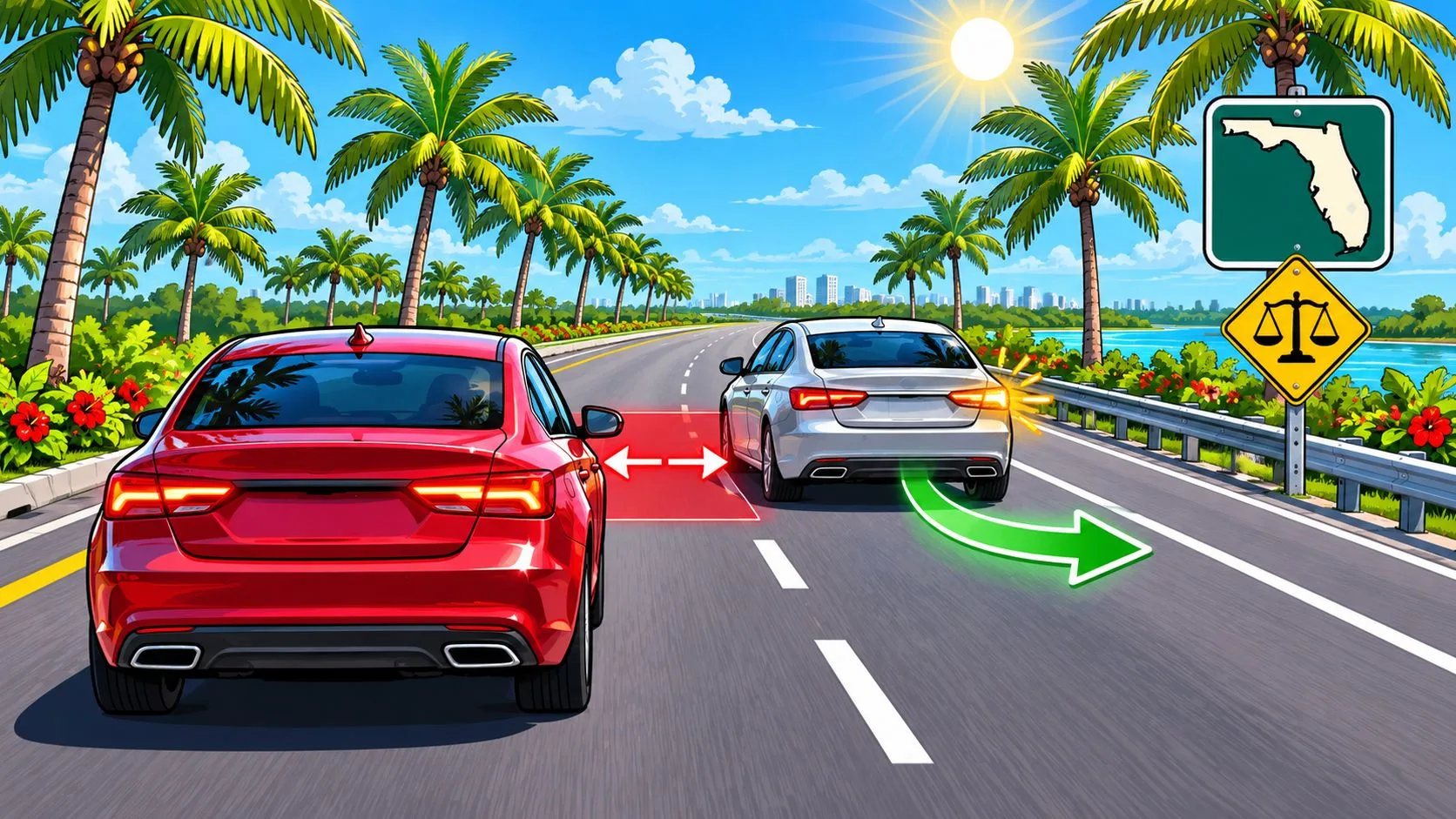
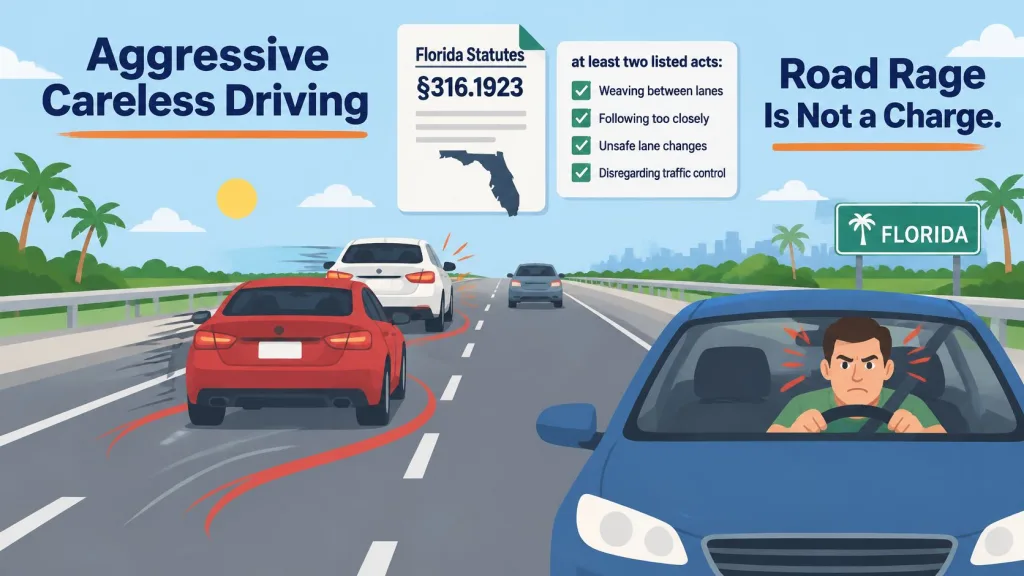
Florida doesn’t use road rage as a standalone charge. Under Florida Statutes §316.1923, aggressive careless driving involves at least two listed violations committed simultaneously or in succession.
The graphic highlights this distinction between an everyday label and a statutory driving category.
Which driving acts qualify
The statute lists these qualifying acts:
- Speeding: Exceeding the posted speed limit.
- Lane changes: Making an unsafe or improper lane change.
- Following distance: Following another vehicle too closely.
- Right-of-way: Failing to yield.
- Passing: Passing improperly.
- Traffic controls: Violating traffic-control or signal devices.
An isolated mistake can still result in a citation. The combination rule means a connected episode involving several listed acts can satisfy the aggressive-careless-driving definition even without an argument.
Say a driver speeds toward a slower vehicle, follows too closely, and then changes lanes unsafely. The legal concern isn’t whether the driver admits feeling angry; it’s the sequence of observable violations.
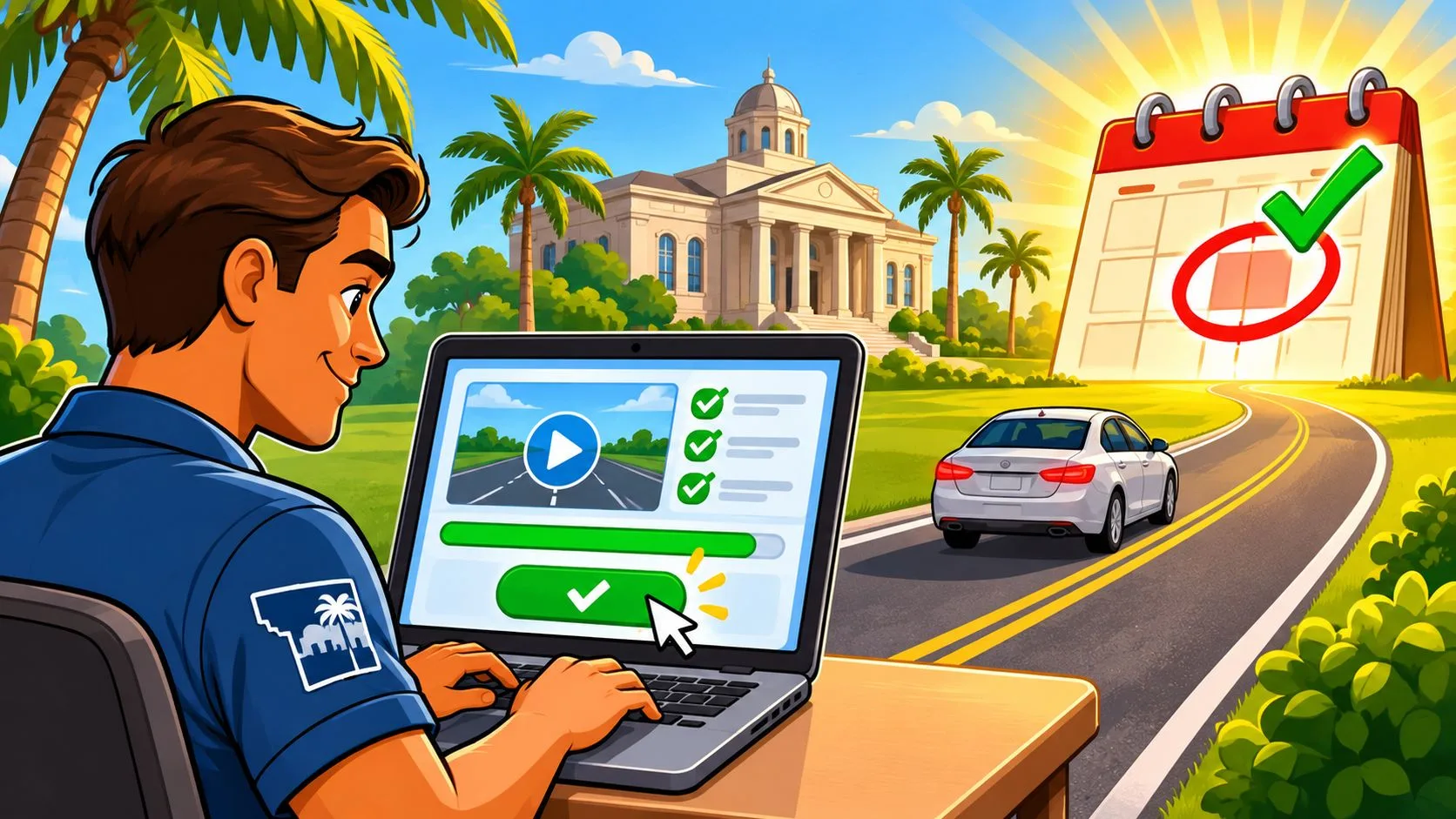
The video below provides an additional driver-education resource.
A traffic label doesn’t cover every possible offense
Threats, pursuit, blocking, and physical contact can raise legal issues beyond the original moving violation. Conduct may be addressed through offenses such as reckless driving or assault when the applicable legal elements are met.
Don’t assume every aggressive maneuver is legally reckless driving, either. Reviewing concrete examples of reckless driving helps separate dangerous conduct from casual labels without treating every incident as the same offense.
Can a course replace the need to address a citation? No. Read the citation and any court instructions, handle the required process, and select training that fits your situation.
Our Basic Driver Improvement course is aimed at drivers who recently received a moving violation. It helps drivers avoid license points and protect against an insurance increase due to that violation, while reinforcing the decisions that prevent another ticket.
Treat a citation as feedback about your driving, not just a bill. Identify the maneuver behind it and practice a specific replacement, such as allowing a merge instead of accelerating to close the gap.
Choose the Course That Fits Your Record
| Your situation | Course | Length |
|---|---|---|
| Recent moving violation, want to avoid points | Basic Driver Improvement (BDI) | 4 hours |
| Court-ordered, or want deeper safe-driving training | Intermediate Driver Improvement (IDI) | 8 hours |
| Habitual aggressive driving or road-rage involvement | Aggressive Driver Course | 8 hours |
| Age 55 or older, want to keep an insurance discount | Mature Driver Course | 6 hours |
Choose based on your record and any court or citation requirements. A recent moving violation, a court order, and repeated retaliatory driving call for different training priorities.
Match the training to the problem
Florida’s Basic Driver Improvement Course, also called Florida Four-Hour Traffic School, is for drivers who recently received a moving violation. It helps drivers avoid license points, maintain Excellent Driver Safe Driver Status/Discount, and avoid an insurance rate increase due to the violation.
Intermediate Driver Improvement offers deeper safe-driving training for court-ordered drivers or those seeking a fuller refresher. Follow the paperwork if a court specifies a course, rather than substituting another program.
The Aggressive Driver Course addresses responsibility and behavior change for habitual offenders involved in road rage. It focuses on the choices that turn frustration into dangerous driving, not only on traffic signs and signals.
If your paperwork names a different program, check that the course name and required duration match the stated obligation. Do not choose a course based on a similar-sounding title.
The Mature Driver Course helps eligible older drivers refresh their safety awareness and maintain an insurance discount. It is intended as a skills and insurance option, not as a replacement for a court-ordered aggressive-driving program.
Practical questions before you enroll
Can I study around work and family commitments? Yes. The online course is self-paced and can be completed anytime, anywhere, at your own pace.
Are other languages available? Yes. Instruction is available in English, Spanish, and Portuguese, so you can study traffic rules and driving decisions in the language you understand best.
How do I receive proof of completion? Certificates are issued electronically, and completion is reported directly to the FLHSMV. Keep your electronic certificate and follow any separate instructions on your citation or court paperwork.
Choose the course that fits your record and required training. You can register for your driving course today and start online.