Most moving violations add 3 points to a Florida driving record, speeding more than 15 mph over the limit adds 4, and a violation involving a crash can add 6. But a relatively ordinary ticket can create an extraordinary problem when it arrives close to other convictions.
The smartest response isn’t automatically paying the fine or immediately buying a course. It’s checking your citation deadline, election history, and license class before you choose how to handle the ticket.
Traffic school can protect an eligible driver’s record. It isn’t a universal reset button, and registering with a school isn’t the same as electing traffic school through the court.
Florida Point Values for Common Violations
Most moving violations carry the standard assessment, but the charge on the citation controls the actual point value. Higher speeds and crash consequences can increase it. Florida’s point-assessment rules set the values below.
Florida points by traffic violation
| Violation | Points | Notes |
|---|---|---|
| Most moving violations | 3 | Standard assessment for many everyday tickets |
| Speeding 15 mph or less over the limit | 3 | Lower speed overage |
| Speeding more than 15 mph over the limit | 4 | Higher speed overage |
| Reckless driving | 4 | Serious behavior charge |
| Passing a stopped school bus | 4 | Applies even without a crash |
| Moving violation that causes a crash | 4 | Generally carries 4 points |
| Unlawful speed resulting in a crash | 6 | Speed plus crash consequence |
| Leaving the scene of a crash | 6 | Includes leaving without required information when damage exceeds $50 |
Do not read this table as a ranking of how much the fine will cost. License points and the payment amount are different consequences. A ticket that is manageable financially can still be costly for your driving privileges, and the timing of the conviction often matters as much as the number on the citation.
Read the charge, not just the description
The distinction that matters is between what happened and what appears on the citation. A driver might describe an incident as speeding, but unlawful speed resulting in a crash receives a different assessment from speeding alone. Do not assume every crash-related moving violation gets the highest assessment. The charge and its consequences determine which row applies.
Check these details on your citation:
- Violation wording: Identify the actual charge rather than relying on your memory of the traffic stop.
- Speed allegation: Read both the alleged speed and the posted limit.
- Crash involvement: Check whether the cited violation caused or resulted in a crash.
- Additional charges: Do not assume the payment screen tells the whole story about the case.
Point prevention isn’t point erasure
An eligible course election can prevent an assessment for the qualifying citation. That is different from deleting points already on your record, and it is different from making the underlying incident disappear. Eligibility limits apply, so check your citation deadline and election history before you assume a course will solve the problem.
If you are comparing advice from other states, Georgia DUI Schools’ explanation of reducing points through defensive driving provides useful context. Do not import another state’s point-reduction rules into a Florida decision. Before you register for any course, confirm the provider appears on the FLHSMV Basic Driver Improvement guide.
Find the closest matching violation in the table and write down its point value. Keep the citation beside that note so you check the exact charge against your driving history instead of deciding from memory.
How Points Turn Into a License Suspension
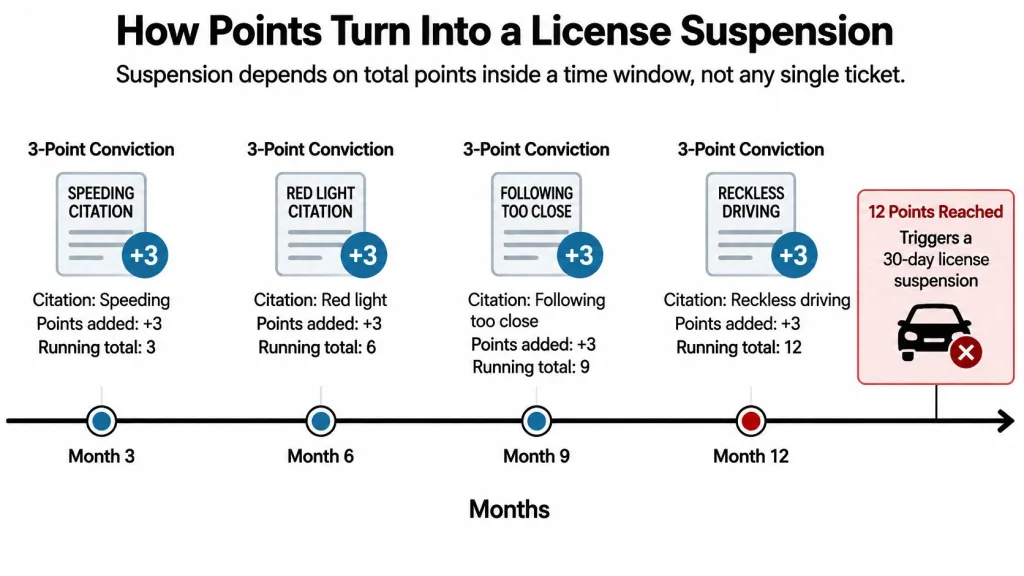
Consider a hypothetical driver with four convictions worth 3 points each within 12 months. That adds up to 12 points, triggering a 30-day suspension under the FLHSMV point-suspension rules.
No individual ticket has to look catastrophic. Several lower-level convictions can create a licensing problem when they fall inside the same assessment window.
Suspension thresholds by points and time window
| Points accumulated | Time window | License suspension |
|---|---|---|
| 12 points | Within 12 months | 30-day suspension |
| 18 points | Within 18 months | Three-month suspension |
| 24 points | Within 36 months | One-year suspension |
The state also says points generally remain on the record for at least five years from the conviction or disposition date. Record retention and the suspension calculation aren’t the same thing: a visible record entry doesn’t necessarily fall inside every suspension window.
Paying can have consequences beyond the receipt
Florida treats payment of a traffic citation as a conviction when applicable points are assessed. That’s why paying first and investigating traffic school afterward is a poor strategy.
Accumulated points can also increase insurance costs before you reach a suspension threshold. Keeping your license doesn’t mean the ticket had no financial effect.
Practical rule: Review your response options before you pay, not after the payment confirmation arrives.
Calculate each window separately
Don’t just look at your lifetime total. Make a worksheet with the violation, relevant dates, disposition, and assessed points for each entry.
List every conviction from the last 36 months and compare the applicable totals with each row of the suspension table. If a date or disposition is unclear, verify it against the official record rather than guessing.
The timing of points traffic violations matters most. An additional conviction can have a very different consequence for someone with a clean recent history than for someone already approaching a suspension threshold.
Who Can Keep Points Off a Driving Record
Traffic school doesn’t automatically remove points or guarantee an unchanged insurance bill. Basic Driver Improvement is aimed at drivers who’ve recently received a moving violation, but the benefit depends on the violation and the driver’s eligibility.
The FLHSMV driver-improvement FAQ explains that approved course completion can result in withheld adjudication, no points for an eligible violation, and protection against an additional premium or refusal to renew solely because of that infraction. Its exceptions include a second infraction within 18 months, a third within 36 months, and speeding more than 15 mph over the limit.
Separately, the FLHSMV driver-improvement election rules limit elections to one every 12 months and eight during a lifetime. Commercial driver-license holders can’t use a course to avoid points, even when driving a noncommercial vehicle.
Course protection by driver situation
| Situation | Course protection | Next step |
|---|---|---|
| First eligible moving violation, no recent election | Points may be withheld and insurance protection may apply | Make a timely election through the clerk |
| Second election within 12 months | Not available | Wait until the interval has passed for a future eligible election; don’t delay the current citation |
| Commercial driver-license holder, any vehicle | Not available for avoiding points | Course cannot be used to avoid points |
| Second infraction within 18 months | Insurance protection generally does not apply | Confirm treatment with your insurer |
| Third infraction within 36 months | Insurance protection generally does not apply | Confirm treatment with your insurer |
| Speeding more than 15 mph over the limit | Protection generally does not apply | Check the speed allegation before electing |
| Passing a stopped school bus, racing, reckless driving, running a red light, or violating a traffic-control device | Course required in addition to the fine after the applicable conviction | Complete the course as ordered |
Separate the different eligibility questions
Election eligibility, insurance protection, and court-ordered attendance are different issues. Don’t treat an exception to insurance protection as a complete explanation of whether you can attend a course or what the court requires.
A mandatory course also isn’t automatically a voluntary point-avoidance election. Read the order and ask the clerk what disposition applies to your citation.
If you hold a commercial license, review our explanation of whether CDL holders can take Florida traffic school. Attending for a required purpose doesn’t create eligibility for point avoidance.
Your pre-registration decision
Before registering, gather:
- The violation: Include the exact charge and any alleged speed overage.
- Your history: Include prior elections and infraction dates.
- Your license class: Identify commercial-driver status.
- Court requirements: Check whether attendance is elective or ordered.
Withheld points don’t erase the underlying citation. Choose the course because it fits your legal situation, not because someone promised that every ticket disappears.
How to Elect Traffic School Within 30 Days
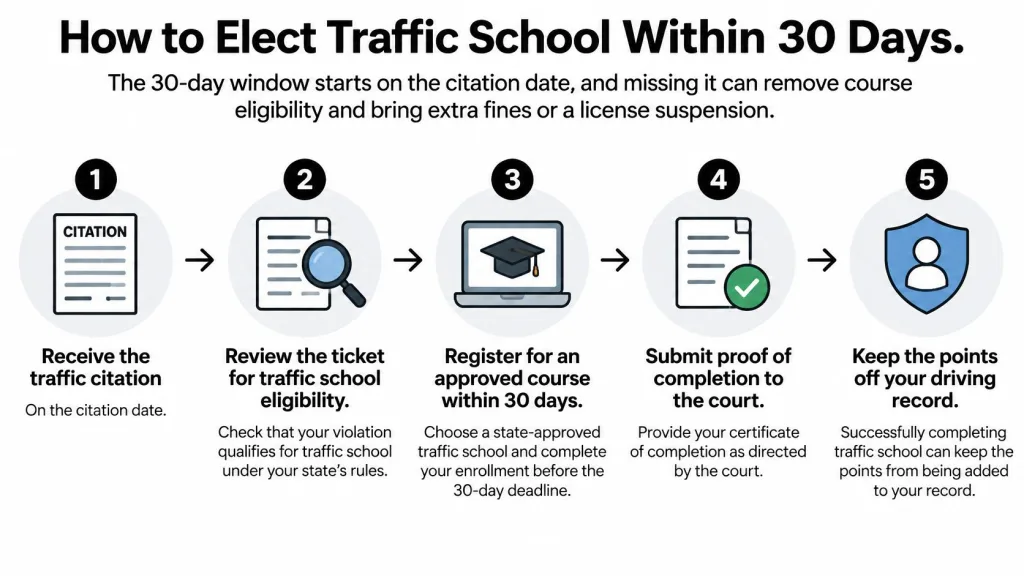
The 30-day window starts on the citation date, not when you open the payment website. According to FLHSMV traffic-citation guidance, eligible drivers generally must elect through the county clerk during that period, pay the citation and applicable court costs, and the civil penalty is reduced by 18%. That reduction is real, but only if your election is accepted. Missing the deadline can eliminate course eligibility and may lead to additional fines or a license suspension. Put the deadline on your calendar before doing anything else.
Follow the clerk’s process before starting class
Record the citation date and response deadline. Use the date printed on the ticket. Don’t calculate from the day you received a reminder.
Check eligibility before paying for attendance. Match your violation, election history, and license class to the requirements. Ask the clerk to resolve any uncertainty before you assume the course will protect your record. Eligibility limits are where drivers get this wrong: a course that fits one ticket may not fit another.
Elect through the county clerk of court. Follow the instructions for the county handling the citation. A school registration receipt isn’t a court election confirmation.
Pay the required citation amount and court costs. Use the clerk’s election procedure so the payment and election are associated correctly. Registering with a school does not pay the ticket.
Register, finish, and verify
Complete the school’s registration form accurately. Then compare the certificate details directly with your driver license. If the certificate is wrong, fix it before the court receives it.
Complete the four-hour course. The online format is self-paced and accessible from your device. Schedule study time around the completion deadline the clerk gives you. The election deadline and the completion deadline are not always the same date.
Verify completion reporting and court compliance. Completion is reported directly to FLHSMV, and certificates are issued electronically. Keep your certificate and confirm whether the clerk requires a separate submission or other action.
BDI School is a Florida HSMV-approved Basic Driver Improvement school. That credential matters, but it doesn’t replace your responsibility to elect correctly and meet the court’s instructions.
Keep the citation, election confirmation, payment receipt, and completion certificate together. A complete paper trail is more useful than a screenshot showing only that you registered.
If your record doesn’t reflect the expected outcome, use those documents when contacting the clerk or school. Completing the lessons does not automatically resolve every administrative requirement.
How Insurers Read Points and Tickets
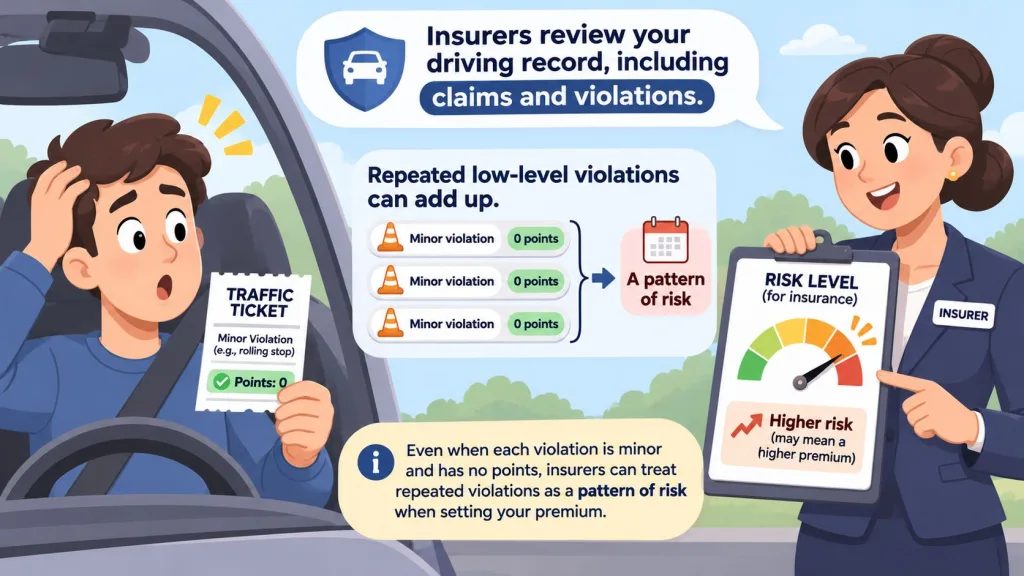
A minor ticket can matter to an insurer even when no license points are added. The important exception is when Florida’s course-related legal protection applies to that specific infraction.
LexisNexis Risk Solutions’ auto-trends reporting describes increased traffic-violation activity and particular growth in minor violations. That doesn’t predict your individual premium, but it explains why dismissing a low-level ticket as financially irrelevant is a mistake.
License points aren’t an insurance quote
Insurers evaluate more than the state point total. Claim history, repeated violations, driver age, vehicle, location, and policy terms can affect how they assess a driver.
Legal protection against an increase solely because of an eligible infraction doesn’t freeze the entire policy price. A change connected to another rating factor isn’t the same as a surcharge for that protected violation.
Our guide to points and insurance helps distinguish the driving-record issue from the policy question. Don’t assume that a clean point assessment automatically produces a discount.
Ask for a specific policy answer
Give your insurer the actual citation and completion details, then ask:
- Surcharge treatment: Will this violation be surcharged, and for how long?
- Certificate treatment: Does the completion certificate change the rate or qualify for a discount?
- Renewal treatment: What happens at renewal if another violation appears?
Send the certificate rather than merely saying you attended traffic school. Ask the insurer to identify any applicable protection or discount and explain what information it still needs.
Call before renewal and provide both the violation date and course-completion date. Request the rate impact in writing, so you can compare an actual explanation with the renewal documents instead of relying on a vague promise of savings.
Costly Mistakes That Cancel Your Course Benefits
Electing late is the mistake to prevent first. Completing lessons doesn’t repair a missed court election, and purchasing access doesn’t extend the citation response period.
Next comes electing when you’re not eligible. Check your election history before paying, using our explanation of how often you can take Florida traffic school to distinguish course attendance from a point-avoidance election.
Registration mistakes can become certificate problems
Enter your name and driver license number exactly as they appear on your license. An incorrect character can interfere with identity validation or produce certificate details that don’t match your record.
Use an email address you can access, and review the registration before submitting it. Don’t let someone else answer identity questions or complete coursework for you.
Our refund policies also matter:
- Reported completion: We don’t issue refunds once completion has been reported to FLHSMV.
- Failed identity validation: We don’t issue refunds for failing required validation, which can include biometrics, security questions, or other methods.
- Cheating: We don’t issue refunds when the school determines a person is cheating.
These requirements support identity verification, state compliance, and certificate integrity. Read them before starting, not after a problem occurs.
Use a final error check
Before opening the lessons, follow this checklist:
- Confirm the citation date. Compare it with the clerk’s response instructions.
- Verify eligibility. Don’t infer approval from successful registration.
- Enter details exactly. Use your license as the reference.
- Protect study time. Complete the course in a sitting when practical, or schedule focused sessions before the court’s completion deadline.
Self-paced access gives you flexibility. It doesn’t make the election, identity checks, or completion requirements optional.
What Happens If You Are Not Eligible or Miss the Window
An ineligible citation or missed election can leave you facing the normal point consequences after conviction. Don’t buy a course expecting it to reverse that outcome automatically.
A missed response deadline can also create problems beyond points. Contact the county clerk promptly instead of waiting for another notice or assuming a late payment resolves everything.
Separate the possible consequences
| Issue | What to check |
|---|---|
| Driving record | Whether a conviction has been entered and points assessed |
| Insurance | Whether course-related protection applies to the actual disposition |
| License status | Whether this citation or accumulated convictions have created a suspension issue |
An underlying conviction can remain visible after the relevant suspension calculation changes. Treat record accuracy and current license status as separate checks.
Other convictions can also change the seriousness of the new assessment. Add the potential points to your recent history and compare the totals against the applicable suspension windows.
Ask the clerk about the citation, not just the course
Have your citation number, license information, and any court correspondence ready. Ask what response options remain, what amounts are due, and whether any hearing or other action is required.
- Before paying: Understand how the payment will dispose of the citation.
- Before enrolling: Confirm whether attendance would satisfy an actual requirement.
- Before driving: Verify your license status if you’ve received a suspension notice.
Basic Driver Improvement is a point-prevention option only where the violation and driver qualify. It isn’t a substitute for resolving an ineligible citation or complying with a suspension.
Enroll in a Florida Basic Driver Improvement Course
If your violation is eligible and your 30-day election window is still open, move now. Complete the clerk’s election first, then register for an approved course. Neither step improves with waiting, and the deadline does not move.
BDISchool’s Florida’s Basic Driver Improvement Course, also called Florida Four-Hour Traffic School, is aimed at drivers who recently received a moving violation. It is HSMV approved and self-paced, and it runs online in English, Spanish and Portuguese, so coursework fits around work and family.

What the course does
Completion keeps points off your license for the qualifying violation and prevents an insurance increase caused by that moving violation. It also helps you keep Excellent Driver Safe Driver status. It does not erase an existing record or reprice a policy for unrelated reasons.
Registration asks for your name, driver license and email address. Those details generate your completion certificate at the end, so enter them accurately.
Frequently asked enrollment questions
Can I start online? Yes. Register and begin on the website. Our guide to registering for online traffic school walks through the form.
Does enrollment count as my court election? No. Election goes through the county clerk, and you keep the confirmation. Registration and election are separate actions.
Will the course erase my existing record? No. An eligible election addresses the qualifying citation’s point assessment only.
What should I have ready? Your citation, election confirmation, driver license and an accessible email address. Confirm the court’s completion instructions before you start.
Decide while you still have options
Timing, eligibility and your insurer’s treatment of the ticket decide the outcome as much as the violation itself. An eligible, properly completed election prevents a new point assessment. Miss the window or misjudge your eligibility and you inherit the consequences instead.
Check your eligibility and deadline, then start through our course registration page. Leave enough time to finish, keep the certificate and verify compliance. Confirm the course matches your citation, then register.