Florida law books contain exactly zero road rage offenses. No statute is titled road rage, no dedicated fine exists, and no special court handles it.
What exists instead is a counting rule, a speed threshold, and a stack of criminal statutes that switch on depending on what the driver did. That means the same angry moment can produce three very different outcomes. One driver walks away with a citation. Another faces a criminal speeding charge. A third, the one who made a threat, picks up an assault charge. Which one lands depends on conduct, not on how furious anyone looked.
Florida Road Rage Penalties at a Glance
Five offenses do the work, and each one has a different trigger and a different cost.
| Offense | Statute | Threshold | Typical outcome |
|---|---|---|---|
| Aggressive careless driving | Fla. Stat. §316.1923 | Two or more listed traffic violations, simultaneous or in succession | Moving violation with points under Chapter 318 |
| Careless driving | Fla. Stat. §316.1925 | Failing to drive carefully and prudently for roadway and traffic conditions | Moving violation with points under Chapter 318 |
| Reckless driving | Fla. Stat. §316.192 | Willful or wanton disregard for safety | Criminal misdemeanor; first conviction up to 90 days jail and $25 to $500 fine, repeat conviction up to six months and $50 to $1,000 fine, or both |
| Dangerous excessive speeding | 2025 dangerous excessive speeding law, effective July 1, 2025 | 50 mph or more over the posted limit, or 100 mph or more in a manner that threatens another person | Criminal offense with possible jail |
| Assault | Fla. Stat. §784.011 | Intentional unlawful threat of violence with apparent ability and well-founded fear of imminent violence | Criminal misdemeanor |
Aggressive careless driving is the workhorse charge. A driver commits it by stacking two or more listed traffic violations at once or in sequence, and the penalty is a moving violation with points under Chapter 318, not a criminal record.
Careless driving is the fallback when only one thing went wrong. It asks whether the driver handled the car carefully and prudently given the roadway and the traffic, and it also lands as a moving violation with points.
Reckless driving changes the language entirely. The state stops counting acts and starts arguing willful or wanton disregard for safety, which is why jail enters the conversation.
Dangerous excessive speeding is the newest row and the most misunderstood. It targets extreme velocity rather than a pattern of maneuvers, and it carries criminal exposure.
Assault has nothing to do with the path of the car. It covers an intentional unlawful threat of violence, made with apparent ability, that creates a well-founded fear of imminent violence.
Match the row before you argue. The statute number printed on a citation tells you which threshold the officer thinks you crossed, and that’s the only fight worth having.
Florida has no standalone road rage offense, so charges follow specific conduct. Read the table by starting with the behavior you observed, finding that row, then checking the outcome. A single unsafe act usually ends as a simple citation. A pattern, extreme speed, or a threat moves the case further down.
How Aggressive Careless Driving Is Defined
Florida’s road rage laws run on a counting rule. A driver commits aggressive careless driving by performing two or more listed traffic violations at the same time or in succession, under Florida Statutes §316.1923. One act, however badly executed, never meets the definition.
Careless and reckless charges handled a single bad decision, but a driver who stacked tailgating, an unsafe lane change and a refusal to yield produced a pattern that was awkward to charge as one thing. The counting rule turned that pattern into a moving violation the state can prove from outside the car, without access to anybody’s temper.
The six acts that count
| Qualifying act | Road example | Evidence to record |
|---|---|---|
| Speeding | Passing a slower car well above the posted limit | Dashcam speed reading or posted limit sign in frame |
| Unsafe or improper lane change | Cutting in front of a car after a near miss | Turn signal use and lane positions on video |
| Following too closely | Tailgating at highway speed | Vehicle spacing and time visible on dashcam |
| Failing to yield | Forcing into a merge without the right-of-way | Yield signs, signals and vehicle positions |
| Improper passing | Passing on the right or in a no-passing zone | Road markings and location |
| Disobeying a traffic signal or sign | Running a red light to keep up with another car | Signal phase timing and witness accounts |
The pattern forms fast in real traffic. A pickup tailgates you at highway speed, cuts into your lane after a near miss, then passes on the shoulder to get ahead. Three listed acts, one after another, all within thirty seconds. Written up separately, each is an ordinary infraction. Together, they satisfy the statute.
The statute counts moves. Nobody has to prove the other driver was angry, and nobody has to prove you were calm.
That cuts both ways, which makes it useful. The law looks at observable conduct, so the strongest record is a sequence: times, lane positions, signal use, following distance, and the location where each move happened. Claims about the other driver’s emotional state add nothing to that report. The behavioral side still matters, because the habits behind a citation usually show up long before the ticket does, and our guide to what aggressive driving looks like in practice covers how the pattern builds.
Where Road Rage Moves From Ticket to Crime
Florida has no standalone road rage offense. What a prosecutor files depends on what the driver did, and the escalation path is short. It runs on evidence rather than adjectives.
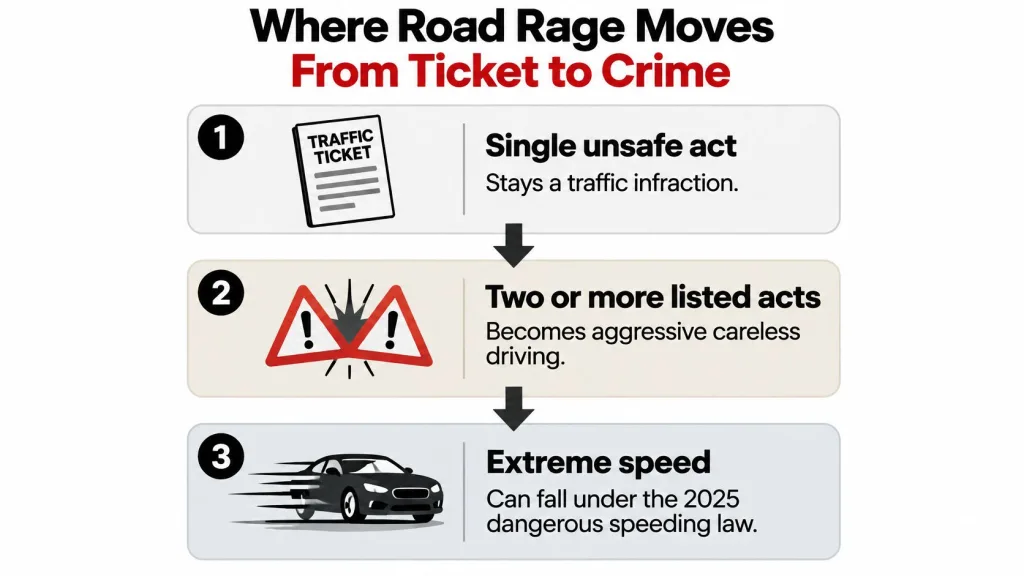
- A single unsafe act stays a traffic infraction. One bad lane change is a ticket with a fine attached, and it usually ends there.
- Two or more listed acts become aggressive careless driving. The driver’s intent is irrelevant. The act count is what matters.
- Extreme speed crosses into criminal territory. Effective July 1, 2025, driving at least 50 mph over the posted limit, or 100 mph or more in a manner that threatens another person, can be a criminal offense with jail behind it, per the Florida Senate statute compilation.
- Willful disregard supports reckless driving. This is the charge for a driver who treated the road as a place to settle something.
- A threat of violence brings assault. No contact is required. Words and gestures at a stoplight can do it.
Notice what the ladder leaves out: anger itself. The same furious thirty seconds can produce a simple citation, a criminal speeding charge or an assault charge. The deciding factors are the acts the driver committed and how many of them occurred. That means one driver can face several charges from a single encounter, each carrying an exposure the one before it didn’t.
A chain that happens more often than it should: a driver tailgates at 90 mph, swerves across two lanes without signaling, then pulls beside you at a light and threatens you through an open window. The tailgating and the lane change support aggressive careless driving. The speed may support the newer dangerous speeding analysis. The threat may support assault. Every step up the ladder adds a separate consequence.
Watch these five points, because they’re the ones you control: speed, following distance, lane changes, signals and threats. Everything else in the encounter belongs to the other driver.
A driving course doesn’t decide which charge applies, and no certificate erases a criminal consequence. The statute and the facts do that. What education changes is the number of times you end up in the situation at all.
Reckless Driving and Assault Penalties Explained
Reckless driving sits one rung above the counting rule, and the penalties show it. Under Florida Statutes §316.192, a first conviction may bring up to 90 days of imprisonment, a fine from $25 to $500, or both, according to the Florida Senate’s compiled Chapter 316 statutes. A second or subsequent conviction raises the ceiling to six months of imprisonment, a fine from $50 to $1,000, or both.
Two different questions decide the charge
Aggressive careless driving asks how many listed acts occurred. Reckless driving asks what the conduct showed about the driver’s state of mind. A prosecutor arguing reckless driving is arguing willful or wanton disregard for the safety of persons or property, and a judge or jury weighs the whole picture: the speed, the traffic around the car, whether the driver kept going after a near miss.
That difference decides how you respond. If the ticket names §316.192, you’re facing a criminal misdemeanor that also carries license points, so the response has to address both the court case and the points on your record. Our collection of examples of reckless driving in Florida shows where courts have drawn the line.
Assault needs no contact at all
Florida assault is an intentional unlawful threat of violence, made with apparent ability to carry it out, that creates a well-founded fear of imminent violence in the person on the receiving end. Yelling a threat across a lane, following a driver into a parking lot while making one, or advancing on a stopped car with something in your hand can each support the charge. Physical contact adds battery exposure on top of it.
A road rage encounter can produce two cases at once. The traffic citation and the criminal charge travel on separate tracks, and resolving one doesn’t resolve the other.
An officer, and later a prosecutor, works through a short sequence. What did the driving look like? Which statute fits that conduct? What does the driver’s record add? A prior reckless conviction moves the penalty tier upward. Prior moving violations push an aggressive careless driving case toward heavier treatment. The penalty follows the conduct and the prior conviction count.
Steps to Defuse a Road Rage Encounter
Your goal in a road rage encounter is not to win it. It’s to end it with sheet metal intact and no citation bearing your name. That takes specific moves, made early.
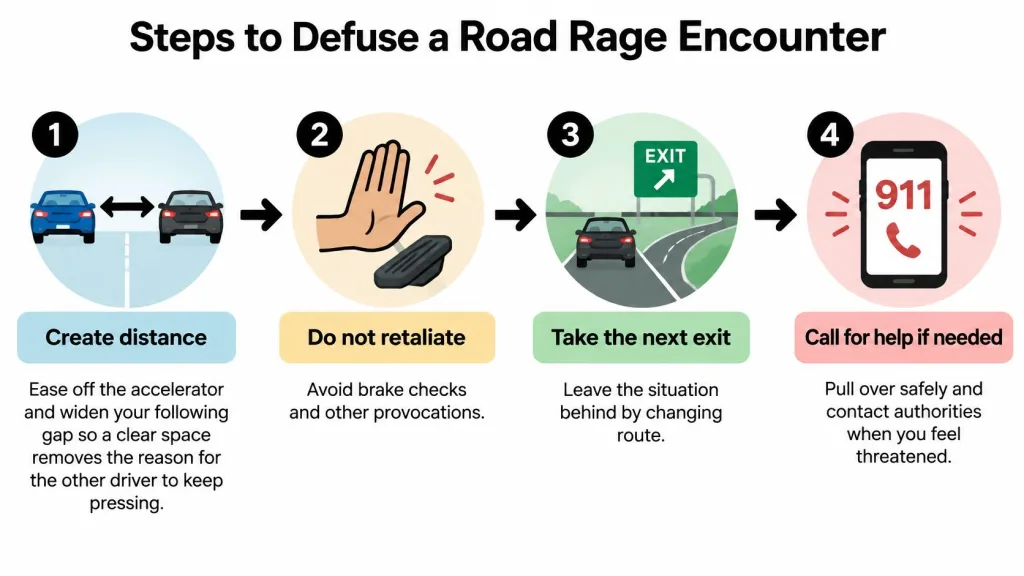
- Create distance first. Ease off the accelerator and let the gap grow to several car lengths. A clear space removes the reason the other driver keeps pressing, and it buys you the seconds you’d need to react.
- Refuse to retaliate. No brake checks, no blocking a pass, no sudden lane changes, no gestures. Each of those adds another act to a sequence that a prosecutor can count.
- Yield the lane instead of defending it. Move right when it’s safe and let the aggressive driver go. Losing a lane position costs you nothing; a racing match on I-4 costs you plenty.
- Keep the doors locked and skip the eye contact. Staring back, mouthing off, or rolling down a window turns a driving dispute into a confrontation, and a confrontation is where assault charges and injuries live.
- Stay near other traffic. Don’t take the empty exit ramp or the deserted side street. If the driver keeps following, drive to a police station, a staffed fire station, or a busy business and park where people can see you.
- Call 911 if you feel threatened. Give your location, direction of travel, the other vehicle’s plate and a description. Dispatchers handle these calls constantly, and a documented call is evidence that you de-escalated.
- Record what you can see. Dashcam footage, the time, lane positions, signal use and witness names. Skip the theories about what the other driver was feeling.
Those seven moves work because they break the sequence the statute counts. No second act, no aggressive careless driving pattern. You also keep the moral and legal high ground, which matters if a report gets written and an insurer reads it later.
If you’re not sure whether your own habits are feeding these encounters, our guide to the signs of road rage is a useful mirror. Most drivers who get into these situations aren’t trying to. They’re defending a lane, matching a speed, or answering an insult.
Success looks boring. Two cars, plenty of space, nobody following you home. Here’s the walkthrough of what that looks like from the driver’s seat:
What to Do After a Citation or Incident
Start with the paper and let the adrenaline settle. Florida does not file a charge called road rage, so the same angry minute can become a citation, a criminal speeding case or an assault case depending on the acts proved and how many were counted.
- Read the statute number before you predict the outcome. One listed act does not meet the aggressive careless driving definition.
- Get names and phone numbers before cars leave. A witness who drives away is usually gone for good.
- Photograph vehicles, lane markings, signals and skid marks. Angle the shots to show position, not just damage.
- Preserve video before it loops. Pull the dashcam file and save any phone clip somewhere it cannot be overwritten.
Can I be cited if I never yelled or threatened anyone? Yes. The charge turns on the driving pattern, and the 2025 Florida Statutes on §316.1923 do not require proof of anger.
Does a driving course erase a criminal charge? No. A course can address points and insurance exposure tied to a moving violation. It does not pick the charge or settle a criminal case.
When do I need a lawyer? Any criminal charge, any serious injury and any crash claim. Florida’s comparative fault rules can bar an injury claim entirely when the person bringing it is found mostly at fault, and fault arguments often start early.
If the matter is a moving violation rather than a crime, Florida’s Basic Driver Improvement course is built for drivers who recently received a moving violation and want to avoid license points and the insurance increase tied to that violation. Match the response to the charge on the citation, then act while the evidence is still fresh.
Choose the Right Florida Course Before Your Court Date
The fastest way to pick a course is to read your citation or court order and match it to a single option. Register once, finish before your date, and keep the certificate.
- Basic Driver Improvement. A 4-hour course for drivers holding a recent moving violation who want to keep points off their license and stop the insurance increase that follows. For a routine ticket, this is the right pick.
- Intermediate Driver Improvement. An 8-hour program for drivers whose court order calls for more than basic instruction, or who want a working understanding of safe driving habits.
- Aggressive Driver Course. Built for repeat offenders and road rage cases, focused on triggers, responsibility and changing the decision that starts the sequence. If your order names aggressive driving, check the 12-hour aggressive driving course and confirm it matches what the court specified.
- Mature Driver Course. A 6-hour refresher for drivers 55 and over who want to sharpen awareness and hold onto an insurance discount.
The course behind the first bullet is Florida’s Basic Driver Improvement Course, also called Florida Four-Hour Traffic School. It is state-approved, accepted by all Florida courts and counties, and runs fully online and self-paced in English, Spanish and Portuguese.
Two details matter more than the choice itself. Complete the registration form with your name, driver license number and email exactly as they appear on your license, because that information generates your completion certificate. And register when you are certain: no refunds are issued once your completion has been reported to FL HSMV.
If your case is heading to a hearing rather than a course, county paperwork rules can still trip you up. Ares on local filing requirements explains why local court rules and deadlines differ enough to check before your date.
BDISchool keeps student course and completion records on file for at least seven years, so a certificate a court asks for later stays retrievable. Register at bdischool.com/courses or drivereducators.com/courses and start before the deadline gets close. If a citation, a court order or a habit you would rather break brought you here, one course is the shortest route from knowing the law to driving like it. Visit BDISchool to choose yours today.