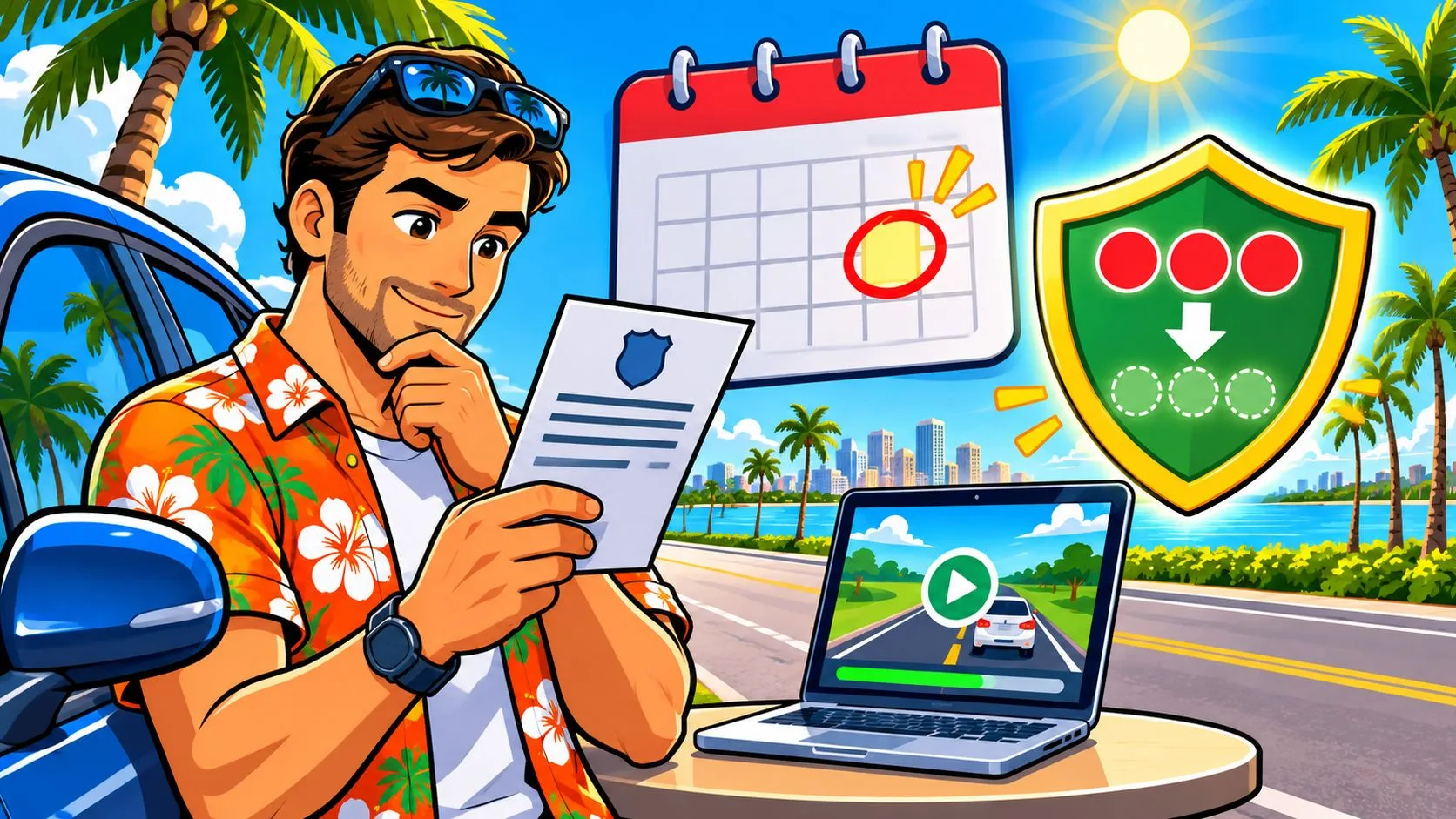
A defensive driving exam is the final test at the end of a Florida-approved driver improvement course, and it checks hazard recognition, safe-following rules and traffic law rather than memory of a handbook. What decides your outcome is timing: an eligible driver has 30 days from the citation to elect an approved course, and the right course can cut the citation fine by 18%.
So which mistake costs Florida drivers more, a wrong answer on the final exam or a course chosen two weeks too late?
Most drivers who go looking for a traffic school are worried about the wrong thing. They picture a trick question about a school bus stop arm. Meanwhile the deadline on the citation is running, the points are waiting to land, and nobody has checked whether the course they picked is the one their county requires.
Florida's requirements come down to three questions. Does your citation qualify, which course does it demand, and what does the exam measure? Answer them in that order and the test becomes the easy part of the process.
What a Defensive Driving Exam Measures
The final test isn't a driving test, and that surprises people. Nobody watches you handle a wheel. The exam checks whether the rules you just read show up in your decisions, which is a different skill from reciting a statute back to a screen.
| Topic | What the question checks | Sample situation |
|---|---|---|
| Following distance | Time gap and stopping room | A heavy truck ahead slows on a wet highway |
| Right of way | Yield rules at intersections | A four-way stop with two vehicles arriving together |
| Speed and conditions | Slowing for rain, fog or night | Traffic on a dark two-lane road |
| Hazard recognition | Spotting developing threats early | A ball rolls into the street from between parked cars |
| Distraction | Attention on phones, navigation and passengers | A navigation alert sounds while you change lanes |
| Impaired and aggressive driving | Choosing not to drive impaired or angry | A tailgater flashes headlights behind you |
Those topics aren't academic filler. Florida records a crash roughly every 44 seconds, and about one in seven crashes involves a distracted driver, according to the FLHSMV's breakdown of distracted driving data. Preliminary 2024 figures cited there count nearly 300 deaths and more than 2,200 serious injuries involving distracted drivers.
Now look at the table again with those numbers in mind. Following distance, hazard recognition and distraction are the three rows most likely to appear on your exam, and they're the three that fill Florida emergency rooms. The exam is asking about habits, not trivia.
Quick self-check: If you can explain why a wet road needs a bigger time gap than a dry one, who yields at a four-way stop when two cars arrive together, and why a bad mood belongs nowhere near a throttle, you already know the core material.
If those three explanations come easily, stop re-reading a handbook and spend your energy on eligibility, course choice and scheduling. That's where the money and the points sit.
Why Passing the Exam Does Not Prove Safe Driving
A passing score shows that you knew the safer answer on the day you sat the test. That is all it proves.
The evidence on these courses is more sobering than the marketing suggests. A peer-reviewed review of 14 controlled studies on defensive-driving courses found that only about one-third were methodologically strong enough to trust. In the stronger studies, the courses produced no consistent reduction in crashes, though they did reduce traffic-violation frequency by approximately 10%.
Read that split carefully. Courses moved the number on tickets and left the crash number alone. A test can verify that you understand rules, following distances, hazard recognition and legal responsibilities. It cannot verify that you apply any of it when the car ahead brakes hard and your phone lights up at the same moment.
Licensing records point the same direction. Drivers who know the rules well enough to pass a written test still crash at rates that surprise people, because knowing the correct answer and producing the correct action under pressure are different skills. Knowledge is the floor, not the ceiling.
A high score tells you that you knew the safer answer. It doesn't tell you that you'll choose it at 70 mph with someone riding your bumper.
Treat the exam as a prompt rather than a certificate. When you finish, go back through every question you missed and write down the earlier action you would take next time: easing off a second sooner, adding half a gap before a lane change, checking the mirror before the brake lights come on. That review is worth more than the score.
How to Spot Hazards Before They Become Emergencies
A ball rolls out from between two parked cars and the question asks what you do first. Lift off the accelerator and check the gap behind those cars. The child chasing the ball can appear before your foot reaches the brake.
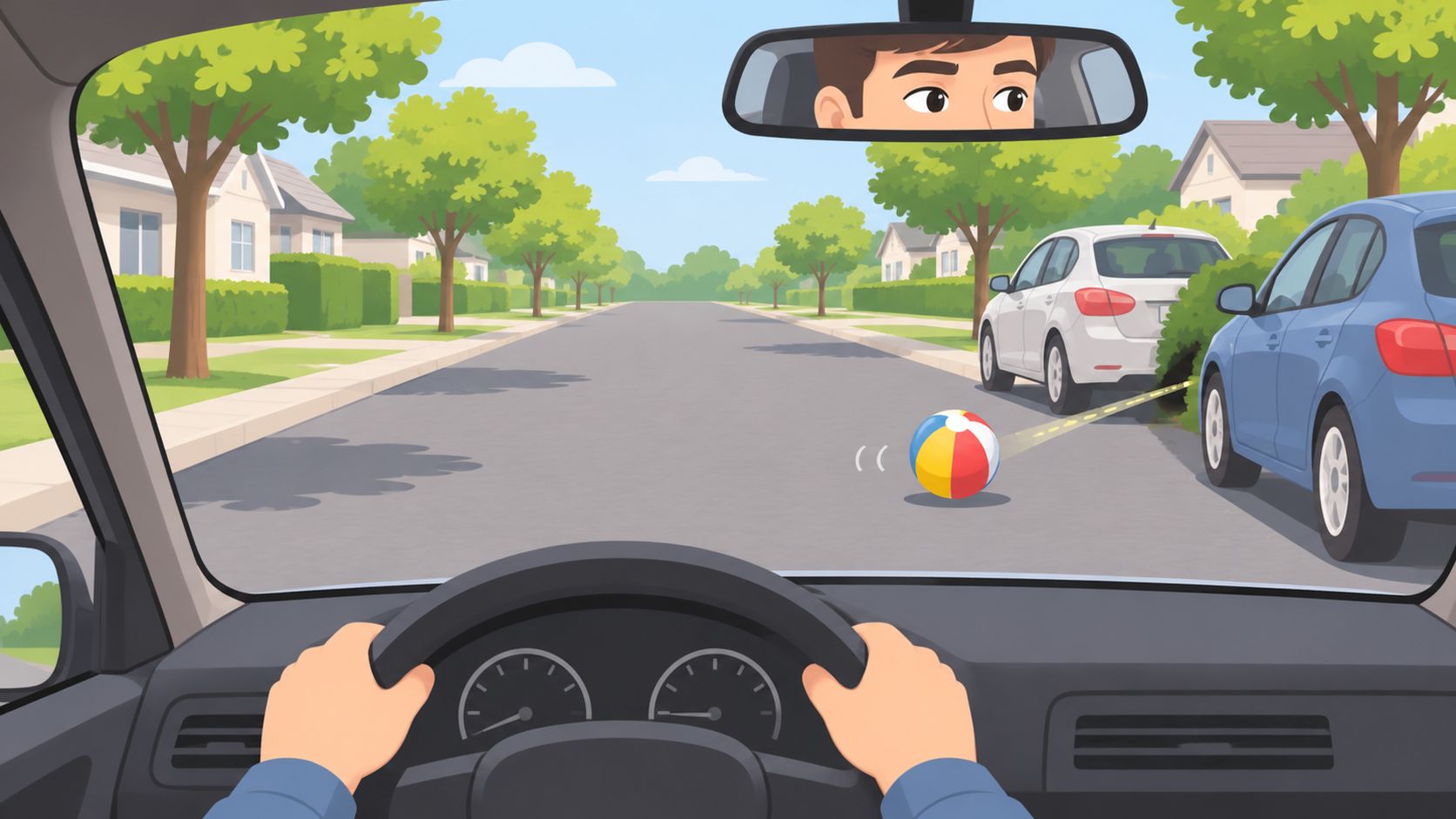
That response can be trained. In NHTSA-sponsored research on Risk Awareness and Perception Training, trained novice drivers correctly fixated on defined roadway hazards during on-road driving 64.4% of the time, against 37.3% for untrained drivers, a 27.1 percentage point difference. The gain came from learning where hazards tend to emerge and rehearsing the response.
Read every scenario for the earliest sign. A developing hazard gives you a short window in which easing off or widening a gap still works.
The three-step method for every hazard question
- Identify the developing hazard. Name it: the ball, the reversing SUV in the driveway or the pedestrian turning toward the curb.
- Predict its likely path. The ball implies a child. The reversing SUV implies a driver looking over a shoulder instead of at you.
- Choose the earliest safe response. Ease off, add a gap and move your eyes to an escape route. The earliest low-cost action beats the latest dramatic one.
Scenario items are graded on whether your response is timely, appropriate and risk-reducing. Braking after the hazard enters your lane is still a response. It just arrives after the seconds the exam expected you to use.
Watch the clip once for the answer, then again with the screen paused.
Pause before the answer appears and say the hazard out loud. Then name its likely path and your first action. If your answer is still "brake," look for the earlier cue you missed.
The real-life scenarios in Florida's Basic Driver Improvement Course use the same scan-and-predict loop to practice hazard recognition. Run each one twice: once to answer and once to spot the first cue that gave the hazard away.
Following Distance as Time, Not Car Lengths
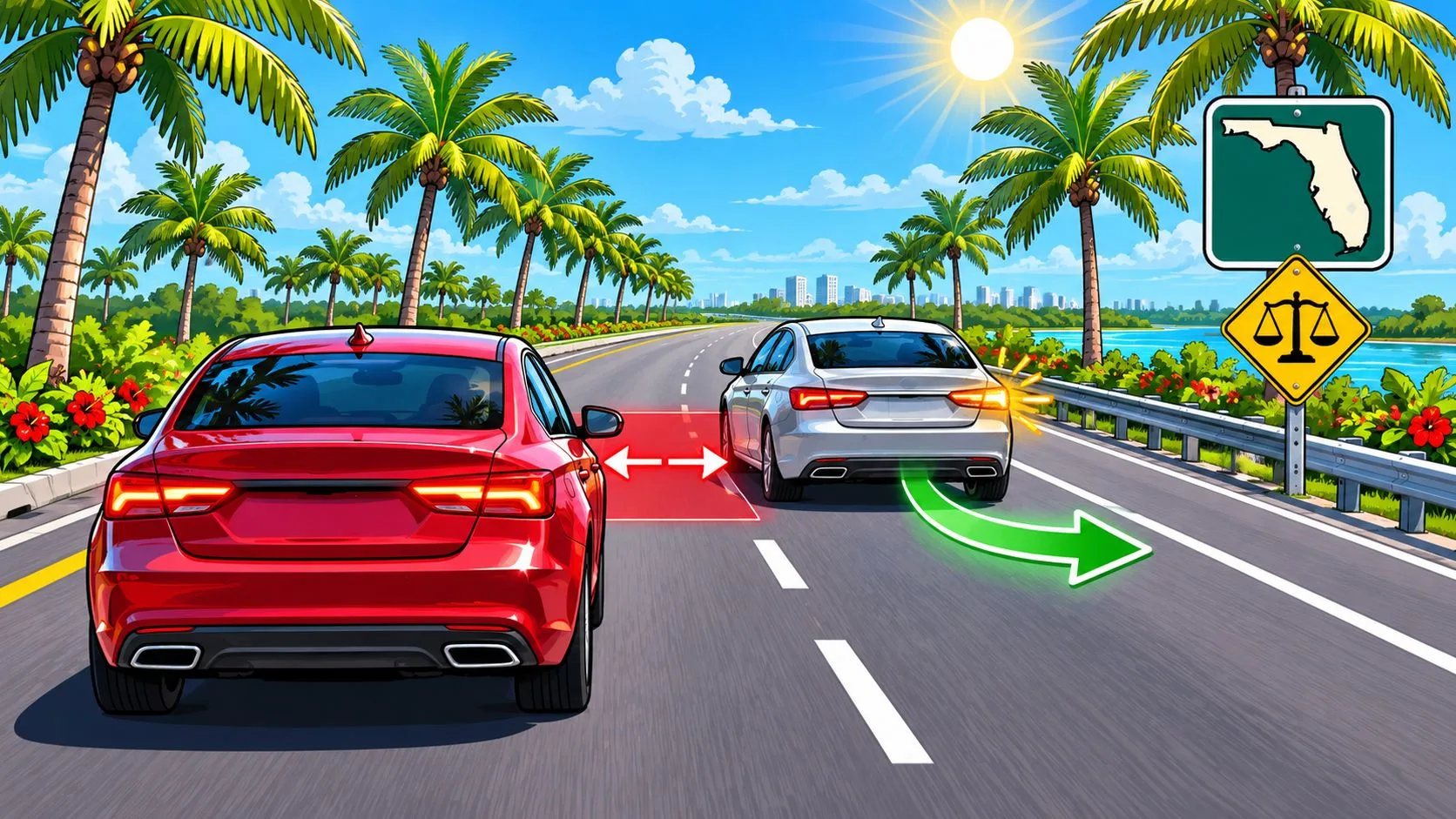
The first thing to unlearn is counting car lengths. A following-distance question is asking for a time gap, because the same visual gap is consumed faster the quicker you travel.
How fast does your brain use that gap? NHTSA research on car following timed how long drivers needed just to register that spacing had changed: about 0.96 seconds on average at 20 meters and 50 km/h, and 2.06 seconds at 40 meters and 70 km/h, with wide variation between drivers.
Why the same gap fails at higher speed
Read those two numbers as a warning. The driver at 70 km/h needed more than twice as long as the driver at 50 km/h to notice a change in spacing, and that's before the foot moves. Perception and response eat the margin first. Braking only gets what's left.
That's why a fixed count of car lengths keeps failing test-takers. The gap that looked generous in the driveway shrinks at speed, and the exam knows it.
Expect the question to arrive in one of these forms:
- Wet or rainy conditions: the correct choice is a longer time gap, not the standard dry-road answer.
- Behind a heavy vehicle: you can't see past it, so the gap has to buy you both stopping room and sight lines.
- Fog, darkness or glare: same speed, less information, so more seconds.
- Heavy congestion: the gap protects you from the chain reaction ahead that you can't see yet.
Scoring rewards early speed reduction and a usable escape option, not a memorized rule.
Count the seconds out loud and you'll never trust car lengths again.
Take a highway-speed drive in heavy rain. The driver who opens a larger gap, eases off the moment the brake lights two cars ahead flicker, and keeps the shoulder in mind as an exit is answering every version of this question correctly. The driver who recites two car lengths and waits is not.
Before you answer any spacing question, pick a fixed roadside marker such as an overhead sign or a bridge joint and count the seconds behind the vehicle ahead. Our guide to safe following distance turns that count into the habit the exam is testing.
Eligibility, Deadlines and Points at Stake
The most expensive mistakes in this process happen before the exam ever starts. Under Florida's driver improvement school rules, a driver with an eligible noncriminal moving violation may elect an FLHSMV-approved, four-hour Basic Driver Improvement course to keep points off the license, and that election must be made within 30 days of the citation. The fine and court fees are due inside the same window, so paying late forfeits the option even if you finish every module.
Eligibility is tighter than drivers assume. The violation must be a noncriminal moving violation, the course must be FLHSMV-approved, and frequency rules limit how often the election can be used. Treat it as a limited option and confirm yours is still open before you count on it. If you have used it before, verify first. The deadline will not pause while you check.
Which course is the right one
Florida keeps these requirements separate, and confusing them is the expensive mistake. The FLHSMV's education courses page lists a Traffic Law and Substance Education course for new applicants, driver-improvement requirements for certain repeat offenses or crashes, and the citation election described above. They are not interchangeable, and enrolling in the wrong one can wipe out the benefit you were counting on.
Then weigh what the election protects. Florida's point schedule climbs with the seriousness of the violation, so a routine moving violation costs less than one tied to high speed, a stopped school bus or a crash. Electing an eligible course inside the window keeps that total off your record and keeps the violation from raising your insurance rate. Waiting hands you both.
Drivers who stall are gambling on a schedule they do not control. Run the eligibility and timing checks in the right order, before money changes hands, with our guide to Florida traffic school rules.
How to Prepare and Pass the Final Exam
The exam itself is rarely what sinks drivers. The deadline and the wrong course do the damage upstream, so once those are settled the test is a formality if you work the steps in order.
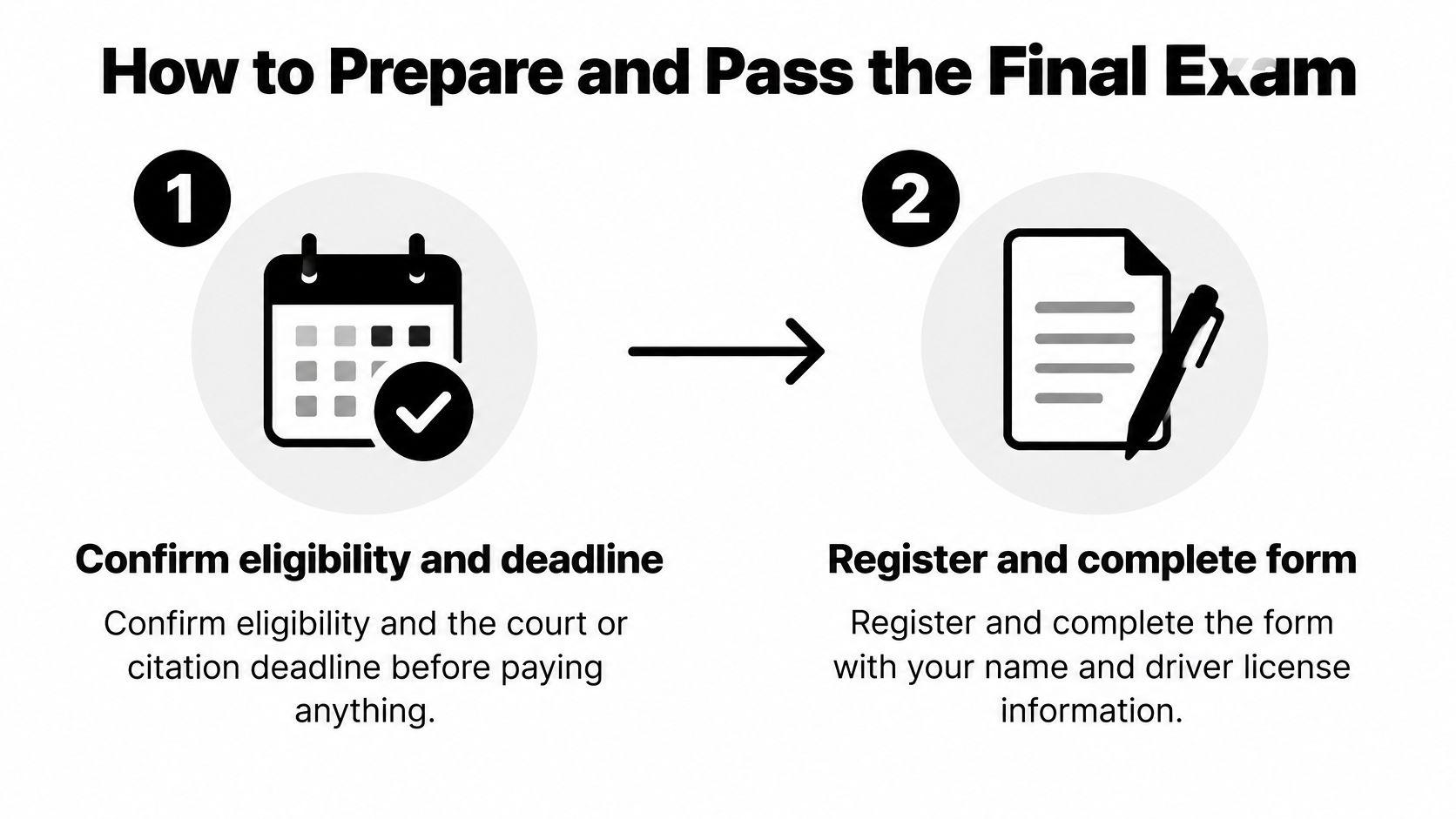
- Confirm the deadline and course type before you pay. Check the citation, any court order and the due date. The expensive mistake is passing an exam for a course that satisfied nothing.
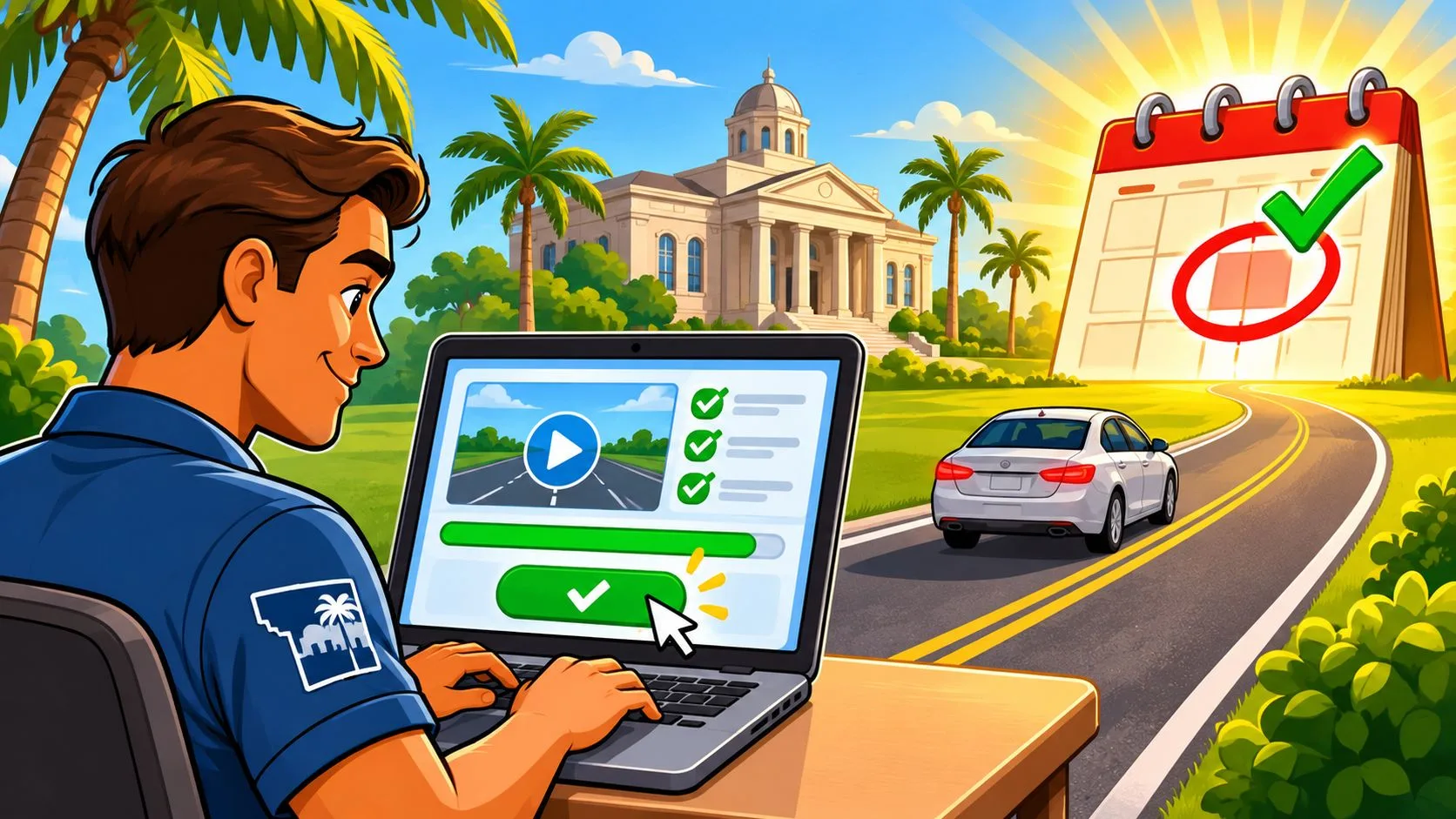
- Register with details that match your license. The registration form asks for your name, driver license number and email address, and that information generates your completion certificate at the end of the course. Check each character before you submit, because a mismatch can leave the certificate out of step with your driving record.
- Set up for identity validation. The course verifies who you are through biometrics, security questions or other required methods, and failing those checks means no refund. Sit at a desk with a working camera and a stable connection instead of squeezing it in from a parking lot.
- Work the modules at a steady pace. Flag every scenario and rule you miss on the way through. The usual slip is cramming a first pass at midnight against a deadline you should have beaten by a week.
- Review until you can explain the reasoning. Knowing which letter was right won't transfer to the road. Be able to say why each wrong option is unsafe, because that judgment is what the scenario questions score.
- Pass the final and every other required assessment. You must pass the final exam plus any in-course assessments set by the course guidelines. Read the feedback on each missed question while the reasoning is still fresh.
- Verify the reporting and keep your copy. Confirm the completion was reported. Florida HSMV requires the school to retain course and completion records for at least seven years, and the copy in your own files is still the one you can produce on demand.
A finished course should leave you with a completed requirement plus three habits you didn't have before: scanning farther ahead, measuring gaps in seconds, choosing the early response. The certificate proves the first part. The habits are what keep you out of the same situation next year.
Enroll in a Florida-Approved Course Before the Deadline
The election window is short enough that picking a course is today's task, not next week's. FLHSMV's guidance on traffic citations explains that choosing an approved driver improvement course can reduce the citation fine by 18%, with points withheld and adjudication of guilt withheld once the process is completed.
The course alone does not deliver that. You still notify the appropriate county clerk, pay the citation and applicable court costs, finish within the court's deadline, and submit the completion certificate. Miss one of those and the discount, the withheld points and the withheld adjudication can all slip away.
The order that matters: elect, pay, complete, submit. Skip one and the others stop counting.
Choose a state-approved course before you register, and confirm it's approved for your situation. BDISchool is a Florida HSMV-approved Basic Driver Improvement school, and its four-hour Basic Driver Improvement Course can be registered for and started on the site the same day. If you're unsure which course your citation allows, this guide to choosing an approved driver education course compares the types side by side.
Find your citation date. Count 30 days. Register before that window closes.
A completed course keeps points off your license and means no insurance rate increase from the moving violation, which is the part that costs you long after the fine is forgotten. BDISchool's course runs four hours, fully online and self-paced, built around the hazard-recognition decisions the final exam asks about. You can register today, work through the modules on your own schedule, and finish with the completion reported for you. Visit BDISchool to start and put the 30-day window to work for you rather than against you.