You’re probably here because something about Florida driving rules feels harder than it should.
Maybe you’re a parent trying to help a teen get started. Maybe you just moved to Florida and the license process looks like a maze. Or maybe you got a ticket, heard the word “points,” and now you’re worried about your record, your insurance, and what happens next.
That confusion is normal. Florida’s system mixes first-time license rules, course requirements, DHSMV paperwork, renewals, and violation consequences in a way that can overwhelm even careful drivers.
The good news is that licencias de conducir in Florida make a lot more sense once you stop treating everything like one big problem. It’s really a set of smaller decisions. What kind of license do you need? Are you applying for the first time, renewing, or fixing a driving record issue? Which course matches your situation?
That’s where a clear roadmap helps. If you’re also sorting out car ownership basics, it helps to understand minimum auto coverage in Florida before you get too far into the process, especially if you’re a new resident buying or registering a vehicle.
I teach this stuff the same way I explain it to students in class. Start with the right license type. Handle the required education early. Bring the right documents the first time. Protect your record before a simple mistake turns into a bigger problem.
Navigating the World of Florida Driving Licenses
A lot of drivers freeze at the same moment. They open the state website, click three different pages, and suddenly they’re staring at terms like Class E, TLSAE, DETS, endorsements, suspensions, and proof of address.
That doesn’t mean the process is impossible. It means the information usually isn’t organized in the order real people need it.
Where most people get stuck
For first-time drivers, the biggest mistake is starting with the test instead of the prerequisites.
For drivers with tickets, the biggest mistake is assuming a citation is just a fine.
For new residents, the biggest mistake is thinking their old habits with documents or insurance will carry over neatly into Florida.
The smartest move is to match your exact problem to the right next step. Not to read everything at once.
Florida licencias de conducir are easier to manage when you separate them into three tracks:
- Getting licensed for the first time means education requirements, testing, and DHSMV documents.
- Keeping your license valid means renewals, address updates, and staying compliant.
- Protecting your record after a ticket or crash means understanding points, deadlines, and course options.
A roadmap beats guesswork
I tell students to think like this: first identify the lane you’re in, then take the shortest legal path forward.
If you’re a teen or first-time applicant, your first lane is education.
If you got a moving violation, your first lane is damage control.
If your license is expiring or you’re transferring from elsewhere, your first lane is documentation.
That’s the approach that saves time, money, and stress. It also helps you choose the right online course instead of wasting effort on the wrong one.
Understanding Florida License Classes
A Florida driver license works like a set of keys. One key opens the door to ordinary personal driving. Other keys are for larger, specialized, or commercial vehicles.
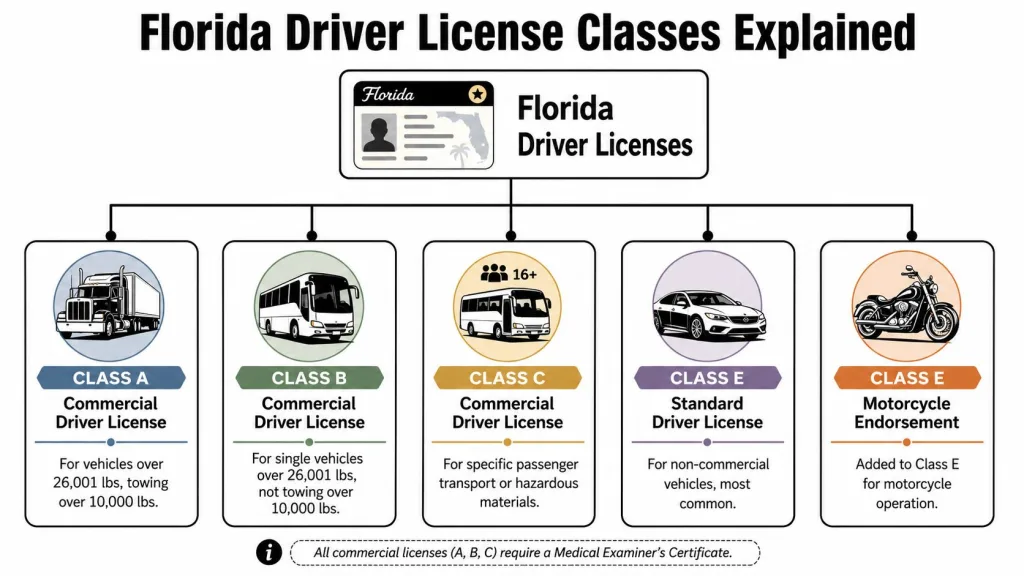
Most readers need Class E. That’s the standard Florida license for non-commercial driving.
The class most people need
Class E is the everyday license. If you drive a personal car, SUV, van, or pickup for normal non-commercial use, this is usually your category.
That’s why so many first-time applicants get distracted by commercial license pages they don’t even need. If you’re not driving professionally in a qualifying commercial role, Class E is usually your focus.
If you want a simple breakdown of larger commercial categories, this guide on what a Class A license is helps sort out where Class A fits compared with the rest.
The commercial classes
Florida also uses Class A, Class B, and Class C for commercial driving.
- Class A usually applies to larger combination vehicles.
- Class B usually applies to a single larger commercial vehicle.
- Class C applies in more specific commercial situations, including certain passenger or hazardous material operations.
You don’t need to memorize every commercial detail unless that’s your career path. The point is to avoid choosing the wrong process.
Motorcycle driving is separate
If you want to operate a motorcycle, your standard license alone may not be enough. Florida handles motorcycle operation through a motorcycle endorsement added to the proper license category.
If you’re driving an ordinary personal vehicle, keep your attention on Class E. That one decision clears away most of the noise.
The rest of the Florida licensing process only becomes useful once you know which license class you’re pursuing.
How to Get Your First Florida License
You finish a required course, book your DMV visit, and assume the hardest part is over. Then you find out you took the wrong class for your age, or you showed up before completing the right testing step. That is how first license applications turn into extra fees, extra trips, and extra stress.
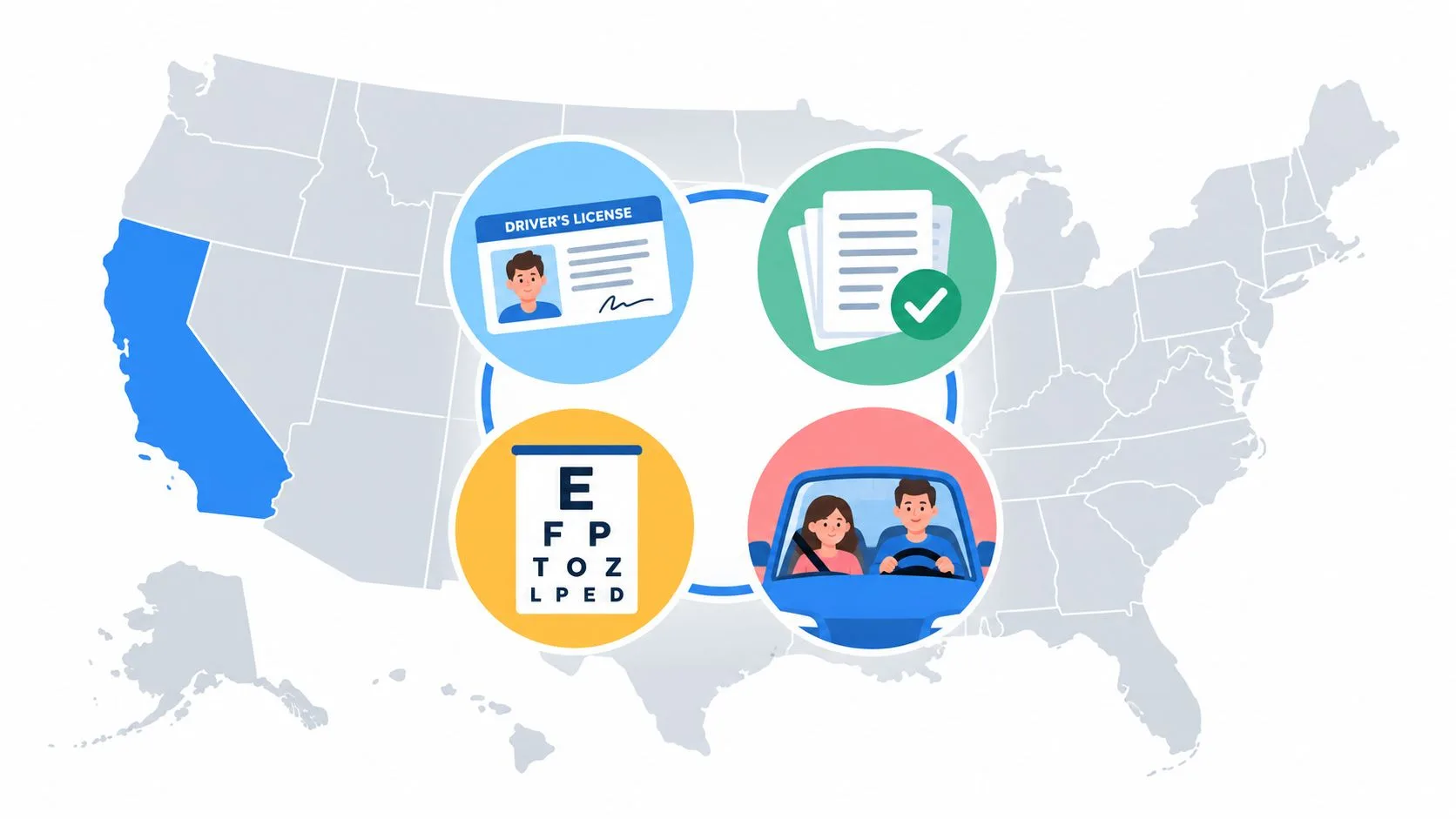
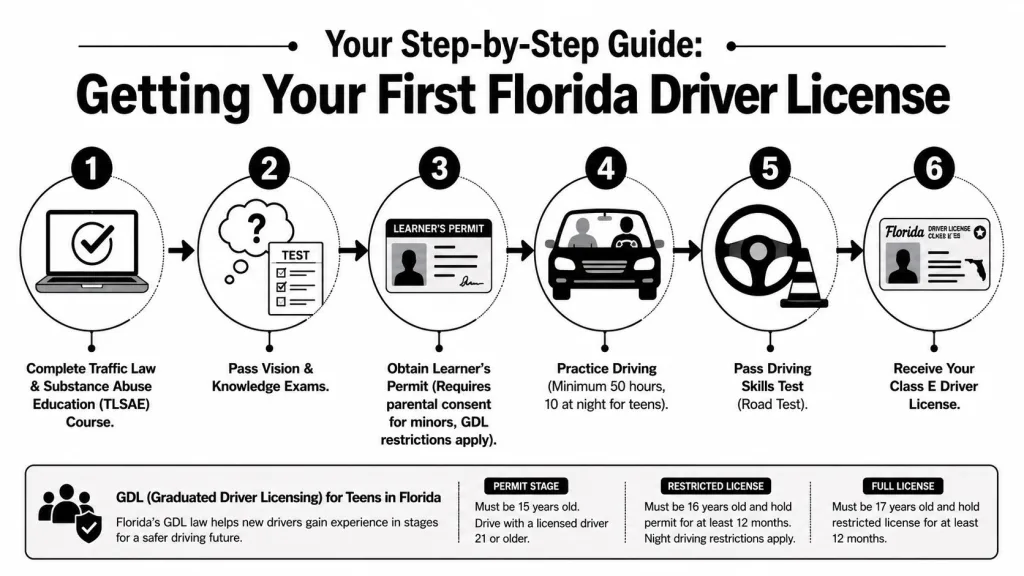
Florida’s first-time licensing process is easier when you treat it like a sequence, not a pile of rules. The goal is simple. Match your age and driving history to the right course, complete the required exams in the right order, and only then schedule the final in-person steps.
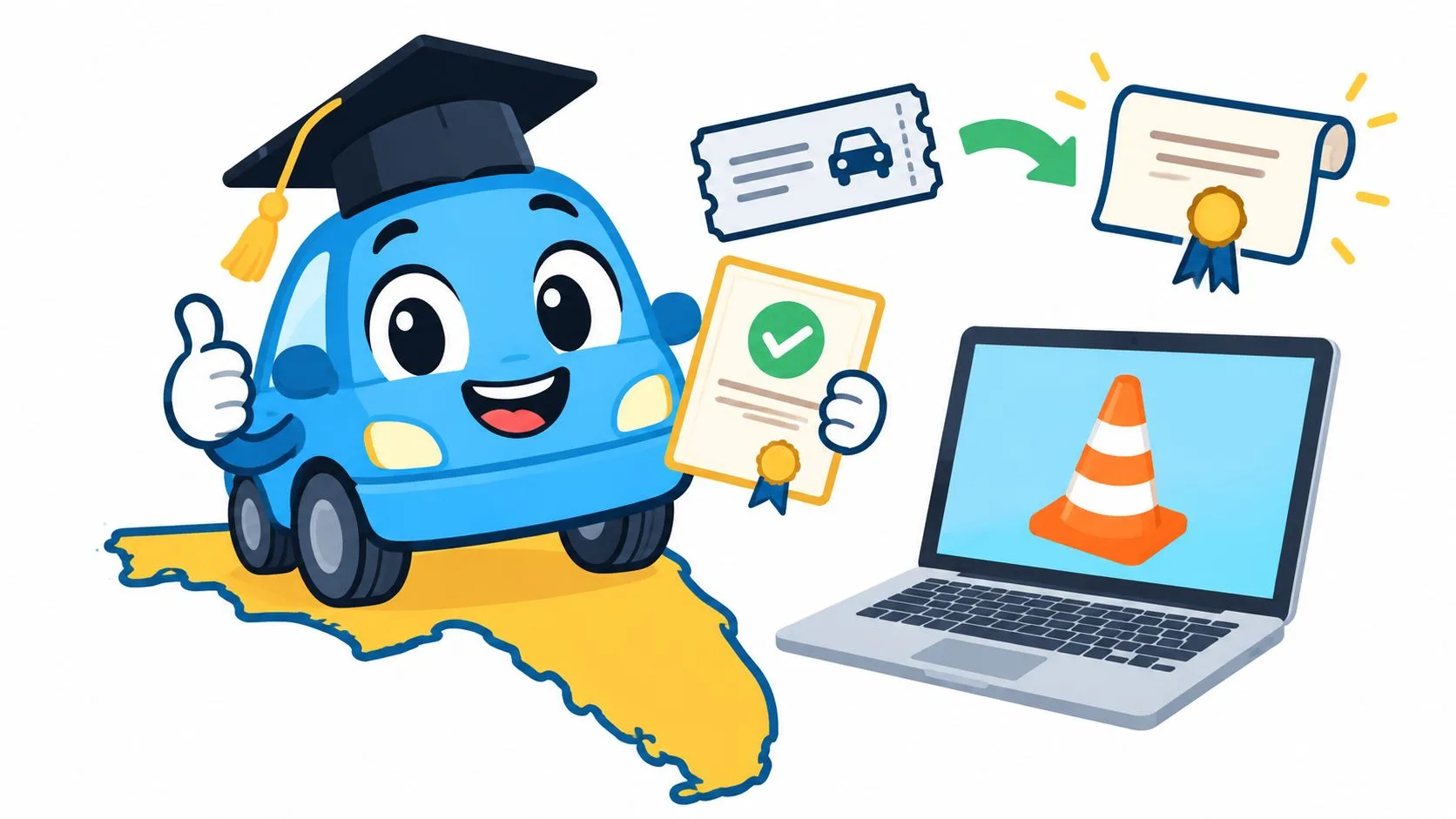
Under Florida law, every applicant for a Florida driver license must complete a Traffic Law and Substance Abuse Education (TLSAE) course, unless they have been previously licensed in another jurisdiction or have completed a Department of Education driver education course according to Florida Statute 322.095.
Start with the requirement that fits your situation
For many adult first-time drivers, the first step is TLSAE.
For teens, the answer may be different. Florida now has a separate rule for younger first-time drivers. If the applicant is under 18 and has never held a driver license, a 6-hour Driver Education Traffic Safety, or DETS, course may apply instead of the older path many parents still remember.
That distinction matters. Taking the wrong course is like studying for the road test with the wrong handbook. You may still learn something, but it does not solve the actual DMV requirement in front of you.
If you want the full sequence in plain language, this step-by-step guide on how to get a Florida license for the first time helps organize the process before you register for anything.
The order that saves time
Once you know which education requirement applies, the rest becomes much clearer.
Complete the correct course
Confirm whether you need TLSAE or the teen-specific DETS route based on age and prior licensing history.Finish the required exams
Florida may require knowledge and vision testing before you can move ahead. Handle those early so you do not build your plan around an incomplete application.Follow the learner stage if it applies
Younger drivers usually need supervised driving practice and must follow learner restrictions before the road test.Schedule the driving test when you are ready
Booking too early creates avoidable pressure. The smart move is to schedule only after your course, testing, practice, and paperwork are all lined up.
Many applicants lose time. They focus on the road test because it feels like the finish line, but the crucial checkpoint is getting the sequence right first.
Here’s a useful visual refresher for the driving process:
What trips people up most
Confusion usually comes from two places.
First, families hear older advice and assume every first-time applicant needs the same class. Florida does not work that way. Age matters. Prior licensing history matters. The state cares about the exact situation, not the general idea.
Second, applicants often separate licensing rules from later driving consequences. That is a mistake. The course you take now is part of a bigger roadmap. Florida uses different online courses for different problems, from first licenses to point reduction and court requirements. If you learn that system early, you make better choices now and avoid expensive detours later.
Practical rule: Verify the course requirement before enrolling. One quick check can save you from paying for a class that does not meet your DMV goal.
A simple roadmap for first-time applicants
Use this order to keep the process under control:
- Identify your path first: Adult first-time applicant and teen first-time applicant do not always follow the same education requirement.
- Complete the right course: Match the course to your age and licensing history.
- Pass the required tests: Do not assume the course alone completes the process.
- Practice under the correct restrictions: Learner rules are part of the path, not a side note.
- Book the final step last: Schedule the road test only after the earlier pieces are finished.
The smart approach is not just getting a license. It is choosing the exact course that solves the exact problem in front of you, with no wasted steps.
Your Essential Document Checklist for the DHSMV
A surprising number of license trips fail for one reason. Missing paperwork.
You can study, pass a course, and show up motivated, then still leave empty-handed if your identity, Social Security record, or address documents don’t line up.
What to gather before you leave home
Florida’s DHSMV expects documents that prove who you are and where you live. In practical terms, most applicants should prepare documents in these categories:
- Proof of identity: Bring the identity document the state accepts for your status.
- Proof of Social Security Number: Make sure the name matches your identity paperwork.
- Two proofs of residential address: Use documents that clearly show your current Florida residence.
If you’re a non-U.S. citizen, bring the additional immigration documents that apply to your legal presence and status.
A focused prep guide on what to bring to DMV can save you from making a second trip.
Why this step causes so much frustration
The confusion usually isn’t about whether someone has documents. It’s about whether they have the right combination of documents.
A utility bill may help with address proof, but it won’t replace identity proof. A card with an old address may not help if the current residence can’t be shown properly. Name differences across documents can also slow everything down.
Gather your documents the night before, place them in one folder, and check that names and addresses match as closely as possible.
A quick pre-appointment review
Before heading to the DHSMV, ask yourself:
- Is my identity document current and acceptable?
- Does my Social Security proof match my legal name?
- Do I have two separate residential proofs?
- If my status is immigration-based, did I bring the supporting records?
That five-minute check is one of the easiest ways to make your visit smoother.
Managing Points Suspensions and Renewals
A lot of drivers don’t worry about their license until they get a ticket. That’s usually when they realize a license is more than a card in a wallet. It’s a record, and that record affects your ability to drive legally.
Renewals are the routine part. Violations are the expensive part.
What a ticket can actually do
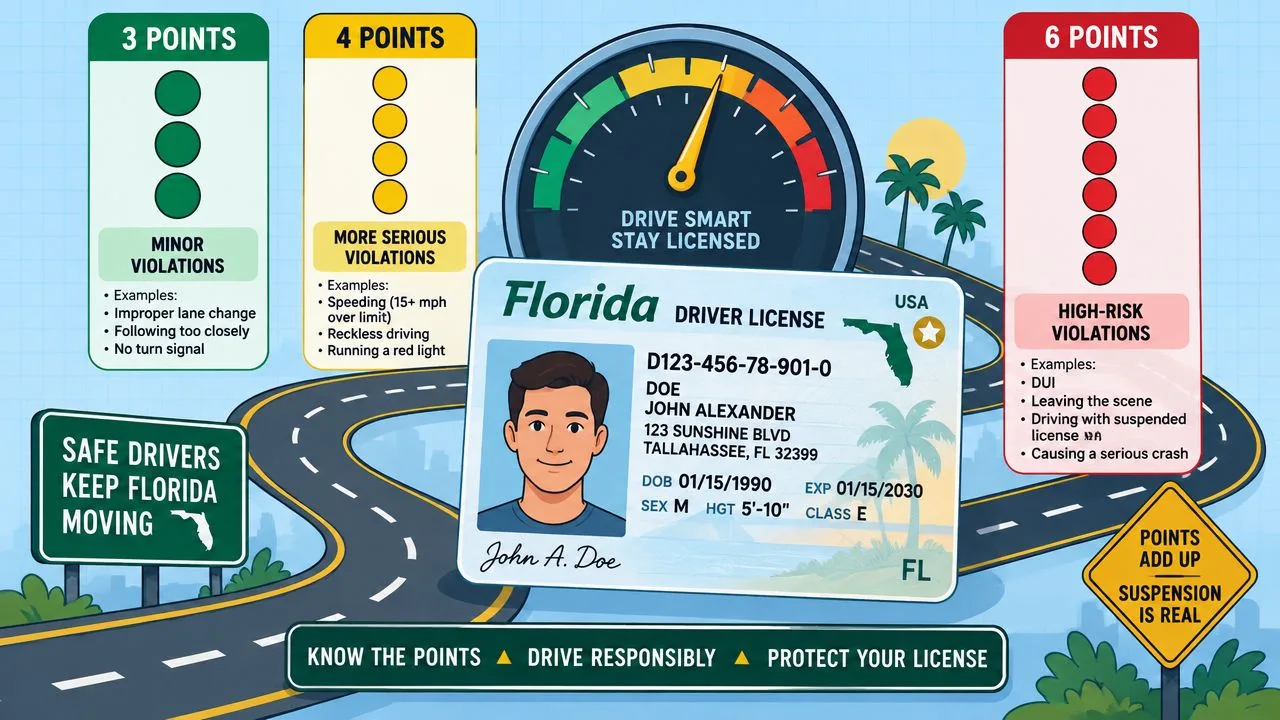
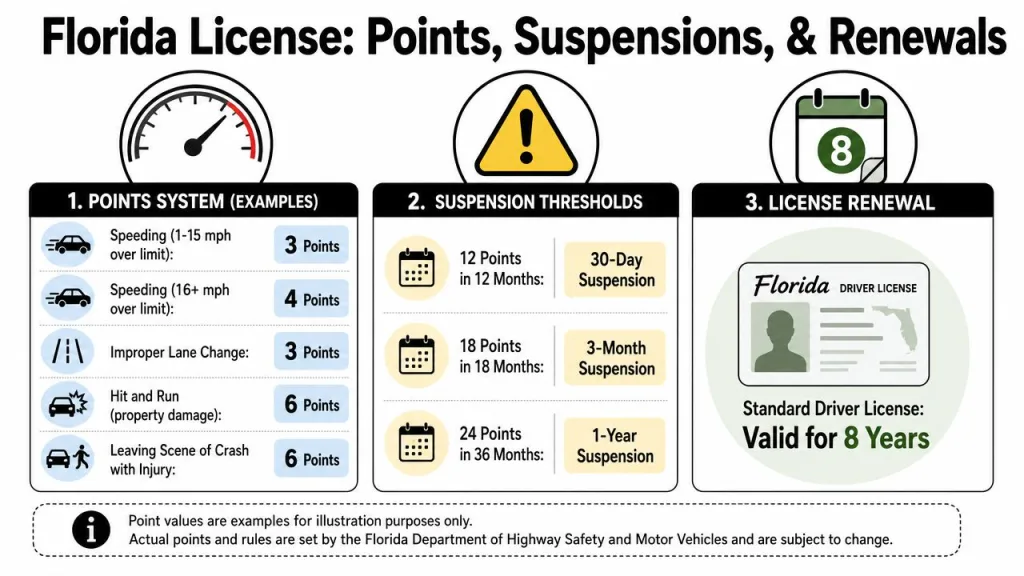
When a moving violation hits your record, the problem isn’t only the citation itself. The bigger issue is what follows.
Points can put your driving privileges at risk. They can also make insurance shopping harder. If you’re already seeing how violations affect premiums, this overview of bad driving record insurance Florida gives useful context on why protecting your record matters early.
Why course timing matters
Florida does allow drivers to use improvement courses in certain situations, but there’s a hard limit.
A driver may attend a course only once in any 12-month period and no more than eight times in an entire lifetime, according to the FLHSMV driver improvement courses FAQ.
That means course use is a finite tool. You can’t treat it like an unlimited reset button.
A traffic school election is most valuable when it fits the current violation and your long-term record strategy.
Renewals and record protection are connected
Drivers often think renewal and ticket issues are separate. In real life, they overlap.
A clean record makes renewal less stressful. A messy record can trigger extra steps, court requirements, or concerns about eligibility. Even if your immediate problem is “I just need to renew,” it still makes sense to look at unresolved violations, compliance deadlines, and whether you should act before points stack up.
Here’s the practical takeaway:
- If you got a ticket, don’t delay your decision.
- If you’ve used traffic school before, confirm whether you’re eligible again.
- If your record is getting complicated, choose the course that matches the legal requirement, not just the shortest option.
That’s where many drivers either protect their license in time or make the problem harder than it needed to be.
Choosing the Right Florida Traffic School Course
Drivers usually waste the most time at this stage because they know they need “a course” but don’t know which one.
That’s a costly mistake. The right course depends on why you need it. A moving violation, a court order, a pattern of serious issues, or an insurance goal can all point to different options.
Match the course to the problem
The easiest way to choose is to ignore marketing language and focus on function.
- Basic Driver Improvement (BDI) fits many drivers dealing with a moving violation who want the course option tied to record protection.
- Intermediate Driver Improvement (IDI) is generally for situations where the court requires a longer course.
- Advanced Driver Improvement (ADI) applies in more serious cases involving license problems or stricter state requirements.
- Mature Driver Course can make sense for older drivers who want a refresher and may be seeking policy benefits tied to safe driving education.
- Aggressive Driver Course addresses behavior-based issues for drivers ordered into that category.
If you’re comparing formats, state approval, and online flexibility, this guide to the best online traffic school in Florida is a practical place to start.
Comparison table
| Which BDISchool Course Is Right for You? | |||
|---|---|---|---|
| Course Name | Length | Primary Use | Key Benefit |
| Basic Driver Improvement (BDI) | 4-hour | Moving violation situations | Helps address ticket-related record concerns |
| Intermediate Driver Improvement (IDI) | 8-hour | Court-ordered situations | Satisfies a longer educational requirement |
| Advanced Driver Improvement (ADI) | 12-hour course component | Serious record or reinstatement-related issues | Helps meet stricter state or court requirements |
| Aggressive Driver Course | 8-hour | Road rage or habitual offender situations | Focuses on responsibility and behavior change |
| Mature Driver Course | 6-hour | Refresher for drivers age 55+ | Supports safer driving awareness and possible insurance-related benefits |
One option available to Florida drivers is BDISchool, which offers state-approved online traffic school programs and first-time driver education in English, Spanish, and Portuguese through its course catalog at BDISchool courses and additional options at Driver Educators courses.
When ADI is not optional
Some situations go far beyond a standard citation.
Drivers in Florida who are at fault in three crashes within a three-year period must complete 12 hours of an approved FLHSMV Advanced Driver Improvement (ADI) course, plus four hours of behind-the-wheel training, and failure to comply within 90 days results in an automatic license cancellation, according to the FLHSMV 3 crashes in 3 years requirement.
That’s not a “nice to have” course. It’s a license-saving requirement.
A smart way to decide today
Ask three questions:
- Was I ticketed, court-ordered, or flagged for a more serious driving issue?
- Am I trying to avoid points, satisfy a judge, or fix a license problem?
- Do I need the course in Spanish or Portuguese so I can finish it correctly the first time?
If insurance cost is part of your thinking, this explainer on insurance discounts with defensive driving is a helpful reminder that driver education can affect more than just the ticket itself.
The key is simple. Don’t buy the shortest course. Enroll in the course that solves your specific Florida problem.
Frequently Asked Questions About Florida Licenses
A lot of license questions show up at the worst time. You are heading to the DHSMV, trying to replace a missing card, or figuring out whether one ticket will affect your record. This part is here to give you clear answers fast, and to help you choose the course, if any, that solves the problem.
Can I transfer an out-of-state or international license to Florida
Often, yes. The primary question is what Florida needs to verify before it lets you keep driving without extra steps.
Start with your documents. Florida will look closely at your identity, your Florida address, and the status of your current license. If anything is expired, inconsistent, or incomplete, a simple transfer can turn into a delayed application. That is why it helps to check the document rules before you leave home.
If you are transferring from another state, the process is often more direct than many drivers expect. International drivers can face more variation, so it is smart to confirm your specific path first.
What if my license was lost or stolen
Request a replacement right away.
A missing license works like a missing key. You may be fine for a day or two, then suddenly need it for work, travel, banking, or a traffic stop. Replacing it is usually easier when your address and identity records are already current, so fix those details first if needed.
Are courses available in Spanish and Portuguese
Yes. That can make a big difference.
Drivers who read road rules in their strongest language usually make fewer mistakes and finish with more confidence. For families searching for help with licencias de conducir, that often means less confusion, fewer retakes, and a better chance of choosing the correct course the first time.
I’m under 18. Do I need DETS or TLSAE
If you are under 18 and have never held a driver license, Florida now requires the 6 hour Driver Education Traffic Safety course before you apply, as noted earlier in this guide.
This is one of the easiest places to get confused because older advice still mentions TLSAE without explaining the newer age-based rule. Parents often walk in expecting one course and learn their teen needs another. Checking this before enrollment saves time and avoids paying for the wrong class.
Can I keep using traffic school every time I get a ticket
No. Florida limits how often you can elect that option.
That limit is why course selection should be strategic, not automatic. If your goal is to avoid points today, you also need to think about what happens if another citation shows up later. A course used at the wrong time can leave you with fewer choices when you need them more.
Do license restrictions matter if they seem minor
Yes. Restrictions on your license are legal conditions.
A corrective-lenses restriction is a simple example. If your license says you must wear glasses or contacts while driving, that is part of your driving privilege, not a suggestion. The RACE explanation of license restriction codes is a helpful reminder that many drivers ignore those codes until a stop or citation brings them into focus.
Are driving rules changing because cars are changing
Yes, gradually.
Driver education now has to cover more than signs, signals, and right of way. Newer vehicles include driver-assistance features that can help, but they do not replace attention, judgment, or responsibility behind the wheel. The GestHispania article on digital permits and ADAS-related testing changes shows why old study habits do not always prepare drivers for newer testing and licensing conversations.
If you need to get licensed, protect your record after a ticket, or complete the right Florida traffic school requirement without wasting time, BDISchool is a practical place to start. You can review the course options, match the course to your exact situation, and complete your training online in the language that fits you best.