One person was killed every 44 minutes in a U.S. alcohol-impaired-driving crash in 2024, NHTSA reported. Not on holiday weekends only. Every 44 minutes, averaged across the whole year.
Most sober-ride advice stops at the front door. Plan ahead, name a designated driver, call a ride, and then it leaves you alone at 1 a.m. with a car in the lot, or asks you to talk a friend out of their keys with nothing but good intentions and a raised eyebrow. Those are the moments where nights go wrong.
This is how to avoid drunk driving with a procedure instead of a hope. It covers the night already in progress, the friend who has to take the keys, the 9 a.m. question nobody answers, and the course that repairs your record if the worst has already happened.
Choose a Sober Ride Before the First Drink
12,429 people died in 2023 in U.S. traffic crashes involving at least one driver at a blood alcohol concentration of 0.08 g/dL or higher, per NHTSA's CrashStats report on alcohol-impaired driving. That's 30% of all U.S. traffic deaths, roughly one death every 42 minutes. Fatalities did fall 7.6% from 13,458 in 2022, which is real progress and still a toll assembled out of unremarkable Friday nights.
Nobody in that number planned to crash. Most of them had a vague intention to be careful, and an intention isn't a plan. Judgment and reaction time can fail well before obvious signs appear, so waiting until you "feel drunk" is the one test you can't run on yourself.
Match the option to the night, not to your mood
Compare the six options. Pick one primary and one backup before the first drink touches your lips.
| Option | Best for | Confirm Before You Go | Watch Out For |
|---|---|---|---|
| Designated sober driver | Small groups with one committed sober person | The driver has agreed and will stay alcohol-free | Drinking less does not count as sober |
| Rideshare app | Any night out, including multiple stops | Account, payment method and pickup area are ready | Surge pricing and longer waits late at night |
| Taxi booked in advance | Nights when apps have poor coverage | Company number saved and pickup time agreed | Wait times in busy hours |
| Public transit | Cities with reliable late service | Last departure time for your route | Service often ends early |
| Overnight stay | Nights out far from home | A bed is confirmed and transport for the car is planned | The car stays at the venue until morning |
| Trusted friend pickup | Emergencies and changed plans | The friend has agreed before the night starts | Depends on the friend being reachable and sober |
The severe cases carry their own warning. 8,272 deaths in 2023, or 67% of alcohol-impaired-driving fatalities, came from crashes where at least one driver was at 0.15 or higher. That's the number produced by "it's only five minutes down the road."
Some readers carry consequences that outlast one night. If an alcohol-related case left you or someone in your group under supervision, know the conditions before you go out, and read this guide to requesting early discharge from Connecticut probation so one decision doesn't undo months of clean compliance.
Choose your primary option and your backup now. Then the car is a piece of metal in a parking space, not a decision you're still making at closing time.
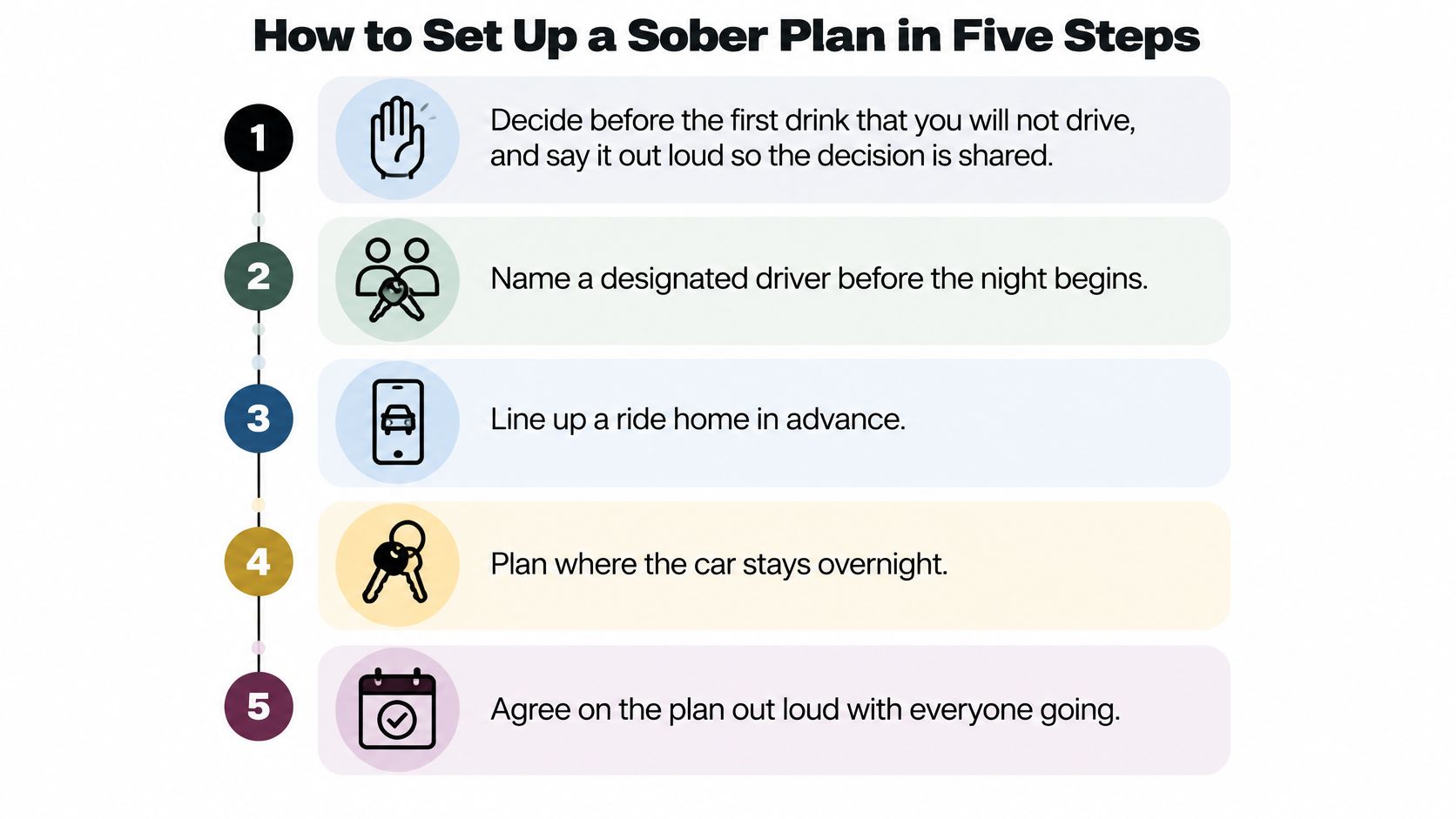
How to Set Up a Sober Plan in Five Steps
A sober plan isn't a mood. It's a sequence you run in order, once, before the part of the night when your judgment stops being a reliable narrator.
- Decide out loud that you're not driving. Say it to the people you're with, not just to yourself. A private decision gets renegotiated at midnight by a brain that's no longer qualified to negotiate.
- Name the sober driver and confirm they'll stay alcohol-free. Not "taking it easy," not "switching to beer." A driver who has had two drinks is a passenger with a license, and confirming this before departure is the whole point.
- Hand over the keys at the start. Give them to the sober driver or lock them inside a bag you can't reach for casually. The person who drove to the venue should not be the one deciding how they get home.
- Line up the ride and the payment. Open the rideshare account, add the card, save the local taxi number while you're still sober enough to type straight. Public-health programs treat this as layered prevention, which the CDC's transportation safety guidance describes as a sober-driver commitment plus available transport, friends who intervene, and no access to the keys.
- Agree on the fallback. A couch, a spare bed, cash for a cab. The plan that has no failure branch is the plan that fails when surge pricing hits.
The whole routine fits on one card.
What to add if this keeps happening
If your plans fail in the same place every month, the plan isn't the problem. Prearrange the rideshare account, keep emergency funds stashed, and identify a safe place to sleep before you need any of it. If drinking is the point of the night rather than the side effect, the Addiction Resource Center's sobriety roadmap walks through how to change that, step by step.
The check: if any of the five steps is still open when the first drink arrives, the plan isn't finished. Fix it before the glass, not after.
What to Do If You Already Started Drinking
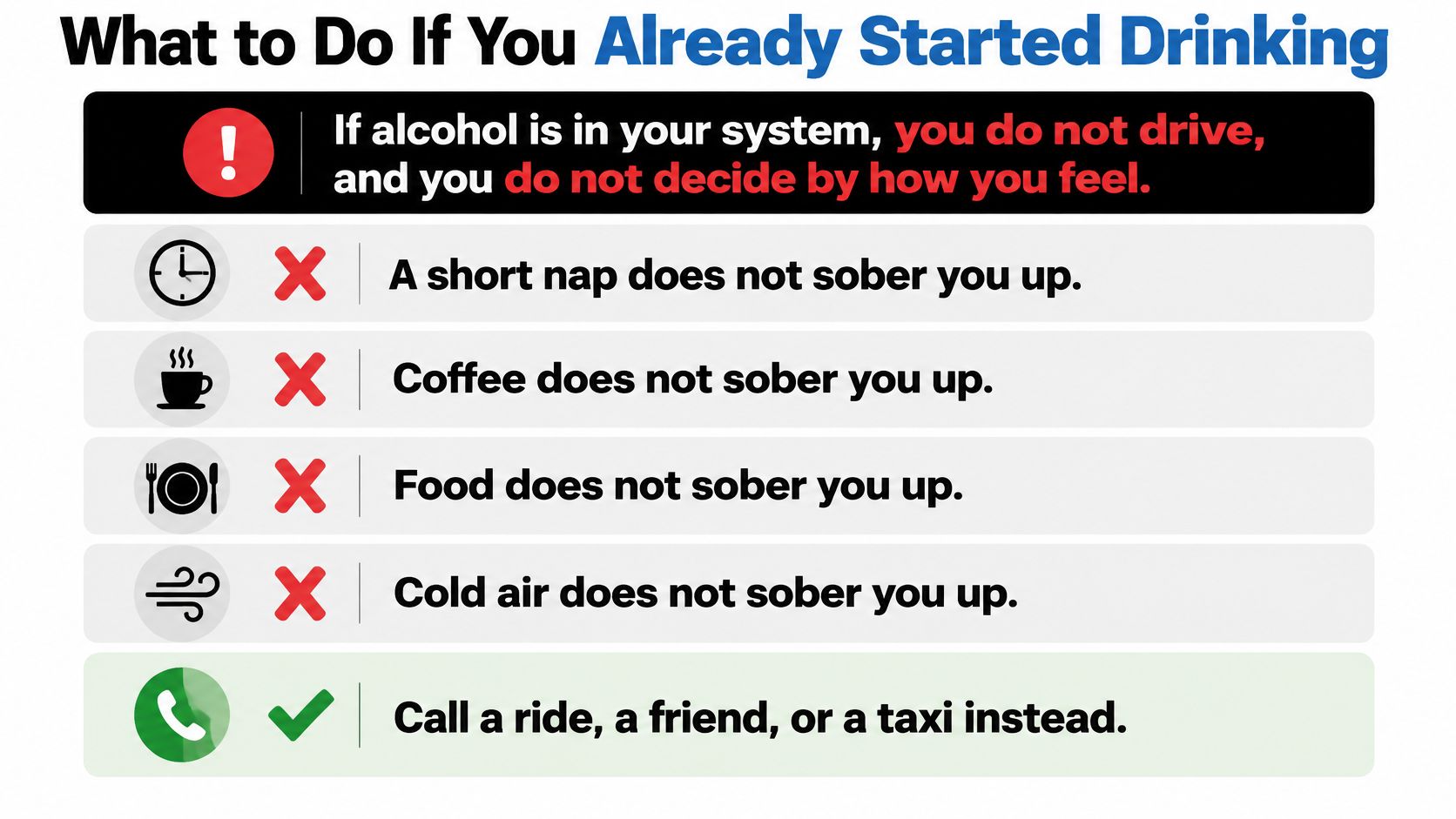
If alcohol is already in your system, the only question left is how you get home without driving. Not whether you're over the limit. Not whether you feel steady.
There's no internal test for fitness to drive, because the impairment you'd need to detect is the same impairment doing the detecting. A short nap, coffee, food, cold air and elapsed time all change how you feel. None of them removes alcohol.
Here's the recovery sequence, in order.
- Hand over the keys and say the sentence out loud. "I'm not driving." Out loud matters; it turns a private wobble into a decision other people can hold you to.
- Open the app you already have. Rideshare first, then the saved taxi number. Both beat a debate in a parking lot.
- Use transit only if you can do it safely and you know your route's last departure. A missed last train turns a good decision into a bad one.
- Stay over. Take the couch, leave the car, sort it out tomorrow.
- Call a sober person who can come to you. That's what the friend in your contact list is for.
A surge-priced ride at 2 a.m. is cheaper than a DUI. It's cheaper than the tow, the lawyer, the insurance increase and the year of consequences that follow.
The scale is not subtle. In 2024, 11,904 people died in alcohol-impaired crashes in the United States, about 30% of all traffic fatalities, a 3.9% decline from 2023, according to NHTSA's crash statistics. Every one of those nights had a moment where a different choice was still available.
Stepping In When a Friend Is About to Drive
In 2022, 13,524 people died in crashes involving an alcohol-impaired driver, 32% of all traffic deaths, and 59% of those killed were the impaired drivers themselves, according to CDC impaired-driving data. Read that split again. The other 41% were passengers, people in other cars, and pedestrians who never chose the ride.
So taking the keys isn't rude. It's a safety act for everyone sharing the road with your friend.

Name the risk plainly and skip the audit. Don't argue about how drunk they are, because that argument can't be won and isn't the point. Offer one specific alternative: a ride you'll pay for, a couch, or a rideshare booked on their phone right now. Then take the keys discreetly and say you'll hand them back in the morning.
If the first attempt bounces off, bring in a second person. If they get behind the wheel anyway, call 911.
If you're hosting: don't hand keys back to a guest who's been drinking. Book the ride on the guest's own phone so it's already paid for, keep them in company until the car leaves without them, and call 911 if they get in anyway.
Here's the part people get wrong. A refusal isn't a verdict, it's a first attempt. Keep the offer open, stay with the person, and don't leave them alone with a set of keys and a bad idea. Venue staff are backup, not a substitute for you.
If a passive alcohol-detection system ever blocks a vehicle you're in, stop safely, call a sober person or roadside service, and never try to bypass it. Technology is still being evaluated for new vehicles, per the Insurance Institute for Highway Safety's alcohol and drug research summary, and nothing on the market today reverses impairment once someone is driving.
The Morning After and Getting the Car Home
It's 9 a.m. The car is still in the lot. You slept six hours, showered, drank coffee, and feel normal. Can you drive?
Use the plan, not your gut. A heavy night can leave a person still impaired the next morning. Hours, coffee, a shower, and food do not clear alcohol faster. They only make you comfortable enough to make a bad call. The morning after is where good plans fall apart because the danger feels distant.
- Have a sober driver take you to the car, or book a ride home, and do not drive the car yourself that morning.
- If neither is possible, leave the car another day. The parking fee is the cheap outcome.
- Do not "just move it" to a side street. A short drive is still a drive.
Treat the car as a separate problem from the person. You can be ready to work, shop, or answer texts while still being unfit to drive. That is why the friend who took your keys should return them when you're clear, ideally in person the next day. Confirm before you accept them. That handover is the last step of the plan, not an afterthought.
Build the return trip into the plan the night before and budget two rides instead of one. NHTSA reported that alcohol-impaired-driving fatalities in 2024 fell nearly 4% from 2023, according to its Drive Sober campaign materials. That is progress worth noting and not a margin to gamble with. A thirty-dollar ride is not the line item to cut.
Blood Alcohol Levels and Why Feeling Fine Fails
There's no number you can drink to and stay safe to drive. Anyone handing you a BAC calculator is handing you a way to justify a decision you've already made, because impairment starts below the legal limit and shows up in measurable ways that NHTSA's Drive Sober campaign documents at each step.
| BAC (g/dL) | What changes behind the wheel | What it means for your plan |
|---|---|---|
| 0.02 | Visual functions decline and doing two tasks at once becomes harder | Impairment is already present, so the ride must be settled before the first drink |
| 0.05 | Coordination and tracking of moving objects decline, steering is harder, emergency responses slow | No one at this level should be the driver, whatever they feel |
| 0.08 | Concentration and short-term memory drop, speed control and information processing slow, perception is impaired | At or above the common legal limit, so the decision was already made or missed |
The middle band is where drivers often get caught. In 2024, 2,028 people died in crashes involving a driver between 0.01 and 0.07 g/dL, according to NHTSA's buzzed driving data. That's the range people describe as fine.
Feeling fine fails for a simple reason. The effects arrive before the signs, so your self-assessment is running on the same impaired hardware as your driving. Two drinks in, you're not measuring your BAC. You're measuring your confidence.
If a long lunch or a wine tasting is on the calendar, arrange the ride home before you choose the venue, and this guide on whether you can drive after a wine tasting is a useful reality check.
Skip the math entirely. For a plain-language breakdown of where the threshold sits and why the limit isn't the standard, read this explanation of what counts as impaired driving. Then decide the ride before the first drink, not after the third.
Ignition Interlocks and Staying Out of Repeat Trouble
You may be here because a court or a licensing requirement put an ignition interlock in your car. Treat it as a continuous control, not as permission.
The device measures breath alcohol and generally blocks the engine from starting at approximately 0.02 g/dL, so a sober driver can start the car and an impaired one usually can't.
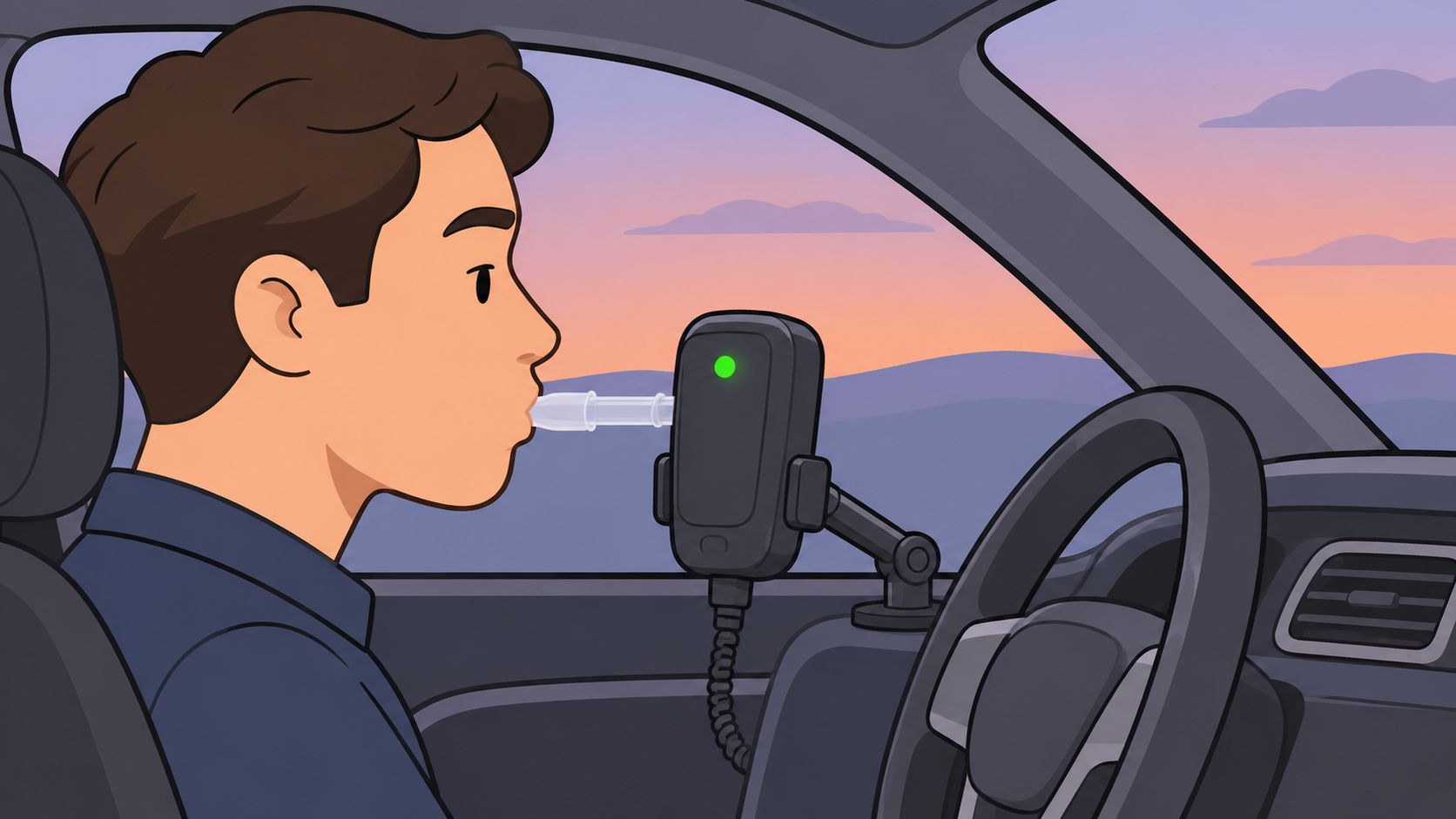
The evidence is strong while the hardware is installed. A Cochrane review found a randomized-trial relative risk of 0.36 for repeat offending during installation, roughly a 64% reduction. A CDC evidence synthesis reported a median 67% reduction in re-arrest rates, and newer CDC summaries put repeat offenses about 70% lower during installation, as detailed in this review of ignition interlock research.
Your job is to keep the device working and the record clean. Install an approved unit, complete every calibration and service visit, give every mandated breath test yourself, and never let another person supply the sample or try to work around the system.
The warning matters more than the numbers. Re-arrest rates returned toward comparison-group levels after removal, which means the device protects you while it's bolted on and demonstrates nothing on its own. Build a step-down plan with your interlock data reviewed, an alcohol-use-disorder screening, treatment where it's indicated, and the same no-driving-after-drinking rule from this article.
If a class is part of your requirement, you can find a DUI class near you and confirm the hours before you register.
Enroll in a BDI Course Before Your Next Violation
Take the course before the points and the insurance increase land, not after. That's the whole recommendation.
Florida's Basic Driver Improvement Course, also called Florida Four-Hour Traffic School, is a 4-hour, fully online, self-paced program approved by Florida's HSMV, and BDI School is a Florida HSMV Approved Basic Driver Improvement School. It helps drivers avoid points on their license and avoid an insurance rate increase from the moving violation, and certificates are reported electronically to the FLHSMV. It's available in English, Spanish and Portuguese.
Different situations need different programs. Court-ordered drivers take the Intermediate Driver Improvement course, drivers 55 and older take the Mature Driver Course, and habitual offenders take the Aggressive Driver Course. You can see the full catalog at BDISchool's course listings or at DriverEducators' course listings, and the Basic Driver Improvement Course can be started on our Florida Basic Driver Improvement Course page.
If you're here after an arrest or citation, the stakes are stacked. Florida treats a BAC of 0.15 g/dL or higher, or a passenger younger than 18, as an aggravating condition that raises punishment above a standard DUI, per Florida Statute 316.193. Confirm which course the court or the FLHSMV requires before you register, then run the plan this article set out: ride decided early, keys handed over, no driving after drinking.
BDISchool offers Florida's HSMV-approved Basic Driver Improvement Course, a 4-hour online, self-paced program you can register for and start today, and it's the same course that helps you avoid points and an insurance increase after a moving violation. If this article made one thing clear, it's that decisions made before the first drink do the protecting, and the paperwork gets handled after. Visit BDISchool to check the course that fits your situation and start this week.